
Synonyms for borrowing include taking on a loan, obtaining, using temporarily, drawing on, and receiving a loan. The best alternative depends on whether you borrow money, books, objects, ideas, or words from another language.
Imagine a friend lends you a book for the weekend. You take it home, read it, and return it on Monday. That simple exchange is borrowing, but other situations call for more precise words.
The word borrowing is common in daily conversation, education, finance, and language studies. Its meaning changes slightly with context, so choosing the right alternative helps you express your idea clearly.
Learning synonyms for borrowing helps students write stronger essays, bloggers avoid repetitive wording, and content writers explain financial or cultural topics accurately. It also gives everyday English users more natural ways to describe temporary use.
This guide explores alternatives and related expressions, with pronunciation, meanings, and practical examples. You will learn which terms fit loans, shared belongings, language, and other contexts.
What Does “Borrowing” Really Mean?
Borrowing is the act of receiving or using something that belongs to someone else, usually with an agreement or expectation that it will be returned. It can also mean obtaining money that must later be repaid.
The word is a noun formed from the verb borrow. It can describe a specific act, such as borrowing a pen, or a broader process, such as borrowing money from a bank.
Borrowing also has specialized meanings. In linguistics, it describes adopting words or expressions from another language. In writing and creative work, it can refer to taking inspiration or adapting an idea from an existing source.
Native English speakers usually understand the meaning from context. Borrowing a library book suggests temporary use. Borrowing money suggests a financial obligation.
Connotative Meaning
(Connotation is the feeling, attitude, or association a word carries beyond its basic definition.)
- Positive tone: Receiving support, accessing resources, and sharing can suggest trust, cooperation, and opportunity.
- Negative tone: Going into debt or relying on credit can suggest financial pressure or dependence.
- Neutral tone: Taking a loan, temporary use, and obtaining funds describe the process without strong emotional judgment.
Borrowing is not automatically positive or negative. Its connotation depends on what is borrowed, the terms involved, and whether the arrangement is fair and manageable.
Etymology
The verb borrow comes through Middle English forms such as borwen. Its deeper history is associated with Germanic language roots. The word has long described receiving something temporarily, often with an obligation to return it.
The suffix -ing turns the verb into a noun describing an activity or process. The same form can also function as a present participle, as in “She is borrowing a dictionary.”
- Old English (450–1100): English had related Germanic vocabulary for lending and borrowing. The modern spelling borrow was not yet established in its current form.
- Middle English (1100–1500): Forms such as borwen developed and were used for receiving something temporarily or obtaining it under an agreement.
- Modern English (1500–present): Borrow became established in its modern form. Its meaning expanded across finance, education, language, and everyday exchanges. The noun borrowing now also describes the adoption of words from other languages.

Pronunciation (US and UK IPA)
- US: /ˈbɑːroʊɪŋ/
- UK: /ˈbɒrəʊɪŋ/
Syllables
Borrowing: bor-row-ing (three syllables)
Affixation Pattern of “Borrowing”
- Root/base: borrow
- Prefix: None
- Suffix: -ing, used to form a noun or present participle
- Word formation: Borrow + -ing → borrowing
Related forms include borrow (verb), borrowed (past tense or participle), and borrower (a person who borrows).
Synonyms List
The word borrowing has no single synonym that works in every situation. Some alternatives describe obtaining money, others refer to temporary use, and a few belong specifically to linguistics or academic writing. The following numbered entries explain their differences.
1. Taking on loan (verb phrase) — US: /ˈteɪkɪŋ ɑːn loʊn/ | UK: /ˈteɪkɪŋ ɒn ləʊn/
Meaning: Receiving something temporarily with an agreement to return it or repay its value.
Tone/Register: Neutral, everyday, financial.
Examples:
I am taking a camera on loan from the media department.
The museum took several paintings on loan for the exhibition.
2. Obtaining a loan (verb phrase) — US: /əbˈteɪnɪŋ ə loʊn/ | UK: /əbˈteɪnɪŋ ə ləʊn/
Meaning: Receiving money or an asset through a formal lending arrangement.
Tone/Register: Formal, financial, professional.
Examples:
The family is obtaining a loan to cover essential repairs.
Obtaining a loan usually involves reviewing the repayment terms.
3. Lending arrangement (noun phrase) — US: /ˈlɛndɪŋ əˌreɪndʒmənt/ | UK: /ˈlendɪŋ əˌreɪndʒmənt/
Meaning: An agreement under which one party provides money or property for another party to use temporarily.
Tone/Register: Formal, financial, legal.
Examples:
The two organizations agreed on a lending arrangement for the equipment.
Their lending arrangement clearly stated when the items had to be returned.
4. Loan (noun) — US: /loʊn/ | UK: /ləʊn/
Meaning: Money or property provided temporarily, usually with an expectation of repayment or return.
Tone/Register: Neutral, common, financial or general.
Examples:
She applied for a student loan to support her studies.
The library arranged a loan of rare books for the exhibition.
5. Credit (noun) — US: /ˈkrɛdɪt/ | UK: /ˈkredɪt/
Meaning: An arrangement that allows a person or organization to receive money, goods, or services before paying for them.
Tone/Register: Financial, professional, neutral.
Examples:
The business used credit to manage a temporary cash shortage.
Always check the terms before relying on credit.
6. Financing (noun) — US: /ˈfaɪnænsɪŋ/ | UK: /ˈfaɪnænsɪŋ/
Meaning: Providing or obtaining money to pay for a purchase, project, or activity, sometimes through borrowing.
Tone/Register: Business, formal, financial.
Examples:
The company arranged financing for its new warehouse.
The project cannot proceed until its financing is confirmed.
7. Debt financing (noun phrase) — US: /dɛt faɪˈnænsɪŋ/ | UK: /det faɪˈnænsɪŋ/
Meaning: Raising money by borrowing it and agreeing to repay the amount under specified terms.
Tone/Register: Technical, financial, professional.
Examples:
The company chose debt financing to expand its operations.
Debt financing requires the business to meet its repayment obligations.
8. Credit borrowing (noun phrase) — US: /ˈkrɛdɪt ˈbɑːroʊɪŋ/ | UK: /ˈkredɪt ˈbɒrəʊɪŋ/
Meaning: Obtaining funds or purchasing power through a credit arrangement.
Tone/Register: Financial, technical.
Examples:
The report examined household credit borrowing during the year.
High credit borrowing can increase repayment pressure.
9. Drawing on credit (verb phrase) — US: /ˈdrɔːɪŋ ɑːn ˈkrɛdɪt/ | UK: /ˈdrɔːɪŋ ɒn ˈkredɪt/
Meaning: Using an available credit facility to obtain funds or make payments.
Tone/Register: Financial, professional.
Examples:
The business drew on credit to cover an unexpected expense.
Drawing on credit helped the company manage a short-term cash gap.
10. Borrowing funds (verb phrase) — US: /ˈbɑːroʊɪŋ fʌndz/ | UK: /ˈbɒrəʊɪŋ fʌndz/
Meaning: Receiving money from another person or institution with an expectation of repayment.
Tone/Register: Neutral, financial, professional.
Examples:
The nonprofit considered borrowing funds for the renovation.
Borrowing funds creates an obligation to repay the lender.
11. Taking a loan (verb phrase) — US: /ˈteɪkɪŋ ə loʊn/ | UK: /ˈteɪkɪŋ ə ləʊn/
Meaning: Receiving money under a loan agreement.
Tone/Register: Everyday, neutral, financial.
Examples:
He is taking a loan to repair his car.
Before taking a loan, she compared the repayment conditions.
12. Raising debt (verb phrase) — US: /ˈreɪzɪŋ dɛt/ | UK: /ˈreɪzɪŋ det/
Meaning: Obtaining money through borrowing, especially for a company, government, or large project.
Tone/Register: Formal, corporate, financial.
Examples:
The company raised debt to fund a major expansion.
Raising debt increased its future repayment commitments.
13. Leveraging (verb/noun form) — US: /ˈlɛvərɪdʒɪŋ/ | UK: /ˈliːvərɪdʒɪŋ/
Meaning: Using borrowed money or existing resources to support a larger financial or strategic objective.
Tone/Register: Business, technical, strategic.
Examples:
The firm used borrowing to leverage its investment capacity.
Leveraging can increase both potential gains and financial risk.
14. Securing a loan (verb phrase) — US: /sɪˈkjʊrɪŋ ə loʊn/ | UK: /sɪˈkjʊərɪŋ ə ləʊn/
Meaning: Successfully arranging or obtaining a loan from a lender.
Tone/Register: Formal, financial, professional.
Examples:
The organization secured a loan for the building project.
Securing a loan may require documents showing the borrower’s ability to repay.
15. Drawing down (phrasal verb) — US: /ˈdrɔːɪŋ daʊn/ | UK: /ˈdrɔːɪŋ daʊn/
Meaning: Accessing money that has already been made available under a loan or credit facility.
Tone/Register: Financial, technical.
Examples:
The company drew down part of its approved credit facility.
The team will draw down additional funds if the project requires them.
16. Temporary use (noun phrase) — US: /ˈtɛmpəˌrɛri juːs/ | UK: /ˈtempərəri juːs/
Meaning: Using an item for a limited period without taking permanent ownership.
Tone/Register: Neutral, general, formal.
Examples:
The agreement allows temporary use of the conference equipment.
Temporary use does not transfer ownership to the recipient.
17. Use on loan (verb phrase) — US: /juːs ɑːn loʊn/ | UK: /juːs ɒn ləʊn/
Meaning: Using something that another person or organization has lent.
Tone/Register: Neutral, everyday or institutional.
Examples:
The school used laptops on loan from a local foundation.
Several costumes were on loan from a theatre company.
18. Borrowing temporarily (verb phrase) — US: /ˈbɑːroʊɪŋ ˈtɛmpəˌrɛrəli/ | UK: /ˈbɒrəʊɪŋ ˈtempərərəli/
Meaning: Taking or using something for a short period with the intention of returning it.
Tone/Register: Neutral, conversational.
Examples:
I am borrowing my sister’s bicycle temporarily.
The office is borrowing temporary chairs for the event.
19. Checking out (phrasal verb) — US: /ˈtʃɛkɪŋ aʊt/ | UK: /ˈtʃekɪŋ aʊt/
Meaning: Officially taking a library item or similar resource for temporary use.
Tone/Register: Informal, educational, institutional.
Examples:
I checked out a novel from the school library.
Students can check out reference books for their assignments.
20. Taking out (phrasal verb) — US: /ˈteɪkɪŋ aʊt/ | UK: /ˈteɪkɪŋ aʊt/
Meaning: Obtaining a loan or financial product from a lender.
Tone/Register: Everyday, financial.
Examples:
They are taking out a loan to repair the roof.
She took out a student loan before starting university.

21. Renting (verb/noun form) — US: /ˈrɛntɪŋ/ | UK: /ˈrentɪŋ/
Meaning: Paying to use property or equipment for a specified period.
Tone/Register: Neutral, everyday, commercial.
Examples:
We are renting a projector for the school presentation.
Renting a car may be more practical than borrowing one from a friend.
22. Leasing (verb/noun form) — US: /ˈliːsɪŋ/ | UK: /ˈliːsɪŋ/
Meaning: Obtaining the right to use property or equipment under a formal contract, usually for an agreed period.
Tone/Register: Formal, business, legal.
Examples:
The company is leasing office space near the station.
Leasing equipment can involve specific maintenance and payment conditions.
23. Hiring (verb/noun form) — US: /ˈhaɪərɪŋ/ | UK: /ˈhaɪərɪŋ/
Meaning: Paying to use a person, service, or item for a particular purpose or period, depending on the context.
Tone/Register: Everyday, British English for renting certain items; general employment use elsewhere.
Examples:
We are hiring a van for the weekend.
The event team arranged the hire of extra chairs.
24. Loaning (verb/noun form) — US: /ˈloʊnɪŋ/ | UK: /ˈləʊnɪŋ/
Meaning: Giving something to another person or organization temporarily, with the expectation that it will be returned.
Tone/Register: Neutral, general.
Examples:
The museum is loaning two sculptures to a gallery.
My neighbor is loaning me a ladder for the afternoon.
Note: Loaning describes the lender’s action, while borrowing describes the recipient’s action.
25. Receiving a loan (verb phrase) — US: /rɪˈsiːvɪŋ ə loʊn/ | UK: /rɪˈsiːvɪŋ ə ləʊn/
Meaning: Getting money or property from a lender under agreed conditions.
Tone/Register: Neutral, financial, formal.
Examples:
The organization received a loan to replace its old equipment.
Receiving a loan does not remove the responsibility to repay it.
26. Obtaining funds (verb phrase) — US: /əbˈteɪnɪŋ fʌndz/ | UK: /əbˈteɪnɪŋ fʌndz/
Meaning: Acquiring money for a particular need or purpose, potentially through borrowing.
Tone/Register: Formal, business, academic.
Examples:
The research team is obtaining funds for its fieldwork.
Obtaining funds may involve grants, donations, or loans.
27. Acquiring (verb) — US: /əˈkwaɪərɪŋ/ | UK: /əˈkwaɪərɪŋ/
Meaning: Getting or gaining possession of something, although the word does not necessarily imply that it must be returned.
Tone/Register: Neutral, formal, broad.
Examples:
The library is acquiring new books for its science section.
Acquiring equipment through a loan differs from purchasing it outright.
28. Accessing (verb) — US: /ˈækˌsɛsɪŋ/ | UK: /ˈæksesɪŋ/
Meaning: Gaining the ability to use or reach a resource, service, or amount of money.
Tone/Register: Neutral, professional, technical.
Examples:
The students are accessing digital books through the school.
Accessing borrowed funds depends on the terms of the agreement.
29. Drawing upon (verb phrase) — US: /ˈdrɔːɪŋ əˈpɑːn/ | UK: /ˈdrɔːɪŋ əˈpɒn/
Meaning: Making use of knowledge, ideas, experiences, or resources that come from another source.
Tone/Register: Formal, academic, professional.
Examples:
The essay draws upon research from several historians.
The team drew upon earlier experience to solve the problem.
30. Making use of (verb phrase) — US: /ˈmeɪkɪŋ juːs əv/ | UK: /ˈmeɪkɪŋ juːs əv/
Meaning: Using something available to achieve a purpose, whether or not it is borrowed.
Tone/Register: Neutral, general, professional.
Examples:
The class made use of reference books from the library.
The project makes use of shared equipment to reduce waste.
31. Adopting (verb) — US: /əˈdɑːptɪŋ/ | UK: /əˈdɒptɪŋ/
Meaning: Taking up a word, method, style, or practice from another source and using it as one’s own.
Tone/Register: Neutral, academic, professional.
Examples:
The organization adopted a method used by another research team.
English has adopted many words from other languages.
32. Appropriating (verb) — US: /əˈproʊpriˌeɪtɪŋ/ | UK: /əˈprəʊpriˌeɪtɪŋ/
Meaning: Taking an idea, style, symbol, or resource for one’s own use, sometimes without permission or proper acknowledgment.
Tone/Register: Formal, critical, cultural, or legal.
Examples:
The critics accused the designer of appropriating traditional patterns.
Writers should acknowledge sources when using others’ ideas.
33. Adaptation (noun) — US: /ˌædæpˈteɪʃən/ | UK: /ˌædæpˈteɪʃən/
Meaning: A change that modifies an existing idea, work, or method for a new purpose.
Tone/Register: Neutral, creative, academic.
Examples:
The film is an adaptation of a popular novel.
The team created an adaptation of the original teaching method.
34. Imitation (noun) — US: /ˌɪmɪˈteɪʃən/ | UK: /ˌɪmɪˈteɪʃən/
Meaning: The act of copying the style, behavior, or features of another person or work.
Tone/Register: Neutral to negative, depending on context.
Examples:
The young musician learned through imitation and regular practice.
The design was criticized as a poor imitation of an older product.
35. Emulation (noun) — US: /ˌɛmjəˈleɪʃən/ | UK: /ˌemjəˈleɪʃən/
Meaning: The effort to match or learn from another person’s achievement, style, or performance.
Tone/Register: Formal, often positive.
Examples:
The student studied the scientist’s work in emulation of her careful methods.
The new team developed its approach through emulation of successful examples.
36. Borrowed wording (noun phrase) — US: /ˈbɑːroʊd ˈwɜːrdɪŋ/ | UK: /ˈbɒrəʊd ˈwɜːdɪŋ/
Meaning: Words or phrases taken from another source or speaker.
Tone/Register: Neutral, linguistic, editorial.
Examples:
The editor flagged borrowed wording that needed a source citation.
Borrowed wording can be appropriate when it is clearly quoted and attributed.
37. Loanword adoption (noun phrase) — US: /ˈloʊnˌwɜːrd əˈdɑːpʃən/ | UK: /ˈləʊnˌwɜːd əˈdɒpʃən/
Meaning: The process of bringing a word from one language into another.
Tone/Register: Academic, linguistic.
Examples:
Loanword adoption often increases when cultures trade and interact.
The study examines loanword adoption in modern English.
38. Lexical borrowing (noun phrase) — US: /ˈlɛksɪkəl ˈbɑːroʊɪŋ/ | UK: /ˈleksɪkəl ˈbɒrəʊɪŋ/
Meaning: The adoption of vocabulary from one language into another.
Tone/Register: Academic, linguistic.
Examples:
Lexical borrowing has shaped English vocabulary over many centuries.
The researcher compared lexical borrowing in two neighboring languages.
39. Linguistic borrowing (noun phrase) — US: /lɪŋˈɡwɪstɪk ˈbɑːroʊɪŋ/ | UK: /lɪŋˈɡwɪstɪk ˈbɒrəʊɪŋ/
Meaning: The adoption of linguistic features, especially words, from another language.
Tone/Register: Academic, technical.
Examples:
Linguistic borrowing can reveal long histories of cultural contact.
The course explores linguistic borrowing across language families.
40. Incorporation (noun) — US: /ɪnˌkɔːrpəˈreɪʃən/ | UK: /ɪnˌkɔːpəˈreɪʃən/
Meaning: The process of including an element from another source within a larger system or work.
Tone/Register: Formal, academic, general.
Examples:
The report describes the incorporation of outside research into the final analysis.
The language shows the incorporation of several foreign terms.

41. Integration (noun) — US: /ˌɪntɪˈɡreɪʃən/ | UK: /ˌɪntɪˈɡreɪʃən/
Meaning: The process of combining something from another source with an existing system or practice.
Tone/Register: Neutral, professional, academic.
Examples:
The team planned the integration of ideas from two research projects.
Successful integration requires adapting the borrowed material to its new setting.
42. Adaptation of ideas (noun phrase) — US: /ˌædæpˈteɪʃən əv aɪˈdiːəz/ | UK: /ˌædæpˈteɪʃən əv aɪˈdɪəz/
Meaning: Changing ideas from another source to suit a new purpose or situation.
Tone/Register: Academic, creative, professional.
Examples:
The teacher developed an adaptation of ideas from an established learning model.
The proposal combines original thinking with adaptation of ideas from earlier studies.
43. Reuse (noun/verb) — US: /ˌriːˈjuːs/ | UK: /ˌriːˈjuːz/
Meaning: Using something again, whether it belongs to you or comes from another source.
Tone/Register: Neutral, practical, environmental.
Examples:
The school encourages the reuse of books and classroom materials.
The writer reused a chart after checking its source and accuracy.
44. Repurposing (noun/verb form) — US: /ˌriːˈpɜːrpəsɪŋ/ | UK: /ˌriːˈpɜːpəsɪŋ/
Meaning: Using something for a different purpose from the one originally intended.
Tone/Register: Neutral, creative, professional.
Examples:
The community center repurposed old furniture for its reading room.
The writer repurposed research notes for a presentation.
45. Borrowed influence (noun phrase) — US: /ˈbɑːroʊd ˈɪnfluəns/ | UK: /ˈbɒrəʊd ˈɪnfluəns/
Meaning: An element of style or thought shaped by another source.
Tone/Register: Academic, creative, critical, or neutral.
Examples:
The artist acknowledged the borrowed influence of traditional folk music.
The essay traces borrowed influences in contemporary poetry.
46. Drawing from (verb phrase) — US: /ˈdrɔːɪŋ frəm/ | UK: /ˈdrɔːɪŋ frəm/
Meaning: Using ideas, knowledge, or inspiration that comes from another source.
Tone/Register: Neutral, professional, academic.
Examples:
The novelist draws from personal experiences to create believable characters.
The lesson plan draws from several established teaching approaches.
47. Taking inspiration from (verb phrase) — US: /ˈteɪkɪŋ ˌɪnspəˈreɪʃən frəm/ | UK: /ˈteɪkɪŋ ˌɪnspəˈreɪʃən frəm/
Meaning: Using another person, work, or idea as a source of creative motivation.
Tone/Register: Positive, creative, informal to professional.
Examples:
The designer took inspiration from the colors of the local landscape.
The students took inspiration from historical photographs for their project.
48. Modeling on (verb phrase) — US: /ˈmɑːdəlɪŋ ɑːn/ | UK: /ˈmɒdəlɪŋ ɒn/
Meaning: Designing or developing something using another example as a model.
Tone/Register: Professional, academic, neutral.
Examples:
The school modeled its mentoring program on a successful local initiative.
The engineer modeled the new structure on an earlier design.
49. Borrowed concept (noun phrase) — US: /ˈbɑːroʊd ˈkɑːnsɛpt/ | UK: /ˈbɒrəʊd ˈkɒnsept/
Meaning: An idea adopted from another person, field, or source.
Tone/Register: Academic, neutral, sometimes critical.
Examples:
The researcher explained how the project used a borrowed concept from economics.
A borrowed concept may need adjustment before it works in a different field.
50. Source adaptation (noun phrase) — US: /sɔːrs ˌædæpˈteɪʃən/ | UK: /sɔːs ˌædæpˈteɪʃən/
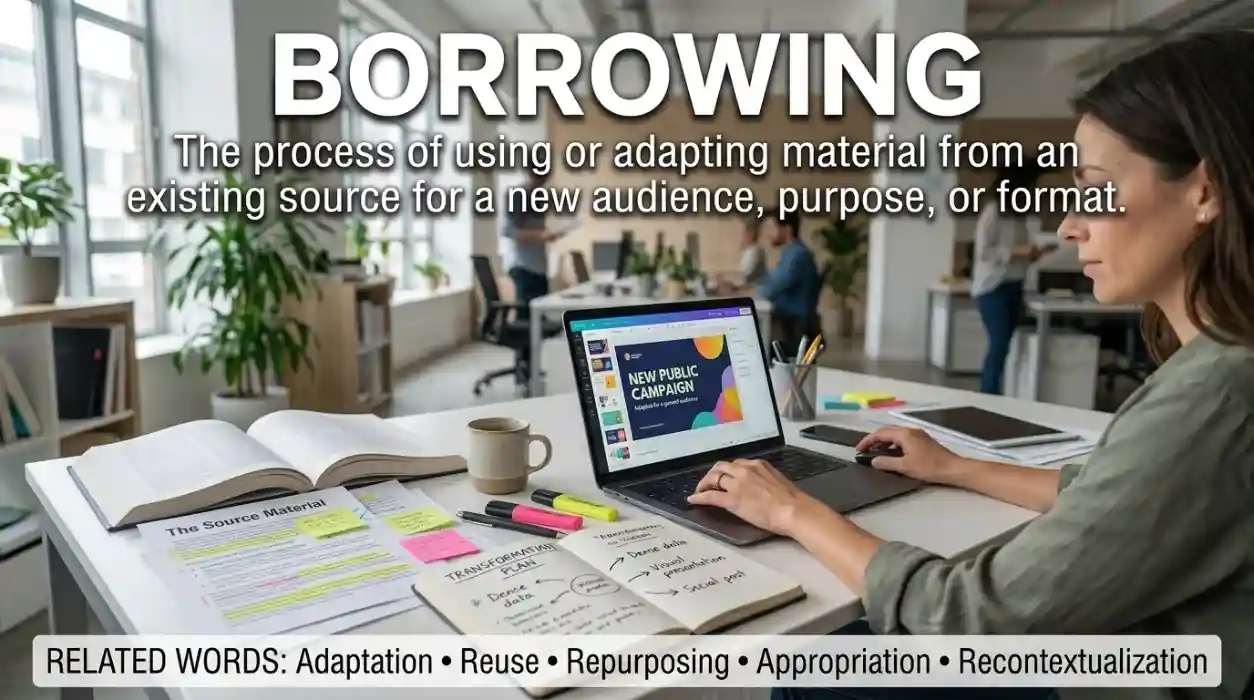
Meaning: Modifying material from an existing source for a new audience, purpose, or format.
Tone/Register: Academic, creative, editorial.
Examples:
The teacher prepared a source adaptation for younger readers.
The documentary used source adaptation to present complex research in an accessible way.
Synonyms by Tone
Tone helps readers understand whether borrowing involves a neutral exchange, a financial obligation, or creative influence. Select words that reflect the situation rather than simply replacing the original word.
Positive or cooperative
- Temporary use
- Taking inspiration from
- Drawing from
- Emulation
- Integration
These terms can suggest learning, access, cooperation, or creative development.
Neutral and descriptive
- Loan
- Taking on a loan
- Obtaining a loan
- Receiving a loan
- Accessing
- Making use of
- Reuse
These expressions describe a transaction or action without strong emotional judgment.
Formal or financial
- Debt financing
- Financing
- Raising debt
- Drawing down
- Securing a loan
- Credit
- Lexical borrowing
These terms suit financial documents, business reports, and academic discussions. Some are specialized rather than interchangeable with the general word borrowing.
Potentially negative or critical
- Going into debt
- Appropriating
- Imitation
- Borrowed influence
These expressions may suggest financial pressure, insufficient originality, or questions about permission and acknowledgment. Context determines whether the implication is fair.
Creative and informal
- Drawing from
- Taking inspiration from
- Modeling on
- Temporary use
- Checking out
These phrases work in conversation, storytelling, and descriptions of how people use resources or develop ideas.
“Borrowing” vs. Close Alternatives
| Word | Main difference | Best use |
|---|---|---|
| Borrowing | Receiving something temporarily or obtaining funds that must be repaid | General use for money, objects, or language |
| Lending | Providing something to another person temporarily | Describing the action of the owner or provider |
| Renting | Paying for the right to use something for a period | Homes, vehicles, equipment, and other paid arrangements |
| Credit | Access to funds or goods with payment due later | Financial transactions and deferred payment |
| Adopting | Taking up an idea, method, or word for use | Language, research, practices, and creative work |
Quick comparison: Borrowing focuses on receiving or using something from another source. Lending focuses on providing it. Renting usually involves payment for temporary use. Credit describes a financial arrangement, while adopting fits ideas, words, and practices.
How “Borrowing” Changes by Context
Daily conversation: Use borrow, take on loan, or check out when talking about books, tools, clothes, or other objects. For example, “Can I borrow your charger?” sounds more natural than “Can I obtain temporary use of your charger?”
Writing and blogging: Choose obtaining a loan, temporary use, or drawing from according to your topic. Financial articles need precise terminology, while lifestyle writing may benefit from simple everyday expressions.
Professional or academic tone: Terms such as debt financing, lexical borrowing, and source adaptation have specialized meanings. Define them when necessary, and avoid using them as generic replacements for borrowing.
Creative or informal use: Phrases such as taking inspiration from and modeling on explain how an idea influenced a project. They do not automatically mean that someone copied another person’s work word for word.
Common Mistakes Learners Make
- Confusing borrowing with lending: The borrower receives the item. The lender provides it. “I borrowed her book” means she let me use it; “I lent her my book” means I provided it.
- Treating renting as identical to borrowing: Renting normally involves payment. Borrowing often involves no payment, although a formal loan may have fees or interest.
- Using credit as a general synonym: Credit is a financial arrangement or ability to obtain goods and funds before payment. It does not describe borrowing a pen or book.
- Confusing inspiration with copying: Drawing from an idea does not necessarily mean copying it. When using another person’s words or distinctive work, attribution and permission may be important.
- Using financial terms outside finance: Debt financing and drawing down are not natural alternatives for borrowing a friend’s umbrella.
- Ignoring repayment obligations: Financial borrowing usually creates an obligation to repay according to agreed terms. Do not assume every form of borrowing has the same conditions.
- Overusing formal expressions: In daily speech, “Can I borrow your notes?” is clearer than “May I obtain temporary access to your written materials?”
Register Notes
In conversation, borrow, loan, rent, and take out a loan are usually clear and natural. In finance, terms such as debt financing and credit borrowing provide more specific information.
Academic writing may use lexical borrowing for vocabulary adopted from another language. Creative writing often uses drawing from or taking inspiration from. Match the phrase to the context and intended meaning.
Real-Life Mini Scenarios
Workplace:
An employee needs a projector for a presentation. They arrange to use one temporarily rather than purchasing new equipment.
Social situations:
A student asks a classmate to borrow lecture notes. The classmate agrees to lend them for one evening.
Media and pop culture:
A film draws inspiration from traditional stories. Reviewers may discuss its influences, adaptation, and originality.
Writing or storytelling:
A writer uses research from earlier studies to support an argument. The writer cites those sources rather than presenting their ideas as entirely original.
Practice Exercise
1. You want to use your friend’s umbrella for one afternoon and then return it. What should you say?
A. I want to rent your umbrella.
B. Can I borrow your umbrella?
C. Can I finance your umbrella?
D. I want to adopt your umbrella.
2. A bank provides money that a customer must repay. Which word best describes the arrangement?
A. Loan
B. Imitation
C. Reuse
D. Integration
3. A library officially allows you to take a book home temporarily. Which phrase is most natural?
A. Raising debt
B. Checking out a book
C. Debt financing a book
D. Modeling on a book
4. A company obtains money by agreeing to repay it later. Which term fits a formal business report?
A. Temporary use
B. Debt financing
C. Loanword adoption
D. Adaptation
5. English adopts a word from another language. What is this process called?
A. Lexical borrowing
B. Renting
C. Credit
D. Drawing down
6. A museum lets another museum display a painting temporarily. What is the first museum doing?
A. Borrowing the painting
B. Loaning the painting
C. Taking out a loan
D. Raising debt
7. A business uses an approved credit facility to access available funds. Which phrase fits?
A. Drawing down
B. Checking out
C. Taking inspiration from
D. Reusing
8. A designer develops a new collection inspired by traditional clothing. Which phrase best describes this influence?
A. Debt financing
B. Taking inspiration from
C. Securing a loan
D. Credit borrowing
Reflection task:
Write one sentence using borrowing, lending, renting, or drawing from. Explain why that word fits your example better than one of the other choices.
Answer key: 1-B, 2-A, 3-B, 4-B, 5-A, 6-B, 7-A, 8-B
External Sources
Explore these established references for definitions, pronunciation, etymology, and language usage:
- Merriam-Webster Dictionary — definitions and usage examples.
- Cambridge Dictionary — learner-friendly meanings and pronunciation.
- Oxford English Dictionary — historical word development and etymology.
- British Council LearnEnglish — English vocabulary and grammar guidance.
- Encyclopaedia Britannica — background information on languages, culture, and financial concepts.
Check a specialist reference when a word belongs to a particular field. This helps you select a synonym that is accurate, natural, and suitable for your audience.
Conclusion
Learning synonyms for borrowing helps you explain financial agreements, shared resources, and the exchange of ideas with greater precision. Each alternative adds a slightly different meaning.
A wider vocabulary can improve essays, blogs, workplace emails, and daily conversations. Choosing words carefully also helps readers understand whether you mean a loan, temporary use, or creative influence.
Remember that borrowing, lending, renting, and adopting are not interchangeable in every situation. Understanding their differences will make your English clearer and more natural.
Practice by writing sentences with three new expressions in your next email, essay, or conversation. Keep noticing how each word changes the meaning, and build your confidence one phrase at a time.
Frequently Asked Questions
1. What is a synonym for borrowing money without using the word “loan”?
You can say obtaining funds, securing financing, accessing credit, or raising debt, depending on the situation. Obtaining funds is broad and does not necessarily mean borrowing. Accessing credit suggests using an available financial facility, while raising debt is more common in corporate or institutional finance.
2. What is the difference between borrowing and taking something on loan?
The phrases are very similar. Borrowing is the general term for receiving or using something temporarily, while taking something on loan emphasizes that an arrangement exists for temporary use. The latter can sound more formal and is often used for equipment, artworks, books, or other items supplied by an institution.
3. What is borrowing called in linguistics?
In linguistics, borrowing commonly refers to the adoption of words or other language features from one language into another. The term lexical borrowing specifically concerns vocabulary. For example, English has adopted words from French, Arabic, Hindi, and many other languages through trade, migration, cultural contact, and historical influence.
4. Is borrowing the same as copying in writing?
No. Borrowing can involve learning from, adapting, or referring to another source. Copying reproduces material more directly. Academic and professional writing should acknowledge source material when required, and direct quotations should be clearly marked. Whether permission is needed depends on the material, its use, and applicable copyright rules.
5. What is a formal word for borrowing equipment?
Obtaining equipment on loan and arranging a temporary equipment loan are clear formal expressions. In institutional settings, equipment loan is especially useful when an organization provides items for a limited period. If payment is required under a contract, leasing or renting may be more accurate.

Hasnain Ali is an SEO Content Strategist and the founder of wordvora.com, a trusted vocabulary platform that helps writers, students, professionals, and English learners find accurate synonyms, antonyms, word meanings, and real-life usage examples. He specializes in keyword research, on-page SEO, topical authority, and creating search-first content that aligns with Google’s latest Search Quality and E-E-A-T guidelines. His work focuses on producing clear, well-structured, and reader-friendly resources that satisfy search intent while maintaining high editorial standards.
Through extensive hands-on experience with SEO tools such as Google Search Console, Google Analytics, SEMrush, and Ahrefs, Hasnain researches user search behavior and develops content that is both informative and easy to understand. Every article published on wordvora.com is carefully reviewed for accuracy, readability, and contextual relevance before publication. His mission is to build one of the web’s most reliable English vocabulary resources by providing practical language guidance, trustworthy explanations, and content that helps readers improve their writing, communication, and vocabulary with confidence.