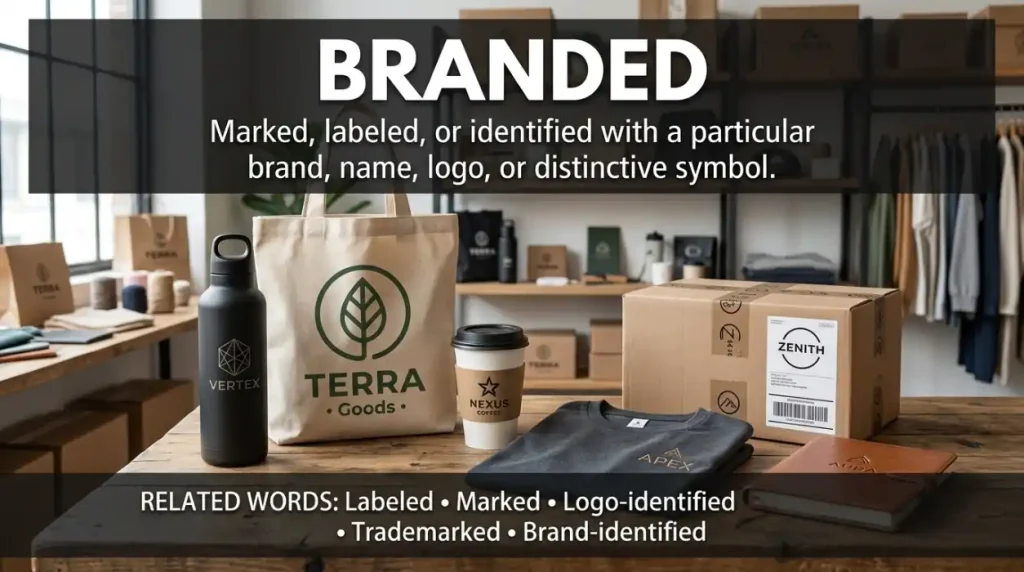
Synonyms for branded include labeled, trademarked, marketed, identified, advertised, and marked. The best alternative depends on whether something carries a brand name, displays an identifying mark, or has been promoted commercially. These words overlap, but each has a distinct meaning.
Imagine shopping for a backpack. One description says it is branded, while another calls it logo-bearing or trademarked. Those descriptions may sound similar, but they do not always communicate the same thing.
The word branded appears in advertising, business, retail, marketing, and everyday conversation. It can describe a product with a recognizable identity or something associated with a particular reputation.
Learning synonyms for branded helps students write precise assignments. Bloggers and content writers can avoid repetition, while everyday English users can describe products, reputations, and business identities more naturally.
A carefully chosen alternative can also prevent confusion. Labeled focuses on identification, while trademarked refers to legal protection for a mark.
What Does “Branded” Really Mean?
Branded is commonly used as an adjective or as the past tense and past participle of the verb brand. It can mean marked with a name, logo, or symbol that identifies a business or product. It can also mean associated with a particular reputation.
In marketing, a branded product carries an identifiable commercial identity. In a broader context, a person or action can be branded dishonest, meaning that others have publicly described or portrayed that person or action in a negative way.
Native English speakers understand the meaning through context. A branded jacket usually refers to clothing associated with a brand. A person branded a troublemaker has received a particular label or reputation.
Common Uses of Branded
- Products: A branded watch carries a recognizable company identity.
- Marketing: Branded content includes a business’s visual identity or messaging.
- Business: A branded campaign follows a company’s established identity.
- Reputation: Someone branded unreliable has been described that way by others.
- Identification: An object may be branded with a name, logo, or identifying mark.
Example: The company released a branded water bottle for its annual event.
Example: The article branded the policy a failure, although the evidence was mixed.
Connotative Meaning of Branded
(Connotation is the emotional or cultural association a word carries beyond its basic meaning.)
Positive tone: Branded can suggest quality, recognition, consistency, trust, and a strong commercial identity.
Negative tone: It can imply excessive advertising, commercial influence, stigma, or an unfair reputation. For example, someone branded a failure may feel judged or misunderstood.
Neutral tone: In product descriptions, the word may simply indicate that an item carries a recognizable company name or logo.
The word is not automatically positive or negative. Its tone depends on what is being branded and why.
Etymology
The verb brand comes from older Germanic roots associated with burning. Historically, a brand could be a burning piece of wood or a mark made by burning. Over time, the word developed the meaning of a mark used to identify ownership or origin.
Old English (450–1100)
Old English used related Germanic vocabulary for fire and burning. The modern commercial meaning of brand had not yet developed in its present form. Identification marks existed, but the familiar business sense emerged later.
Middle English (1100–1500)
During Middle English, forms related to brand continued to refer to burning and marks. The practice of marking livestock and property helped connect the idea of a physical mark with identification and ownership.
Modern English (1500–present)
The meaning expanded from a mark made by burning to a symbol of identity. Businesses increasingly used brands to distinguish their goods from those of competitors.
Today, branded can refer to commercial identity, promotional material, recognizable products, or a reputation imposed on a person or idea.
Pronunciation
- US: /ˈbrændɪd/
- UK: /ˈbrændɪd/
Syllables
Brand-ed — two syllables.
Affixation Pattern of Branded
- Root: Brand
- Prefix: None.
- Suffix: -ed, marking the past tense or past participle of the verb.
- Related forms: Brand, branding, brandable, and brand identity.
The spelling branded also functions as an adjective, as in “branded merchandise.”
Synonyms List
The following alternatives cover the main senses of branded. Some apply to commercial identity, while others describe marking, advertising, or assigning a reputation. Choose according to the sentence rather than treating every word as interchangeable.
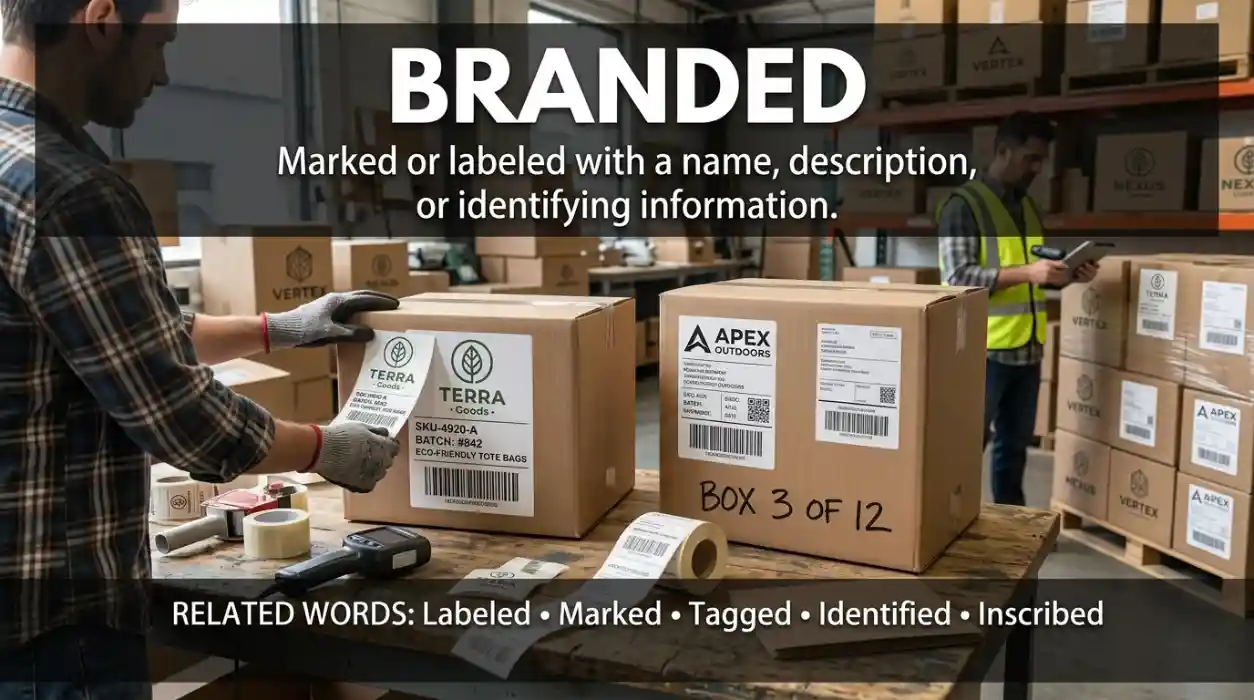
1. Labeled (Adjective/Verb) — US / UK: /ˈleɪbəld/ /ˈleɪbəld/
Meaning: Marked with a name, description, or identifying information.
Tone/Register: Neutral, everyday, business.
Examples:
Every box was labeled with the department name.
Please check the label before opening it.
2. Trademarked (Adjective/Verb) — US / UK: /ˈtreɪdmɑːrkt/ /ˈtreɪdmɑːkt/
Meaning: Protected or identified by a legally recognized trademark.
Tone/Register: Legal, formal, business.
Examples:
The company uses a trademarked symbol on its packaging.
Check the registration details before using a similar design.
3. Marketed (Verb, past tense/participle) — US / UK: /ˈmɑːrkɪtɪd/ /ˈmɑːkɪtɪd/
Meaning: Promoted or presented to potential customers.
Tone/Register: Business, marketing.
Examples:
The new drink was marketed to young adults.
The campaign emphasized convenience and flavor.
4. Advertised (Adjective/Verb) — US / UK: /ˈædvərˌtaɪzd/ /ˈædvətaɪzd/
Meaning: Promoted publicly to attract attention or encourage interest.
Tone/Register: Neutral, commercial.
Examples:
The advertised offer ends on Friday.
Read the conditions before making a decision.
5. Marked (Adjective/Verb) — US / UK: /mɑːrkt/ /mɑːkt/
Meaning: Identified by a visible sign, symbol, name, or feature.
Tone/Register: Neutral, general.
Examples:
The equipment was marked with the laboratory’s initials.
That made it easier to identify the correct items.
6. Identified (Adjective/Verb) — US / UK: /aɪˈdɛntɪˌfaɪd/ /aɪˈdentɪfaɪd/
Meaning: Recognized or distinguished by specific information or characteristics.
Tone/Register: Neutral, academic, professional.
Examples:
The package was identified by its serial number.
Staff traced it to the correct shipment.
7. Logo-bearing (Adjective) — US / UK: /ˈloʊɡoʊ ˌbɛrɪŋ/ /ˈləʊɡəʊ ˌbeərɪŋ/
Meaning: Displaying a logo associated with a company, group, or organization.
Tone/Register: Descriptive, business.
Examples:
The staff received logo-bearing shirts for the conference.
They wore them during the welcome session.
8. Company-marked (Adjective) — US / UK: /ˈkʌmpəni mɑːrkt/ /ˈkʌmpəni mɑːkt/
Meaning: Carrying a mark that identifies a particular company.
Tone/Register: Formal, descriptive.
Examples:
The delivery vans were company-marked.
Customers could recognize them at a glance.
9. Branded-up (Adjective, Informal) — US / UK: /ˌbrændɪd ˈʌp/ /ˌbrændɪd ˈʌp/
Meaning: Given a more noticeable or consistent brand identity.
Tone/Register: Informal, workplace jargon.
Examples:
The team branded up the event materials before launch.
The updated designs matched the company colors.
10. Endorsed (Verb, past tense/participle) — US / UK: /ɪnˈdɔːrst/ /ɪnˈdɔːst/
Meaning: Publicly supported or recommended by a person or organization.
Tone/Register: Business, public relations.
Examples:
The product was endorsed by a well-known athlete.
The campaign highlighted the athlete’s personal experience.
11. Sponsored (Adjective/Verb) — US / UK: /ˈspɑːnsərd/ /ˈspɒnsəd/
Meaning: Supported financially or materially by a person or organization.
Tone/Register: Business, media, events.
Examples:
The team wore sponsored jerseys during the tournament.
The sponsors’ names appeared on the front.
12. Promotional (Adjective) — US / UK: /prəˈmoʊʃənəl/ /prəˈməʊʃənəl/
Meaning: Designed to publicize a product, service, event, or organization.
Tone/Register: Marketing, professional.
Examples:
The company distributed promotional notebooks at the seminar.
Attendees used them to take notes.
13. Commercialized (Adjective/Verb) — US / UK: /kəˈmɝːʃəˌlaɪzd/ /kəˈmɜːʃəlaɪzd/
Meaning: Adapted or used for commercial purposes.
Tone/Register: Business, analytical.
Examples:
The festival became more commercialized over time.
Some visitors missed its earlier community focus.
14. Branded as (Verb Phrase) — US / UK: /ˈbrændɪd æz/ /ˈbrændɪd æz/
Meaning: Described or presented as belonging to a particular category or reputation.
Tone/Register: Neutral, media, sometimes critical.
Examples:
The proposal was branded as a major reform.
Critics argued that the changes were relatively small.
15. Designated (Adjective/Verb) — US / UK: /ˈdɛzɪɡˌneɪtɪd/ /ˈdezɪɡneɪtɪd/
Meaning: Officially selected or assigned a particular name, role, or status.
Tone/Register: Formal, administrative.
Examples:
The room was designated for staff training.
Visitors were asked to use the other entrance.
16. Stamped (Adjective/Verb) — US / UK: /stæmpt/ /stæmpt/
Meaning: Marked with a design, symbol, or identifying impression.
Tone/Register: Neutral, physical description.
Examples:
The leather wallet was stamped with the maker’s initials.
The mark appeared inside the cover.
17. Inscribed (Adjective/Verb) — US / UK: /ɪnˈskraɪbd/ /ɪnˈskraɪbd/
Meaning: Marked with words, letters, or symbols written or engraved on a surface.
Tone/Register: Formal, descriptive.
Examples:
The award was inscribed with the organization’s name.
The recipient kept it on a desk.
18. Imprinted (Adjective/Verb) — US / UK: /ɪmˈprɪntɪd/ /ɪmˈprɪntɪd/
Meaning: Printed or pressed onto a surface to leave a visible mark.
Tone/Register: Technical, descriptive.
Examples:
The logo was imprinted on the reusable cup.
It remained visible after several washes.
19. Embossed (Adjective/Verb) — US / UK: /ɪmˈbɔːst/ /ɪmˈbɒst/
Meaning: Decorated with a raised design or lettering on a surface.
Tone/Register: Design, manufacturing.
Examples:
The notebook had an embossed emblem on its cover.
The raised detail gave it a distinctive texture.
20. Engraved (Adjective/Verb) — US / UK: /ɪnˈɡreɪvd/ /ɪnˈɡreɪvd/
Meaning: Marked by cutting letters or designs into a hard surface.
Tone/Register: Formal, craft, manufacturing.
Examples:
The plaque was engraved with the institution’s name.
The lettering was easy to read.

21. Monogrammed (Adjective/Verb) — US / UK: /ˈmɑːnəˌɡræmd/ /ˈmɒnəˌɡræmd/
Meaning: Marked with initials arranged as a decorative design.
Tone/Register: Fashion, personal, descriptive.
Examples:
She carried a monogrammed travel bag.
Her initials appeared in gold thread.
22. Insignia-marked (Adjective) — US / UK: /ɪnˈsɪɡniə mɑːrkt/ /ɪnˈsɪɡniə mɑːkt/
Meaning: Displaying an emblem that represents an organization, rank, or group.
Tone/Register: Formal, institutional.
Examples:
The uniforms were insignia-marked.
The emblems showed each person’s unit.
23. Logoed (Adjective) — US / UK: /ˈloʊɡoʊd/ /ˈləʊɡəʊd/
Meaning: Printed or decorated with a logo.
Tone/Register: Informal, retail, business.
Examples:
The volunteers wore logoed caps during the event.
The matching hats helped visitors find them.
24. Branded with a Logo (Adjective Phrase) — US / UK: /ˈbrændɪd wɪð ə ˈloʊɡoʊ/ /ˈbrændɪd wɪð ə ˈləʊɡəʊ/
Meaning: Carrying a visible logo that identifies a brand or organization.
Tone/Register: Neutral, commercial.
Examples:
The conference bags were branded with a logo.
Participants carried them throughout the day.
25. Proprietary (Adjective) — US / UK: /prəˈpraɪəˌtɛri/ /prəˈpraɪətəri/
Meaning: Owned or controlled by a particular person or company, often with restricted rights.
Tone/Register: Business, legal, technical.
Examples:
The software uses a proprietary file format.
Other applications may not open it easily.
26. Registered (Adjective/Verb) — US / UK: /ˈrɛdʒɪstərd/ /ˈredʒɪstəd/
Meaning: Officially recorded with an authority or organization.
Tone/Register: Formal, administrative, legal.
Examples:
The business operates under a registered name.
Its records are available through the relevant authority.
27. Branded Merchandise (Noun Phrase) — US / UK: /ˈbrændɪd ˈmɝːtʃənˌdaɪs/ /ˈbrændɪd ˈmɜːtʃəndaɪs/
Meaning: Products carrying a company’s name, logo, or visual identity.
Tone/Register: Business, retail.
Examples:
The store sells branded merchandise for the local club.
Fans often choose scarves and caps.
28. Corporate (Adjective) — US / UK: /ˈkɔːrpərət/ /ˈkɔːpərət/
Meaning: Relating to a company or its organizational identity.
Tone/Register: Business, formal.
Examples:
The website follows the company’s corporate design.
Its colors and typography remain consistent.
29. Branded Content (Noun Phrase) — US / UK: /ˈbrændɪd ˈkɑːntɛnt/ /ˈbrændɪd ˈkɒntent/
Meaning: Media created to communicate a brand’s identity or values, often in an editorial or entertainment format.
Tone/Register: Marketing, media.
Examples:
The magazine published branded content about sustainable travel.
The article explained the sponsor’s environmental goals.
30. Co-branded (Adjective) — US / UK: /ˌkoʊˈbrændɪd/ /ˌkəʊˈbrændɪd/
Meaning: Created or presented jointly by two or more brands.
Tone/Register: Business, marketing.
Examples:
The companies released a co-branded collection.
Both logos appeared on the packaging.
31. Rebranded (Adjective/Verb) — US / UK: /ˌriːˈbrændɪd/ /ˌriːˈbrændɪd/
Meaning: Given a new brand identity or public presentation.
Tone/Register: Business, marketing.
Examples:
The organization rebranded after expanding internationally.
Its new identity reflected a broader mission.
32. Recognizable (Adjective) — US / UK: /ˈrɛkəɡˌnaɪzəbəl/ /ˈrekəɡˌnaɪzəbəl/
Meaning: Easy to identify because of familiar features or characteristics.
Tone/Register: Neutral, everyday, business.
Examples:
The company created a recognizable visual style.
Customers could identify its posts immediately.
33. Distinctive (Adjective) — US / UK: /dɪˈstɪŋktɪv/ /dɪˈstɪŋktɪv/
Meaning: Having features that make something different from others.
Tone/Register: Neutral, often positive.
Examples:
The café has a distinctive green sign.
Visitors often use it as a meeting point.
34. Signature (Adjective) — US / UK: /ˈsɪɡnətʃər/ /ˈsɪɡnətʃə/
Meaning: Characteristic of a particular person, organization, or style.
Tone/Register: Business, fashion, creative.
Examples:
The designer used her signature pattern on the collection.
Fans recognized it from earlier work.
35. Branded by Reputation (Adjective Phrase) — US / UK: /ˈbrændɪd baɪ ˌrɛpjəˈteɪʃən/ /ˈbrændɪd baɪ ˌrepjʊˈteɪʃən/
Meaning: Associated with a lasting public judgment or reputation.
Tone/Register: Descriptive, often critical.
Examples:
The company was branded by its reputation for poor service.
It had to rebuild customer trust.
36. Stigmatized (Adjective/Verb) — US / UK: /ˈstɪɡməˌtaɪzd/ /ˈstɪɡmətaɪzd/
Meaning: Treated unfairly or negatively because of an associated trait or label.
Tone/Register: Social, academic, critical.
Examples:
People with the condition should not be stigmatized.
Public education can challenge harmful assumptions.
37. Stereotyped (Adjective/Verb) — US / UK: /ˈstɛriəˌtaɪpt/ /ˈsteriəˌtaɪpt/
Meaning: Judged according to an oversimplified belief about a group or type of person.
Tone/Register: Social, critical, academic.
Examples:
The character was stereotyped as the class troublemaker.
The story later revealed a more complex personality.
38. Typecast (Adjective/Verb) — US / UK: /ˈtaɪpˌkæst/ /ˈtaɪpˌkɑːst/
Meaning: Repeatedly assigned a narrow role or category, especially in acting or public perception.
Tone/Register: Entertainment, informal.
Examples:
The actor felt typecast after several similar roles.
She wanted to play a more complex character.
39. Categorized (Adjective/Verb) — US / UK: /ˈkætəɡəˌraɪzd/ /ˈkætəɡəraɪzd/
Meaning: Placed into a group or category based on shared features.
Tone/Register: Neutral, academic, administrative.
Examples:
The products were categorized by intended use.
That made the inventory easier to manage.
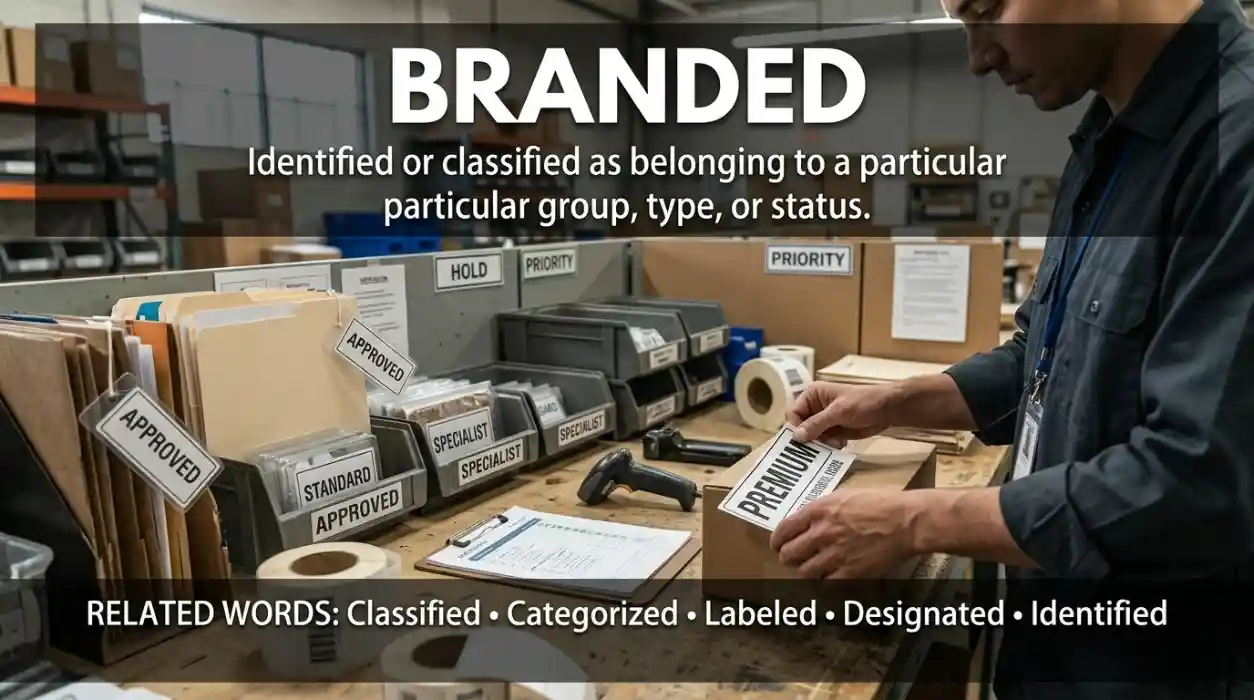
40. Classified (Adjective/Verb) — US / UK: /ˈklæsɪˌfaɪd/ /ˈklæsɪfaɪd/
Meaning: Assigned to a particular group, type, or status.
Tone/Register: Formal, academic, administrative.
Examples:
The material was classified as confidential.
Only authorized staff could access it.
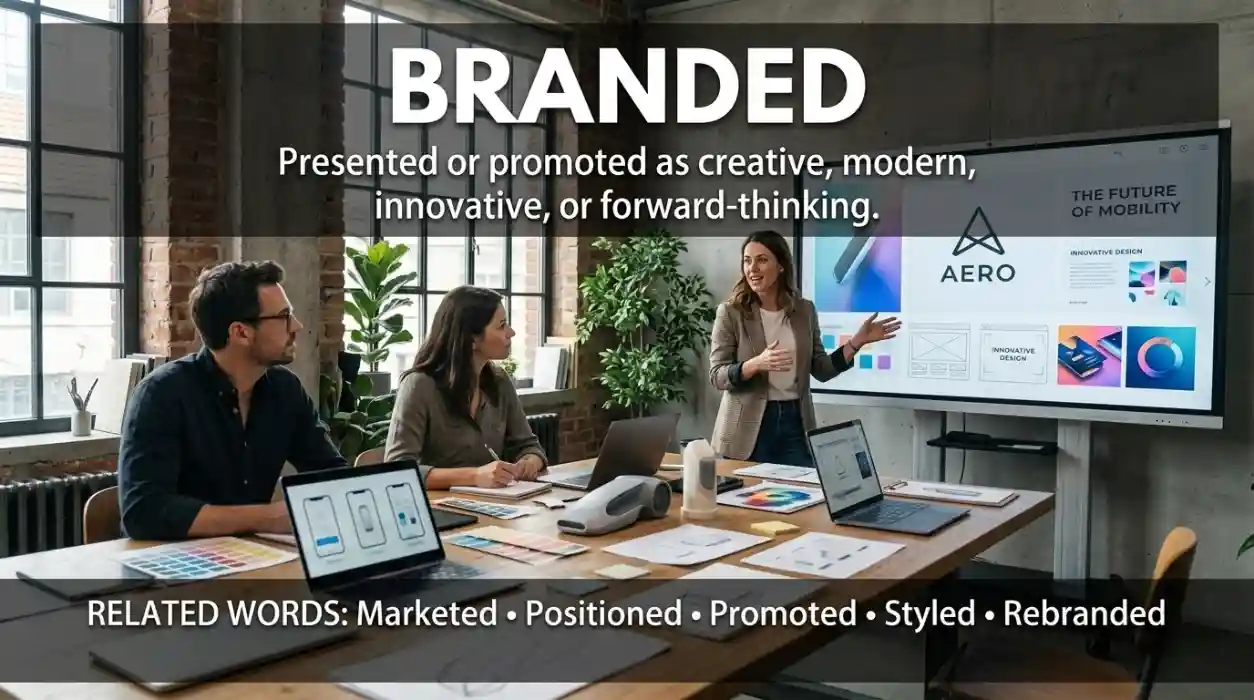
41. Design-branded (Adjective) — US / UK: /dɪˈzaɪn ˌbrændɪd/ /dɪˈzaɪn ˌbrændɪd/
Meaning: Given a coordinated visual identity through its design elements.
Tone/Register: Design, business.
Examples:
The presentation was design-branded for the annual summit.
Its layout matched the event’s official style.
42. Personalized (Adjective/Verb) — US / UK: /ˈpɝːsənəˌlaɪzd/ /ˈpɜːsənəlaɪzd/
Meaning: Adapted to a particular person through names, preferences, or individual details.
Tone/Register: Neutral, customer experience.
Examples:
The welcome message was personalized for each guest.
It included their names and arrival details.
43. Customized (Adjective/Verb) — US / UK: /ˈkʌstəˌmaɪzd/ /ˈkʌstəmaɪzd/
Meaning: Modified to meet particular needs or preferences.
Tone/Register: Business, everyday.
Examples:
The team ordered customized folders for the workshop.
Each folder included the participant’s role.
44. Branded Internally (Adjective Phrase) — US / UK: /ˈbrændɪd ɪnˈtɝːnəli/ /ˈbrændɪd ɪnˈtɜːnəli/
Meaning: Given a consistent identity for use within an organization.
Tone/Register: Corporate, professional.
Examples:
The internal portal was branded with the company’s visual identity.
Staff could find official resources more easily.
45. Branded Externally (Adjective Phrase) — US / UK: /ˈbrændɪd ɪkˈstɝːnəli/ /ˈbrændɪd ɪkˈstɜːnəli/
Meaning: Presented with a brand identity for audiences outside an organization.
Tone/Register: Corporate, marketing.
Examples:
The report was branded externally for public distribution.
It followed the organization’s communication guidelines.
46. Market-Positioned (Adjective) — US / UK: /ˈmɑːrkɪt pəˌzɪʃənd/ /ˈmɑːkɪt pəˌzɪʃənd/
Meaning: Presented to occupy a particular place in a market or in customers’ minds.
Tone/Register: Marketing, strategic.
Examples:
The service was market-positioned as a simple option for beginners.
Its campaign emphasized ease of use.
47. Identity-marked (Adjective) — US / UK: /aɪˈdɛntəti mɑːrkt/ /aɪˈdentəti mɑːkt/
Meaning: Carrying a feature or symbol that communicates identity.
Tone/Register: Technical, descriptive.
Examples:
The uniforms were identity-marked for each department.
The different symbols helped staff find the right team.
48. Branded for Recognition (Adjective Phrase) — US / UK: /ˈbrændɪd fər ˌrɛkəɡˈnɪʃən/ /ˈbrændɪd fə ˌrekəɡˈnɪʃən/
Meaning: Designed or marked so that people can recognize its source or identity.
Tone/Register: Business, descriptive.
Examples:
The community vehicles were branded for recognition.
Residents could identify official transport quickly.
49. Branded as Unreliable (Verb Phrase) — US / UK: /ˈbrændɪd æz ˌʌnrɪˈlaɪəbəl/ /ˈbrændɪd æz ˌʌnrɪˈlaɪəbəl/
Meaning: Publicly described as lacking reliability or dependability.
Tone/Register: Critical, reputational.
Examples:
The supplier was branded as unreliable after repeated delays.
It later introduced a more accurate delivery system.
50. Branded as Innovative (Verb Phrase) — US / UK: /ˈbrændɪd æz ˈɪnəˌveɪtɪv/ /ˈbrændɪd æz ˈɪnəˌveɪtɪv/
Meaning: Presented or described as creative, modern, or forward-thinking.
Tone/Register: Business, promotional.
Examples:
The startup was branded as innovative in its launch coverage.
Its new approach attracted attention from industry experts.
Synonyms by Tone
Tone determines whether a word sounds factual, promotional, or judgmental. A product description usually needs a neutral term, while a discussion of public reputation may need a word that captures social consequences.
Positive
- Recognizable
- Distinctive
- Signature
- Endorsed
- Personalized
- Customized
These words can suggest identity, recognition, individuality, or public support.
Neutral
- Labeled
- Marked
- Identified
- Registered
- Designated
- Classified
- Logo-bearing
These alternatives focus on identification or status rather than emotion.
Negative or Critical
- Stigmatized
- Stereotyped
- Typecast
- Commercialized
- Branded as unreliable
These words can imply unfair judgment, excessive commercial influence, or a limiting public image.
Marketing and Business
- Marketed
- Advertised
- Sponsored
- Promotional
- Co-branded
- Rebranded
- Market-positioned
These alternatives are useful when discussing campaigns, brand identity, and commercial communication.
Branded vs. Close Alternatives
| Word | Main difference | Best use |
|---|---|---|
| Branded | Associated with a particular brand or reputation | Products, campaigns, public descriptions |
| Labeled | Given a name, tag, or identifying description | Packaging, files, classification |
| Trademarked | Protected by trademark law or identified by a trademark | Legal and intellectual-property contexts |
| Marketed | Promoted to attract an audience or customers | Advertising and sales |
| Stigmatized | Given a harmful or discrediting social association | Social issues and public perception |
Quick rule: Use branded for a recognizable identity, labeled for identification, trademarked for a legal mark, and marketed for promotion. Use stigmatized when the label carries social harm.
How Branded Changes by Context
Daily Conversation
In casual speech, people often say logoed, labeled, or with a brand name when describing an item. These phrases are clear and natural.
Example: “Is that a branded backpack, or did you add the logo yourself?”
Writing and Blogging
Writers should choose alternatives based on the point they want to make. Recognizable describes visibility, marketed describes promotion, and distinctive highlights qualities that make a brand stand out.
Example: “The company developed a distinctive visual identity for its new website.”
Professional and Academic Writing
Business reports may use registered, trademarked, market-positioned, or commercialized. Each word expresses a different fact. Check the legal meaning before describing a mark as trademarked.
Example: “The logo is registered in the relevant jurisdiction.”
Creative and Informal Use
When describing people or characters, branded as, typecast, and stereotyped can express how society assigns labels. These terms often have stronger emotional implications than product-related uses.
Example: “After one mistake, he was branded as careless by his colleagues.”
Common Mistakes and Native Usage
1. Treating “Branded” and “Trademarked” as Identical
A branded product may display a company name or logo. That does not automatically mean every design element has registered trademark protection.
Use trademarked only when legal protection or trademark status is relevant and accurate.
2. Using “Marketed” When You Mean “Labeled”
A label identifies something. Marketing promotes it to an audience. A box can be labeled with a product name without being part of a marketing campaign.
3. Confusing “Branded” with “Personalized”
A branded notebook may carry a company’s logo. A personalized notebook may include a person’s name or preferred details. Some products do both, but the words describe different features.
4. Ignoring the Negative Meaning of “Branded As”
In a sentence such as “She was branded a liar,” the verb does not describe a company logo. It means someone publicly assigned her a damaging reputation.
Register Notes
- Formal: Trademarked, registered, designated, classified.
- Business: Marketed, sponsored, co-branded, market-positioned.
- Everyday: Labeled, marked, logoed, personalized.
- Social or critical: Stigmatized, stereotyped, typecast.
For more vocabulary practice, compare these terms with synonyms for labeled and marketed in your English notes.
Real-Life Mini Scenarios
Workplace
A company prepares conference folders with its logo and official colors. The folders are branded because they reflect the organization’s identity.
Social Situations
A person makes one mistake and becomes known as unreliable. Friends may say that the person was branded as careless, even if the label is unfair.
Media and Pop Culture
A celebrity collaborates with a clothing company on a collection. The products may be co-branded because both identities appear in the campaign.
Writing and Storytelling
A fictional character is repeatedly cast as the villain by the people around them. Describing the character as typecast or branded as dangerous can reveal how others see them.
Practice Exercise
1. A box has a sticker showing its contents. Which word fits best?
A. Labeled
B. Sponsored
C. Stigmatized
2. A business promotes a new service through public campaigns. Which word is most suitable?
A. Engraved
B. Marketed
C. Inscribed
3. A logo has legal protection under trademark law. Which word is most precise?
A. Trademarked
B. Personalized
C. Categorized
4. Two companies release a product featuring both logos. What is the product?
A. Co-branded
B. Typecast
C. Pending
5. A notebook has a customer’s initials added to it. Which word fits best?
A. Commercialized
B. Personalized
C. Classified
6. A person receives an unfair negative public label. Which word is most suitable?
A. Stigmatized
B. Sponsored
C. Registered
7. A product is easy to identify because of its familiar design. Which word describes it?
A. Recognizable
B. Conditional
C. Unresolved
8. A company changes its name, logo, and visual identity. What has it done?
A. Rebranded
B. Engraved
C. Endorsed
9. An athlete publicly recommends a sports drink. Which term describes the relationship?
A. Endorsed
B. Labeled
C. Classified
10. A metal award has letters cut into its surface. Which word fits best?
A. Marketed
B. Engraved
C. Sponsored
Reflection Task
Write two original sentences about a product, business, or person’s reputation.
- Use branded in the first sentence.
- Replace it in the second sentence with a more precise alternative.
Answer key: 1-A, 2-B, 3-A, 4-A, 5-B, 6-A, 7-A, 8-A, 9-A, 10-B
Suggested External Sources
Consult these established references for definitions, pronunciation, usage examples, and legal distinctions:
- Merriam-Webster Dictionary — definitions and usage examples for brand, label, and related terms.
- Cambridge Dictionary — learner-friendly definitions and US/UK pronunciation.
- Oxford English Dictionary — historical development and etymology of brand.
- United States Patent and Trademark Office (USPTO) — authoritative information about trademarks and legal protection.
- British Council LearnEnglish — practical vocabulary and English-learning guidance.
When writing about a commercial identity, verify the precise meaning of each term. A logo, a marketing campaign, and a registered trademark are related concepts, but they are not the same thing.
Conclusion
Learning synonyms for branded helps you describe products, marketing, identity, and reputation with greater accuracy. The right word can make your writing clearer and more trustworthy.
Students can strengthen assignments with precise vocabulary. Bloggers and content writers can reduce repetition, while everyday English users can explain what makes a product or reputation distinctive.
Remember that labeled, trademarked, marketed, and personalized describe different ideas. Look at the context before replacing branded with another word.
Practice by describing three products or public figures using different alternatives. Try the words in emails, essays, and everyday conversations to make your vocabulary more natural.
FAQs
1. What is the best synonym for branded products?
The best alternative depends on the feature you want to describe. Use logo-bearing or logoed when a product visibly displays a logo. Use trademarked only when trademark status matters. In general product descriptions, “products carrying a company logo” is a clear option when you want to avoid ambiguity.
2. Is branded the same as trademarked?
No. Branded generally means associated with a recognizable brand identity, name, or logo. Trademarked refers to a mark protected or registered under applicable trademark law. A product may carry a business logo without every element being a registered trademark. In legal or business writing, avoid using the words interchangeably unless the facts support that meaning.
3. What does branded mean in marketing?
In marketing, branded means that a product, message, campaign, or piece of content carries an identifiable brand’s name, visual style, values, or identity. Branded material helps an audience connect the content with an organization. The exact meaning depends on context: branded merchandise displays identity, while branded content communicates a brand through media or storytelling.
4. What does “branded as a failure” mean?
“Branded as a failure” means that someone publicly described a person, project, or effort as unsuccessful. The phrase can carry a harsh or unfair judgment. It does not simply mean that the person or project has a logo. For example, someone may be branded a failure after one setback even if they later recover and succeed.
5. What is the difference between branded and personalized?
Branded connects an item with a company or organization’s identity. Personalized adapts an item to an individual, often by adding a name, initials, or personal preference. A company may give employees personalized branded notebooks: the logo identifies the organization, while each employee’s name makes the notebook personal.

Hasnain Ali is an SEO Content Strategist and the founder of wordvora.com, a trusted vocabulary platform that helps writers, students, professionals, and English learners find accurate synonyms, antonyms, word meanings, and real-life usage examples. He specializes in keyword research, on-page SEO, topical authority, and creating search-first content that aligns with Google’s latest Search Quality and E-E-A-T guidelines. His work focuses on producing clear, well-structured, and reader-friendly resources that satisfy search intent while maintaining high editorial standards.
Through extensive hands-on experience with SEO tools such as Google Search Console, Google Analytics, SEMrush, and Ahrefs, Hasnain researches user search behavior and develops content that is both informative and easy to understand. Every article published on wordvora.com is carefully reviewed for accuracy, readability, and contextual relevance before publication. His mission is to build one of the web’s most reliable English vocabulary resources by providing practical language guidance, trustworthy explanations, and content that helps readers improve their writing, communication, and vocabulary with confidence.