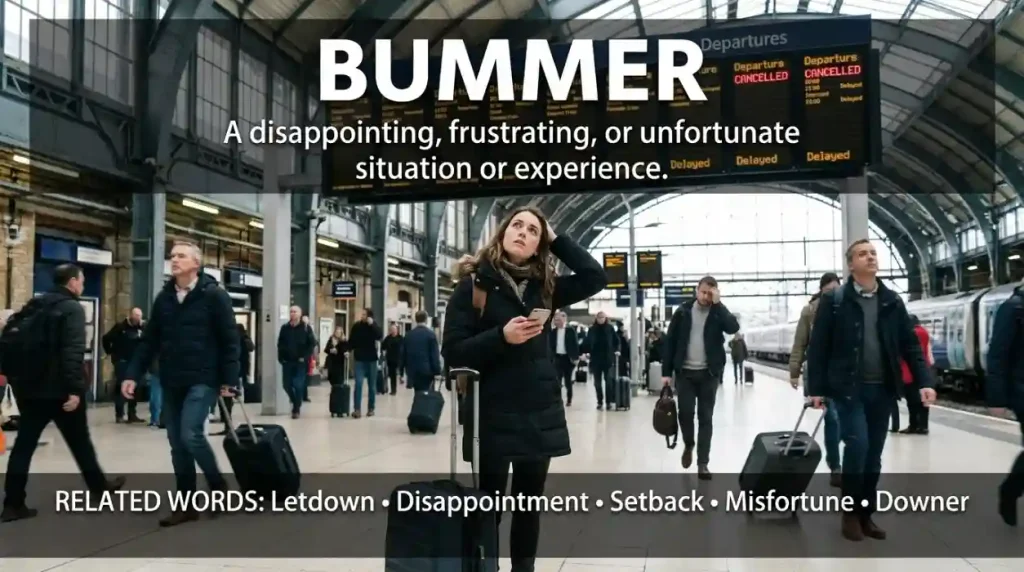
Synonyms for bummer include disappointment, letdown, setback, disappointment, drag, downer, nuisance, and shame. The best alternative depends on the situation. Some words describe an unfortunate event, while others express sadness, frustration, or sympathy in everyday conversation.
You miss your bus, spill coffee on your shirt, and arrive late for work. Someone might simply say, “What a bummer!” This familiar phrase captures a frustrating moment in just three words.
The word bummer is popular because it sounds casual, friendly, and natural. Learning alternatives helps you describe bad news without repeating the same expression in every conversation.
For students, bloggers, and content writers, synonyms make sentences more precise and engaging. Daily English users can also choose words that fit the situation, from a minor inconvenience to a serious disappointment.
This guide explores synonyms for bummer, with simple definitions, American and British pronunciations, and practical examples. You will also learn how tone changes meaning and how to choose the right word.
What Does “Bummer” Really Mean?
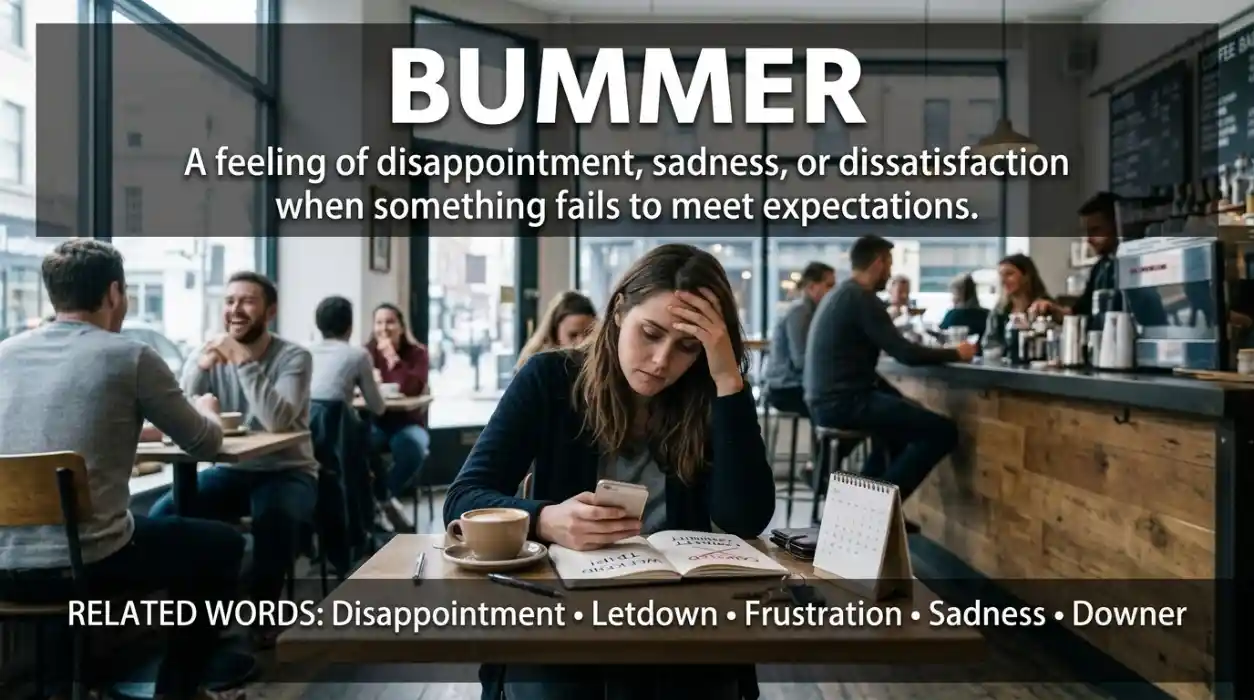
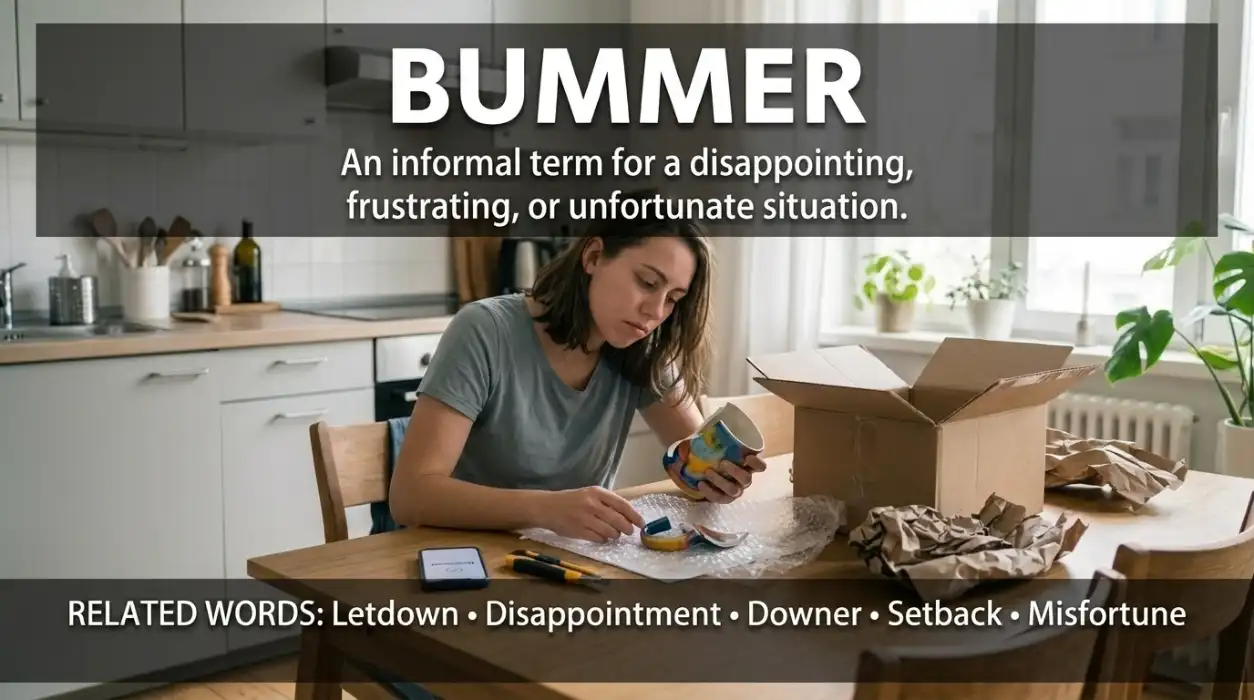
A bummer is an unpleasant, disappointing, or frustrating experience. It is an informal noun used when something goes wrong or fails to meet expectations.
For example, if your favorite restaurant is closed when you arrive, you might say, “That’s a bummer.” The phrase expresses disappointment without making the situation sound too serious.
Native English speakers commonly use bummer in casual conversations, text messages, social media posts, and informal storytelling. It can also express sympathy when another person shares bad news.
Although the word usually describes something negative, it does not always suggest a major problem. Missing a movie, receiving a canceled invitation, and losing an important opportunity can all be described as bummers.
Part of Speech
Bummer is a noun.
- Singular: That was a bummer.
- Plural: We had a few bummers during the trip.
- Common expression: What a bummer!
- Sympathetic response: That’s a real bummer. I’m sorry.
The expression is generally informal. In professional reports, academic writing, or formal correspondence, alternatives such as setback, disappointment, or unfortunate development may be more appropriate.
Connotative Meaning of “Bummer”
(Connotation means the feelings, associations, or attitudes a word suggests beyond its basic dictionary meaning.)
Positive tone: The word itself is not positive, but it can support a warm, reassuring response. “That’s a bummer, but you’ll have another chance” acknowledges a problem while offering encouragement.
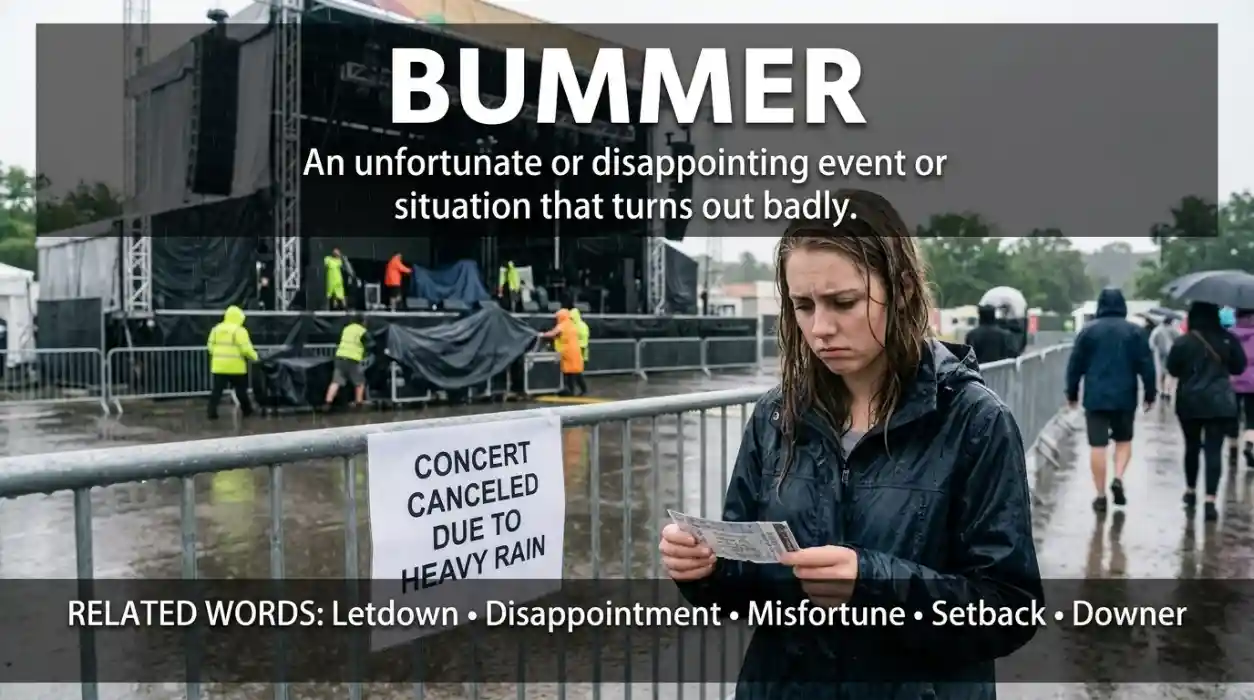
Negative tone: It communicates disappointment, frustration, sadness, or annoyance. “It’s a bummer that the concert was canceled” shows dissatisfaction.
Neutral tone: In casual speech, it can simply acknowledge an unfortunate fact without expressing strong emotion. “The meeting moved to Friday. A bit of a bummer, but manageable.”
The emotional strength depends on context. A bummer often sounds lighter than a disaster or a tragedy. Choosing a more serious word for a minor inconvenience can make your message sound exaggerated.
Etymology
The word bummer is associated with American English slang from the nineteenth century. It is commonly linked to bum, a word that could refer to an idle or disreputable person and later developed other slang meanings.
Its history is not a simple, direct continuation of an Old English word with the modern meaning of disappointment. The modern expression developed through slang usage, so its history should be understood separately from the broader history of English.
Historical Development
Old English (450–1100): The modern slang noun bummer was not used with its current meaning. Speakers used other words to express grief, trouble, hardship, and misfortune.
Middle English (1100–1500): English vocabulary continued to develop through French and Norse influences. Words associated with sorrow, trouble, and disappointment evolved, but the modern slang expression had not yet become established.
Modern English (1500–present): Bummer emerged in American slang during the nineteenth century. Over time, it became a familiar informal expression for an unpleasant experience or disappointing outcome.
Pronunciation
- US IPA: /ˈbʌm.ɚ/
- UK IPA: /ˈbʌm.ə/
Syllables: bum-mer
Root: bum (the historical slang base)
Prefix: None.
Suffix: -er, part of the noun’s formation.
The word is usually pronounced with the stress on the first syllable: BUM-mer.
Synonyms List
The following alternatives share some meaning with bummer, but they are not interchangeable in every sentence. Some describe an event, others express an emotion, and a few emphasize inconvenience or bad luck.
1. Disappointment (Noun) — US: /ˌdɪs.əˈpɔɪnt.mənt/ | UK: /ˌdɪs.əˈpɔɪnt.mənt/
Meaning: A feeling of sadness or dissatisfaction when something does not meet your expectations.
Tone/Register: Neutral; suitable for everyday, academic, and professional English.
Examples:
The canceled workshop was a disappointment.
I felt real disappointment when the results arrived.
2. Letdown (Noun) — US: /ˈlet.daʊn/ | UK: /ˈlet.daʊn/
Meaning: An event or result that is less satisfying than expected.
Tone/Register: Informal to neutral.
Examples:
The movie’s ending was a letdown.
After all that advertising, the new café felt like a letdown.
3. Setback (Noun) — US: /ˈset.bæk/ | UK: /ˈset.bæk/
Meaning: A problem that delays progress or makes a goal harder to achieve.
Tone/Register: Neutral to professional.
Examples:
The delayed shipment was a setback for our project.
Her injury caused a setback, but she continued training.
4. Downer (Noun) — US: /ˈdaʊ.nɚ/ | UK: /ˈdaʊ.nə/
Meaning: Something that makes a situation or mood feel less cheerful.
Tone/Register: Informal.
Examples:
The gloomy announcement was a real downer.
I hate to be a downer, but we need to discuss the delay.
5. Drag (Noun) — US: /dræɡ/ | UK: /dræɡ/
Meaning: An unpleasant, boring, or tiring experience.
Tone/Register: Informal.
Examples:
Waiting three hours at the airport was a drag.
The rainy weekend turned our beach plans into a drag.
6. Bother (Noun) — US: /ˈbɑː.ðɚ/ | UK: /ˈbɒð.ə/
Meaning: Something that causes annoyance or inconvenience.
Tone/Register: Neutral; common in conversation.
Examples:
It was a bother to reschedule everything.
The extra paperwork is a bit of a bother.
7. Nuisance (Noun) — US: /ˈnuː.səns/ | UK: /ˈnjuː.səns/
Meaning: A person, situation, or thing that causes irritation or inconvenience.
Tone/Register: Neutral to formal.
Examples:
The constant construction noise is a nuisance.
Replacing the broken card was an unnecessary nuisance.
8. Inconvenience (Noun) — US: /ˌɪn.kənˈviː.njəns/ | UK: /ˌɪn.kənˈviː.ni.əns/
Meaning: A difficulty that disrupts your plans or makes something less convenient.
Tone/Register: Neutral to formal.
Examples:
The power cut caused an inconvenience for residents.
Sorry for the inconvenience caused by the schedule change.
9. Misfortune (Noun) — US: /mɪsˈfɔːr.tʃən/ | UK: /mɪsˈfɔː.tʃuːn/
Meaning: An unfortunate event or an instance of bad luck.
Tone/Register: Neutral to formal.
Examples:
Losing his passport abroad was a serious misfortune.
By misfortune, we arrived just after the last train left.
10. Shame (Noun, exclamation) — US: /ʃeɪm/ | UK: /ʃeɪm/
Meaning: An expression of regret or sympathy about an unfortunate situation.
Tone/Register: Conversational; often sympathetic.
Examples:
What a shame that you couldn’t attend the wedding.
It’s a shame the garden party was canceled.
11. Pity (Noun, exclamation) — US: /ˈpɪt̬.i/ | UK: /ˈpɪt.i/
Meaning: A feeling of sympathy or regret about something unfortunate.
Tone/Register: Neutral.
Examples:
It’s a pity that the library closes so early.
What a pity we missed the opening performance.
12. Bad luck (Noun phrase) — US: /ˌbæd ˈlʌk/ | UK: /ˌbæd ˈlʌk/
Meaning: An unfortunate outcome that seems to result from chance.
Tone/Register: Informal to neutral.
Examples:
Your bike getting a flat tire on race day is bad luck.
It was bad luck that the rain started just before the picnic.
13. Hard Luck (Noun phrase) — US: /ˌhɑːrd ˈlʌk/ | UK: /ˌhɑːd ˈlʌk/
Meaning: An expression that acknowledges someone’s unfortunate circumstances.
Tone/Register: Informal; sometimes sympathetic.
Examples:
Hard luck on missing the final by one point.
That’s hard luck, especially after all your preparation.
14. Trouble (Noun) — US: /ˈtrʌb.əl/ | UK: /ˈtrʌb.əl/
Meaning: A problem or difficulty that creates stress or interrupts normal activities.
Tone/Register: Neutral.
Examples:
The faulty printer caused trouble before the presentation.
We had trouble finding a hotel near the station.
15. Problem (Noun) — US: /ˈprɑː.bləm/ | UK: /ˈprɒb.ləm/
Meaning: A situation that needs attention or a solution.
Tone/Register: Neutral; suitable in almost any setting.
Examples:
The missing document created a problem for the team.
Our biggest problem was the lack of reliable transport.
16. Difficulty (Noun) — US: /ˈdɪf.ə.kəl.t̬i/ | UK: /ˈdɪf.ɪ.kəl.ti/
Meaning: A condition that makes an activity harder than expected.
Tone/Register: Neutral to formal.
Examples:
We faced difficulty booking a room during the festival.
She had difficulty logging into her account.
17. Obstacle (Noun) — US: /ˈɑːb.stə.kəl/ | UK: /ˈɒb.stə.kəl/
Meaning: Something that blocks progress toward a goal.
Tone/Register: Neutral to formal.
Examples:
The lack of funding became an obstacle to the research.
Traffic was another obstacle on our way to the airport.
18. Hiccup (Noun) — US: /ˈhɪk.ʌp/ | UK: /ˈhɪk.ʌp/
Meaning: A small, usually temporary problem that interrupts progress.
Tone/Register: Informal; often lighthearted.
Examples:
We had a small hiccup with the booking system.
The event started late because of a technical hiccup.
19. Snag (Noun) — US: /snæɡ/ | UK: /snæɡ/
Meaning: An unexpected problem that prevents a plan from going smoothly.
Tone/Register: Informal to neutral.
Examples:
We hit a snag when the delivery address proved incorrect.
There was one snag with the venue reservation.
20. Glitch (Noun) — US: /ɡlɪtʃ/ | UK: /ɡlɪtʃ/
Meaning: A small technical fault or temporary malfunction.
Tone/Register: Informal to professional, especially in technology.
Examples:
A payment glitch prevented us from checking out.
The livestream stopped briefly because of a software glitch.
21. Fiasco (Noun) — US: /fiˈæs.koʊ/ | UK: /fiˈæs.kəʊ/
Meaning: A complete failure that often involves confusion, embarrassment, or poor planning.
Tone/Register: Informal to formal; strongly negative.
Examples:
The poorly organized launch turned into a fiasco.
Our first attempt at the group project was a fiasco.
22. Disaster (Noun) — US: /dɪˈzæs.tɚ/ | UK: /dɪˈzɑː.stə/
Meaning: An extremely bad event or a situation that ends very badly.
Tone/Register: Neutral to dramatic.
Examples:
The camping trip was a disaster after our tent flooded.
Forgetting the presentation file would be a disaster.
23. Catastrophe (Noun) — US: /kəˈtæs.trə/.fi/ | UK: /kəˈtæs.trə.fi/
Meaning: An event that causes severe damage, suffering, or failure.
Tone/Register: Formal to dramatic.
Examples:
The flood was a catastrophe for the farming community.
Without a backup, losing the only copy could be a catastrophe.
24. Calamity (Noun) — US: /kəˈlæm.ə.t̬i/ | UK: /kəˈlæm.ə.ti/
Meaning: A serious event that causes great distress or damage.
Tone/Register: Formal or literary.
Examples:
The storm proved a calamity for the coastal village.
The novel begins with a family calamity.
25. Adversity (Noun) — US: /ədˈvɝː.sə.t̬i/ | UK: /ədˈvɜː.sə.ti/
Meaning: A difficult or unfavorable situation that tests someone’s ability to cope.
Tone/Register: Formal, motivational, or academic.
Examples:
The team learned to work together through adversity.
She remained hopeful despite years of adversity.
26. Misstep (Noun) — US: /ˈmɪs.step/ | UK: /ˈmɪs.step/
Meaning: A mistake or poor decision that creates an unwanted result.
Tone/Register: Neutral to professional.
Examples:
Publishing the announcement too early was a misstep.
One careless misstep damaged the team’s reputation.
27. Blunder (Noun) — US: /ˈblʌn.dɚ/ | UK: /ˈblʌn.də/
Meaning: A careless or serious mistake.
Tone/Register: Neutral to negative.
Examples:
I made a blunder by sending the email to the wrong person.
The referee’s blunder changed the course of the match.
28. Faux Pas (Noun) — US: /ˌfoʊ ˈpɑː/ | UK: /ˌfəʊ ˈpɑː/
Meaning: A social mistake that breaks an expected rule of politeness or behavior.
Tone/Register: Formal to conversational.
Examples:
Asking about her salary at dinner was a faux pas.
He committed a faux pas by interrupting the guest speaker.
29. Frustration (Noun) — US: /frʌˈstreɪ.ʃən/ | UK: /frʌˈstreɪ.ʃən/
Meaning: The feeling of being upset because something is difficult or not working.
Tone/Register: Neutral.
Examples:
The repeated cancellations caused considerable frustration.
I understand your frustration with the slow connection.
30. Annoyance (Noun) — US: /əˈnɔɪ.əns/ | UK: /əˈnɔɪ.əns/
Meaning: A feeling of mild anger or irritation.
Tone/Register: Neutral.
Examples:
The constant notifications became an annoyance.
To my annoyance, the train doors closed just before I arrived.
31. Irritation (Noun) — US: /ˌɪr.əˈteɪ.ʃən/ | UK: /ˌɪr.ɪˈteɪ.ʃən/
Meaning: A feeling of being bothered or impatient about something.
Tone/Register: Neutral to formal.
Examples:
His irritation grew as the meeting continued.
The unexpected noise caused irritation among the guests.
32. Aggravation (Noun) — US: /ˌæɡ.rəˈveɪ.ʃən/ | UK: /ˌæɡ.rəˈveɪ.ʃən/
Meaning: Extra trouble or frustration caused by an irritating situation.
Tone/Register: Conversational to formal.
Examples:
The unnecessary paperwork was a source of aggravation.
I don’t need the aggravation of another last-minute change.
33. Woe (Noun) — US: /woʊ/ | UK: /wəʊ/
Meaning: Deep sadness or trouble, often used in a dramatic or literary way.
Tone/Register: Literary, expressive, or humorous.
Examples:
He shared his travel woes with anyone who would listen.
The story follows a family through years of woe.
34. Heartbreak (Noun) — US: /ˈhɑːrt.breɪk/ | UK: /ˈhɑːt.breɪk/
Meaning: Intense emotional pain caused by loss, rejection, or deep disappointment.
Tone/Register: Emotional; suitable for personal and creative writing.
Examples:
Losing the family home was heartbreaking for them.
Her heartbreak after the breakup lasted for months.
35. Regret (Noun) — US: /rɪˈɡret/ | UK: /rɪˈɡret/
Meaning: Sadness or disappointment about something that happened or a choice you made.
Tone/Register: Neutral to formal.
Examples:
I regret missing my friend’s graduation.
She expressed regret that the event had to be postponed.
36. Sadness (Noun) — US: /ˈsæd.nəs/ | UK: /ˈsæd.nəs/
Meaning: The feeling of being unhappy because of an unpleasant event or loss.
Tone/Register: Neutral.
Examples:
There was a touch of sadness when the visitors left.
The news brought sadness to the entire community.
37. Sorrow (Noun) — US: /ˈsɑːr.oʊ/ | UK: /ˈsɒr.əʊ/
Meaning: A deep feeling of sadness, often associated with loss or suffering.
Tone/Register: Formal, emotional, or literary.
Examples:
The letter expressed sorrow over the missed opportunity.
The poem explores sorrow and the hope of healing.
38. Grief (Noun) — US: /ɡriːf/ | UK: /ɡriːf/
Meaning: Deep emotional suffering, especially after the death of someone or another major loss.
Tone/Register: Serious and sensitive.
Examples:
She needed time and support to process her grief.
The community came together to help the family through grief.
39. Worry (Noun) — US: /ˈwɝː.i/ | UK: /ˈwʌr.i/
Meaning: Uneasiness about a problem or something that might go wrong.
Tone/Register: Neutral.
Examples:
The unexpected bill was a worry for the family.
Try not to let one disappointing result become a constant worry.
40. Anxiety (Noun) — US: /æŋˈzaɪ.ə.t̬i/ | UK: /æŋˈzaɪ.ə.ti/
Meaning: Uneasiness or apprehension about an uncertain or potentially difficult situation.
Tone/Register: Neutral to formal; sometimes health-related.
Examples:
The uncertainty surrounding the results caused anxiety.
She felt anxiety about speaking in front of the class.
41. Unfortunate Event (Noun phrase) — US: /ʌnˈfɔːr.tʃənət ɪˈvent/ | UK: /ʌnˈfɔː.tʃənət ɪˈvent/
Meaning: Something unpleasant that happens, often without anyone intending it.
Tone/Register: Neutral to formal.
Examples:
The canceled flight was an unfortunate event during their holiday.
We treated the data loss as an unfortunate event and reviewed our backups.
42. Unpleasant Surprise (Noun phrase) — US: /ʌnˈplez.ənt sərˈpraɪz/ | UK: /ʌnˈplez.ənt səˈpraɪz/
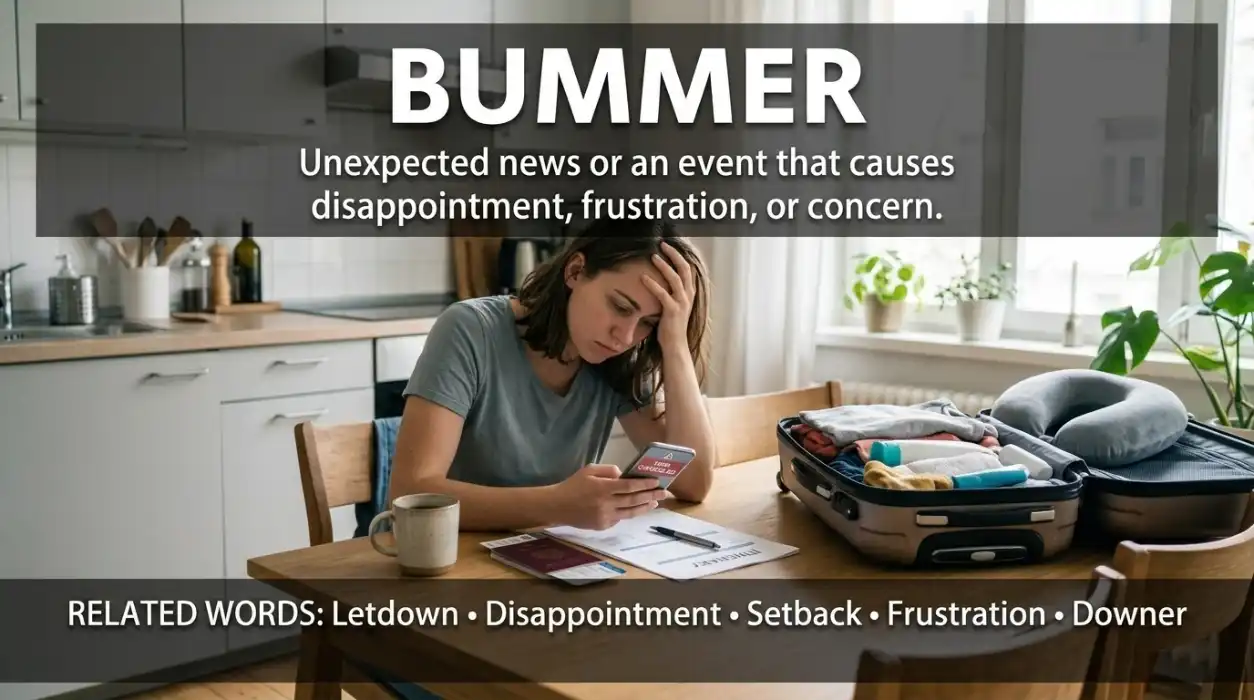
Meaning: Unexpected news or an event that causes disappointment or concern.
Tone/Register: Neutral.
Examples:
The extra charge was an unpleasant surprise.
Opening the fridge to find everything spoiled was an unpleasant surprise.
43. Rough Patch (Noun phrase) — US: /ˌrʌf ˈpætʃ/ | UK: /ˌrʌf ˈpætʃ/
Meaning: A period when life, work, or a relationship becomes difficult.
Tone/Register: Informal to neutral; often reassuring.
Examples:
Our team is going through a rough patch this season.
She had a rough patch after moving to a new city.
44. Bad Break (Noun phrase) — US: /ˌbæd ˈbreɪk/ | UK: /ˌbæd ˈbreɪk/
Meaning: An unlucky event that puts someone at a disadvantage.
Tone/Register: Informal.
Examples:
Breaking his glasses before the exam was a bad break.
It was a bad break to get injured just before the final.
45. Raw Deal (Noun phrase) — US: /ˌrɔː ˈdiːl/ | UK: /ˌrɔː ˈdiːl/
Meaning: An unfair or unfavorable treatment or outcome.
Tone/Register: Informal.
Examples:
The workers felt they had received a raw deal.
She got a raw deal when her contribution went unrecognized.
46. Bummer of a Day (Noun phrase) — US: /ˈbʌm.ɚ əv ə ˈdeɪ/ | UK: /ˈbʌm.ə əv ə ˈdeɪ/
Meaning: An informal description of a day filled with disappointments or frustrations.
Tone/Register: Very informal and conversational.
Examples:
I missed the bus and lost my keys. What a bummer of a day!
After the laptop crashed and the rain started, it became a bummer of a day.
47. Pain (Noun) — US: /peɪn/ | UK: /peɪn/
Meaning: Informally, a person or situation that causes repeated annoyance or difficulty.
Tone/Register: Informal; context-dependent.
Examples:
Resetting all my passwords was a pain.
That long detour was a real pain after work.
48. Hassle (Noun) — US: /ˈhæs.əl/ | UK: /ˈhæs.əl/
Meaning: An irritating situation that requires extra effort or creates unnecessary complications.
Tone/Register: Informal.
Examples:
Returning the damaged item was a hassle.
Finding a replacement at the last minute became a huge hassle.
49. Headache (Noun) — US: /ˈhed.eɪk/ | UK: /ˈhed.eɪk/
Meaning: Informally, a difficult or annoying problem that requires time and attention.
Tone/Register: Informal to professional.
Examples:
The outdated booking system has become a headache for staff.
Sorting out the paperwork was a headache nobody expected.
50. Bummer Situation (Noun phrase) — US: /ˈbʌm.ɚ ˌsɪtʃ.uˈeɪ.ʃən/ | UK: /ˈbʌm.ə ˌsɪtʃ.uˈeɪ.ʃən/
Meaning: An informal description of a circumstance that feels disappointing or unfortunate.
Tone/Register: Informal.
Examples:
Having the match canceled after traveling so far was a bummer situation.
It’s a bummer situation, but we can still make the most of the weekend.
Synonyms by Tone
The best synonym depends on how serious the situation is and how you want your listener to feel.
Positive or Reassuring
These words do not mean that the event is positive. They help acknowledge a problem without making it sound hopeless.
- Hiccup: A small problem that can usually be fixed.
- Setback: A difficulty that does not necessarily prevent future success.
- Rough patch: A difficult period that may pass.
- Snag: A temporary obstacle in a plan.
Example: “The launch had a small hiccup, but we’re back on schedule.”
Neutral
Use these words when you want to describe the situation clearly without sounding overly emotional.
- Disappointment
- Inconvenience
- Problem
- Difficulty
- Unfortunate event
- Regret
- Misfortune
Example: “The delay was an inconvenience, but the meeting continued.”
Negative
These words express stronger frustration, failure, sadness, or distress.
- Fiasco
- Disaster
- Catastrophe
- Frustration
- Heartbreak
- Grief
- Blunder
Example: “The entire event became a fiasco after several planning mistakes.”
Be careful with catastrophe and grief. They can imply serious harm or deep emotional suffering, so they are not suitable substitutes for every minor bummer.
Playful or Informal
These choices are common in everyday conversations and casual messages.
- Downer
- Drag
- Hassle
- Pain
- Bother
- Bad luck
- Letdown
Example: “Missing the last bus was such a drag.”
Why Tone Matters
Word choice shapes how people interpret your message. Calling a canceled lunch a catastrophe sounds exaggerated. Calling a major financial loss a hiccup may seem dismissive.
Match the word to the seriousness of the event, your relationship with the listener, and the setting. This makes your English sound more natural and considerate.
“Bummer” vs. Close Alternatives
| Word | Main meaning | Tone | Best use |
|---|---|---|---|
| Bummer | An unpleasant or disappointing experience | Casual | Everyday conversation |
| Disappointment | An unsatisfactory result or feeling | Neutral | General and professional writing |
| Letdown | Something that fails to meet expectations | Informal to neutral | Reviews and personal reactions |
| Setback | A problem that delays progress | Neutral to professional | Work, studies, and goals |
| Downer | Something that lowers the mood | Informal | Social conversations |
Bummer vs. disappointment: Bummer sounds more relaxed and conversational. Disappointment is more versatile in formal writing.
Bummer vs. letdown: A bummer can describe almost any unfortunate experience. A letdown often suggests that something failed to meet expectations.
Bummer vs. setback: A setback specifically affects progress. A canceled picnic may be a bummer, while a delayed research project is more naturally described as a setback.
How “Bummer” Changes by Context
Daily Conversation
In casual speech, bummer is a convenient way to show sympathy or acknowledge bad news.
“Your flight was canceled? That’s a bummer.”
It can sound warm and friendly when paired with a supportive comment. For a serious loss, however, a more thoughtful response may be better.
Writing and Blogging
Writers can use disappointment, letdown, frustration, or setback to create more precise descriptions.
For example, a travel blog might describe a rainy holiday as a disappointment. A product review might call an overhyped film a letdown.
Vary your vocabulary to keep the writing engaging. Do not replace bummer with a complicated word simply for variety if the original word is clearer.
Professional and Academic English
In workplace emails, reports, and essays, setback, inconvenience, difficulty, and unfortunate outcome are usually more appropriate.
Instead of writing, “The missed deadline was a bummer,” write, “The missed deadline created a setback for the project.”
The second sentence communicates the impact more clearly.
Creative and Informal Use
In dialogue, captions, personal blogs, and social posts, expressions such as what a drag, that’s a downer, and what a shame can sound natural.
A character who speaks casually may say, “Well, that’s a bummer.” A formal narrator might describe the same event as an unfortunate development.
Common Mistakes Learners Make
1. Using “Bummer” in Every Situation
Although bummer is widely understood in informal English, repeating it can make your speech or writing feel limited.
Better approach: Choose hassle for an annoying task, letdown for unmet expectations, and setback for delayed progress.
2. Confusing an Event With an Emotion
A disappointment can describe an experience or a feeling. Frustration primarily names an emotional response.
Compare:
- “The cancellation was a disappointment.”
- “The cancellation caused frustration.”
Both are natural, but they emphasize different things.
3. Overstating a Minor Problem
Words like catastrophe, disaster, and calamity suggest serious consequences.
Use them when the scale of the problem justifies the intensity. For a delayed coffee order, annoyance or inconvenience is usually more suitable.
4. Assuming Every Alternative Is Interchangeable
You can say “a technical glitch,” but “a technical grief” does not work. Similarly, faux pas refers to a social mistake rather than any unfortunate event.
Learn each synonym in a complete phrase, not as an isolated word.
5. Using Casual Slang in Formal Messages
“That’s a bummer” works well in a friendly text. In a formal email, “I’m sorry to hear about the delay” or “This creates an unexpected setback” may be more suitable.
Register Notes
Formal: setback, inconvenience, misfortune, adverse outcome.
Neutral: disappointment, problem, difficulty, unfortunate event.
Informal: bummer, downer, drag, hassle, bad break.
Spoken English: “What a shame!” and “That’s a bummer.”
Written English: “The delay was disappointing” or “The change created an unexpected setback.”
For more vocabulary practice, explore related topics such as alternatives to “disappointed” and expressions of sympathy.
Real-Life Examples
Workplace
A team discovers that a presentation file is missing minutes before a meeting. A colleague might call it a setback because it delays the work. In a casual conversation, they might say, “That’s a bummer.”
Social Situations
A friend cannot attend a birthday dinner because of a family commitment. “What a shame” expresses sympathy without blaming anyone. “That’s a downer” sounds more casual and focuses on the disappointing mood.
Media and Pop Culture
A highly anticipated movie receives poor reviews. Viewers might call it a letdown because it failed to meet expectations. A reviewer may use disappointment for a more measured assessment.
Writing and Storytelling
A character misses a once-in-a-lifetime opportunity. Calling the event a setback suggests the character may recover. Calling it heartbreak highlights the emotional impact instead.
Practice Quiz:
1. Your favorite concert is canceled at the last minute. What is the most natural casual response?
A. That’s a bummer.
B. That’s a prefix.
C. That’s a benefit.
D. That’s a triumph.
2. A software problem temporarily interrupts an online meeting. Which word fits best?
A. Grief
B. Glitch
C. Catastrophe
D. Sorrow
3. A research project loses two weeks because the equipment arrives late. Which word best describes the delay?
A. Setback
B. Faux pas
C. Joy
D. Relief
4. Your friend misses a train by a few seconds. Which phrase expresses sympathy casually?
A. Hard luck
B. Academic success
C. Great achievement
D. Perfect timing
5. A film receives lots of publicity but turns out to be disappointing. Which word fits best?
A. Letdown
B. Obstacle
C. Calamity
D. Anxiety
6. Someone accidentally asks an embarrassing personal question at a formal dinner. What is this social mistake called?
A. Hiccup
B. Faux pas
C. Setback
D. Inconvenience
7. You need to describe a small delay in a professional project update without sounding dramatic. Which word is best?
A. Catastrophe
B. Calamity
C. Setback
D. Heartbreak
8. A friend is upset because their plans were canceled. Which response sounds supportive?
A. “That’s a shame. I’m sorry.”
B. “That’s your fault.”
C. “What a triumph!”
D. “Excellent inconvenience!”
9. You spend an hour fixing a confusing online form. Which informal noun fits?
A. Hassle
B. Celebration
C. Victory
D. Reward
Reflection Task
Write two short sentences about a disappointing experience. Use bummer in one sentence and a suitable synonym in the other. Explain why you chose the alternative.
Answer key: 1-A, 2-B, 3-A, 4-A, 5-A, 6-B, 7-C, 8-A, 9-A, 10-B
Conclusion
Learning synonyms for bummer helps you express disappointment with greater accuracy. Words such as letdown, setback, and hassle each describe a different kind of unpleasant experience.
The right vocabulary also improves essays, blogs, workplace messages, and everyday conversations. It helps you sound natural while showing that you understand the situation and your listener’s feelings.
You do not need to memorize all words at once. Start with a few useful alternatives, notice how native speakers use them, and practice choosing words that fit different situations.
Try using three new synonyms in your next email, essay, or conversation. Small steps build stronger vocabulary and make your English clearer, more confident, and more expressive.
FAQs
1. What is the closest synonym for “bummer” in everyday American English?
The closest alternative depends on the sentence. Letdown works well when something fails to meet expectations. Downer describes something that lowers the mood, while disappointment is more general. In casual conversation, “What a shame!” can also express sympathy. For the most natural choice, consider whether you are describing an event, a feeling, or a reaction.
2. How can I say “bummer” politely without sounding too casual?
Use phrases such as “That’s unfortunate,” “I’m sorry to hear that,” or “What a shame.” These expressions are suitable when you want to acknowledge a problem without relying on slang. In a professional email, you might write, “I’m sorry the schedule has changed” or “The delay is unfortunate.” Choose a phrase that recognizes the other person’s situation.
3. Is “bummer” considered rude or offensive?
In most everyday American English conversations, bummer is not considered rude. It is an informal expression of disappointment. However, using it to respond to serious grief, illness, or trauma may sound dismissive because it can make a painful experience seem minor. In sensitive situations, express sympathy directly and choose words that reflect the seriousness of the news.
4. What is the difference between “bummer,” “bummer,” and “bummer situation”?
Bummer is the standard informal noun for an unpleasant experience. Bummer situation is an understandable phrase, but it is often less natural than simply saying “a bummer” or “an unfortunate situation.” For example, “Missing the train was a bummer” sounds more concise than “Missing the train was a bummer situation.” Native speakers generally prefer the simpler expression.
5. Which synonyms for “bummer” are best for formal writing?
For formal writing, consider disappointment, setback, inconvenience, unfortunate outcome, or adverse development. The best option depends on the meaning. Use setback when progress is delayed, inconvenience when plans are disrupted, and disappointment when expectations are not met. Avoid casual slang when writing academic papers, official reports, or formal business correspondence.

Hasnain Ali is an SEO Content Strategist and the founder of wordvora.com, a trusted vocabulary platform that helps writers, students, professionals, and English learners find accurate synonyms, antonyms, word meanings, and real-life usage examples. He specializes in keyword research, on-page SEO, topical authority, and creating search-first content that aligns with Google’s latest Search Quality and E-E-A-T guidelines. His work focuses on producing clear, well-structured, and reader-friendly resources that satisfy search intent while maintaining high editorial standards.
Through extensive hands-on experience with SEO tools such as Google Search Console, Google Analytics, SEMrush, and Ahrefs, Hasnain researches user search behavior and develops content that is both informative and easy to understand. Every article published on wordvora.com is carefully reviewed for accuracy, readability, and contextual relevance before publication. His mission is to build one of the web’s most reliable English vocabulary resources by providing practical language guidance, trustworthy explanations, and content that helps readers improve their writing, communication, and vocabulary with confidence.