

Synonyms for checked out depend on the context. You can say borrowed, examined, investigated, left, departed, lost interest, or mentally disengaged. The right alternative depends on whether someone borrowed an item, inspected something, left a place, or stopped paying attention.
Imagine a friend asking whether you have checked out the new library book. You might mean that you borrowed it. But if your teacher says you checked out during class, they probably mean you stopped paying attention.
The phrase “checked out” is common in everyday English because it has several meanings. Understanding the context helps you choose a more precise word and avoid confusion.
Learning synonyms for checked out can help students improve their vocabulary, bloggers write more naturally, and content writers avoid repetition. It also helps everyday English users understand conversations, books, movies, and workplace messages.
For example, “I checked out the new café” may mean you visited or investigated it. Saying “I explored the new café” makes your intention clearer when you want to describe discovering a place.
What Does “Checked Out” Really Mean?
“Checked out” is the past tense and past participle of the phrasal verb check out. Its meaning changes according to the situation.
It can mean borrowing an item, examining something, leaving a hotel, investigating a person or place, or mentally disengaging from an activity. In some informal contexts, it can also refer to dying.
Here are five common uses:
- Borrowing: “I checked out two books from the library.”
- Examining: “She checked out the new phone before buying it.”
- Leaving: “We checked out of the hotel at noon.”
- Investigating: “I’ll check out that restaurant.”
- Losing attention: “He checked out halfway through the lecture.”
These meanings are related to the general idea of checking, reviewing, or completing a process. However, they are not interchangeable.
Part of Speech
Checked out is a verb phrase formed from the verb check and the particle out.
It can function as the simple past tense, as in “She checked out the book,” or as a past participle, as in “The books have been checked out.”
The grammatical role remains verbal, but the phrasal verb can express different actions depending on its object and context.
How Native Speakers Understand It
Native speakers usually identify the intended meaning from the surrounding words.
“Check out a book” commonly means borrowing it from a library. “Check out a hotel” can mean completing the departure process.
When someone says, “I completely checked out during that meeting,” they usually mean they stopped concentrating or became mentally disengaged.
Connotative Meaning
(Connotation is the emotional or social association a word or phrase carries beyond its basic meaning.)
The phrase “checked out” has different emotional tones depending on how a speaker uses it.
Positive tone: “I checked out a fascinating exhibition.” This suggests curiosity and interest.
Negative tone: “He checked out during our conversation.” This suggests boredom or a lack of attention.
Neutral tone: “She checked out three books from the library.” This simply describes a routine action.
The phrase itself is not inherently positive or negative. The intended meaning and surrounding words determine its tone.
Etymology and History
The phrasal verb check out combines check with the particle out. Its meanings developed through English usage, particularly in commercial, administrative, and everyday situations.
Old English (450–1100)
The modern phrasal verb check out did not exist in its current form during the Old English period. English speakers used native verbs for looking, observing, and examining.
The word check itself entered English much later through French influence, so it would be inaccurate to attribute the modern expression directly to Old English.
Middle English (1100–1500)
The word check developed through Anglo-French and Old French forms connected to chess and the idea of stopping or restraining. It also became associated with verification and control.
During this broader period, English vocabulary continued to absorb words from French and other languages.
Modern English (1500–Present)
The verb check acquired a wider range of meanings, including examining, verifying, and monitoring. The particle out helped form the phrasal verb check out, which later developed several practical meanings.
In modern English, the phrase is widely used in libraries, hotels, shops, websites, and informal conversation. Its flexibility explains why context is essential when selecting a synonym.

Pronunciation, Syllables, and Affixation
The pronunciation of checked out is generally the same in American and British English, although accents can affect the exact sound.
- US IPA: /tʃekt aʊt/
- UK IPA: /tʃekt aʊt/
- Syllables: checked-out
Root: Check is the main verb. Out is a particle that contributes to the phrasal verb’s meaning.
Prefix: None.
Suffix: The past-tense ending -ed appears in checked. In this form, it is pronounced /t/ because the verb ends in the voiceless sound /k/.
Affixation pattern: Check + -ed + out.
The expression is a phrasal verb, not a single word formed by attaching a prefix and suffix to one root.
Synonyms List
The following list groups alternatives by meaning. Some are close synonyms, while others are suitable replacements only in specific contexts. Use the meaning and example to choose the right expression.
1. Borrowed (Verb) — US / UK: /ˈbɑːroʊd/ / /ˈbɒrəʊd/
Meaning: Took something temporarily with the intention of returning it.
Tone/Register: Neutral; everyday and educational.
Examples:
I borrowed two novels from the library yesterday.
She borrowed her brother’s headphones for the trip.
2. Loaned (Verb) — US / UK: /loʊnd/ / /ləʊnd/
Meaning: Gave something to someone temporarily, usually with the expectation of its return.
Tone/Register: Neutral to formal.
Examples:
The library loaned me a tablet for the workshop.
My neighbor loaned us a ladder for the weekend.
Usage note: Loaned describes the person or organization providing the item, not the borrower.
3. Rented (Verb) — US / UK: /ˈrentɪd/ / /ˈrentɪd/
Meaning: Paid to use something temporarily.
Tone/Register: Neutral; commercial and everyday.
Examples:
We rented a car for our holiday.
He rented a film to watch at home.
4. Hired (Verb) — US / UK: /ˈhaɪərd/ / /ˈhaɪəd/
Meaning: Arranged to use something temporarily in exchange for payment, especially in British English.
Tone/Register: Neutral; common in British English.
Examples:
We hired bicycles near the station.
She hired a formal dress for the ceremony.
5. Borrowed From the Library (Verb Phrase) — US / UK: /ˈbɑːroʊd frəm ðə ˈlaɪbreri/ / /ˈbɒrəʊd frəm ðə ˈlaɪbrəri/
Meaning: Took books or other library materials for temporary use under library rules.
Tone/Register: Neutral; educational.
Examples:
I borrowed the history book from the library.
He borrowed an audiobook for his commute.
6. Examined (Verb) — US / UK: /ɪɡˈzæmɪnd/ / /ɪɡˈzæmɪnd/
Meaning: Looked at something carefully to understand its condition or details.
Tone/Register: Neutral to formal.
Examples:
The mechanic examined the engine before giving an estimate.
She examined the document for errors.
7. Inspected (Verb) — US / UK: /ɪnˈspektɪd/ / /ɪnˈspektɪd/
Meaning: Checked something systematically for quality, safety, or problems.
Tone/Register: Professional and formal.
Examples:
The engineer inspected the building this morning.
We inspected the package before signing for it.
8. Investigated (Verb) — US / UK: /ɪnˈvestɪɡeɪtɪd/ / /ɪnˈvestɪɡeɪtɪd/
Meaning: Looked into a subject, event, or problem to discover more information.
Tone/Register: Formal; professional and academic.
Examples:
The journalist investigated the allegations.
I investigated several options before choosing a course.
9. Explored (Verb) — US / UK: /ɪkˈsplɔːrd/ / /ɪkˈsplɔːd/
Meaning: Looked into something to discover its features or possibilities.
Tone/Register: Neutral; curious and positive.
Examples:
We explored a new neighborhood during our visit.
She explored several ideas for her research project.
10. Looked At (Verb Phrase) — US / UK: /lʊkt æt/ / /lʊkt æt/
Meaning: Viewed or considered something.
Tone/Register: Informal to neutral.
Examples:
I looked at the apartment before making a decision.
He looked at the report during lunch.
11. Reviewed (Verb) — US / UK: /rɪˈvjuːd/ / /rɪˈvjuːd/
Meaning: Examined something again to evaluate its quality, content, or accuracy.
Tone/Register: Professional and academic.
Examples:
The editor reviewed my article before publication.
We reviewed the contract together.
12. Evaluated (Verb) — US / UK: /ɪˈvæljueɪtɪd/ / /ɪˈvæljueɪtɪd/
Meaning: Judged the quality, usefulness, or value of something.
Tone/Register: Formal; analytical.
Examples:
The team evaluated three possible designs.
She evaluated the course before recommending it.
13. Assessed (Verb) — US / UK: /əˈsest/ / /əˈsest/
Meaning: Considered a situation or item to determine its quality, importance, or condition.
Tone/Register: Professional and academic.
Examples:
The doctor assessed the injury.
We assessed the risks before starting the project.
14. Verified (Verb) — US / UK: /ˈverɪfaɪd/ / /ˈverɪfaɪd/
Meaning: Confirmed that information or details were accurate or genuine.
Tone/Register: Formal; professional.
Examples:
I verified the address before sending the invitation.
The researcher verified the figures against the original records.
15. Checked (Verb) — US / UK: /tʃekt/ / /tʃekt/
Meaning: Looked at something to confirm its condition or accuracy.
Tone/Register: Neutral; highly versatile.
Examples:
I checked the timetable before leaving home.
She checked the figures one more time.
16. Looked Into (Verb Phrase) — US / UK: /lʊkt ˈɪntuː/ / /lʊkt ˈɪntuː/
Meaning: Investigated a question, issue, or possibility.
Tone/Register: Neutral; common in conversation and business.
Examples:
I’ll look into the delivery delay this afternoon.
They looked into several schools before moving.
17. Researched (Verb) — US / UK: /ˈriːsɜːrtʃt/ / /rɪˈsɜːtʃt/
Meaning: Studied a subject carefully to gather reliable information.
Tone/Register: Academic and professional.
Examples:
She researched the topic before writing her essay.
We researched local traditions for the documentary.
18. Visited (Verb) — US / UK: /ˈvɪzɪtɪd/ / /ˈvɪzɪtɪd/
Meaning: Went to a place to see it or spend time there.
Tone/Register: Neutral; everyday.
Examples:
We visited the new museum on Saturday.
He visited the campus before applying.
19. Tried Out (Verb Phrase) — US / UK: /traɪd aʊt/ / /traɪd aʊt/
Meaning: Tested something to see whether it works or suits your needs.
Tone/Register: Informal to neutral.
Examples:
I tried out the new keyboard at the store.
She tried out a different study routine.
20. Tested (Verb) — US / UK: /ˈtestɪd/ / /ˈtestɪd/
Meaning: Used a method or procedure to determine performance, quality, or reliability.
Tone/Register: Neutral to technical.
Examples:
The team tested the app before its release.
I tested the microphone before the presentation.

21. Sampled (Verb) — US / UK: /ˈsæmpəld/ / /ˈsæmpəld/
Meaning: Tried a small amount or selection to judge its quality.
Tone/Register: Neutral; food, retail, and creative contexts.
Examples:
We sampled three flavors at the market.
The designer sampled several fabrics before choosing one.
22. Browsed (Verb) — US / UK: /braʊzd/ / /braʊzd/
Meaning: Looked through items or information without necessarily making a decision.
Tone/Register: Neutral; casual and digital.
Examples:
I browsed the bookstore for half an hour.
She browsed the website while waiting for her train.
23. Scanned (Verb) — US / UK: /skænd/ / /skænd/
Meaning: Looked over something quickly to find key details.
Tone/Register: Neutral; practical and professional.
Examples:
He scanned the email for the meeting time.
I scanned the menu for vegetarian options.
24. Surveyed (Verb) — US / UK: /sərˈveɪd/ / /səˈveɪd/
Meaning: Looked over an area or situation to gain a broad understanding.
Tone/Register: Formal; descriptive or technical.
Examples:
She surveyed the room before choosing a seat.
The team surveyed the site before construction began.
25. Checked Up On (Verb Phrase) — US / UK: /tʃekt ʌp ɑːn/ / /tʃekt ʌp ɒn/
Meaning: Sought information about someone or something to confirm that everything was all right.
Tone/Register: Conversational; caring or supervisory.
Examples:
I checked up on my grandfather after the storm.
The manager checked up on the team’s progress.
26. Followed Up On (Verb Phrase) — US / UK: /ˈfɑːloʊd ʌp ɑːn/ / /ˈfɒləʊd ʌp ɒn/
Meaning: Took additional action to learn more about an issue or confirm its progress.
Tone/Register: Professional and conversational.
Examples:
I followed up on the complaint yesterday.
She followed up on the application by email.
27. Looked Over (Verb Phrase) — US / UK: /lʊkt ˈoʊvər/ / /lʊkt ˈəʊvə/
Meaning: Examined something briefly to understand its general condition or content.
Tone/Register: Informal to neutral.
Examples:
Could you look over my presentation before the meeting?
He looked over the menu and chose a salad.
28. Went Through (Verb Phrase) — US / UK: /went θruː/ / /went θruː/
Meaning: Examined a collection of items or information, often one part at a time.
Tone/Register: Neutral; common in daily and professional English.
Examples:
We went through the files before the audit.
I went through my notes before the exam.
29. Checked Over (Verb Phrase) — US / UK: /tʃekt ˈoʊvər/ / /tʃekt ˈəʊvə/
Meaning: Examined something to find mistakes or confirm that it was in good condition.
Tone/Register: Neutral; practical.
Examples:
The technician checked over the machine before switching it on.
I checked over my answers before submitting the test.
30. Scrutinized (Verb) — US / UK: /ˈskruːtənaɪzd/ / /ˈskruːtɪnaɪzd/
Meaning: Examined something very carefully, often to identify flaws or inconsistencies.
Tone/Register: Formal; analytical.
Examples:
The committee scrutinized every part of the proposal.
Reporters scrutinized the official statement.
31. Audited (Verb) — US / UK: /ˈɔːdɪtɪd/ / /ˈɔːdɪtɪd/
Meaning: Examined financial records, processes, or systems systematically for accuracy and compliance.
Tone/Register: Professional and technical.
Examples:
The firm audited its accounts at the end of the year.
The department audited its procedures for safety issues.
32. Vetted (Verb) — US / UK: /ˈvetɪd/ / /ˈvetɪd/
Meaning: Checked a person, source, or proposal for suitability, reliability, or potential problems.
Tone/Register: Professional; journalism, hiring, and administration.
Examples:
The editor vetted the sources before publishing the story.
We vetted the candidates before inviting them to interview.
33. Cleared (Verb) — US / UK: /klɪrd/ / /klɪəd/
Meaning: Received approval or completed a required check so that someone or something could proceed.
Tone/Register: Neutral to formal.
Examples:
The shipment cleared customs this morning.
She cleared the background check before starting work.
34. Registered (Verb) — US / UK: /ˈredʒɪstərd/ / /ˈredʒɪstəd/
Meaning: Officially recorded someone or something in a system.
Tone/Register: Neutral; administrative.
Examples:
I registered for the course online.
The receptionist registered each guest upon arrival.
35. Signed Out (Verb Phrase) — US / UK: /saɪnd aʊt/ / /saɪnd aʊt/
Meaning: Recorded a departure or formally ended a session, often in a workplace, school, or digital system.
Tone/Register: Neutral; administrative and technical.
Examples:
Please sign out before leaving the laboratory.
She signed out of the computer at the end of her shift.
36. Departed (Verb) — US / UK: /dɪˈpɑːrtɪd/ / /dɪˈpɑːtɪd/
Meaning: Left a place, especially when describing a journey or scheduled movement.
Tone/Register: Formal to neutral.
Examples:
Our train departed at seven in the morning.
The guests departed shortly after dinner.
37. Left (Verb) — US / UK: /left/ / /left/
Meaning: Went away from a place or person.
Tone/Register: Neutral; everyday English.
Examples:
We left the hotel before sunrise.
He left the meeting when his phone rang.
38. Checked Out of (Verb Phrase) — US / UK: /tʃekt aʊt əv/ / /tʃekt aʊt əv/
Meaning: Completed the departure procedure at a hotel or similar accommodation.
Tone/Register: Neutral; travel and hospitality.
Examples:
We checked out of the hotel before breakfast.
She checked out of the guesthouse and called a taxi.
39. Moved Out (Verb Phrase) — US / UK: /muːvd aʊt/ / /muːvd aʊt/
Meaning: Left a home or other living space, usually to live somewhere else.
Tone/Register: Neutral; everyday.
Examples:
My cousin moved out last month.
They moved out of the apartment after finding a quieter place.
40. Withdrew (Verb) — US / UK: /wɪðˈdruː/ / /wɪðˈdruː/
Meaning: Removed oneself from an activity, situation, or commitment.
Tone/Register: Formal to neutral.
Examples:
She withdrew from the competition before the final round.
The company withdrew its proposal after further discussion.
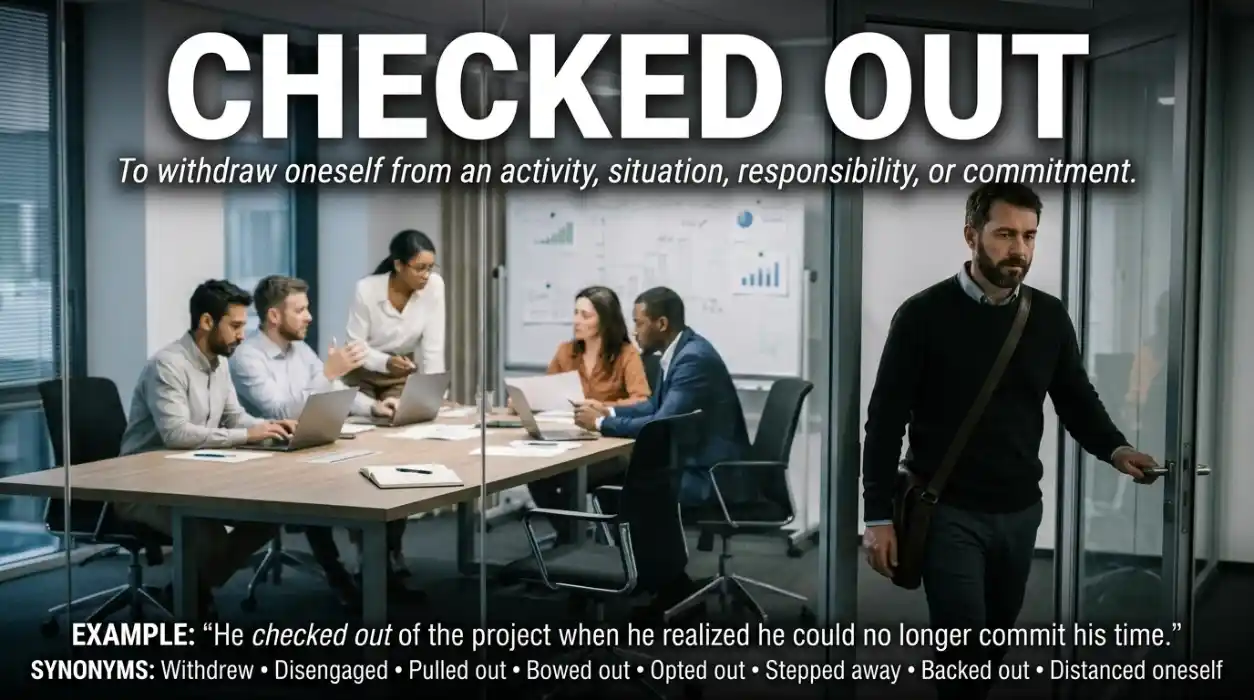
41. Disengaged (Verb) — US / UK: /ˌdɪsɪnˈɡeɪdʒd/ / /ˌdɪsɪnˈɡeɪdʒd/
Meaning: Stopped participating mentally or emotionally in an activity.
Tone/Register: Professional; psychological and educational.
Examples:
Several students disengaged during the long lecture.
He disengaged from the debate when it became personal.
42. Zoned Out (Verb Phrase) — US / UK: /zoʊnd aʊt/ / /zəʊnd aʊt/
Meaning: Stopped paying attention temporarily, often without realizing it.
Tone/Register: Informal; everyday speech.
Examples:
I zoned out during the lengthy announcement.
She zoned out while thinking about tomorrow’s interview.
43. Tuned Out (Verb Phrase) — US / UK: /tuːnd aʊt/ / /tjuːnd aʊt/
Meaning: Stopped listening or paying attention, either deliberately or because of boredom.
Tone/Register: Informal to neutral.
Examples:
He tuned out when the conversation turned to office gossip.
I tuned out the background noise and finished my work.
44. Lost Interest (Verb Phrase) — US / UK: /lɔːst ˈɪntrəst/ / /lɒst ˈɪntrəst/
Meaning: No longer felt interested or motivated to continue paying attention.
Tone/Register: Neutral; can sound mildly negative.
Examples:
I lost interest in the show after the second season.
She lost interest in the discussion when it became repetitive.
45. Switched Off (Verb Phrase) — US / UK: /swɪtʃt ɔːf/ / /swɪtʃt ɒf/
Meaning: Stopped concentrating or responding mentally, often because something was dull or overwhelming.
Tone/Register: Informal; especially common in British English.
Examples:
I switched off halfway through the speech.
He switches off whenever the conversation becomes too technical.
46. Became Distracted (Verb Phrase) — US / UK: /bɪˈkeɪm dɪˈstræktɪd/ / /bɪˈkeɪm dɪˈstræktɪd/
Meaning: Started paying attention to something other than the task or conversation at hand.
Tone/Register: Neutral.
Examples:
I became distracted by the noise outside.
She became distracted when several messages arrived at once.
47. Lost Focus (Verb Phrase) — US / UK: /lɔːst ˈfoʊkəs/ / /lɒst ˈfəʊkəs/
Meaning: Stopped concentrating on the main task or goal.
Tone/Register: Neutral; educational and professional.
Examples:
I lost focus while preparing for the exam.
The team lost focus after the unexpected delay.
48. Became Unresponsive (Verb Phrase) — US / UK: /bɪˈkeɪm ˌʌnrɪˈspɑːnsɪv/ / /bɪˈkeɪm ˌʌnrɪˈspɒnsɪv/
Meaning: Stopped responding to communication, prompts, or other attempts to engage.
Tone/Register: Formal; technical or medical contexts.
Examples:
The application became unresponsive after the update.
During the call, he became unresponsive to repeated questions.
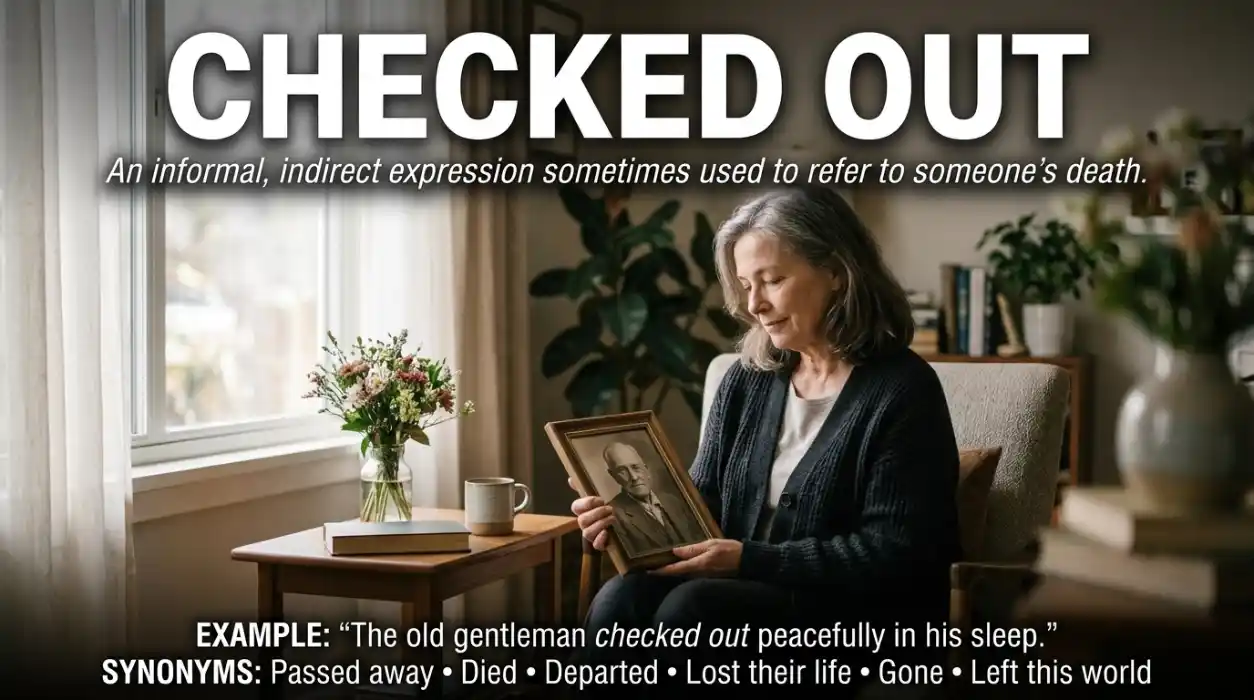
49. Died (Verb) — US / UK: /daɪd/ / /daɪd/
Meaning: Ceased to live; this can be a euphemistic interpretation of checked out in certain informal expressions.
Tone/Register: Direct and neutral, although the subject is sensitive.
Examples:
The character died at the end of the film.
In the story, the old king died peacefully in his sleep.
Usage note: “Checked out” can be slang for dying, as in “He checked out years ago.” Use died when clarity matters. Avoid slang when speaking sensitively about a real person’s death.
50. Passed Away (Verb Phrase) — US / UK: /pæst əˈweɪ/ / /pɑːst əˈweɪ/
Meaning: Refers gently and respectfully to someone’s death.
Tone/Register: Polite; sensitive and widely understood.
Examples:
Her grandfather passed away peacefully last winter.
We sent the family a card after their neighbor passed away.
Usage note: This is a euphemism, not a general synonym for checked out. It only fits when the original phrase refers to death.
Synonyms by Tone
The most suitable alternative depends on what happened and how you want to describe it. A word that sounds natural in casual conversation may be too informal for a professional report.
Positive
These alternatives can suggest curiosity, careful work, or a useful discovery:
- Explored — suggests curiosity and discovery.
- Reviewed — suggests careful consideration.
- Evaluated — emphasizes thoughtful judgment.
- Tried out — suggests willingness to experiment.
- Visited — describes going somewhere to experience it.
Example: “I explored the new study app and found several useful features.”
Neutral
These expressions describe an action without a strong emotional judgment:
- Borrowed
- Examined
- Checked
- Inspected
- Looked over
- Registered
- Departed
- Left
- Checked out of
Example: “We checked out of the hotel at eleven.”
Negative or Critical
These alternatives may suggest inattention, reluctance, or a problem:
- Disengaged
- Zoned out
- Tuned out
- Lost interest
- Switched off
- Lost focus
- Became unresponsive
Example: “He tuned out during the explanation and missed the instructions.”
These phrases are not automatically negative. Someone may zone out because they are tired rather than rude.
Playful or Informal
These expressions are common in casual conversations:
- Zoned out
- Switched off
- Tuned out
- Checked out itself, when used to mean losing interest
Example: “I totally zoned out during that three-hour meeting.”
Choose the tone carefully. A casual phrase can sound friendly among friends but unprofessional in a formal report.
“Checked Out” vs. Close Alternatives
| Expression | Main meaning | Best context |
|---|---|---|
| Checked out | Borrowed, inspected, departed, or disengaged, depending on context | Everyday English |
| Looked into | Investigated a question or issue | Problems and research |
| Borrowed | Took something temporarily with the intention of returning it | Libraries and personal items |
| Zoned out | Temporarily stopped paying attention | Casual conversation |
| Checked out of | Completed a hotel departure process | Travel and accommodation |
Consider these examples:
- “I checked out the website.” This usually means you visited or explored it.
- “I looked into the website.” This suggests investigating it more carefully, perhaps to verify its reliability.
- “I zoned out during the presentation.” This means your attention drifted away.
- “I checked out of the hotel.” This means you completed the departure process.
The grammar matters as much as the meaning. You can say “I checked out the hotel” when you mean you inspected or considered it, but “I checked out of the hotel” describes leaving after a stay.
How “Checked Out” Changes by Context
Daily Conversation
In casual English, checked out is convenient because the context usually explains what happened. If someone says, “I checked out that new café,” they probably visited it or looked into it.
When clarity matters, choose a more specific alternative. Say visited if you went there, tried if you experienced something, or investigated if you researched it.
Writing and Blogging
Bloggers often use explored, reviewed, examined, and investigated to make descriptions more precise. The best verb depends on what the writer actually did.
For example, “I checked out five writing apps” is casual. “I tested five writing apps” tells readers that you tried them rather than merely viewed their websites.
Professional or Academic Writing
In reports, emails, and academic work, evaluated, assessed, verified, and reviewed often communicate the intended action more clearly.
Instead of writing, “We checked out the figures,” you might write, “We verified the figures against the original records.” The second version tells the reader exactly what the team did.
Creative or Informal Use
In dialogue, zoned out, tuned out, and switched off can sound natural when describing a character who stops paying attention.
For example, “Mia zoned out while her brother explained the game” gives the scene a casual, relatable tone. “Mia disengaged from the conversation” sounds more analytical.
Common Mistakes Learners Make
1. Forgetting That Context Changes the Meaning
“Checked out” does not have one universal synonym. Borrowed works for library materials, while departed works for leaving a place. Neither is an appropriate replacement in every context.
Tip: Identify the action first. Ask yourself whether the person borrowed something, inspected it, left, or stopped paying attention.
2. Confusing “Checked Out” With “Checked Out of”
The particle out can form part of the phrasal verb, but adding of changes the construction when describing a hotel departure.
- “I checked out the hotel.” — I inspected or considered the hotel.
- “I checked out of the hotel.” — I completed my departure.
The object and preposition help identify the intended meaning.
3. Using Informal Slang in Formal Writing
“Zoned out” and “switched off” are natural in conversation. In a formal report, lost focus or disengaged may be more suitable.
Choose vocabulary that matches the audience. Formal language should remain clear and readable.
4. Treating “Borrowed” and “Loaned” as Interchangeable
The borrower takes an item temporarily. The lender provides it temporarily.
Correct: “I borrowed a book from the library.”
Correct: “The library loaned me a book.”
Remember who gives the item and who receives it.
5. Using “Checked Out” When a More Specific Verb Is Better
Writers sometimes choose a broad phrasal verb even when a precise word is available. “I checked out the data” leaves the reader wondering what you did.
Use reviewed if you read it, verified if you confirmed its accuracy, or analyzed if you studied it in detail.
Register Notes: Formal vs. Informal
Formal: Investigated, evaluated, assessed, scrutinized, audited, verified.
Neutral: Checked, examined, reviewed, borrowed, visited, left.
Informal: Zoned out, tuned out, switched off, tried out.
Spoken English: Phrasal verbs such as checked out and looked into are common because they are flexible and conversational.
Written English: More specific verbs can improve precision. However, a simple phrasal verb is perfectly appropriate when it clearly expresses the meaning.
For additional vocabulary practice, explore related English phrasal verbs and their meanings in different contexts.
Real-Life Mini Scenarios
Workplace:
Your supervisor asks whether you checked out the latest figures. If you confirmed their accuracy, say, “I verified the figures.” If you read them, “I reviewed the figures” is more precise.
Social situation:
Your friend asks about a new restaurant. If you went there for dinner, say, “I visited the restaurant” or “I tried it.” If you only researched its reviews, say, “I looked into it.”
Media and pop culture:
A viewer might say, “I checked out the new series last night.” This means they watched it or gave it a try. “I sampled the first episode” emphasizes trying just a small part.
Writing and storytelling:
A teacher notices that a student has stopped paying attention. “He zoned out during the lesson” sounds casual. “He became disengaged during the lesson” sounds more formal and observational.
Practice Exercise
1. You took a library book home temporarily. What did you do?
Borrowed it
Inspected it
Departed it
2. You carefully checked a contract for mistakes. Which verb fits best?
Zoned out
Reviewed
Moved out
3. You stopped paying attention during a boring lecture. What happened?
Registered
Audited
Zoned out
4. You completed the departure process at a hotel. Which phrase is correct?
Checked out of the hotel
Checked over the hotel
Up on the hotel
5. You researched whether a company was trustworthy. What did you do?
Looked into the company
Borrowed the company
Departed the company
6. You tested a new keyboard to see whether you liked it. Which phrase fits?
Withdrew
Tried out
Passed away
7. You confirmed that the figures were accurate. Which verb is most precise?
Verified
Visited
Zoned out
8. You left your apartment to live somewhere else. What happened?
Moved out
Looked over
Sampled
9. You examined a machine carefully for safety problems. Which verb fits best?
Inspected
Lost interest
Loaned
10. You want to describe someone’s death respectfully. Which phrase is appropriate?
Tuned out
Passed away
Checked over
Answer key:
1. Borrowed it · 2. Reviewed · 3. Zoned out · 4. Checked out of the hotel · 5. Looked into the company · 6. Tried out · 7. Verified · 8. Moved out · 9. Inspected · 10. Passed away
Reflection task:
Write two sentences using checked out. In the first, describe examining or trying something. In the second, describe losing attention. Then replace the phrase in each sentence with a more precise alternative.
External Learning Sources
For authoritative definitions, pronunciation, and examples, consult these dictionaries:
Cambridge Dictionary — learner-friendly definitions and UK and US pronunciation.
Oxford Learner’s Dictionaries — usage examples, grammar patterns, and pronunciation guidance.
Merriam-Webster — definitions, word history, and American English usage.
Conclusion
Learning synonyms for checked out helps you express exactly what happened. Whether you borrowed a book, examined a product, or lost focus, a precise verb makes your message clearer.
A wider vocabulary improves essays, blogs, workplace emails, and everyday conversations. You can sound more natural by choosing words that match your meaning instead of repeating the same phrase.
You do not need to memorize all alternatives today. Start with practical words such as borrowed, examined, reviewed, explored, and zoned out.
Practice these expressions in your own sentences, messages, and conversations. Notice how context changes their meaning, and keep building your vocabulary one useful phrase at a time.
FAQs
1. What does “checked out” mean in slang?
In slang, “checked out” often means someone has stopped paying attention or participating mentally. For example, “He checked out during the meeting” suggests that he was no longer concentrating. In some informal expressions, it can also refer to dying. Because the phrase has several meanings, use the surrounding conversation to understand the intended sense.
2. What is the difference between “checked out” and “looked into”?
“Checked out” can mean examined, visited, borrowed, or left, depending on context. “Looked into” specifically means investigated a question, issue, or possibility. For example, “I checked out the website” may mean you visited it, while “I looked into the website” suggests you researched it to learn more or verify its reliability.
3. What is a professional alternative to “checked out”?
The best professional alternative depends on the action. Use reviewed for reading material, verified for confirming accuracy, evaluated for judging quality, and investigated for researching a problem. These words provide more information than the general phrase “checked out.” Choose the one that accurately describes what you did.
4. Is “checked out” one word or two words?
“Checked out” is written as two words when used as a verb phrase. For example, “She checked out a book.” The noun checkout is usually written as one word, as in “The checkout line was long.” The correct form depends on the grammatical function, so distinguish the verb phrase from the noun.
5. What does “checked out” mean in a hotel?
In a hotel, “checked out” usually means a guest completed the departure process, returned any required keys, and settled the account according to the hotel’s procedures. For example, “We checked out at 11 a.m.” describes leaving after a stay. The phrase “checked out of the hotel” makes this departure meaning especially clear.

Hasnain Ali is an SEO Content Strategist and the founder of wordvora.com, a trusted vocabulary platform that helps writers, students, professionals, and English learners find accurate synonyms, antonyms, word meanings, and real-life usage examples. He specializes in keyword research, on-page SEO, topical authority, and creating search-first content that aligns with Google’s latest Search Quality and E-E-A-T guidelines. His work focuses on producing clear, well-structured, and reader-friendly resources that satisfy search intent while maintaining high editorial standards.
Through extensive hands-on experience with SEO tools such as Google Search Console, Google Analytics, SEMrush, and Ahrefs, Hasnain researches user search behavior and develops content that is both informative and easy to understand. Every article published on wordvora.com is carefully reviewed for accuracy, readability, and contextual relevance before publication. His mission is to build one of the web’s most reliable English vocabulary resources by providing practical language guidance, trustworthy explanations, and content that helps readers improve their writing, communication, and vocabulary with confidence.