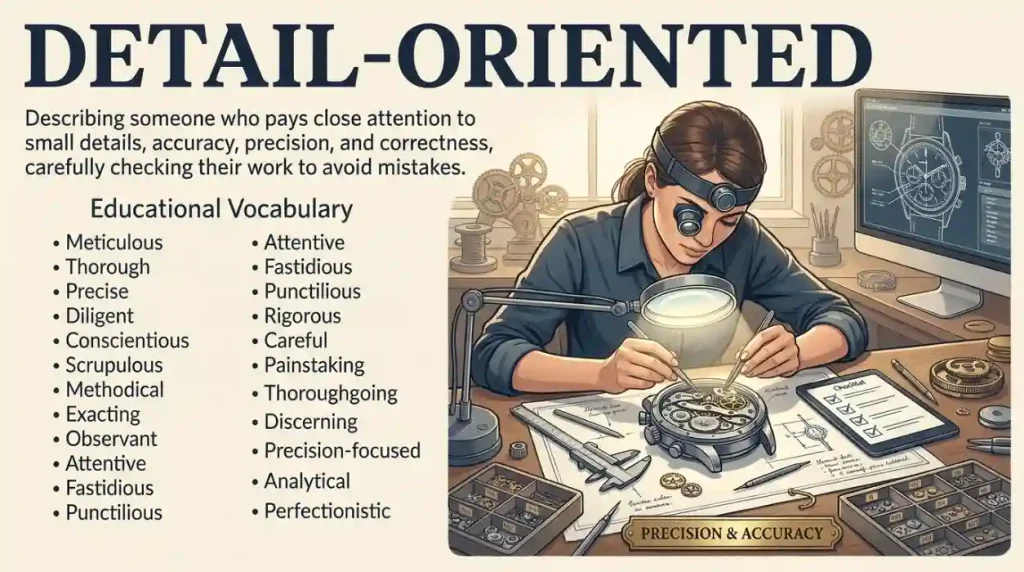
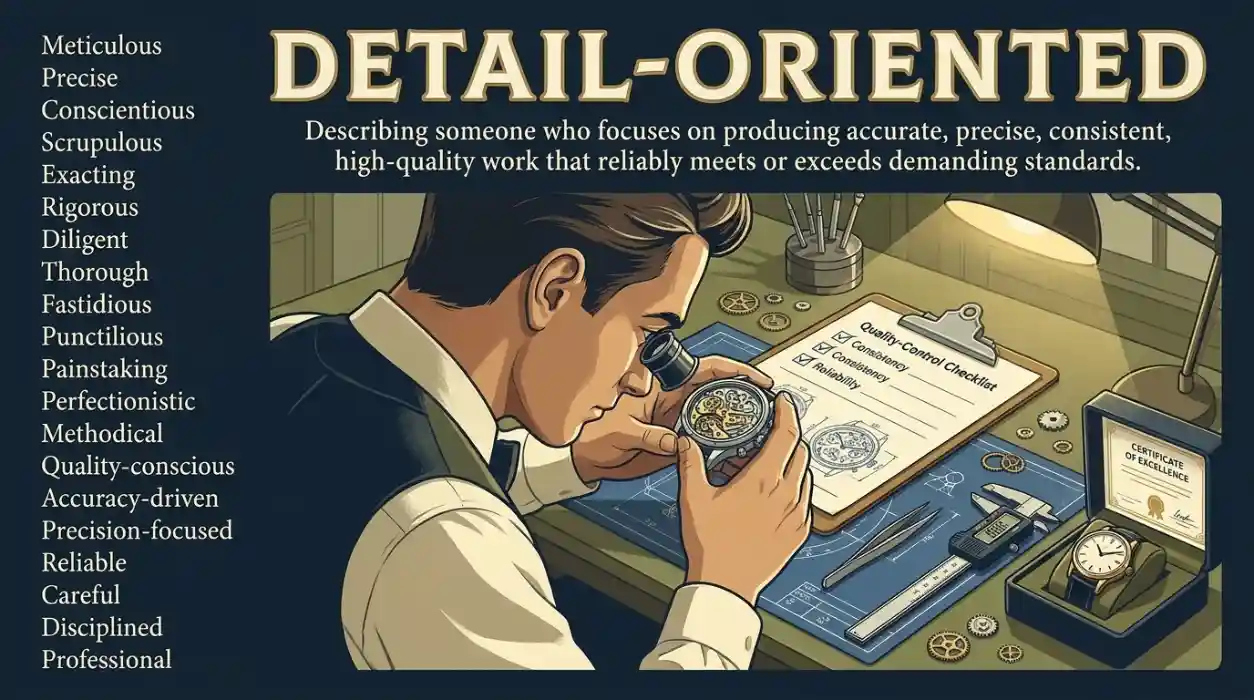
Synonyms for detail-oriented include meticulous, thorough, precise, careful, attentive, observant, and methodical. These words describe someone who notices small details, works accurately, and checks their work carefully. The best choice depends on the person’s habits and the situation.
Imagine a colleague reviewing a report before a meeting. They notice a missing figure, correct a spelling error, and check every calculation. You might describe this person as meticulous or thorough.
The phrase detail-oriented is common in job descriptions, performance reviews, academic writing, and everyday conversations. It highlights accuracy and careful work.
Learning synonyms for detail-oriented helps you describe skills more precisely. Students can improve assignments, while bloggers and content writers can avoid repetitive language.
These alternatives also help everyday English users communicate strengths clearly. Whether you are writing a résumé or praising a colleague, the right word makes your message stronger.
What Does “Detail Oriented” Really Mean?
Detail-oriented describes a person who pays close attention to small parts of a task. Such a person notices errors, checks information, follows instructions carefully, and aims to produce accurate work.
It is an adjective phrase. It usually appears before a noun or after a linking verb.
Examples:
- She is a detail-oriented editor.
- He is detail-oriented when preparing financial reports.
- We need a detail-oriented approach to this project.
Native English speakers generally associate the phrase with accuracy, organization, careful observation, and reliability. It often appears in professional settings, but people also use it to describe students, artists, researchers, and anyone who works carefully.
Connotative Meaning
(Connotation is the emotional association or impression a word creates beyond its basic dictionary meaning.)
- Positive tone: Detail-oriented suggests responsibility, accuracy, reliability, and professionalism.
- Negative tone: In some situations, excessive attention to minor details can suggest perfectionism, slowness, or difficulty seeing the bigger picture.
- Neutral tone: The phrase can simply describe someone’s working style without praising or criticizing it.
The phrase is usually positive, especially in employment and education. However, context matters. A person can be careful without being excessively focused on minor issues.
Etymology of “Detail Oriented”
The phrase combines two words with different histories.
Detail entered English through French détail, which came from the idea of dividing or cutting something into smaller parts. It eventually developed the meaning of an individual element or small piece of information.
Oriented comes from orient, historically connected to the Latin oriens, meaning “rising” or “east.” The word developed the broader sense of directing or positioning something toward a particular point.
Together, detail-oriented describes someone whose attention is directed toward individual parts of a task.
A Short History of the Phrase
Old English period (450–1100): Neither modern word appeared in its current form in Old English. Speakers used native words and expressions to describe careful observation, accuracy, and attention.
Middle English period (1100–1500): French influence introduced detail into English. Related forms of orient also developed through Latin and French influences.
Modern English period (1500–present): Both words gained wider use. The compound expression detail-oriented became especially useful in modern professional English, where employers needed concise ways to describe accuracy and careful working habits.
Pronunciation (US and UK – IPA)
Detail:
- US: /ˈdiːteɪl/
- UK: /ˈdiːteɪl/
Oriented:
- US: /ˈɔːriˌentɪd/
- UK: /ˈɔːriəntɪd/
Detail oriented: /ˈdiːteɪl ˈɔːriˌentɪd/ (US) and /ˈdiːteɪl ˈɔːriəntɪd/ (UK).
Syllables
- Detail: de-tail — 2 syllables.
- Oriented: o-ri-ent-ed — commonly 4 syllables.
- Detail oriented: approximately 6 syllables in total.
Affixation Pattern of “Detail Oriented”
- Root 1: detail
- Root 2: orient
- Prefix: None in the complete phrase.
- Suffix: -ed in oriented.
- Formation: detail + oriented = detail-oriented.
The suffix -ed helps form the adjective oriented. The full phrase describes a person or approach directed toward accuracy and individual details.
Synonyms List
The following alternatives describe careful work, accurate observation, close attention, and organized thinking. Some are direct substitutes, while others emphasize one particular aspect of being detail-oriented.
1. Meticulous (Adjective) — US /məˈtɪkjələs/ | UK /məˈtɪkjələs/
Meaning: Showing extremely careful attention to even the smallest details.
Tone/Register: Positive; formal, professional, and academic.
Examples:
She is meticulous when checking financial records.
His meticulous editing improved the final report.
2. Thorough (Adjective) — US /ˈθɜːroʊ/ | UK /ˈθʌrə/
Meaning: Carefully completing all parts of a task without overlooking important information.
Tone/Register: Positive and neutral; common in professional and academic English.
Examples:
The manager conducted a thorough review of the proposal.
Please give the application a thorough check before submitting it.
3. Precise (Adjective) — US /prɪˈsaɪs/ | UK /prɪˈsaɪs/
Meaning: Being exact and accurate when handling information or performing a task.
Tone/Register: Formal and professional.
Examples:
The engineer provided precise measurements.
Her precise instructions helped the team avoid confusion.
4. Careful (Adjective) — US /ˈkerfəl/ | UK /ˈkeəfəl/
Meaning: Taking time to avoid mistakes and handle something correctly.
Tone/Register: Neutral and positive; widely used in everyday English.
Examples:
Be careful when entering customer information.
He is careful with every document he prepares.
5. Attentive (Adjective) — US /əˈtentɪv/ | UK /əˈtentɪv/
Meaning: Giving close attention to information, people, or activities.
Tone/Register: Positive; professional and conversational.
Examples:
The attentive assistant noticed a missing signature.
She remained attentive throughout the presentation.
6. Observant (Adjective) — US /əbˈzɜːrvənt/ | UK /əbˈzɜːvənt/
Meaning: Quick to notice small changes, details, or unusual things.
Tone/Register: Positive; neutral to formal.
Examples:
An observant student noticed the difference between the two diagrams.
Her observant nature makes her an excellent investigator.
7. Methodical (Adjective) — US /məˈθɑːdɪkəl/ | UK /məˈθɒdɪkəl/
Meaning: Working in an organized, systematic way and following clear steps.
Tone/Register: Positive; professional and academic.
Examples:
He takes a methodical approach to solving problems.
The researcher methodically recorded every result.
8. Diligent (Adjective) — US /ˈdɪlɪdʒənt/ | UK /ˈdɪlɪdʒənt/
Meaning: Showing consistent effort and care when completing responsibilities.
Tone/Register: Positive; formal and professional.
Examples:
The diligent student checked every answer.
She is diligent about maintaining accurate records.
9. Conscientious (Adjective) — US /ˌkɑːnʃiˈenʃəs/ | UK /ˌkɒnʃiˈenʃəs/
Meaning: Taking responsibilities seriously and making a genuine effort to do things correctly.
Tone/Register: Strongly positive; formal and professional.
Examples:
He is a conscientious employee who checks his work.
Her conscientious approach earned the team’s trust.
10. Accurate (Adjective) — US /ˈækjərət/ | UK /ˈækjərət/
Meaning: Producing correct information or results without errors.
Tone/Register: Neutral and professional.
Examples:
The accountant prepared accurate financial statements.
We need accurate figures for the annual report.
11. Exact (Adjective) — US /ɪɡˈzækt/ | UK /ɪɡˈzækt/
Meaning: Correct in every relevant detail, with no unnecessary variation.
Tone/Register: Neutral to formal.
Examples:
Please provide the exact date of the meeting.
The technician followed the exact measurements.
12. Fastidious (Adjective) — US /fæˈstɪdiəs/ | UK /fæˈstɪdiəs/
Meaning: Extremely attentive to accuracy, cleanliness, or small details.
Tone/Register: Formal; positive or mildly critical depending on context.
Examples:
She is fastidious about the formatting of her reports.
His fastidious habits keep the laboratory organized.
13. Scrupulous (Adjective) — US /ˈskruːpjələs/ | UK /ˈskruːpjələs/
Meaning: Being extremely careful, honest, and thorough when following rules or handling responsibilities.
Tone/Register: Formal and strongly positive.
Examples:
The auditor was scrupulous about checking every transaction.
They maintain scrupulous standards when handling research data.
14. Particular (Adjective) — US /pərˈtɪkjələr/ | UK /pəˈtɪkjələ/
Meaning: Caring strongly about specific details or the way something is done.
Tone/Register: Neutral; can sound positive or critical.
Examples:
She is particular about the quality of her work.
He is very particular when choosing materials.
15. Perfectionistic (Adjective) — US /pərˌfekʃəˈnɪstɪk/ | UK /pəˌfekʃəˈnɪstɪk/
Meaning: Having a strong desire to make everything as perfect as possible.
Tone/Register: Neutral to critical; psychological and professional contexts.
Examples:
His perfectionistic nature makes him check every sentence repeatedly.
She is trying to balance perfectionistic habits with realistic deadlines.
16. Organized (Adjective) — US /ˈɔːrɡənaɪzd/ | UK /ˈɔːɡənaɪzd/
Meaning: Arranging information, tasks, or materials in a clear and orderly way.
Tone/Register: Positive; common in business and everyday English.
Examples:
The organized assistant keeps every file easy to find.
Her organized notes helped the group prepare for the exam.
17. Systematic (Adjective) — US /ˌsɪstəˈmætɪk/ | UK /ˌsɪstəˈmætɪk/
Meaning: Following a planned process that covers each relevant part of a task.
Tone/Register: Formal, academic, and professional.
Examples:
The team used a systematic method to review the data.
A systematic inspection revealed the problem.
18. Observant-minded (Adjective Phrase) — US /əbˈzɜːrvənt ˈmaɪndɪd/ | UK /əbˈzɜːvənt ˈmaɪndɪd/
Meaning: Having a habit of noticing details and changes around you.
Tone/Register: Descriptive; less conventional than observant.
Examples:
The observant-minded designer noticed the uneven spacing.
An observant-minded reviewer quickly spotted the missing information.
19. Thoroughgoing (Adjective) — US /ˌθɜːroʊˈɡoʊɪŋ/ | UK /ˌθʌrəˈɡəʊɪŋ/
Meaning: Complete and careful in every important respect.
Tone/Register: Formal and literary.
Examples:
The committee carried out a thoroughgoing assessment.
We need a thoroughgoing review before making a decision.
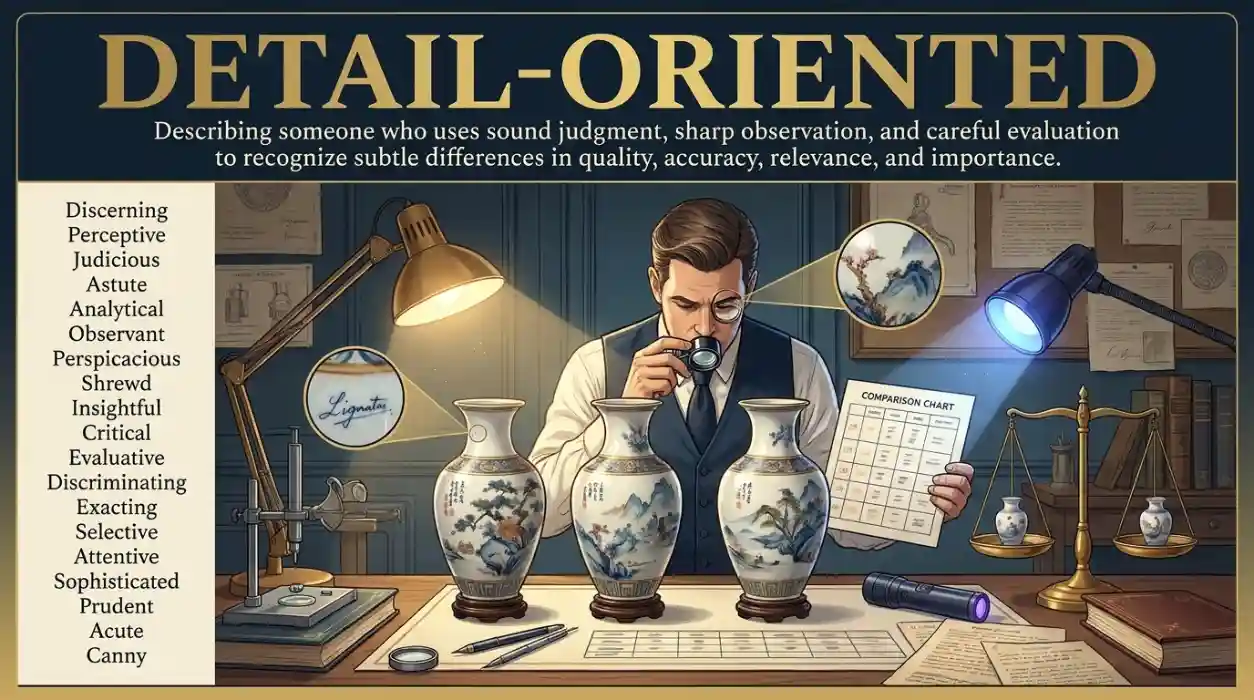
20. Discerning (Adjective) — US /dɪˈsɜːrnɪŋ/ | UK /dɪˈsɜːnɪŋ/
Meaning: Showing good judgment when noticing differences in quality or importance.
Tone/Register: Positive; formal and sophisticated.
Examples:
A discerning editor can recognize subtle writing problems.
Her discerning eye helped select the strongest photographs.
21. Perceptive (Adjective) — US /pərˈseptɪv/ | UK /pəˈseptɪv/
Meaning: Quick to understand or notice details that others may miss.
Tone/Register: Positive; academic and professional.
Examples:
His perceptive comments improved the discussion.
The perceptive reviewer noticed a weakness in the argument.
22. Focused (Adjective) — US /ˈfoʊkəst/ | UK /ˈfəʊkəst/
Meaning: Giving sustained attention to a task or goal without becoming easily distracted.
Tone/Register: Positive and neutral.
Examples:
She stayed focused while checking the complex spreadsheet.
The focused team completed the inspection on time.
23. Concentrated (Adjective) — US /ˈkɑːnsənˌtreɪtɪd/ | UK /ˈkɒnsənˌtreɪtɪd/
Meaning: Giving strong mental attention to a particular activity or subject.
Tone/Register: Neutral and professional.
Examples:
He remained concentrated while reviewing the contract.
The task requires concentrated attention.
24. Analytical (Adjective) — US /ˌænəˈlɪtɪkəl/ | UK /ˌænəˈlɪtɪkəl/
Meaning: Examining information carefully by separating it into smaller parts.
Tone/Register: Academic and professional.
Examples:
Her analytical approach helped identify the cause of the error.
The role requires strong analytical thinking.
25. Logical (Adjective) — US /ˈlɑːdʒɪkəl/ | UK /ˈlɒdʒɪkəl/
Meaning: Using clear reasoning and sensible connections when examining information.
Tone/Register: Neutral to formal.
Examples:
He used a logical process to check the figures.
Her logical explanation made the issue easier to understand.
26. Structured (Adjective) — US /ˈstrʌktʃərd/ | UK /ˈstrʌktʃəd/
Meaning: Arranged according to a clear plan or organized framework.
Tone/Register: Professional and academic.
Examples:
The editor follows a structured review process.
A structured approach prevents important steps from being missed.
27. Thorough-minded (Adjective Phrase) — US /ˈθɜːroʊ ˈmaɪndɪd/ | UK /ˈθʌrə ˈmaɪndɪd/
Meaning: Inclined to examine a task carefully and consider all relevant parts.
Tone/Register: Descriptive; uncommon compared with thorough.
Examples:
A thorough-minded researcher checks the source of every claim.
Her thorough-minded approach improved the final document.
28. Punctilious (Adjective) — US /pʌŋkˈtɪliəs/ | UK /pʌŋkˈtɪliəs/
Meaning: Paying extremely close attention to rules, formalities, and small details.
Tone/Register: Formal and sometimes old-fashioned.
Examples:
The punctilious editor checked every citation.
He is punctilious about meeting professional standards.
29. Scrutinizing (Verb/Adjective) — US /ˈskruːtəˌnaɪzɪŋ/ | UK /ˈskruːtɪnaɪzɪŋ/
Meaning: Examining something very closely to find errors or understand it fully.
Tone/Register: Formal and analytical.
Examples:
She is scrutinizing every line of the agreement.
The committee spent hours scrutinizing the evidence.
30. Vigilant (Adjective) — US /ˈvɪdʒələnt/ | UK /ˈvɪdʒələnt/
Meaning: Remaining alert to possible problems, changes, or risks.
Tone/Register: Positive; professional and safety-related.
Examples:
The security team remained vigilant throughout the event.
Be vigilant when checking unfamiliar payment requests.
31. Alert (Adjective) — US /əˈlɜːrt/ | UK /əˈlɜːt/
Meaning: Quick to notice what is happening and respond to important details.
Tone/Register: Neutral and positive.
Examples:
The alert receptionist noticed the incorrect appointment time.
Stay alert when reviewing the figures.
32. Mindful (Adjective) — US /ˈmaɪndfəl/ | UK /ˈmaɪndfəl/
Meaning: Being consciously aware of details, consequences, or the needs of others.
Tone/Register: Positive; common in professional and everyday English.
Examples:
She is mindful of small errors in customer records.
Be mindful of the instructions before submitting your work.
33. Exacting (Adjective) — US /ɪɡˈzæktɪŋ/ | UK /ɪɡˈzæktɪŋ/
Meaning: Requiring a very high standard of accuracy and care.
Tone/Register: Formal; often used for demanding tasks or standards.
Examples:
The position involves exacting quality checks.
The designer works to exacting standards.
34. Quality-conscious (Adjective) — US /ˈkwɑːləti ˈkɑːnʃəs/ | UK /ˈkwɒləti ˈkɒnʃəs/
Meaning: Caring strongly about maintaining a high standard and avoiding defects.
Tone/Register: Positive; business and professional.
Examples:
The quality-conscious manufacturer checks every product.
She is quality-conscious when selecting materials.
35. Error-conscious (Adjective) — US /ˈerər ˈkɑːnʃəs/ | UK /ˈerə ˈkɒnʃəs/
Meaning: Particularly aware of possible mistakes and careful to prevent them.
Tone/Register: Descriptive; workplace and technical contexts.
Examples:
An error-conscious reviewer checks names and figures twice.
The team adopted an error-conscious approach to data entry.
36. Fine-grained (Adjective) — US /ˈfaɪn ɡreɪnd/ | UK /ˈfaɪn ɡreɪnd/
Meaning: Involving close examination of small distinctions or individual elements.
Tone/Register: Technical, academic, and analytical.
Examples:
The researcher conducted a fine-grained analysis of the interviews.
The report offers a fine-grained view of customer behaviour.
37. Discriminating (Adjective) — US /dɪˈskrɪməˌneɪtɪŋ/ | UK /dɪˈskrɪmɪneɪtɪŋ/
Meaning: Able to recognize and judge subtle differences in quality or value.
Tone/Register: Positive; formal and sophisticated.
Examples:
A discriminating reader notices differences in writing style.
Her discriminating judgment improved the selection process.
38. Orderly (Adjective) — US /ˈɔːrdərli/ | UK /ˈɔːdəli/
Meaning: Arranged neatly and logically, with little confusion or disorder.
Tone/Register: Neutral and positive.
Examples:
He keeps an orderly record of every transaction.
The orderly workspace makes documents easy to locate.
39. Neat (Adjective) — US /niːt/ | UK /niːt/
Meaning: Keeping work or belongings clean, tidy, and carefully arranged.
Tone/Register: Informal to neutral.
Examples:
She keeps neat notes during every lecture.
His neat presentation made the information easy to follow.
40. Exact-minded (Adjective Phrase) — US /ɪɡˈzækt ˈmaɪndɪd/ | UK /ɪɡˈzækt ˈmaɪndɪd/
Meaning: Having a strong preference for exact information and accurate results.
Tone/Register: Descriptive; less common than precise or exact.
Examples:
The exact-minded accountant checked every total.
An exact-minded editor rarely overlooks punctuation errors.
41. Detail-conscious (Adjective) — US /ˈdiːteɪl ˈkɑːnʃəs/ | UK /ˈdiːteɪl ˈkɒnʃəs/
Meaning: Aware of small details and careful to include or check them.
Tone/Register: Professional and descriptive.
Examples:
The detail-conscious designer checked every label.
We need a detail-conscious approach to the final review.
42. Quality-focused (Adjective) — US /ˈkwɑːləti ˈfoʊkəst/ | UK /ˈkwɒləti ˈfəʊkəst/
Meaning: Concentrating on producing work that meets high standards.
Tone/Register: Positive; business and professional.
Examples:
The quality-focused team checks each stage of production.
She takes a quality-focused approach to editing.
43. Thoroughgoing (Adjective)
US: /ˌθɜːroʊˈɡoʊɪŋ/ | UK: /ˌθʌrəˈɡəʊɪŋ/
Meaning: Complete and careful in every important respect.
Tone/Register: Formal and literary.
Examples:
The committee carried out a thoroughgoing assessment.
We need a thoroughgoing review before making a decision.
44. Conscientious-minded (Adjective Phrase) — US /ˌkɑːnʃiˈenʃəs ˈmaɪndɪd/ | UK /ˌkɒnʃiˈenʃəs ˈmaɪndɪd/
Meaning: Having a responsible attitude toward completing work carefully and correctly.
Tone/Register: Descriptive and formal; conscientious alone is more idiomatic.
Examples:
A conscientious-minded employee checks important details before sending a report.
Her conscientious-minded approach builds trust with clients.
45. Observational (Adjective) — US /ˌɑːbzərˈveɪʃənəl/ | UK /ˌɒbzəˈveɪʃənəl/
Meaning: Based on careful watching, noticing, and recording what happens.
Tone/Register: Academic, scientific, and descriptive.
Examples:
The study used observational methods to record behaviour.
His observational skills help him notice subtle changes.
46. Perfectionist (Noun/Adjective) — US /pərˈfekʃənɪst/ | UK /pəˈfekʃənɪst/
Meaning: A person who expects work to meet extremely high standards and often notices tiny imperfections.
Tone/Register: Neutral to critical, depending on context.
Examples:
As a perfectionist, she checks every slide before presenting.
The perfectionist designer adjusted the spacing several times.
47. Careful-minded (Adjective Phrase) — US /ˈkerfəl ˈmaɪndɪd/ | UK /ˈkeəfəl ˈmaɪndɪd/
Meaning: Inclined to think cautiously and consider details before acting.
Tone/Register: Descriptive; less idiomatic than careful.
Examples:
A careful-minded planner checks the schedule before confirming appointments.
His careful-minded approach reduces avoidable errors.
48. Attentive to Detail (Adjective Phrase) — US /əˈtentɪv tə ˈdiːteɪl/ | UK /əˈtentɪv tə ˈdiːteɪl/
Meaning: Consistently noticing and considering the small parts of a task.
Tone/Register: Positive; professional and natural.
Examples:
She is attentive to detail when preparing client documents.
The role suits someone attentive to detail.
49. Detail-focused (Adjective) — US /ˈdiːteɪl ˈfoʊkəst/ | UK /ˈdiːteɪl ˈfəʊkəst/
Meaning: Giving particular attention to the small elements of a task or project.
Tone/Register: Professional and business-friendly.
Examples:
We need a detail-focused person to review the database.
His detail-focused approach improved the final design.
50. Quality-minded (Adjective) — US /ˈkwɑːləti ˈmaɪndɪd/ | UK /ˈkwɒləti ˈmaɪndɪd/
Meaning: Naturally concerned with producing reliable, accurate, and high-quality work.
Tone/Register: Positive; professional and business-related.
Examples:
The quality-minded employee checks products before shipment.
She is quality-minded and takes pride in her work.
Synonyms by Tone
The tone of a synonym affects how others interpret a person’s working style. A résumé should highlight strengths, while a performance review may need a balanced description.
Positive Synonyms
Use these words to emphasize strong work habits and professional strengths:
- Meticulous
- Thorough
- Precise
- Attentive
- Observant
- Diligent
- Conscientious
- Accurate
- Discerning
- Perceptive
- Methodical
- Quality-conscious
- Detail-focused
Example: “She is a meticulous and conscientious team member” presents attention to detail as a professional strength.
Neutral Synonyms
These describe working habits without making a strong judgment:
- Careful
- Organized
- Systematic
- Exact
- Focused
- Concentrated
- Structured
- Orderly
- Mindful
- Analytical
Example: “He follows a systematic process when checking documents” describes his method clearly.
Potentially Negative or Critical Synonyms
These words may suggest excessive attention to detail or difficulty accepting imperfections:
- Fastidious
- Perfectionistic
- Punctilious
- Particular
- Exacting
- Perfectionist
Example: “She can be overly fastidious about formatting” suggests that her attention may sometimes slow progress.
Formal and Technical Synonyms
These expressions suit research, analysis, quality control, and specialist writing:
- Scrupulous
- Thoroughgoing
- Fine-grained
- Discriminating
- Scrutinizing
- Observational
Example: “The researchers conducted a fine-grained analysis of the results.”
“Detail Oriented” vs Close Alternatives
Three particularly useful alternatives are meticulous, thorough, and precise. Each highlights a different quality.
| Expression | Meaning difference | Best use |
|---|---|---|
| Detail oriented | Notices and considers small parts of a task | Résumés, job descriptions, general work habits |
| Meticulous | Extremely careful about even tiny details | Editing, design, accounting, craftsmanship |
| Thorough | Covers all important parts of a task | Research, reviews, inspections |
| Precise | Produces exact and accurate results | Measurements, instructions, technical work |
Detail-oriented vs meticulous: Both describe careful attention. Meticulous usually suggests a higher level of care and attention to very small elements.
Detail-oriented vs thorough: A thorough person makes sure all relevant parts receive attention. A detail-oriented person is especially aware of the smaller elements within those parts.
Detail-oriented vs precise: Precise focuses on exactness. Someone can be precise when giving a measurement, while a detail-oriented person may carefully check the entire process.
How “Detail Oriented” Changes by Context
Daily Conversation
In everyday speech, people often say careful, observant, organized, or good at noticing details.
For example, “She’s really observant. She notices things that everyone else misses.” This sounds more natural in casual conversation than using a formal word such as punctilious.
Writing and Blogging
Bloggers and content writers can use meticulous, thorough, precise, and attentive to describe editing, research, and content quality.
For example, “A meticulous fact-checking process helps prevent misleading information.” This gives readers a clearer picture of the writer’s standards.
Professional and Academic English
In professional settings, conscientious, methodical, systematic, and analytical communication communicates dependable work habits.
A résumé might say, “I take a methodical approach to reviewing financial data.” An academic report might describe a systematic analysis of research findings.
Creative and Informal Use
Creative writers may use observant, perceptive, or discerning to describe characters who notice subtle details.
Informal speakers may prefer careful, neat, or particular. The best word depends on whether you want to praise someone’s attention or suggest that they worry too much about minor things.
Common Mistakes Learners Make
1. Assuming Every Synonym Has the Same Meaning
Meticulous, accurate, and organized are related, but they describe different qualities.
A person can be organized without checking every detail. Someone can also produce accurate work without following a highly organized process.
Choose the word that describes the actual behaviour.
2. Confusing Detail-Oriented With Perfectionistic
Being detail-oriented means noticing and checking important details. Being perfectionistic often means expecting everything to be flawless.
The first quality is generally useful. The second can become difficult when it causes unnecessary delays or stress.
3. Using Formal Vocabulary in Casual Conversations
Words such as punctilious, scrupulous, and discerning may sound too formal in ordinary conversations.
Instead of saying, “My brother is punctilious about his notes,” you can simply say, “My brother is very careful with his notes.”
4. Describing Someone as Detail Oriented Without Evidence
On a résumé or in an interview, avoid making unsupported claims.
Give a practical example. Mention how you checked records, caught a mistake, maintained accurate information, or followed a quality-control process.
5. Overusing the Same Expression
Repeating detail-oriented several times can make a résumé or article sound monotonous.
Use alternatives such as meticulous, thorough, or attentive to detail when they accurately describe the skill.
Register Notes: Formal vs Informal
- Formal: meticulous, conscientious, scrupulous, punctilious, systematic.
- Neutral: careful, precise, accurate, organized, attentive.
- Informal: neat, particular, observant.
- Technical: fine-grained, analytical, exacting, observational.
In spoken English, simple words usually sound more natural. In professional writing, a more specific adjective can communicate a skill with greater precision.
For related vocabulary practice, explore lessons on synonyms for organized, careful, and hardworking.
Real-Life Mini Scenarios
Workplace
A project coordinator checks deadlines, names, figures, and attachments before sending a report. A manager might describe this person as meticulous and conscientious.
Social Situations
A friend remembers small preferences, such as how everyone takes their tea. You might call that person attentive or observant.
Media and Pop Culture
A detective notices a small clue that others overlook. Words such as perceptive, discerning, and observant help describe this character.
Writing and Storytelling
A novelist carefully tracks character names, timelines, and locations. A meticulous or methodical writing process helps prevent continuity errors.

Practice Exercise
1. An editor checks every punctuation mark and spelling choice. Which word fits best?
A. Meticulous
B. Casual
C. Distracted
D. Careless
2. A researcher follows the same organized steps for every experiment. Which word is most suitable?
A. Impulsive
B. Methodical
C. Forgetful
D. Random
3. Someone notices a tiny change in a colleague’s presentation. Which adjective describes this ability?
A. Observant
B. Greedy
C. Uncertain
D. Relaxed
4. A person checks every task carefully and takes responsibility seriously. Which word fits?
A. Conscientious
B. Impatient
C. Casual
D. Unfocused
5. A designer wants exact measurements for a product. Which word is most appropriate?
A. Wistful
B. Precise
C. Playful
D. Flexible
6. Someone insists that every tiny detail must be perfect, even when deadlines are close. Which word may describe this habit?
A. Perfectionistic
B. Carefree
C. Unobservant
D. Spontaneous
7. A security guard remains alert to possible risks. Which word is most suitable?
A. Vigilant
B. Messy
C. Unconcerned
D. Hesitant
8. A student keeps notes in clear sections and labels every document. Which word fits best?
A. Organized
B. Avaricious
C. Impulsive
D. Vague
9. A reviewer examines a contract closely to find hidden problems. Which word describes the action?
A. Scrutinizing
B. Guessing
C. Ignoring
D. Relaxing
10. A person can recognize subtle differences in quality. Which adjective fits?
A. Discerning
B. Forgetful
C. Impatient
D. Careless
Reflection and Application Task
Choose three synonyms from this article. Write one original sentence for each.
Use one word to describe a student, another to describe a colleague, and the third to describe a professional task. Then explain why each word fits its context.
Answer key: 1-A, 2-B, 3-A, 4-A, 5-B, 6-A, 7-A, 8-A, 9-A, 10-A
External Learning Sources
For further study, consult these trusted language references:
- Cambridge Dictionary:
- Oxford Learner’s Dictionaries: https://www.oxfordlearnersdictionaries.com/
- Merriam-Webster:
- Online Etymology Dictionary:
These sources can help you check definitions, pronunciation, word origins, and examples of natural usage.
Conclusion
Learning synonyms for detail-oriented helps you describe accuracy, careful thinking, and reliable work with greater precision. Each word highlights a slightly different strength.
A wider vocabulary improves essays, blogs, résumés, and everyday communication. It also helps you explain professional qualities without repeating the same expression.
Start with familiar alternatives such as careful, thorough, and organized. Then practise more specific words such as meticulous, perceptive, and conscientious.
Use three new expressions in your next email, essay, or conversation. With regular practice, you can communicate your strengths clearly and confidently.
FAQs
1. What is the best synonym for detail-oriented on a résumé?
Meticulous, thorough, and attentive to detail are strong résumé alternatives. Choose the expression that matches your actual work habits. For example, meticulous suits careful editing, while thorough works well for research and reviews. Support the adjective with a short achievement that demonstrates accuracy or attention.
2. How do you describe someone who notices things others miss?
You can describe that person as observant, perceptive, or discerning. An observant person notices small changes. A perceptive person understands what those changes may mean. A discerning person recognizes important differences and makes thoughtful judgments. The best choice depends on whether you want to emphasize noticing, understanding, or evaluating.
3. Is detail-oriented a personality trait or a professional skill?
It can be both. As a personal trait, it describes someone who naturally notices small details. As a professional skill, it refers to the ability to check information, follow instructions, and produce accurate work. Employers often value it in roles involving finance, research, editing, healthcare administration, and quality control.
4. What is a better way to say detail-oriented in a job interview?
Use a specific phrase that matches the job. You might say, “I take a methodical approach to checking information” or “I am careful about accuracy.” Then give a brief example, such as catching a reporting error or improving a document review process. Evidence makes the description more convincing.
5. What is the difference between being meticulous and being a perfectionist?
A meticulous person pays close attention to details and aims for accurate results. A perfectionist may expect every part of a task to be flawless. Meticulousness can improve quality, while perfectionism can sometimes lead to unnecessary revisions or delays. The two qualities can overlap, but they are not identical.

Hasnain Ali is an SEO Content Strategist and the founder of wordvora.com, a trusted vocabulary platform that helps writers, students, professionals, and English learners find accurate synonyms, antonyms, word meanings, and real-life usage examples. He specializes in keyword research, on-page SEO, topical authority, and creating search-first content that aligns with Google’s latest Search Quality and E-E-A-T guidelines. His work focuses on producing clear, well-structured, and reader-friendly resources that satisfy search intent while maintaining high editorial standards.
Through extensive hands-on experience with SEO tools such as Google Search Console, Google Analytics, SEMrush, and Ahrefs, Hasnain researches user search behavior and develops content that is both informative and easy to understand. Every article published on wordvora.com is carefully reviewed for accuracy, readability, and contextual relevance before publication. His mission is to build one of the web’s most reliable English vocabulary resources by providing practical language guidance, trustworthy explanations, and content that helps readers improve their writing, communication, and vocabulary with confidence.