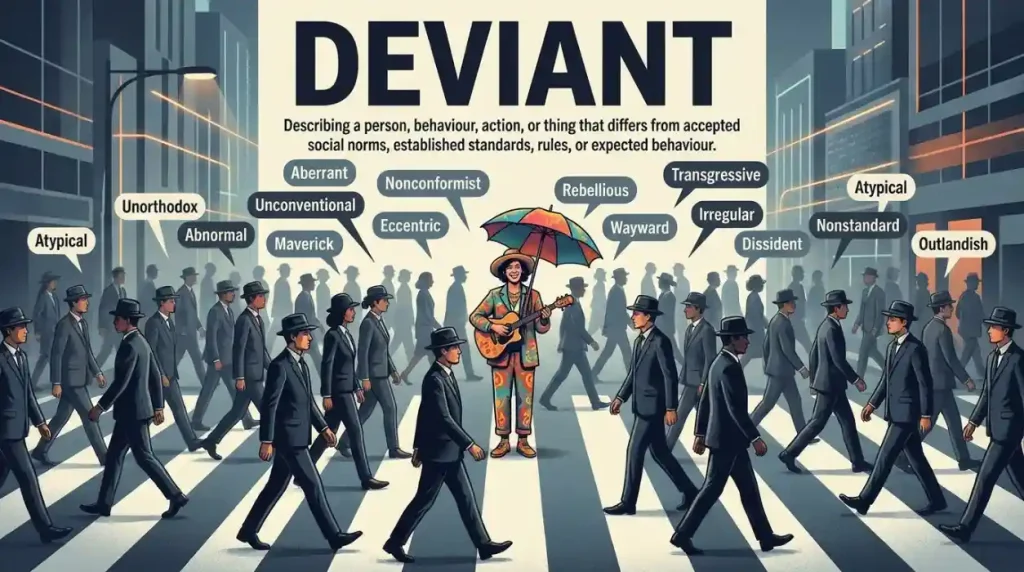
Synonyms for deviant include abnormal, unconventional, nonconformist, atypical, aberrant, unorthodox, and eccentric. Each word describes someone or something that differs from an accepted standard, rule, or pattern. However, these alternatives carry different levels of criticism, formality, and emotional meaning.
Imagine someone choosing an unusual career path while everyone around them follows a traditional route. One person might call that choice unconventional. Another might describe it as deviant. The word you choose changes the message.
The word deviant appears in psychology, sociology, education, literature, and everyday discussions. Its meaning depends heavily on the situation and the speaker’s attitude.
Learning synonyms for deviant helps you express differences more accurately. Students, bloggers, content writers, and everyday English users can all benefit from a wider vocabulary.
Instead of repeating one word, you can choose a more precise alternative. This makes your writing clearer and helps you communicate without creating an unintended judgment.
What Does “Deviant” Really Mean?
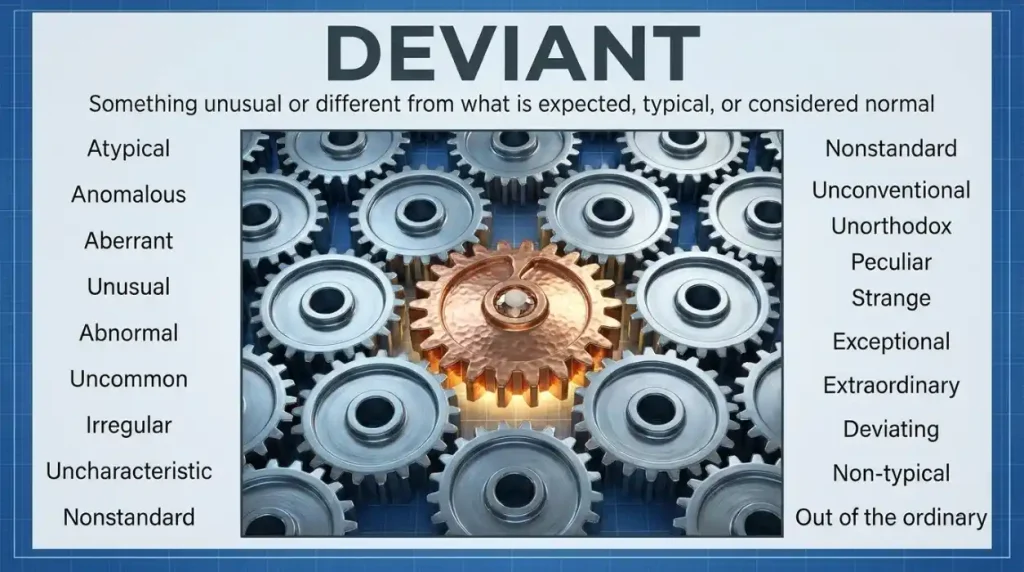
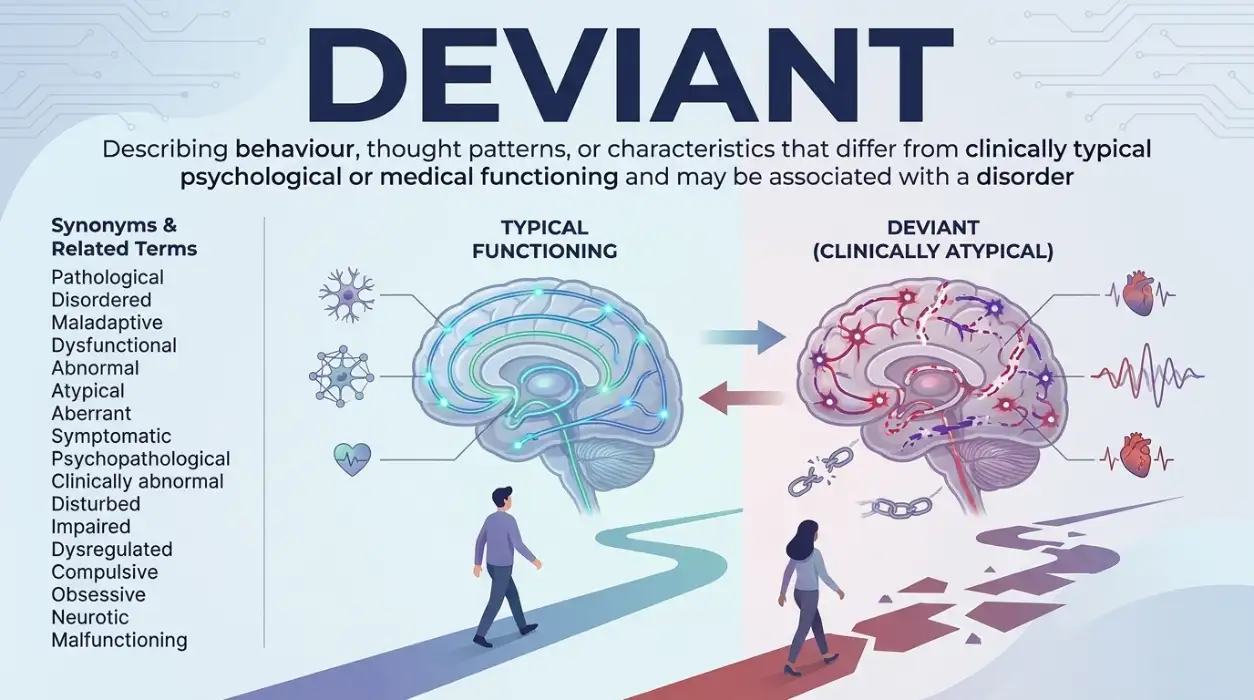
Deviant describes a person, behavior, action, or thing that differs from an accepted rule, social norm, standard, or expected pattern.
In simple English, something deviant does not follow what a particular group considers normal or acceptable.
The word is commonly used as an adjective:
- Adjective: A deviant behavior pattern attracted attention.
- Noun: The report examined how society labels a deviant.
As a noun, deviant can describe a person whose behavior differs from accepted social standards. However, using it to label an individual can sound judgmental or stigmatizing.
How Native English Speakers Understand the Word
Native speakers usually understand deviant as a word about departure from an established norm. It often appears in academic, psychological, sociological, and legal discussions.
Its meaning is not automatically the same as dangerous, criminal, or immoral. Something can be unusual without causing harm.
For example, an unconventional fashion choice may be harmless. A behavior described as socially deviant may simply violate a particular community’s expectations.
Connotative Meaning
(Connotation means the emotional associations or feelings a word carries beyond its basic dictionary definition.)
Positive tone: The word itself is rarely positive, but a person described as a nonconformist or unconventional thinker may be admired for originality and independence.
Negative tone: Deviant can suggest behavior that violates social rules, moral expectations, or accepted standards. In some contexts, it sounds critical or disapproving.
Neutral tone: In sociology and research, deviant can describe behavior that differs from a group’s norms without automatically declaring it harmful or immoral.
Etymology and History of “Deviant”
The word deviant comes from the verb deviate, which traces back to Latin.
The Latin word deviare combines de- (away from) and via (way or road). Its basic sense is to move away from a path or established route.
The English word developed from this idea of departing from a usual direction or standard.
Historical Development
Old English (450–1100)
The modern word deviant was not part of ordinary Old English vocabulary. However, Old English had words and expressions for turning aside, leaving a path, or moving away from something.
Middle English (1100–1500)
English vocabulary increasingly absorbed words through French and Latin influence. The Latin idea of moving away from a road or course helped establish the vocabulary from which deviate later developed.
Modern English (1500–Present)
The deviate word family became established in English. Deviant developed as a term for someone or something departing from an expected standard. Its use expanded in social science, especially in discussions of social norms and behavior.
Pronunciation
- US IPA: /ˈdiː.vi.ənt/
- UK IPA: /ˈdiː.vi.ənt/
Syllables: de-vi-ant
Part of speech: Adjective and noun
Affixation Pattern
- Root: Latin via, meaning way or road, through the deviate word family.
- Prefix: de- — away from or aside.
- Suffix: -ant — a suffix used in forming adjectives and nouns.
The word can be understood through its historical connection to the idea of moving away from an established path.
Synonyms List
The following alternatives describe different kinds of departure from accepted behavior, standards, or expectations. Not every word is interchangeable with deviant. Choose according to context and tone.
1. Abnormal (Adjective) — US / UK: /æbˈnɔːr.məl/ / /æbˈnɔː.məl/
Meaning: Different from what is usual, expected, or considered normal.
Tone/Register: Neutral to negative; common in everyday, medical, and technical English.
Examples:
The test revealed an abnormal result.
The machine made an abnormal noise during the night.
2. Aberrant (Adjective) — US / UK: /əˈber.ənt/ / /əˈber.ənt/
Meaning: Departing noticeably from an accepted pattern, standard, or expected behavior.
Tone/Register: Formal; common in academic and scientific writing.
Examples:
Researchers investigated the aberrant results.
The report identified an aberrant pattern in the data.
3. Atypical (Adjective) — US / UK: /eɪˈtɪp.ɪ.kəl/ / /eɪˈtɪp.ɪ.kəl/
Meaning: Not representative of the usual type or normal pattern.
Tone/Register: Neutral; suitable for academic and everyday communication.
Examples:
Her response was atypical for someone in that situation.
The study examined an atypical case.
4. Unconventional (Adjective) — US / UK: /ˌʌn.kənˈven.ʃən.əl/ / /ˌʌn.kənˈven.ʃən.əl/
Meaning: Different from traditional methods, customs, or accepted ways of doing things.
Tone/Register: Usually positive or neutral; common in conversation and professional writing.
Examples:
He chose an unconventional approach to teaching.
Their unconventional home design attracted attention.
5. Nonconformist (Noun/Adjective) — US / UK: /ˌnɑːn.kənˈfɔːr.mɪst/ / /ˌnɒn.kənˈfɔː.mɪst/
Meaning: A person or attitude that refuses to follow established customs or expectations.
Tone/Register: Often positive or neutral; common in social and cultural discussions.
Examples:
She has always been a nonconformist.
The artist developed a nonconformist style.
6. Unorthodox (Adjective) — US / UK: /ʌnˈɔːr.θə.dɑːks/ / /ʌnˈɔː.θə.dɒks/
Meaning: Different from traditional beliefs, accepted methods, or established practices.
Tone/Register: Neutral to positive; common in academic and professional English.
Examples:
The coach introduced an unorthodox training method.
His unorthodox ideas encouraged debate.
7. Eccentric (Adjective/Noun) — US / UK: /ɪkˈsen.trɪk/ / /ɪkˈsen.trɪk/
Meaning: Unusually different in personality, habits, or appearance.
Tone/Register: Informal to neutral; sometimes affectionate or humorous.
Examples:
Our eccentric neighbor collects vintage clocks.
The writer was famous for her eccentric habits.
8. Irregular (Adjective) — US / UK: /ɪˈreɡ.jə.lɚ/ / /ɪˈreɡ.jə.lə/
Meaning: Not following a usual rule, pattern, or arrangement.
Tone/Register: Neutral; used in grammar, mathematics, science, and daily speech.
Examples:
The machine produced irregular signals.
The company noticed an irregular payment pattern.
9. Unusual (Adjective) — US / UK: /ʌnˈjuː.ʒu.əl/ / /ʌnˈjuː.ʒu.əl/
Meaning: Different from what commonly happens or is normally expected.
Tone/Register: Neutral and conversational.
Examples:
It was unusual to see snow in April.
She made an unusual choice for the final project.
10. Deviating (Adjective) — US / UK: /ˈdiː.vi.eɪ.tɪŋ/ / /ˈdiː.vi.eɪ.tɪŋ/
Meaning: Moving away from an established rule, direction, or standard.
Tone/Register: Formal to neutral; common in technical and academic writing.
Examples:
The team investigated the deviating measurements.
Any deviating procedure requires approval.
11. Anomalous (Adjective) — US / UK: /əˈnɑː.mə.ləs/ / /əˈnɒm.ə.ləs/
Meaning: Different from what is expected or normally found in a particular situation.
Tone/Register: Formal and scientific.
Examples:
The researchers noticed an anomalous reading.
An anomalous result prompted another experiment.
12. Uncharacteristic (Adjective) — US / UK: /ʌnˌker.ək.təˈrɪs.tɪk/ / /ʌnˌkær.ək.təˈrɪs.tɪk/
Meaning: Not typical of a person’s usual behavior or a thing’s normal qualities.
Tone/Register: Neutral; useful in everyday and professional English.
Examples:
His uncharacteristic silence worried his friends.
The player made an uncharacteristic mistake.
13. Unconforming (Adjective) — US / UK: /ˌʌn.kənˈfɔːr.mɪŋ/ / /ˌʌn.kənˈfɔː.mɪŋ/
Meaning: Not complying with a particular standard, rule, or requirement.
Tone/Register: Technical or formal; less common in everyday speech.
Examples:
The inspector rejected the nonconforming materials.
The design did not meet the required specifications.
14. Rebellious (Adjective) — US / UK: /rɪˈbel.jəs/ / /rɪˈbel.jəs/
Meaning: Resisting authority, rules, or established control.
Tone/Register: Informal to neutral; often negative, but sometimes admiring.
Examples:
The rebellious teenager questioned every household rule.
Her rebellious attitude shaped her music.
15. Dissident (Noun/Adjective) — US / UK: /ˈdɪs.ɪ.dənt/ / /ˈdɪs.ɪ.dənt/
Meaning: A person who openly disagrees with an established political, religious, or institutional position.
Tone/Register: Formal; common in political and historical writing.
Examples:
The dissident criticized the government’s policies.
Several dissident voices challenged the official statement.
16. Heterodox (Adjective) — US / UK: /ˈhet.ə.rə.dɑːks/ / /ˈhet.ə.rə.dɒks/
Meaning: Holding beliefs that differ from officially accepted or traditional opinions.
Tone/Register: Formal and academic.
Examples:
The professor presented a heterodox interpretation.
Her heterodox views challenged established theory.
17. Idiosyncratic (Adjective) — US / UK: /ˌɪd.i.oʊ.sɪŋˈkræt̬.ɪk/ / /ˌɪd.i.ə.sɪŋˈkræt.ɪk/
Meaning: Having distinctive habits, characteristics, or ways of thinking that are unusual to an individual.
Tone/Register: Formal to neutral; often descriptive rather than critical.
Examples:
His idiosyncratic writing style is easy to recognize.
The designer has an idiosyncratic approach to color.
18. Peculiar (Adjective) — US / UK: /pɪˈkjuː.li.ɚ/ / /pɪˈkjuː.li.ə/
Meaning: Unusual or different in a way that attracts attention.
Tone/Register: Neutral to negative; common in everyday English.
Examples:
There was a peculiar smell in the hallway.
She noticed his peculiar way of answering questions.
19. Outlandish (Adjective) — US / UK: /aʊtˈlæn.dɪʃ/ / /aʊtˈlæn.dɪʃ/
Meaning: Extremely unusual, strange, or difficult to accept.
Tone/Register: Informal to neutral; often humorous or critical.
Examples:
He arrived wearing an outlandish costume.
The proposal included several outlandish ideas.
20. Eccentric-minded (Adjective) — US / UK: /ɪkˈsen.trɪk ˈmaɪn.dɪd/ / /ɪkˈsen.trɪk ˈmaɪn.dɪd/
Meaning: Having an unusually individual or unconventional way of thinking.
Tone/Register: Informal and descriptive; a phrase rather than a standard direct synonym.
Examples:
The eccentric-minded inventor filled his notebook with strange designs.
Her eccentric-minded approach made the project memorable.
21. Unusual-minded (Adjective) — US / UK: /ʌnˈjuː.ʒu.əl ˈmaɪn.dɪd/ / /ʌnˈjuː.ʒu.əl ˈmaɪn.dɪd/
Meaning: Thinking in ways that differ from common expectations.
Tone/Register: Informal; uncommon and best replaced by unconventional in polished writing.
Examples:
The unusual-minded artist rejected familiar techniques.
His unusual-minded perspective inspired a new design.
22. Antinomian (Noun/Adjective) — US / UK: /ˌæn.tɪˈnoʊ.mi.ən/ / /ˌæn.tɪˈnəʊ.mi.ən/
Meaning: Rejecting or opposing established laws or moral rules, especially in religious or philosophical contexts.
Tone/Register: Highly formal and specialized.
Examples:
The historian studied an antinomian movement.
The essay explored antinomian ideas about religious law.
23. Nonstandard (Adjective) — US / UK: /ˌnɑːnˈstæn.dɚd/ / /ˌnɒnˈstæn.dəd/
Meaning: Not following an accepted or established standard.
Tone/Register: Neutral and technical; common in education and linguistics.
Examples:
The report used a nonstandard measurement system.
The speaker used a nonstandard grammatical form.
24. Unconventionalist (Noun) — US / UK: /ˌʌn.kənˈven.ʃən.əl.ɪst/ / /ˌʌn.kənˈven.ʃən.əl.ɪst/
Meaning: A person who favors methods or ideas that depart from conventional practice.
Tone/Register: Formal to neutral; relatively uncommon.
Examples:
The unconventionalist challenged the industry’s usual approach.
As an unconventionalist, she preferred independent thinking.
25. Maverick (Noun/Adjective) — US / UK: /ˈmæv.ər.ɪk/ / /ˈmæv.ər.ɪk/
Meaning: An independent person who refuses to follow the usual rules or group expectations.
Tone/Register: Informal to neutral; often positive in business and creative settings.
Examples:
The maverick entrepreneur built a different kind of company.
Her maverick style made her stand out.
26. Iconoclastic (Adjective) — US / UK: /aɪˌkɑː.nəˈklæs.tɪk/ / /aɪˌkɒn.əˈklæs.tɪk/
Meaning: Challenging established beliefs, traditions, or respected institutions.
Tone/Register: Formal; common in cultural, academic, and literary writing.
Examples:
The filmmaker became known for iconoclastic ideas.
His iconoclastic essay questioned old assumptions.
27. Transgressive (Adjective) — US / UK: /trænzˈɡres.ɪv/ / /trænzˈɡres.ɪv/
Meaning: Crossing social, moral, artistic, or cultural boundaries.
Tone/Register: Formal; common in literature, art, and cultural criticism.
Examples:
The novel explores transgressive themes.
The artist became famous for transgressive performances.
28. Rule-breaking (Adjective/Noun) — US / UK: /ˈruːlˌbreɪ.kɪŋ/ / /ˈruːlˌbreɪ.kɪŋ/
Meaning: Involving the deliberate violation of established rules.
Tone/Register: Informal to neutral.
Examples:
The school introduced new measures after repeated rule-breaking.
His rule-breaking approach changed the competition.
29. Nonconforming (Adjective) — US / UK: /ˌnɑːn.kənˈfɔːr.mɪŋ/ / /ˌnɒn.kənˈfɔː.mɪŋ/
Meaning: Not behaving or developing according to an accepted standard or expectation.
Tone/Register: Neutral to formal; common in social and technical contexts.
Examples:
The survey included nonconforming responses.
The organization supports nonconforming creative approaches.
30. Unorthodox-minded (Adjective) — US / UK: /ʌnˈɔːr.θə.dɑːkst ˈmaɪn.dɪd/ / /ʌnˈɔː.θə.dɒkst ˈmaɪn.dɪd/
Meaning: Inclined to think in ways that differ from traditional beliefs or methods.
Tone/Register: Informal descriptive phrase; unorthodox is usually more natural.
Examples:
The unorthodox-minded researcher questioned the usual method.
An unorthodox-minded director reimagined the familiar story.
31. Radical (Adjective/Noun) — US / UK: /ˈræd.ɪ.kəl/ / /ˈræd.ɪ.kəl/
Meaning: Favoring fundamental change or ideas far removed from established views.
Tone/Register: Neutral to negative, depending on context; common in politics and social debate.
Examples:
The group proposed radical changes to the system.
Her radical ideas divided the audience.
32. Subversive (Adjective/Noun) — US / UK: /səbˈvɝː.sɪv/ / /səbˈvɜː.sɪv/
Meaning: Seeking to undermine established authority, values, or institutions.
Tone/Register: Formal; often negative in political contexts, but sometimes positive in art.
Examples:
The play used subversive humor to challenge authority.
Officials described the publication as subversive.
33. Unruly (Adjective) — US / UK: /ʌnˈruː.li/ / /ʌnˈruː.li/
Meaning: Difficult to control because of a refusal to follow rules or instructions.
Tone/Register: Informal to neutral; often negative.
Examples:
The teacher calmed the unruly class.
The crowd became unruly after the match.
34. Wayward (Adjective) — US / UK: /ˈweɪ.wɚd/ / /ˈweɪ.wəd/
Meaning: Difficult to guide or control because of unpredictable or disobedient behavior.
Tone/Register: Literary to neutral; sometimes affectionate or critical.
Examples:
The story follows a wayward young traveler.
His wayward decisions worried his family.
35. Recalcitrant (Adjective) — US / UK: /rɪˈkæl.sɪ.trənt/ / /rɪˈkæl.sɪ.trənt/
Meaning: Stubbornly resisting authority, discipline, or instructions.
Tone/Register: Formal; common in academic, legal, and professional writing.
Examples:
The manager struggled with a recalcitrant employee.
The report addressed recalcitrant behavior in the institution.
36. Insubordinate (Adjective) — US / UK: /ˌɪn.səˈbɔːr.dən.ət/ / /ˌɪn.səˈbɔː.dɪ.nət/
Meaning: Refusing to obey someone in a position of authority.
Tone/Register: Formal; especially common in workplace and military contexts.
Examples:
The supervisor documented the insubordinate conduct.
Repeated insubordinate comments led to a meeting.
37. Mutinous (Adjective) — US / UK: /ˈmjuː.tən.əs/ / /ˈmjuː.tɪ.nəs/
Meaning: Showing resistance or rebellion against an authority, especially within an organized group.
Tone/Register: Formal and dramatic.
Examples:
The captain noticed a mutinous mood among the crew.
The workers exchanged mutinous looks.
38. Antisocial (Adjective) — US / UK: /ˌæn.tiˈsoʊ.ʃəl/ / /ˌæn.tiˈsəʊ.ʃəl/
Meaning: Opposed to or harmful to accepted social rules, or, in everyday usage, avoiding social interaction.
Tone/Register: Neutral to negative; meaning depends strongly on context.
Examples:
The researchers examined antisocial behavior among adolescents.
He felt antisocial and stayed home that evening.
39. Disruptive (Adjective) — US / UK: /dɪsˈrʌp.tɪv/ / /dɪsˈrʌp.tɪv/
Meaning: Causing interruption or disturbance to an established process or environment.
Tone/Register: Neutral to negative; common in education and business.
Examples:
The disruptive behavior interrupted the lesson.
The company introduced a disruptive new business model.
40. Maladaptive (Adjective) — US / UK: /ˌmæl.əˈdæp.tɪv/ / /ˌmæl.əˈdæp.tɪv/
Meaning: Describing behavior or responses that make it harder to adjust successfully to a situation.
Tone/Register: Formal and psychological.
Examples:
The therapist helped him recognize maladaptive habits.
The study explored maladaptive coping strategies.
41. Pathological (Adjective) — US / UK: /ˌpæθ.əˈlɑː.dʒɪ.kəl/ / /ˌpæθ.əˈlɒdʒ.ɪ.kəl/
Meaning: Relating to disease or behavior associated with a psychological or medical disorder.
Tone/Register: Medical and formal; should be used carefully.
Examples:
The specialist examined the pathological changes.
The article discussed pathological patterns in a clinical context.
42. Antisocially inclined (Adjective phrase) — US / UK: /ˌæn.tiˈsoʊ.ʃəl.i ɪnˈklaɪnd/ / /ˌæn.tiˈsəʊ.ʃəl.i ɪnˈklaɪnd/
Meaning: Inclined toward behavior that avoids social interaction or conflicts with social expectations.
Tone/Register: Descriptive; the exact meaning depends on context.
Examples:
The character is portrayed as antisocially inclined.
He seemed antisocially inclined during the group activity.
43. Deviational (Adjective) — US / UK: /ˌdiː.viˈeɪ.ʃən.əl/ / /ˌdiː.viˈeɪ.ʃən.əl/
Meaning: Relating to a departure from a standard, expected value, or usual pattern.
Tone/Register: Technical and academic; not a common everyday substitute.
Examples:
The paper examined deviational patterns in the data.
The analyst calculated the deviational values.
44. Unregulated (Adjective) — US / UK: /ˌʌnˈreɡ.jə.leɪ.tɪd/ / /ˌʌnˈreɡ.jə.leɪ.tɪd/
Meaning: Not controlled or governed by formal rules or regulations.
Tone/Register: Neutral and technical.
Examples:
The report examined the unregulated market.
The activity took place in an unregulated environment.
45. Unrestrained (Adjective) — US / UK: /ˌʌn.rɪˈstreɪnd/ / /ˌʌn.rɪˈstreɪnd/
Meaning: Not controlled or limited by rules, restraint, or moderation.
Tone/Register: Neutral to negative; also used positively for open expression.
Examples:
The debate turned into unrestrained criticism.
She expressed unrestrained excitement about the result.
46. Unruly-minded (Adjective phrase) — US / UK: /ʌnˈruː.li ˈmaɪn.dɪd/ / /ʌnˈruː.li ˈmaɪn.dɪd/
Meaning: Tending to resist control or behave in a disorderly way.
Tone/Register: Informal and uncommon; rebellious or unruly is more natural.
Examples:
The unruly-minded character refused to accept instructions.
His unruly-minded attitude created tension.
47. Contrarian (Noun/Adjective) — US / UK: /kənˈtrer.i.ən/ / /kənˈtreə.ri.ən/
Meaning: A person who tends to oppose popular opinions or commonly accepted views.
Tone/Register: Neutral to critical; common in business, politics, and everyday conversation.
Examples:
The contrarian questioned the popular recommendation.
Her contrarian opinion started a lively discussion.
48. Heretical (Adjective) — US / UK: /həˈret̬.ɪ.kəl/ / /həˈret.ɪ.kəl/
Meaning: Opposing established religious beliefs or, more broadly, accepted doctrines and ideas.
Tone/Register: Formal and often critical; especially common in religious and intellectual contexts.
Examples:
The scholar defended a heretical interpretation.
His proposal seemed heretical to traditional thinkers.
49. Unorthodoxly (Adverb) — US / UK: /ʌnˈɔːr.θə.dɑːks.li/ / /ʌnˈɔː.θə.dɒks.li/
Meaning: In a manner that departs from accepted methods or traditional expectations.
Tone/Register: Formal to neutral.
Examples:
The team approached the challenge unorthodoxly.
She unorthodoxly combined two different research methods.
50. Deviant-like (Adjective phrase) — US / UK: /ˈdiː.vi.ənt laɪk/ / /ˈdiː.vi.ənt laɪk/
Meaning: Resembling behavior or characteristics that depart from an accepted norm.
Tone/Register: Descriptive but uncommon; use a more precise alternative in formal writing.
Examples:
The fictional character displays deviant-like behavior.
The study avoided labeling ordinary differences as deviant-like.
Synonyms by Tone
The emotional effect of a synonym matters. A word that sounds neutral in a research paper may sound insulting in a personal conversation.
Positive or Respectful Alternatives
These words can describe independence, originality, or a willingness to challenge convention:
- Unconventional
- Nonconformist
- Maverick
- Eccentric
- Iconoclastic
- Idiosyncratic
- Contrarian
Example: Calling a designer a maverick may recognize creativity and independence rather than criticize their choices.
Neutral Alternatives
These words describe difference without necessarily expressing approval or disapproval:
- Atypical
- Unusual
- Irregular
- Nonstandard
- Uncharacteristic
- Anomalous
- Deviating
Example: A researcher might describe a result as anomalous without suggesting that anyone has done something wrong.
Negative Alternatives
These words can suggest resistance, disruption, or violation of rules:
- Aberrant
- Rebellious
- Unruly
- Insubordinate
- Recalcitrant
- Subversive
- Maladaptive
- Mutinous
Example: Calling an employee insubordinate suggests refusal to follow authority, not simply an unusual personality.
Playful or Informal Alternatives
These words can describe unusual personalities or unconventional choices more lightly:
- Eccentric
- Peculiar
- Outlandish
- Maverick
- Wayward
Example: Describing a friend as eccentric can sound affectionate when the unusual behavior is harmless.
“Deviant” vs. Close Alternatives
Some synonyms look similar but communicate different ideas. These distinctions help you select the right word.
| Word | Main meaning | Tone | Best use |
|---|---|---|---|
| Deviant | Departs from a social norm or standard | Often negative or academic | Sociology and discussions of social behavior |
| Abnormal | Differs from what is usual or expected | Neutral to negative | Medical, scientific, and general descriptions |
| Unconventional | Does not follow traditional practices | Often positive or neutral | Creative work, lifestyles, and methods |
| Aberrant | Departs noticeably from an expected pattern | Formal and often negative | Research, technical writing, and analysis |
| Nonconformist | Resists following accepted customs | Often positive | Personality, culture, and independent thinking |
Which word should you choose?
Use deviant when the focus is on departure from a social norm. Choose abnormal when something differs from an expected condition. Use unconventional when you want to emphasize originality without implying wrongdoing.
How “Deviant” Changes by Context
Daily Conversation
In everyday speech, unusual, strange, peculiar, and eccentric are often more natural than deviant.
For example, you might say, “That’s an unusual way to solve the problem.” Calling the same choice deviant could sound unnecessarily judgmental.
Writing and Blogging
Content writers can use unconventional, atypical, nonconformist, or aberrant when the context supports them.
Avoid repeating deviant in every paragraph. Choose alternatives that preserve the exact meaning and maintain a natural reading experience.
Professional and Academic Writing
In sociology, psychology, and research, deviant may be appropriate when discussing behavior that departs from a defined social norm.
However, define the relevant standard. Social norms differ across communities, cultures, and historical periods.
Creative and Informal Writing
Writers can choose eccentric, maverick, outlandish, or wayward to develop a character’s personality.
For example, an eccentric inventor sounds distinctive. A rebellious teenager suggests resistance to authority. These choices help readers understand characters without lengthy explanations.
Common Mistakes Learners Make
1. Treating Every Unusual Action as Deviant
Unusual behavior is not automatically deviant. A person can have uncommon interests or habits without violating a social norm.
2. Confusing Deviant With Criminal
The words are not interchangeable. Some behavior considered socially deviant is not illegal. Criminal behavior specifically involves breaking the law.
3. Using Abnormal as a Personal Insult
Abnormal can sound harsh when applied to a person’s identity or personality. Consider using unusual or unconventional when you simply mean different.
4. Using Clinical Words Without Evidence
Words such as pathological and maladaptive have specialized meanings. Do not use them as casual substitutes for strange or unusual.
5. Confusing Antisocial With Nonconformist
An antisocial person may avoid social interaction or display behavior that harms social relationships. A nonconformist simply resists following common expectations. These are different ideas.
Register Notes
- Formal: Aberrant, anomalous, heterodox, recalcitrant, transgressive.
- Informal: Strange, peculiar, eccentric, outlandish.
- Academic: Deviant, atypical, nonstandard, maladaptive.
- Positive or respectful: Maverick, unconventional, nonconformist.
In spoken English, simpler words usually sound more natural. In formal writing, precise vocabulary can clarify your argument.
For more vocabulary practice, explore related lessons on synonyms for unusual and unconventional.
Real-Life Mini Scenarios
Workplace
A manager notices that an employee ignores an agreed procedure. The behavior may be described as nonconforming or insubordinate, depending on whether the issue involves a technical requirement or refusal to follow authority.
Social Situations
A person dresses differently from their friends and prefers an unusual lifestyle. Eccentric or unconventional may describe the situation without unfairly judging them.
Media and Pop Culture
A film challenges traditional storytelling and explores controversial themes. A reviewer might describe it as transgressive or iconoclastic.
Writing and Storytelling
A novelist creates a character who refuses to follow family traditions. Calling the character a nonconformist suggests independence, while calling them rebellious emphasizes resistance.

Practice Exercise
1. A scientist finds a result that differs significantly from the expected pattern. Which word fits best?
A. Maverick
B. Anomalous
C. Eccentric
D. Wayward
2. A designer creates clothing that rejects traditional fashion rules. Which description sounds most positive?
A. Unconventional
B. Insubordinate
C. Maladaptive
D. Mutinous
3. An employee repeatedly refuses to follow a supervisor’s instructions. Which word is most precise?
A. Atypical
B. Insubordinate
C. Peculiar
D. Idiosyncratic
4. A person regularly challenges popular opinions. What might you call them?
A. Contrarian
B. Irregular
C. Pathological
D. Unregulated
5. A student uses an unusual but effective method to solve a problem. Which word is most suitable?
A. Recalcitrant
B. Unorthodox
C. Mutinous
D. Antisocial
6. A researcher describes behavior that makes successful adjustment more difficult. Which term fits?
A. Maverick
B. Maladaptive
C. Outlandish
D. Nonconformist
7. A character has unusual habits that make them memorable. Which word is most natural?
A. Eccentric
B. Insubordinate
C. Deviational
D. Heretical
8. A political activist openly disagrees with the government’s position. Which noun is appropriate?
A. Dissident
B. Irregular
C. Unruly
D. Atypical
9. A person deliberately challenges respected traditions and beliefs. Which adjective fits?
A. Iconoclastic
B. Unregulated
C. Uncharacteristic
D. Unrestrained
10. A classroom becomes difficult to control because students keep interrupting. Which word is most appropriate?
A. Heterodox
B. Unruly
C. Anomalous
D. Idiosyncratic
Reflection Task
Write two original sentences using different synonyms for deviant. Use one word to describe a harmless difference and another to describe behavior that breaks an established rule.
Answer Key: 1-B, 2-A, 3-B, 4-A, 5-B, 6-B, 7-A, 8-A, 9-A, 10-B
External Sources for Further Learning
For reliable definitions, pronunciation, word history, and academic context, consult these established reference sources:
- Merriam-Webster Dictionary: https://www.merriam-webster.com/
- Cambridge Dictionary:
- Oxford Learner’s Dictionaries:
- Online Etymology Dictionary:
- American Psychological Association Dictionary of Psychology:
Conclusion
Learning synonyms for deviant helps you describe unusual behavior, independent thinking, and departures from social expectations with greater accuracy and care.
The right vocabulary improves essays, blogs, professional writing, and everyday conversations. It also helps you express your ideas without creating unintended judgments.
Remember that unconventional, aberrant, and nonconformist have different meanings. Choose words according to context, tone, and the message you want to communicate.
Keep practicing these alternatives in emails, essays, and daily conversations. Try writing your own examples and build a vocabulary that feels natural and confident.
FAQs
1. What is the closest synonym for deviant in everyday English?
Unusual is often the simplest everyday alternative, but it does not always carry the same meaning. If you mean someone who rejects accepted social expectations, nonconformist may be more accurate. For behavior that departs from a defined standard, aberrant or atypical may fit better.
2. Is deviant a negative word?
It often has a negative or critical association, especially when used to label a person. However, in sociology and other academic fields, it can be a descriptive term for behavior that departs from social norms. Its effect depends on context, intention, and the standard being discussed.
3. What is a more polite word than deviant?
Consider unconventional, atypical, nonconformist, or eccentric. These alternatives can describe differences without automatically suggesting that someone is harmful or morally wrong. Choose the word that reflects the actual behavior rather than using a label that may unfairly judge an individual.
4. What is the difference between deviant and abnormal?
Deviant usually refers to behavior or characteristics that depart from a social norm or accepted standard. Abnormal means different from what is usual or expected. The first often appears in discussions of social rules, while the second has broader uses in medicine, science, and everyday English.
5. Can deviant be used as a noun?
Yes. Deviant can function as both an adjective and a noun. As an adjective, it describes behavior that departs from an accepted norm. As a noun, it can refer to a person whose behavior differs from social expectations. The noun can sound stigmatizing, so describe the specific behavior when possible.

Hasnain Ali is an SEO Content Strategist and the founder of wordvora.com, a trusted vocabulary platform that helps writers, students, professionals, and English learners find accurate synonyms, antonyms, word meanings, and real-life usage examples. He specializes in keyword research, on-page SEO, topical authority, and creating search-first content that aligns with Google’s latest Search Quality and E-E-A-T guidelines. His work focuses on producing clear, well-structured, and reader-friendly resources that satisfy search intent while maintaining high editorial standards.
Through extensive hands-on experience with SEO tools such as Google Search Console, Google Analytics, SEMrush, and Ahrefs, Hasnain researches user search behavior and develops content that is both informative and easy to understand. Every article published on wordvora.com is carefully reviewed for accuracy, readability, and contextual relevance before publication. His mission is to build one of the web’s most reliable English vocabulary resources by providing practical language guidance, trustworthy explanations, and content that helps readers improve their writing, communication, and vocabulary with confidence.