

Synonyms for foul language can help you describe rude, offensive, or inappropriate speech without repeating the same phrase. They help you write clearly and choose the right tone.
Synonyms for foul language appear in conversations about communication, movies, books, social behavior, and workplace etiquette. Each alternative can carry a slightly different meaning.
Learning synonyms for foul language can strengthen vocabulary for students, bloggers, content writers, and everyday English users. It also helps you understand how native speakers describe offensive speech.
Whether you are writing an essay, discussing a film, or describing someone’s speech, the right vocabulary makes your message clearer. These alternatives help you express ideas naturally and precisely.
What Does “Foul Language” Really Mean?
Foul language refers to words or expressions that are considered rude, offensive, vulgar, obscene, or socially inappropriate.
People often use the phrase as a general label. It can describe profanity, swear words, abusive expressions, or other speech that violates normal standards of politeness.
For example:
“The teacher asked the students not to use foul language.”
Here, the phrase does not identify a particular word. Instead, it describes the general type of speech being used.
Part of Speech: Noun phrase
Simple definition: Language that contains rude, offensive, vulgar, or inappropriate words.
Native speakers usually understand foul language as a broad expression. However, its exact meaning depends on the situation, speaker, and cultural setting.
Connotative Meaning
Connotation (the emotional or cultural feeling associated with a word beyond its basic dictionary meaning) can change how this phrase sounds.
Positive tone: The phrase itself is rarely positive. However, in comedy, storytelling, or friendly discussion, people may describe colorful or salty language humorously.
Negative tone: This is the strongest and most common connotation. It can suggest disrespect, vulgarity, anger, or poor manners.
Neutral tone: In education, journalism, or language studies, foul language can simply describe a category of speech without personally criticizing the speaker.
Etymology
The word foul comes from Old English fūl, meaning dirty, unclean, corrupt, or morally offensive. Over time, its meaning expanded from physical dirtiness to unpleasant or improper behavior and speech.
The word language entered English through Anglo-French and Old French forms related to langage, ultimately connected with Latin lingua, meaning “tongue” or “language.”
Old English: 450–1100
During the Old English period, fūl was already used for something dirty, impure, or morally unpleasant. English had many words for speech, but the modern fixed phrase foul language was not yet established in its present form.
Middle English: 1100–1500
During Middle English, French influence increased English vocabulary. Words connected with speech, morality, and improper behavior developed more specialized meanings.
Modern English: 1500–Present
In Modern English, foul language became a familiar expression for profanity, obscenity, vulgar speech, and offensive wording. Today, it appears frequently in everyday conversation and discussions about media or public behavior.
Pronunciation
US: /faʊl ˈlæŋɡwɪdʒ/
UK: /faʊl ˈlæŋɡwɪdʒ/
Syllables
foul-language
Affixation Pattern
Root: foul + language
Prefix: None
Suffix: None in the complete phrase
The word language itself developed historically through French and Latin forms rather than being created by adding a modern English prefix or suffix.
Synonyms List
Profanity (Noun) — US /prəˈfænəti/ | UK /prəˈfænəti/
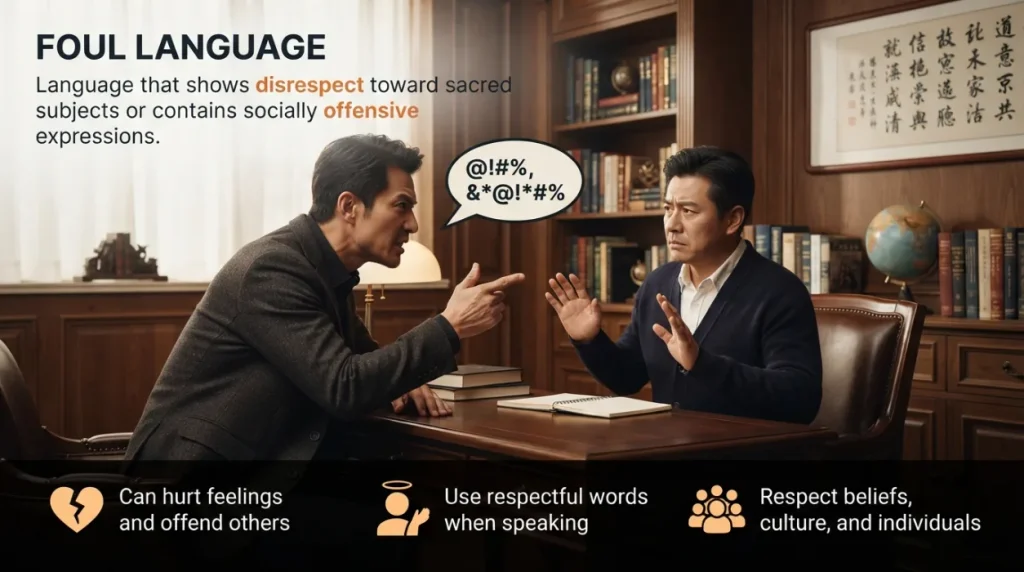
Meaning: Language that shows disrespect toward sacred subjects or contains socially offensive expressions.
Tone/Register: Neutral, formal, academic
Example:
The article discusses profanity in modern entertainment.
The teacher explained why excessive profanity can affect a professional impression.
Vulgarity (Noun) — US /vʌlˈɡærəti/ | UK /vʌlˈɡærəti/
Meaning: Speech or behavior considered crude, rude, or lacking refinement.
Tone/Register: Formal, neutral
Example:
The editor removed several vulgarities from the manuscript.
His casual vulgarity made the interview uncomfortable.
Obscenity (Noun) — US /əbˈsenəti/ | UK /əbˈsenəti/
Meaning: Extremely offensive language or material that violates accepted standards of decency.
Tone/Register: Formal, legal, academic
Example:
The broadcaster received complaints about obscenity.
The film contains scenes and dialogue that may be considered obscene.
Swearing (Noun) — US /ˈswerɪŋ/ | UK /ˈswerɪŋ/
Meaning: The act of using swear words or profane expressions.
Tone/Register: Informal, everyday
Example:
His swearing became noticeable during the heated match.
She apologized for swearing in front of the children.
Cursing (Noun) — US /ˈkɜːrsɪŋ/ | UK /ˈkɜːsɪŋ/
Meaning: The use of curse words, often to express anger, frustration, or surprise.
Tone/Register: Informal, everyday
Example:
Cursing will not solve the problem.
He started cursing after his phone stopped working.
Cussing (Noun) — US /ˈkʌsɪŋ/ | UK /ˈkʌsɪŋ/
Meaning: An informal term for using swear words.
Tone/Register: Informal, conversational
Example:
My grandfather never tolerated cussing at the dinner table.
The character is known for constant cussing.
Bad Language (Noun Phrase) — US /bæd ˈlæŋɡwɪdʒ/ | UK /bæd ˈlæŋɡwɪdʒ/
Meaning: A common informal expression for rude or offensive words.
Tone/Register: Informal, everyday
Example:
The coach warned the players about bad language.
The children were told that bad language was unacceptable.
Strong Language (Noun Phrase) — US /strɔːŋ ˈlæŋɡwɪdʒ/ | UK /strɒŋ ˈlæŋɡwɪdʒ/
Meaning: A polite or indirect way to refer to words that may offend or shock people.
Tone/Register: Neutral, polite, written
Example:
The program contains strong language.
The review warns readers that strong language appears throughout the book.
Coarse Language (Noun Phrase) — US /kɔːrs ˈlæŋɡwɪdʒ/ | UK /kɔːs ˈlæŋɡwɪdʒ/
Meaning: Speech that is rough, vulgar, or lacking in social refinement.
Tone/Register: Formal, neutral
Example:
The novel contains some coarse language.
The manager asked employees to avoid coarse language at work.
Crude Language (Noun Phrase) — US /kruːd ˈlæŋɡwɪdʒ/ | UK /kruːd ˈlæŋɡwɪdʒ/
Meaning: Speech that is offensively direct, vulgar, or lacking in delicacy.
Tone/Register: Neutral, informal
Example:
The comedian is famous for crude language.
His crude language surprised the audience.
Offensive Language (Noun Phrase) — US /əˈfensɪv ˈlæŋɡwɪdʒ/ | UK /əˈfensɪv ˈlæŋɡwɪdʒ/
Meaning: Words that insult, upset, or disrespect people.
Tone/Register: Neutral, formal
Example:
The website prohibits offensive language.
She reported the comment because it contained offensive language.
Abusive Language (Noun Phrase) — US /əˈbjuːsɪv ˈlæŋɡwɪdʒ/ | UK /əˈbjuːsɪv ˈlæŋɡwɪdʒ/
Meaning: Speech used to attack, insult, threaten, or humiliate another person.
Tone/Register: Formal, professional
Example:
The employee was warned about abusive language.
Moderators removed the abusive language from the discussion.
Indecent Language (Noun Phrase) — US /ɪnˈdiːsənt ˈlæŋɡwɪdʒ/ | UK /ɪnˈdiːsənt ˈlæŋɡwɪdʒ/
Meaning: Language that is considered improper, offensive, or unsuitable for polite settings.
Tone/Register: Formal
Example:
The complaint focused on indecent language.
The presenter apologized for the indecent wording.
Profane Language (Noun Phrase) — US /prəˈfeɪn ˈlæŋɡwɪdʒ/ | UK /prəˈfeɪn ˈlæŋɡwɪdʒ/
Meaning: Language that treats sacred or religious subjects disrespectfully or uses profanity.
Tone/Register: Formal, academic
Example:
The book contains several examples of profane language.
The discussion examined the use of profane language in films.
Vulgar Speech (Noun Phrase) — US /ˈvʌlɡər spiːtʃ/ | UK /ˈvʌlɡə spiːtʃ/
Meaning: Spoken language that is crude, rude, or socially unacceptable.
Tone/Register: Formal, academic
Example:
The study examines vulgar speech in online communities.
Vulgar speech can sound especially harsh in formal settings.
Coarse Speech (Noun Phrase) — US /kɔːrs spiːtʃ/ | UK /kɔːs spiːtʃ/
Meaning: Speech characterized by rough, vulgar, or offensive wording.
Tone/Register: Formal, descriptive
Example:
The character uses coarse speech throughout the novel.
Her coarse speech contrasted with her polite appearance.
Crude Speech (Noun Phrase) — US /kruːd spiːtʃ/ | UK /kruːd spiːtʃ/
Meaning: Direct and vulgar speech that may offend listeners.
Tone/Register: Neutral
Example:
His crude speech was inappropriate for the ceremony.
The writer uses crude speech to show the character’s personality.
Offensive Speech (Noun Phrase) — US /əˈfensɪv spiːtʃ/ | UK /əˈfensɪv spiːtʃ/
Meaning: Spoken words that cause offense or deliberately disrespect others.
Tone/Register: Formal, professional
Example:
The policy addresses offensive speech in the workplace.
The moderator removed offensive speech from the live discussion.
Foul Speech (Noun Phrase) — US /faʊl spiːtʃ/ | UK /faʊl spiːtʃ/
Meaning: A direct alternative for speech containing rude or offensive words.
Tone/Register: Neutral
Example:
The referee was criticized for using foul speech.
The character’s foul speech reflects his frustration.
Swear Words (Noun Phrase) — US /swer wɜːrdz/ | UK /sweə wɜːdz/
Meaning: Words used to express strong emotion or considered offensive or vulgar.
Tone/Register: Informal, everyday
Example:
Children often hear swear words in popular media.
The teacher asked the class to avoid swear words.
Curse Words (Noun Phrase) — US /kɜːrs wɜːrdz/ | UK /kɜːs wɜːdz/
Meaning: Informal words used as profanity or to express anger, frustration, or surprise.
Tone/Register: Informal
Example:
He muttered a few curse words after missing the train.
The movie contains several curse words.
Cuss Words (Noun Phrase) — US /kʌs wɜːrdz/ | UK /kʌs wɜːdz/
Meaning: A casual American expression for swear words.
Tone/Register: Informal, conversational
Example:
The comedian uses plenty of cuss words.
She asked her younger brother not to repeat cuss words.
Bad Words (Noun Phrase) — US /bæd wɜːrdz/ | UK /bæd wɜːdz/
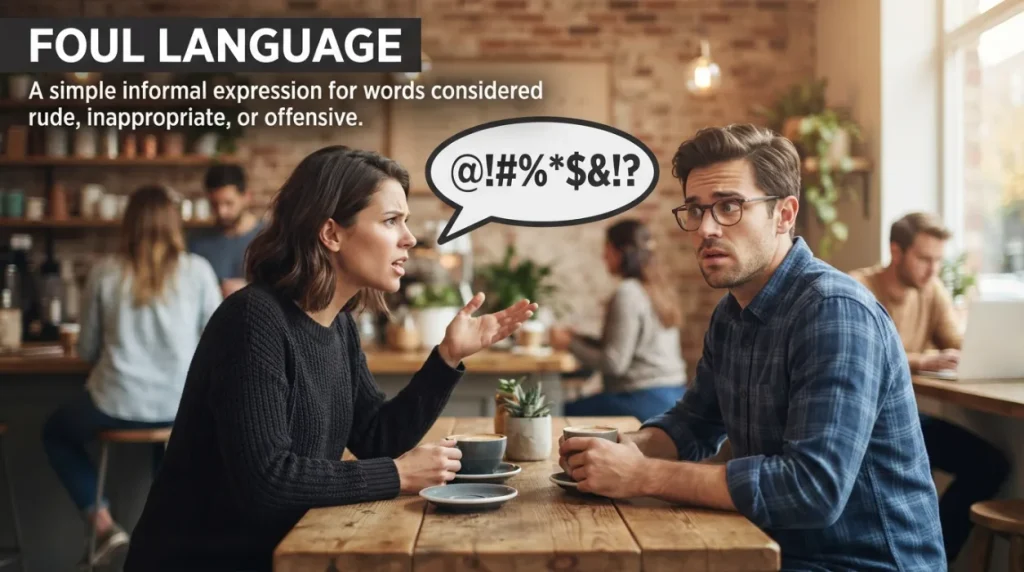
Meaning: A simple informal expression for words considered rude, inappropriate, or offensive.
Tone/Register: Informal, child-friendly
Example:
Parents often tell young children not to use bad words.
The student apologized after saying a bad word in class.
Four-Letter Words (Noun Phrase) — US /ˌfɔːr ˈletər wɜːrdz/ | UK /ˌfɔː ˈletə wɜːdz/
Meaning: A euphemistic expression for short, commonly recognized swear words.
Tone/Register: Informal, idiomatic
Example:
The dialogue is full of four-letter words.
The editor removed several four-letter words from the article.
Expletives (Noun) — US /ɪkˈspletɪvz/ | UK /ɪkˈspletɪvz/
Meaning: Offensive or emotional words used to express anger, surprise, pain, or frustration.
Tone/Register: Formal, neutral
Example:
He shouted several expletives after the accident.
The report avoids quoting the expletives directly.
Verbal Obscenities (Noun Phrase) — US /ˈvɜːrbəl əbˈsenətiz/ | UK /ˈvɜːbəl əbˈsenətiz/
Meaning: Spoken words or expressions that are extremely offensive or indecent.
Tone/Register: Formal
Example:
The witness reported repeated verbal obscenities.
The broadcast was criticized for allowing verbal obscenities.
Profane Expressions (Noun Phrase) — US /prəˈfeɪn ɪkˈspreʃənz/ | UK /prəˈfeɪn ɪkˈspreʃənz/
Meaning: Expressions containing profanity or disrespect toward sacred ideas.
Tone/Register: Formal, academic
Example:
The researcher recorded several profane expressions.
Some profane expressions have become common in casual dialogue.
Vulgar Expressions (Noun Phrase) — US /ˈvʌlɡər ɪkˈspreʃənz/ | UK /ˈvʌlɡə ɪkˈspreʃənz/
Meaning: Phrases that sound crude, rude, or socially inappropriate.
Tone/Register: Neutral
Example:
The writer avoided vulgar expressions in the formal report.
Some vulgar expressions are common in casual comedy.
Crude Expressions (Noun Phrase) — US /kruːd ɪkˈspreʃənz/ | UK /kruːd ɪkˈspreʃənz/
Meaning: Rudely direct or vulgar phrases that may offend listeners.
Tone/Register: Informal, neutral
Example:
The speaker apologized for using crude expressions.
The character relies on crude expressions to appear rebellious.
Offensive Expressions (Noun Phrase) — US /əˈfensɪv ɪkˈspreʃənz/ | UK /əˈfensɪv ɪkˈspreʃənz/
Meaning: Words or phrases that can hurt, insult, or upset another person.
Tone/Register: Formal, neutral
Example:
The guide explains why certain offensive expressions should be avoided.
She replaced the offensive expression with a respectful phrase.
Profane Terms (Noun Phrase) — US /prəˈfeɪn tɜːrmz/ | UK /prəˈfeɪn tɜːmz/
Meaning: Individual words or terms regarded as profane or disrespectful.
Tone/Register: Formal, academic
Example:
The linguist analyzed several profane terms.
The glossary explains how profane terms developed over time.
Vulgar Terms (Noun Phrase) — US /ˈvʌlɡər tɜːrmz/ | UK /ˈvʌlɡə tɜːmz/
Meaning: Words considered crude, rude, or socially unacceptable.
Tone/Register: Neutral, formal
Example:
The textbook identifies several vulgar terms.
The author chose not to repeat the vulgar terms in the article.
Obscene Terms (Noun Phrase) — US /əbˈsiːn tɜːrmz/ | UK /əbˈsiːn tɜːmz/
Meaning: Words considered extremely offensive or indecent.
Tone/Register: Formal, legal
Example:
The platform restricts obscene terms in public comments.
The documentary discusses the history of obscene terms.
Derogatory Language (Noun Phrase) — US /dɪˈrɑːɡətɔːri ˈlæŋɡwɪdʒ/ | UK /dɪˈrɒɡətəri ˈlæŋɡwɪdʒ/
Meaning: Language that expresses disrespect or a negative judgment about someone.
Tone/Register: Formal, academic
Example:
The report identifies derogatory language in the conversation.
Editors should remove derogatory language from professional content.
Insulting Language (Noun Phrase) — US /ɪnˈsʌltɪŋ ˈlæŋɡwɪdʒ/ | UK /ɪnˈsʌltɪŋ ˈlæŋɡwɪdʒ/
Meaning: Words used to offend, belittle, or attack another person.
Tone/Register: Neutral
Example:
The argument quickly turned into insulting language.
She stayed calm despite the insulting language.
Insult-Laden Speech (Noun Phrase) — US /ˈɪnsʌlt leɪdən spiːtʃ/ | UK /ˈɪnsʌlt leɪdən spiːtʃ/
Meaning: Speech containing many personal attacks or insulting remarks.
Tone/Register: Formal, descriptive
Example:
The debate became filled with insult-laden speech.
The interviewer redirected the insult-laden conversation.
Invective (Noun) — US /ɪnˈvektɪv/ | UK /ɪnˈvektɪv/
Meaning: Harsh, insulting, and strongly critical language directed at someone or something.
Tone/Register: Formal, literary
Example:
The speech contained fierce political invective.
The novelist uses invective to reveal the character’s anger.
Verbal Abuse (Noun Phrase) — US /ˈvɜːrbəl əˈbjuːs/ | UK /ˈvɜːbəl əˈbjuːs/
Meaning: Repeated spoken attacks, insults, or degrading remarks directed toward another person.
Tone/Register: Formal, serious
Example:
The organization has a strict policy against verbal abuse.
The player reported verbal abuse from the crowd.
Name-Calling (Noun) — US /ˈneɪm ˌkɔːlɪŋ/ | UK /ˈneɪm ˌkɔːlɪŋ/
Meaning: The practice of using insulting names or labels against another person.
Tone/Register: Informal, everyday
Example:
Name-calling made the disagreement worse.
The children were reminded that name-calling is disrespectful.
Epithets (Noun) — US /ˈepəθets/ | UK /ˈepɪθets/
Meaning: Descriptive labels or terms applied to people, especially when they are insulting or abusive.
Tone/Register: Formal, literary
Example:
The historical text contains several insulting epithets.
The writer avoided offensive epithets when describing the character.
Colorful Language (Noun Phrase) — US /ˈkʌlərfəl ˈlæŋɡwɪdʒ/ | UK /ˈkʌləfəl ˈlæŋɡwɪdʒ/
Meaning: A euphemistic and often humorous phrase for vivid, forceful, or sometimes offensive language.
Tone/Register: Informal, euphemistic
Example:
He used some colorful language when the computer crashed.
The writer is known for colorful language in his stories.
Blue Language (Noun Phrase) — US /bluː ˈlæŋɡwɪdʒ/ | UK /bluː ˈlæŋɡwɪdʒ/
Meaning: An informal expression referring to language that is vulgar, profane, or sexually explicit.
Tone/Register: Informal, idiomatic
Example:
The comedian is famous for blue language.
The podcast occasionally uses blue language.
Salty Language (Noun Phrase) — US /ˈsɔːlti ˈlæŋɡwɪdʒ/ | UK /ˈsɔːlti ˈlæŋɡwɪdʒ/
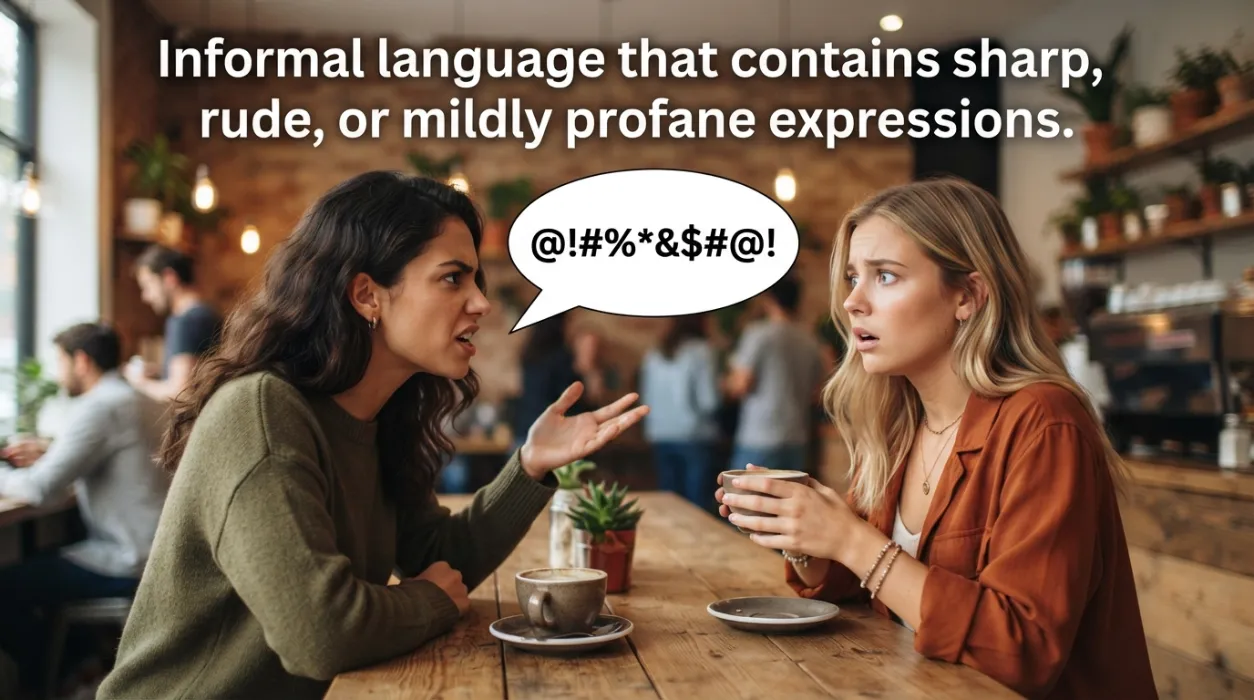
Meaning: Informal language that contains sharp, rude, or mildly profane expressions.
Tone/Register: Informal, playful
Example:
The sailor was known for salty language.
She added a little salty language to the humorous story.
Dirty Language (Noun Phrase) — US /ˈdɜːrti ˈlæŋɡwɪdʒ/ | UK /ˈdɜːti ˈlæŋɡwɪdʒ/
Meaning: Informal speech that is vulgar, obscene, or sexually inappropriate.
Tone/Register: Informal
Example:
The show is not suitable for children because of its dirty language.
The character’s dirty language was part of the film’s adult humor.
Raunchy Language (Noun Phrase) — US /ˈrɔːntʃi ˈlæŋɡwɪdʒ/ | UK /ˈrɔːntʃi ˈlæŋɡwɪdʒ/
Meaning: Informal language that is openly vulgar or sexually suggestive.
Tone/Register: Informal
Example:
The comedy routine includes raunchy language.
The review warns readers about the film’s raunchy dialogue.
Locker-Room Language (Noun Phrase) — US /ˈlɑːkər ruːm ˈlæŋɡwɪdʒ/ | UK /ˈlɒkə ruːm ˈlæŋɡwɪdʒ/
Meaning: Informal speech stereotypically associated with casual groups and often containing vulgar or sexual remarks.
Tone/Register: Informal, idiomatic
Example:
The manager asked the team to avoid locker-room language.
The article criticizes the use of locker-room language in public debates.
Explicit Speech (Noun Phrase) — US /ɪkˈsplɪsɪt spiːtʃ/ | UK /ɪkˈsplɪsɪt spiːtʃ/
Meaning: Speech that directly states offensive, sexual, or otherwise adult content without softening it.
Tone/Register: Neutral, formal
Example:
The program contains explicit speech.
Parents may want to check the content before allowing children to watch it.
Indecent Speech (Noun Phrase) — US /ɪnˈdiːsənt spiːtʃ/ | UK /ɪnˈdiːsənt spiːtʃ/
Meaning: Speech considered improper or offensive according to social or legal standards.
Tone/Register: Formal
Example:
The complaint described the comments as indecent speech.
The speaker was criticized for using indecent speech during the event.
Scatological Language (Noun Phrase) — US /ˌskætəˈlɑːdʒɪkəl ˈlæŋɡwɪdʒ/ | UK /ˌskætəˈlɒdʒɪkəl ˈlæŋɡwɪdʒ/
Meaning: Language that refers crudely or humorously to bodily waste or related subjects.
Tone/Register: Academic, literary
Example:
The novel uses scatological language for comic effect.
The researcher examined scatological language in medieval humor.
Blasphemous Language (Noun Phrase) — US /ˈblæsfəməs ˈlæŋɡwɪdʒ/ | UK /ˈblæsfəməs ˈlæŋɡwɪdʒ/
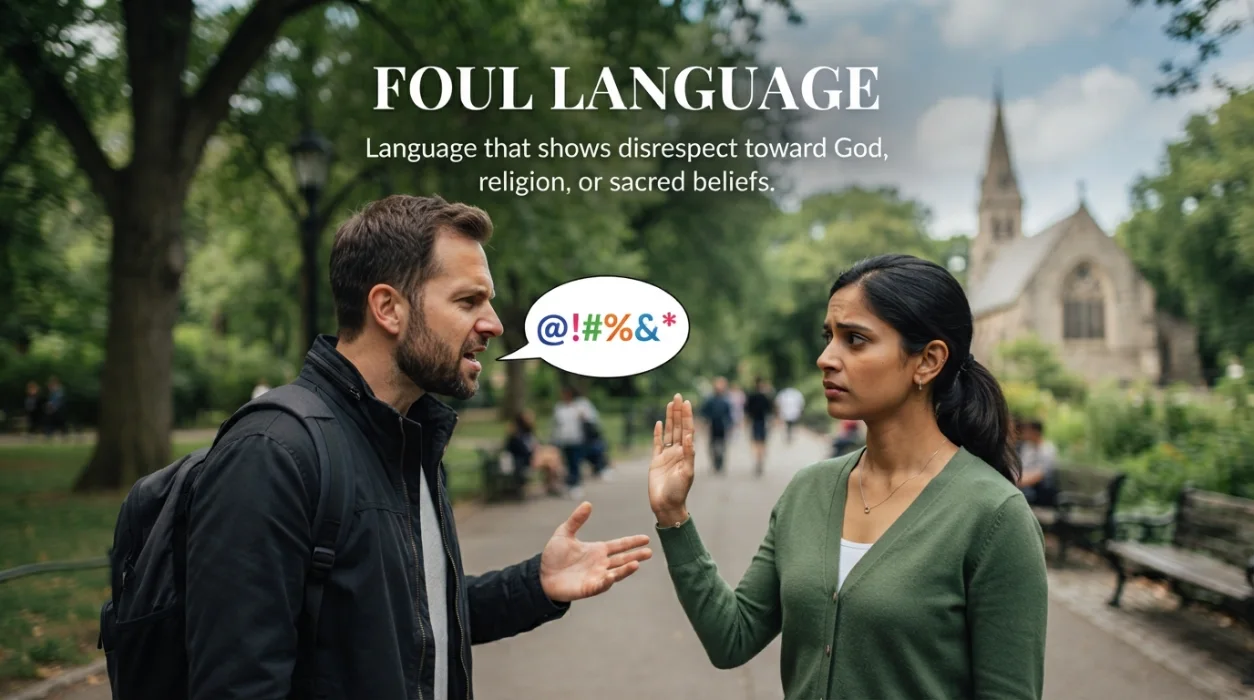
Meaning: Language that shows disrespect toward God, religion, or sacred beliefs.
Tone/Register: Formal, religious
Example:
The speech was criticized for its blasphemous language.
The historical text contains several examples of blasphemous language.
Synonyms by Tone
Positive or Playful Use
Some alternatives can sound lighter when used descriptively or humorously. Colorful language and salty language are good examples.
However, they still suggest language that may be inappropriate in certain situations.
Neutral Use
For neutral descriptions, consider foul speech, strong language, offensive language, swearing, or expletives.
These choices work well when you want to describe the speech without strongly judging the person.
Negative Use
When the focus is on harm or disrespect, terms such as abusive language, verbal abuse, derogatory language, and insulting language are more precise.
They emphasize the effect on another person rather than simply the presence of swear words.
Formal or Academic Use
For essays, reports, and linguistic discussions, profanity, obscenity, vulgarity, invective, and scatological language may be more suitable.
Therefore, always choose according to context rather than replacing one phrase mechanically.
Foul Language vs Close Alternatives
Foul language vs profanity:
Foul language is broader. Profanity often focuses on swear words or disrespectful expressions, especially those connected with religion or strong emotion.
Foul language vs vulgarity:
Vulgarity emphasizes crude or socially unacceptable wording. It can also describe behavior, jokes, or manners.
Foul language vs verbal abuse:
Verbal abuse is narrower and more serious. It focuses on speech used to attack, humiliate, threaten, or degrade someone.
How Foul Language Changes by Context
Daily Conversation
In everyday speech, people commonly say bad language, swearing, cussing, or swear words.
These choices sound natural and conversational. They are useful when talking with friends or explaining something to children.
Writing and Blogging
Bloggers often choose broader expressions such as strong language, offensive language, or colorful language.
These terms can make writing sound smoother, especially when discussing books, films, music, or online conversations.
Professional and Academic Writing
In professional settings, precision matters. Profanity, obscenity, derogatory language, and abusive language can describe the issue more clearly.
For example, a workplace report might discuss offensive language rather than using a casual phrase like bad words.
Creative and Informal Writing
Authors may use blue language, salty language, raunchy language, or locker-room language when creating a particular voice.
However, these expressions should match the character, audience, and setting.
Common Mistakes Learners Make
One common mistake is treating every synonym as completely interchangeable. They are not.
For example, verbal abuse usually involves harmful personal attacks, while swearing simply describes the use of swear words.
Another mistake is using informal phrases in formal writing. Cuss words and bad words are natural in conversation but may sound too casual in an academic essay.
Learners also sometimes confuse explicit language with foul language. Explicit language can include adult or sexual content without necessarily being profanity.
Register Notes
Formal: profanity, obscenity, invective, derogatory language, indecent language
Neutral: foul speech, offensive language, strong language, vulgarity
Informal: cussing, bad words, cuss words, colorful language, salty language
Academic: scatological language, verbal obscenities, profane expressions
As a result, the best synonym depends on the audience and purpose.
Real-Life Mini Scenarios
Workplace
A manager may describe inappropriate comments as offensive language or abusive language.
This sounds more professional than saying someone used “bad words.”
Social Situations
Friends might casually say, “He was swearing all evening.”
Similarly, someone may say that a movie contains strong language.
Media and Pop Culture
Film reviews often use explicit speech, strong language, or colorful language.
These expressions help readers understand content warnings without quoting offensive words.
Storytelling
A novelist may choose coarse speech or crude expressions to make a character sound aggressive or rebellious.
Meanwhile, salty language can create a more humorous impression.
Why Synonym Choice Matters
Choosing the right synonym is not simply about replacing one word with another.
Instead, it is about matching meaning, tone, audience, and purpose. A strong vocabulary lets you describe the same general idea from different angles.
For instance, profanity sounds analytical, cussing sounds casual, and verbal abuse sounds serious.
Therefore, understanding these differences helps you communicate with greater accuracy.
Related Questions About Foul Language
What Is the Use of Foul Language Called?
The use of foul language is commonly called swearing, cursing, cussing, or using profanity. These terms describe the act of using words or expressions that may be considered rude, vulgar, offensive, or socially inappropriate.
For example:
“He was swearing during the argument.”
In formal writing, using profanity or using offensive language may sound more appropriate than informal terms such as cussing or cursing.
What Is It Called to Use Bad Language?
To use bad language is commonly called swearing, cursing, or cussing. Among these, swearing is widely understood in everyday English, while cussing is especially common in informal American English.
For example:
“The teacher asked the students to stop swearing.”
The noun forms are swearing, cursing, and cussing, depending on the variety and context of English.
What Is a Person Who Uses Bad Words Called?
There is no single standard English noun that specifically means “a person who speaks bad words.” A person who frequently uses such language can be described as someone who swears, someone who uses profanity, or someone who uses foul language.
In informal contexts, a person may also be described as a frequent swearer, although this expression is less common than simply saying that someone “swears a lot.”
For example:
“He is known for swearing frequently.”
This describes the person’s use of language without suggesting that every person who occasionally swears has a particular label.
What Is Language That Is Vulgar, Abusive, or Disrespectful of Sacred Things Called?
The most precise term depends on the type of language involved.
- Vulgar language refers to crude or socially unacceptable expressions.
- Abusive language refers to speech used to insult, threaten, humiliate, or attack another person.
- Profane language can refer to language involving profanity or disrespect toward sacred subjects.
- Blasphemous language specifically refers to speech that shows disrespect toward God, religion, or sacred beliefs.
- Foul language is a broad expression that can cover several of these categories.
Therefore, these terms are related but are not always exact synonyms. Choosing the term that describes the specific type of offensive speech makes the meaning clearer.
What Is Another Term for Foul Language?
Several terms can be used instead of foul language, depending on tone and context. Common alternatives include profanity, vulgarity, obscenity, swearing, cursing, cussing, bad language, strong language, coarse language, crude language, offensive language, and profane language.
For example:
“The movie contains strong language.”
This is a relatively polite way to warn readers or viewers about offensive or profane speech without repeating the actual words.
What Is Another Word for Inappropriate Language?
Depending on the context, offensive language, improper language, indecent language, inappropriate language, strong language, or derogatory language may be used.
However, the meaning can differ slightly. Derogatory language focuses on disrespect toward a person or group, while offensive language is broader. Indecent language emphasizes language considered improper or unsuitable according to social or cultural standards.
What Is a Dictionary Definition of Foul Language?
In general English usage, foul language means language containing words or expressions that are considered rude, offensive, vulgar, profane, or socially inappropriate.
It is a broad noun phrase rather than the name of one particular type of swear word.
What Does “Profane Terms” Mean?
Profane terms are words or expressions regarded as profane, especially when they show disrespect toward sacred or religious subjects. In broader everyday usage, profane language can also refer to profanity or swear words.
Profane terms can take many forms, so the exact meaning depends on the context in which they are used.
What Does “Verbal Obscenities” Mean?
Verbal obscenities are spoken words or expressions considered extremely offensive, indecent, or obscene. The phrase is more formal than everyday expressions such as swear words or cuss words.
For example:
“The report documented repeated verbal obscenities during the incident.”
What Does “Profuse Language” Mean?
Profuse language is not normally used as a synonym for foul language. The word profuse generally means abundant, plentiful, or excessive.
If you mean language containing profanity, the appropriate expression is usually profane language, profanity, or foul language.
This distinction is important because profuse and profane are different words with different meanings.
Is “Please Refrain From Using Offensive Language” Correct?
Yes. “Please refrain from using offensive language” is a polite and formal way to ask someone to stop using words that may insult, upset, or offend others.
The verb refrain means to deliberately avoid doing something. Therefore, the sentence is commonly suitable for workplace rules, community guidelines, moderation notices, educational settings, and other formal communication.
For example:
“Please refrain from using offensive language in the discussion.”
What Are Other Words for Bad Language?
Other expressions for bad language include foul language, profanity, vulgarity, swearing, cursing, cussing, strong language, offensive language, coarse language, crude language, and profane language.
The best choice depends on the intended meaning. Swearing and cussing sound conversational, while profanity, vulgarity, and offensive language are generally more suitable for formal or descriptive writing.
What Is the Difference Between Foul Language and Bad Language?
Foul language and bad language are very close in meaning and can often be used interchangeably in everyday English. Both refer broadly to rude, offensive, vulgar, or inappropriate speech.
The main difference is one of tone. Bad language can sound simpler and more conversational, while foul language can sound somewhat stronger or more descriptive.
Are Foul Language, Profanity, and Verbal Abuse the Same?
No. These expressions overlap, but they are not identical.
Foul language is a broad term for rude, vulgar, offensive, or inappropriate speech. Profanity generally refers to swear words or profane expressions. Verbal abuse is more specific and involves speech used to attack, threaten, humiliate, intimidate, or degrade another person.
For example, someone may use profanity out of frustration without directing it at another person. That would not necessarily constitute verbal abuse.
Quick Guide to the Most Common Terms
| Term | Main meaning | Typical use |
|---|---|---|
| Foul language | Broad term for rude or offensive speech | General |
| Profanity | Profane or offensive expressions | Formal/academic |
| Swearing | The act of using swear words | Everyday |
| Cursing | Using curse words, often to express emotion | Everyday |
| Cussing | Informal term for swearing | Conversational |
| Vulgarity | Crude or socially unacceptable language | Formal/neutral |
| Obscenity | Extremely offensive or indecent language | Formal/legal |
| Strong language | Polite indirect reference to offensive language | Reviews/content warnings |
| Offensive language | Language that causes offense | Professional/general |
| Abusive language | Language used to attack or harm someone | Professional/serious |
| Derogatory language | Language expressing disrespect or negative judgment | Academic/formal |
| Invective | Harsh, insulting language directed at someone | Literary/formal |
| Blasphemous language | Disrespectful language concerning sacred beliefs | Religious/formal |
Key Takeaway
The phrase foul language has many related expressions, but they are not all interchangeable. Swearing, cussing, and cursing describe the act of using offensive words, while profanity, vulgarity, obscenity, offensive language, and abusive language describe different aspects or categories of inappropriate speech.
When choosing a synonym, consider whether you are describing profanity itself, crude wording, personal insults, abusive behavior, religious disrespect, or simply inappropriate speech. This makes your writing more accurate and natural.
Interactive Practice Quiz
1. A student is writing an academic essay about swear words in films. Which term fits best?
A. Cuss words
B. Profanity
C. Bad words
D. Salty language
2. A parent casually tells a child to stop using rude words. Which phrase sounds most natural?
A. Bad words
B. Invective
C. Scatological language
D. Verbal obscenities
3. A workplace report describes repeated personal attacks against an employee. Which term is most precise?
A. Colorful language
B. Verbal abuse
C. Cussing
D. Four-letter words
4. A film review politely warns readers about profanity. Which expression is suitable?
A. Strong language
B. Cuss words
C. Bad words
D. Name-calling
5. A novelist wants to describe rough, vulgar dialogue. Which term works best?
A. Coarse speech
B. Formal speech
C. Polite wording
D. Neutral vocabulary
6. A comedian uses vivid and mildly offensive expressions. Which informal phrase could describe this?
A. Salty language
B. Academic language
C. Technical language
D. Formal terminology
7. A debate contains harsh personal attacks. Which term is appropriate?
A. Invective
B. Politeness
C. Courtesy
D. Praise
8. A language researcher studies references to bodily waste in literature. Which term fits?
A. Scatological language
B. Cuss words
C. Strong language
D. Bad language
9. A teacher wants a neutral description of rude speech. Which term is best?
A. Offensive language
B. Funny language
C. Beautiful language
D. Academic praise
10. A character uses insulting names against another character. Which term fits best?
A. Name-calling
B. Courtesy
C. Complimenting
D. Formal speech
Reflection Task: Write one original sentence using any synonym from the list. Then rewrite the sentence with a different synonym and compare the tone.
Answer Key: 1-B | 2-A | 3-B | 4-A | 5-A | 6-A | 7-A | 8-A | 9-A | 10-A |
Conclusion
Learning synonyms for foul language gives you more ways to describe offensive speech. It helps you avoid repetition while keeping your writing natural.
Synonyms for foul language are especially useful when discussing rude expressions in essays, articles, reviews, stories, or everyday conversations. The right alternative can also show the seriousness, tone, or context of the speech.
For students, bloggers, writers, and English learners, synonyms for foul language can improve vocabulary and make communication more precise. Understanding these alternatives helps you recognize differences between informal, neutral, and formal language.
By choosing words carefully, you can explain offensive speech without sounding repetitive or unclear. Practice using these alternatives in short sentences, essays, and conversations to build confidence and stronger English communication skills.
FAQs
1. What is a polite synonym for foul language?
A polite synonym is strong language. It is commonly used when you want to mention rude, offensive, or profane speech without repeating the actual words. This expression works particularly well in film reviews, content warnings, workplace discussions, and general writing because it sounds less direct than terms such as profanity or obscenity.
2. What is the difference between foul language and profanity?
Foul language is a broad term for rude, vulgar, offensive, or inappropriate speech. Profanity is more specific and often refers to swear words or expressions involving sacred subjects. Therefore, profanity can be considered one type of foul language, while foul language may include other forms of offensive speech as well.
3. What synonym for foul language is best for academic writing?
For academic writing, profanity, obscenity, vulgarity, or derogatory language may be appropriate, depending on the subject. These terms are more precise than casual expressions such as bad words or cuss words. In a linguistic paper, choose the term that accurately describes the type of language being studied.
4. Is “bad language” the same as “foul language”?
Bad language and foul language are very close in everyday English. Both can describe rude, offensive, or vulgar speech. However, bad language sounds slightly simpler and more conversational. Foul language can sound somewhat stronger or more descriptive, especially when discussing inappropriate speech in media, public settings, or formal discussions.
5. Can “verbal abuse” replace “foul language”?
Sometimes, but not always. Verbal abuse specifically suggests speech intended to hurt, intimidate, humiliate, or attack another person. Foul language may contain swear words without targeting anyone. Therefore, use verbal abuse when harmful treatment through speech is the main idea, rather than simply the presence of profanity.

Hasnain Ali is an SEO Content Strategist and the founder of wordvora.com, a trusted vocabulary platform that helps writers, students, professionals, and English learners find accurate synonyms, antonyms, word meanings, and real-life usage examples. He specializes in keyword research, on-page SEO, topical authority, and creating search-first content that aligns with Google’s latest Search Quality and E-E-A-T guidelines. His work focuses on producing clear, well-structured, and reader-friendly resources that satisfy search intent while maintaining high editorial standards.
Through extensive hands-on experience with SEO tools such as Google Search Console, Google Analytics, SEMrush, and Ahrefs, Hasnain researches user search behavior and develops content that is both informative and easy to understand. Every article published on wordvora.com is carefully reviewed for accuracy, readability, and contextual relevance before publication. His mission is to build one of the web’s most reliable English vocabulary resources by providing practical language guidance, trustworthy explanations, and content that helps readers improve their writing, communication, and vocabulary with confidence.