
Synonyms for panting can make a simple scene much more vivid. Imagine finishing a steep run, stopping at the top, and struggling to catch your breath.
A writer might say, “He was panting after the race.” However, “he was gasping for air” creates a different image and emotional effect.
The word panting is common because it quickly describes fast, heavy breathing. Still, alternatives help you express its exact intensity.
Learning synonyms for panting helps students, bloggers, content writers, and everyday English users describe movement, emotion, exhaustion, and physical effort naturally.
What Does “Panting” Really Mean?
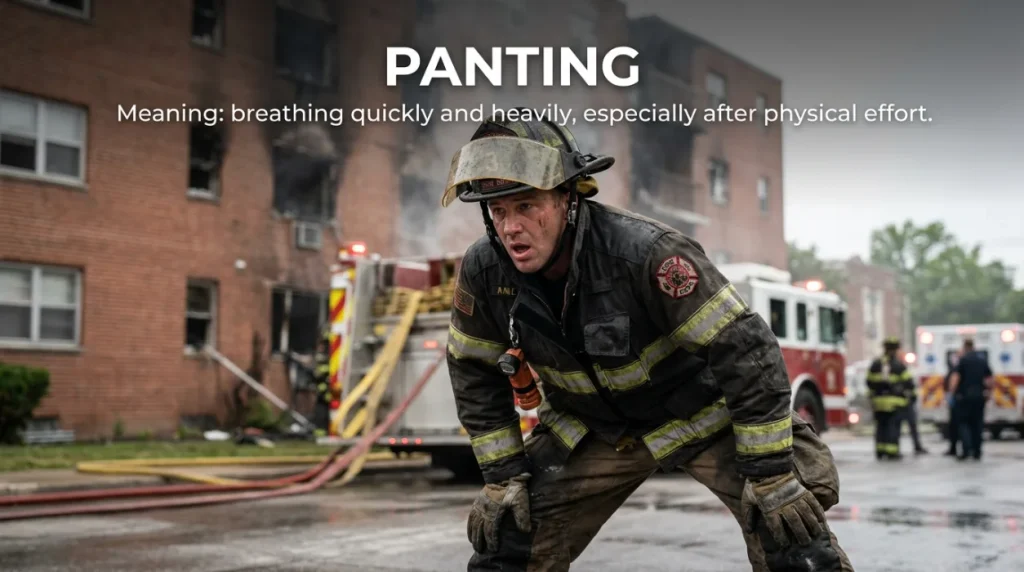
Panting means breathing quickly and heavily, usually through the mouth, because of physical activity, heat, excitement, fear, stress, or another cause.
In simple English, panting means taking fast, noticeable breaths.
For example:
“The dog was panting after chasing the ball.”
The dog is breathing rapidly because it has been active.
Another example is:
“She was panting after running up the stairs.”
Here, the rapid breathing suggests physical exertion.
Part of Speech
Panting can function as a present participle or gerund of the verb pant.
The base verb is pant.
Its forms include:
- pant
- pants
- panted
- panting
As a present participle, it can describe an action:
“The exhausted runner came inside, panting.”
As a gerund, it can function as a noun:
“Panting after exercise is normal.”
The exact meaning depends on context.
How Native Speakers Understand “Panting”
Native speakers usually associate panting with repeated, quick breaths that are clearly noticeable.
The word often suggests physical effort.
However, panting can also result from fear, anxiety, excitement, heat, illness, or intense emotion.
The surrounding sentence tells the reader why the breathing is happening.
For instance:
“The puppy was panting happily.”
This sounds light and positive.
By contrast:
“He was panting in panic.”
This creates a tense and frightening image.
Connotative Meaning of “Panting”
Connotation (the emotional feeling or association connected with a word beyond its basic dictionary meaning) matters when choosing an alternative.
Positive Tone
Panting can have a positive or energetic feeling when it follows exercise, play, excitement, or adventure.
“The children came back from the game, panting and laughing.”
The breathing signals energy rather than danger.
Negative Tone
The word can suggest exhaustion, fear, distress, or physical struggle.
“He was panting after the long climb.”
The reader may imagine someone physically overwhelmed.
Neutral Tone
In a straightforward description, panting simply reports rapid breathing.
“The dog was panting in the afternoon heat.”
There is no strong emotional judgment.
Etymology of “Panting”
The word panting comes from the verb pant.
The exact origin of pant is uncertain. English has used forms related to pant since the Middle English period. Linguists generally connect it with expressive or imitative formations associated with heavy breathing.
The word developed around the idea of breathing rapidly, heavily, or with difficulty.
Old English: 450–1100
The modern verb pant was not established in Old English in its present form.
Old English had other verbs and expressions for breathing, sighing, gasping, and physical exertion.
These older vocabulary patterns provided part of the semantic background from which later English developed more specific words for breathing.
Middle English: 1100–1500
During the Middle English period, forms related to pant appeared.
The word was associated with rapid or labored breathing. Its expressive quality made it useful in descriptions of physical effort and strong emotion.
As English vocabulary expanded, pant became increasingly recognizable as a verb connected with heavy breathing.
Modern English: 1500–Present
In Modern English, pant, panting, and related forms became firmly established.
The word is now common in descriptions of exercise, animals, heat, fear, exhaustion, and emotional excitement.
Today, panting is especially useful because it can describe breathing without automatically implying a medical condition.
Pronunciation
US: /ˈpæn.tɪŋ/
UK: /ˈpæn.tɪŋ/
Syllables
pant-ing
There are two syllables.
Affixation Pattern of “Panting”
Root: pant
Prefix: None
Suffix: -ing
The -ing suffix creates the present participle panting and can also form a gerund.
The word is therefore structurally simple:
pant + ing = panting
Synonyms List
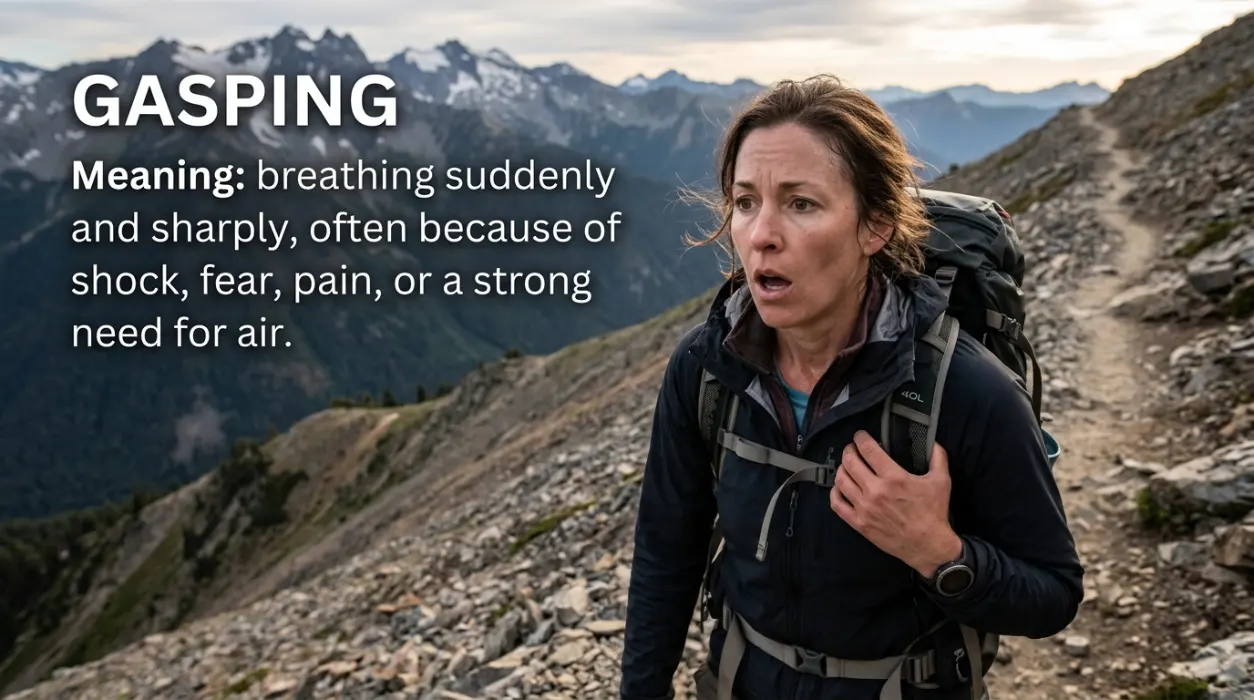
Gasping (Verb/Present Participle) — US /ˈɡæs.pɪŋ/ — UK /ˈɡɑː.spɪŋ/
Meaning: Breathing suddenly and sharply, often because of shock, fear, pain, or a strong need for air.
Tone/Register: Neutral, dramatic, descriptive.
Example:
She was gasping after the sudden sprint.
He came through the door, gasping for breath.
Puffing (Verb/Present Participle) — US /ˈpʌf.ɪŋ/ — UK /ˈpʌf.ɪŋ/
Meaning: Breathing heavily in short bursts, usually after physical effort.
Tone/Register: Informal, conversational.
Example:
He arrived at the top of the hill, puffing hard.
She was puffing after carrying the boxes upstairs.
Heaving (Verb/Present Participle) — US /ˈhiː.vɪŋ/ — UK /ˈhiː.vɪŋ/
Meaning: Breathing heavily with strong, noticeable movements of the chest or body.
Tone/Register: Neutral, descriptive.
Example:
His chest was heaving after the race.
She stood against the wall, heaving for breath.
Breathing Heavily (Verb Phrase) — US /ˈbriː.ðɪŋ ˈhev.ə.li/ — UK /ˈbriː.ðɪŋ ˈhev.ə.li/
Meaning: Taking large or rapid breaths that are clearly stronger than normal breathing.
Tone/Register: Neutral, everyday.
Example:
I was breathing heavily after the workout.
She sat down and started breathing heavily.
Breathing Hard (Verb Phrase) — US /ˈbriː.ðɪŋ hɑːrd/ — UK /ˈbriː.ðɪŋ hɑːd/
Meaning: Breathing rapidly and forcefully because of physical effort.
Tone/Register: Informal, common.
Example:
He was breathing hard after the final lap.
I was still breathing hard when I reached the car.
Short of Breath (Adjective Phrase) — US /ʃɔːrt əv breθ/ — UK /ʃɔːt əv breθ/
Meaning: Having difficulty breathing normally or feeling unable to get enough air.
Tone/Register: Neutral, everyday, medical.
Example:
She felt short of breath after climbing the stairs.
He was slightly short of breath after the hike.
Breathless (Adjective) — US /ˈbreθ.ləs/ — UK /ˈbreθ.ləs/
Meaning: Unable to breathe normally because of exertion, excitement, surprise, or strong emotion.
Tone/Register: Neutral, literary, expressive.
Example:
They reached the finish line breathless but smiling.
The announcement left her breathless with excitement.
Winded (Adjective) — US /ˈwɪn.dɪd/ — UK /ˈwɪn.dɪd/
Meaning: Temporarily unable to breathe comfortably after intense physical activity or a sudden impact.
Tone/Register: Informal, common.
Example:
The steep stairs left me completely winded.
He was winded after the long chase.
Out of Breath (Adjective Phrase) — US /aʊt əv breθ/ — UK /aʊt əv breθ/
Meaning: Breathing with difficulty after exertion or intense activity.
Tone/Register: Informal, everyday.
Example:
I was out of breath after running for the bus.
She arrived out of breath but right on time.
Struggling to Breathe (Verb Phrase) — US /ˈstrʌɡ.lɪŋ tə briːð/ — UK /ˈstrʌɡ.lɪŋ tə briːð/
Meaning: Having difficulty getting enough air or maintaining normal breathing.
Tone/Register: Serious, descriptive.
Example:
The exhausted climber was struggling to breathe.
He stopped and rested after struggling to breathe.
Laboring to Breathe (Verb Phrase) — US /ˈleɪ.bər.ɪŋ tə briːð/ — UK /ˈleɪ.bər.ɪŋ tə briːð/
Meaning: Breathing with considerable effort and difficulty.
Tone/Register: Formal, literary, serious.
Example:
The injured runner was laboring to breathe.
She sat quietly, laboring to breathe after the climb.
Drawing Breath (Verb Phrase) — US /ˈdrɔː.ɪŋ breθ/ — UK /ˈdrɔː.ɪŋ breθ/
Meaning: Taking a breath, especially when recovering from exertion or intense emotion.
Tone/Register: Literary, descriptive.
Example:
He paused before drawing breath again.
She stopped at the gate, barely drawing breath.
Fighting for Breath (Verb Phrase) — US /ˈfaɪ.tɪŋ fər breθ/ — UK /ˈfaɪ.tɪŋ fə breθ/
Meaning: Breathing with extreme difficulty and making a strong effort to get enough air.
Tone/Register: Dramatic, serious.
Example:
The runner collapsed, fighting for breath.
He climbed the final steps, fighting for breath.
Choking for Breath (Verb Phrase) — US /ˈtʃoʊ.kɪŋ fər breθ/ — UK /ˈtʃəʊ.kɪŋ fə breθ/
Meaning: Struggling to breathe normally because airflow feels restricted.
Tone/Register: Dramatic, serious.
Example:
She was choking for breath after the smoke filled the room.
He stumbled outside, choking for breath.
Sucking in Air (Verb Phrase) — US /ˈsʌk.ɪŋ ɪn er/ — UK /ˈsʌk.ɪŋ ɪn eə/
Meaning: Taking large, quick breaths to recover from physical effort or shock.
Tone/Register: Informal, vivid.
Example:
He leaned against the fence, sucking in air.
She finished the race and stood there sucking in air.
Taking Deep Breaths (Verb Phrase) — US /ˈteɪ.kɪŋ diːp breθs/ — UK /ˈteɪ.kɪŋ diːp breθs/
Meaning: Deliberately inhaling more deeply than usual, often to recover or calm down.
Tone/Register: Neutral, everyday.
Example:
She sat down and started taking deep breaths.
He took several deep breaths before continuing.
Rapid Breathing (Noun Phrase) — US /ˈræp.ɪd ˈbriː.ðɪŋ/ — UK /ˈræp/.ɪd ˈbriː.ðɪŋ/
Meaning: Breathing that occurs faster than normal.
Tone/Register: Formal, medical, technical.
Example:
The athlete showed rapid breathing after the sprint.
Rapid breathing can occur after intense exercise.
Fast Breathing (Noun Phrase) — US /fæst ˈbriː.ðɪŋ/ — UK /fɑːst ˈbriː.ðɪŋ/
Meaning: Breathing at a faster rate than usual.
Tone/Register: Simple, neutral.
Example:
His fast breathing slowed after a few minutes.
The dog had fast breathing after playing outside.
Heavy Breathing (Noun Phrase) — US /ˈhev.i ˈbriː.ðɪŋ/ — UK /ˈhev.i ˈbriː.ðɪŋ/
Meaning: Noticeably strong or forceful breathing, often following exertion.
Tone/Register: Neutral, conversational.
Example:
We could hear his heavy breathing from the doorway.
Her heavy breathing showed how hard she had worked.
Labored Breathing (Noun Phrase) — US /ˈleɪ.bɚd ˈbriː.ðɪŋ/ — UK/ˈleɪ/ɪ.bəd ˈbriː.ðɪŋ/
Meaning: Breathing that requires unusual effort and may suggest physical distress.
Tone/Register: Medical, formal.
Example:
The patient developed labored breathing.
The character’s labored breathing created tension in the scene.
Noisy Breathing (Noun Phrase) — US /ˈnɔɪ.zi ˈbriː.ðɪŋ/ — U/ˈnɔɪ/ɔɪ.zi ˈbriː.ðɪŋ/
Meaning: Breathing that produces noticeable sounds.
Tone/Register: Neutral, descriptive.
Example:
The dog had noisy breathing after the long walk.
His noisy breathing was easy to hear in the quiet room.
Audible Breathing (Noun Phrase) — US /ˈɔː.də.bəl ˈbriː.ðɪŋ/ — UK /ˈɔː.də.bəl ˈbriː.ðɪŋ/
Meaning: Breathing loud enough for another person to hear.
Tone/Register: Formal, descriptive.
Example:
Her audible breathing filled the silent room.
The recording captured his audible breathing.
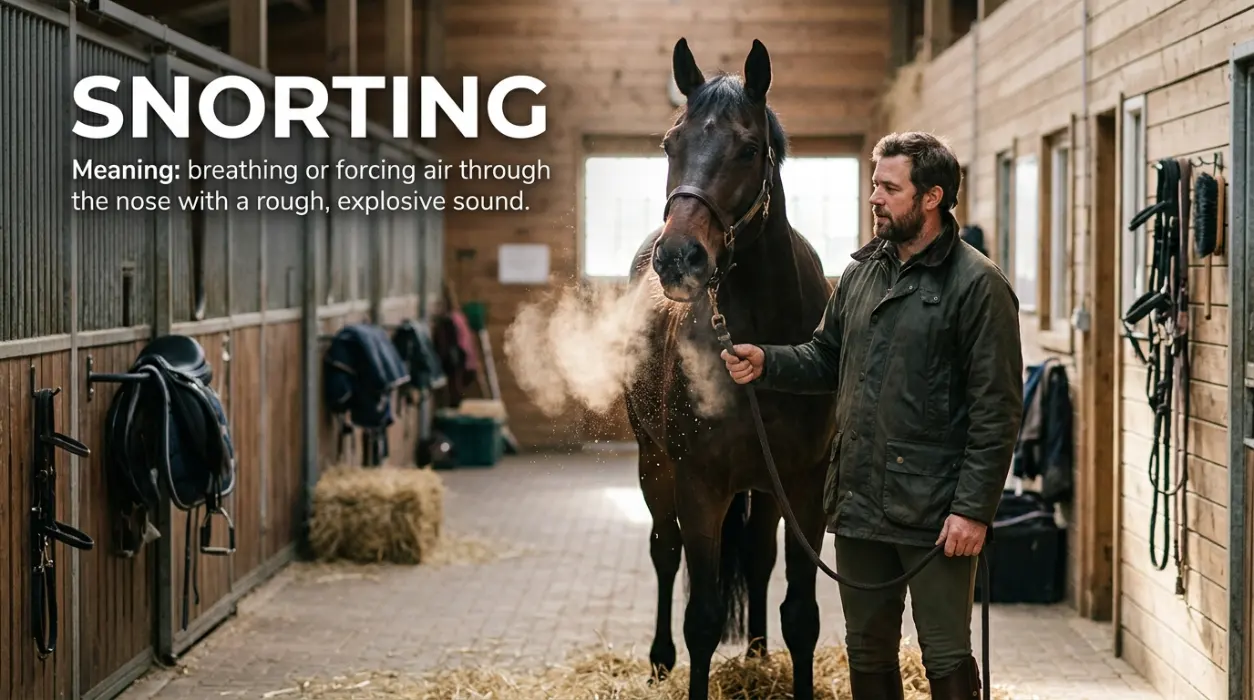
Snorting (Verb/Present Participle) — US /ˈsnɔːr.tɪŋ/ — UK /ˈsnɔː.tɪŋ/
Meaning: Breathing or forcing air through the nose with a rough, explosive sound.
Tone/Register: Informal, descriptive.
Example:
The horse was snorting after the run.
He was snorting and breathing heavily after the joke made him laugh.
Huffing (Verb/Present Participle) — US /ˈhʌf.ɪŋ/ — UK /ˈhʌf.ɪŋ/
Meaning: Breathing heavily or making forceful breaths, often after exertion.
Tone/Register: Informal, expressive.
Example:
She came upstairs huffing and puffing.
He was huffing after carrying the furniture.
Puffing and Panting (Verb Phrase) — US /ˈpʌf.ɪŋ ænd ˈpæn.tɪŋ/ — UK /ˈpʌf.ɪŋ ənd ˈpæn.tɪŋ/
Meaning: Breathing very heavily after strenuous physical activity.
Tone/Register: Informal, idiomatic.
Example:
We reached the summit puffing and panting.
He arrived puffing and panting after the long walk.
Huffing and Puffing (Verb Phrase) — US /ˈhʌf.ɪŋ ænd ˈpʌf.ɪŋ/ — UK /ˈhʌf.ɪŋ ənd ˈpʌf.ɪŋ/
Meaning: Breathing heavily and noisily, especially after physical effort.
Tone/Register: Informal, playful.
Example:
Grandpa came in huffing and puffing after gardening.
I was huffing and puffing by the final staircase.
Wheezing (Verb/Present Participle) — US /ˈwiː.zɪŋ/ — UK /ˈwiː.zɪŋ/
Meaning: Breathing with a high-pitched or whistling sound.
Tone/Register: Medical, descriptive.
Example:
He was wheezing after the intense workout.
The character began wheezing as the scene became tense.
Sighing (Verb/Present Participle) — US /ˈsaɪ.ɪŋ/ — UK /ˈsaɪ.ɪŋ/
Meaning: Breathing out slowly and audibly, often because of relief, tiredness, sadness, or frustration.
Tone/Register: Neutral, expressive.
Example:
She sat down, sighing with relief.
He was sighing after the stressful meeting.
Exhaling Heavily (Verb Phrase) — US /eksˈheɪ.lɪŋ ˈhev.ə.li/ — UK /eksˈheɪ.lɪŋ ˈhev.ə.li/
Meaning: Breathing air out with noticeable force or volume.
Tone/Register: Neutral, descriptive.
Example:
He stopped running and began exhaling heavily.
She exhaled heavily before answering.
Breathing Rapidly (Verb Phrase) — US /ˈbriː.ðɪŋ ˈræp.ɪd.li/ — UK /ˈbriː.ðɪŋ ˈræp.ɪd.li/
Meaning: Taking breaths at a faster rate than normal.
Tone/Register: Neutral, formal.
Example:
The runner was breathing rapidly after the race.
The puppy was breathing rapidly after chasing the ball.
Breathing Fast (Verb Phrase) — US /ˈbriː.ðɪŋ fæst/ — UK /ˈbriː.ðɪŋ fɑːst/
Meaning: Breathing more quickly than usual.
Tone/Register: Informal, everyday.
Example:
I was breathing fast after the short sprint.
The child was breathing fast after playing outside.
Breathing Hard Through the Mouth (Verb Phrase) — US /ˈbriː.ðɪŋ hɑːrd θruː ðə maʊθ/ — UK /ˈbriː.ðɪŋ hɑːd θruː ðə maʊθ/
Meaning: Taking strong, rapid breaths through the mouth after exertion.
Tone/Register: Descriptive, neutral.
Example:
He was breathing hard through the mouth after the climb.
The runner stopped, breathing hard through her mouth.
Catching Your Breath (Verb Phrase) — US /ˈkætʃ.ɪŋ jər breθ/ — UK /ˈkætʃ.ɪŋ jə breθ/
Meaning: Recovering normal breathing after physical effort or surprise.
Tone/Register: Informal, very common.
Example:
Give me a minute to catch my breath.
She stopped running to catch her breath.
Regaining Your Breath (Verb Phrase) — US /rɪˈɡeɪ.nɪŋ jər breθ/ — UK /rɪˈɡeɪ.nɪŋ jə breθ/
Meaning: Returning to comfortable, normal breathing after exertion.
Tone/Register: Neutral.
Example:
He paused to regain his breath.
She needed a moment to regain her breath.
Recovering Your Breath (Verb Phrase) — US /rɪˈkʌv.ər.ɪŋ jər breθ/ — UK /rɪˈkʌv.ər.ɪŋ jə breθ/
Meaning: Gradually returning to normal breathing after intense activity.
Tone/Register: Neutral.
Example:
He sat on the bench, recovering his breath.
She rested quietly while recovering her breath.
Regulating Your Breathing (Verb Phrase) — US /ˈreɡ.jə.leɪ.tɪŋ jər ˈbriː.ðɪŋ/ — UK /ˈreɡ.jə.leɪ.tɪŋ jə ˈbriː.ðɪŋ/
Meaning: Deliberately controlling breathing to make it slower, steadier, or more comfortable.
Tone/Register: Formal, wellness, instructional.
Example:
She paused to regulate her breathing.
The runner focused on regulating his breathing.
Taking in Air (Verb Phrase) — US /ˈteɪ.kɪŋ ɪn er/ — UK /ˈteɪ.kɪŋ ɪn eə/
Meaning: Inhaling air, especially in large or repeated breaths.
Tone/Register: Neutral, descriptive.
Example:
He stopped and took in several deep breaths of air.
She stood quietly, taking in air after the climb.
Drawing in Air (Verb Phrase) — US /ˈdrɔː.ɪŋ ɪn er/ — UK /ˈdrɔː.ɪŋ ɪn eə/
Meaning: Inhaling noticeably, often to recover from exertion.
Tone/Register: Literary, descriptive.
Example:
He leaned forward, drawing in air.
She paused before drawing in another breath.
Dragging in Breath (Verb Phrase) — US /ˈdræɡ.ɪŋ ɪn breθ/ — UK /ˈdræɡ.ɪŋ ɪn breθ/
Meaning: Taking difficult, slow, or strained breaths.
Tone/Register: Literary, dramatic.
Example:
The exhausted traveler was dragging in breath.
He climbed the final steps, dragging in each breath.
Taking Labored Breaths (Verb Phrase) — US /ˈteɪ.kɪŋ ˈleɪ.bɚd breθs/ — UK /ˈteɪ.kɪŋ ˈleɪ.bəd breθs/
Meaning: Breathing with obvious effort or difficulty.
Tone/Register: Formal, serious.
Example:
The exhausted man was taking labored breaths.
She rested quietly, taking slow, labored breaths.
Taking Shallow Breaths (Verb Phrase) — US /ˈteɪ.kɪŋ ˈʃæ.loʊ breθs/ — UK /ˈteɪ.kɪŋ ˈʃæ.ləʊ breθs/
Meaning: Breathing with small amounts of air rather than deep inhalations.
Tone/Register: Neutral, medical, descriptive.
Example:
He was taking shallow breaths after the shock.
She sat quietly, taking shallow breaths.
Taking Quick Breaths (Verb Phrase) — US /ˈteɪ.kɪŋ kwɪk breθs/ — UK /ˈteɪ.kɪŋ kwɪk breθs/
Meaning: Inhaling and exhaling rapidly in repeated short cycles.
Tone/Register: Neutral, simple.
Example:
The child was taking quick breaths after running.
She took several quick breaths before speaking.
Breath Coming in Gasps (Phrase) — US /breθ ˈkʌm.ɪŋ ɪn ɡæsps/ — UK /breθ ˈkʌm.ɪŋ ɪn ɡɑːsps/
Meaning: Breathing in sudden, separated bursts rather than smoothly.
Tone/Register: Literary, dramatic.
Example:
His breath came in gasps after the climb.
Her breath came in gasps as she ran toward safety.
Gulping for Air (Verb Phrase) — US /ˈɡʌl.pɪŋ fər er/ — UK /ˈɡʌl.pɪŋ fə eə/
Meaning: Taking large, urgent breaths because of a strong need for air.
Tone/Register: Informal, dramatic.
Example:
He surfaced from the water, gulping for air.
She finished the sprint, gulping for air.
Grabbing for Air (Verb Phrase) — US /ˈɡræb.ɪŋ fər er/ — UK /ˈɡræb.ɪŋ fə eə/
Meaning: Trying urgently to inhale enough air.
Tone/Register: Informal, dramatic.
Example:
The swimmer surfaced, grabbing for air.
He stopped running, grabbing for air.
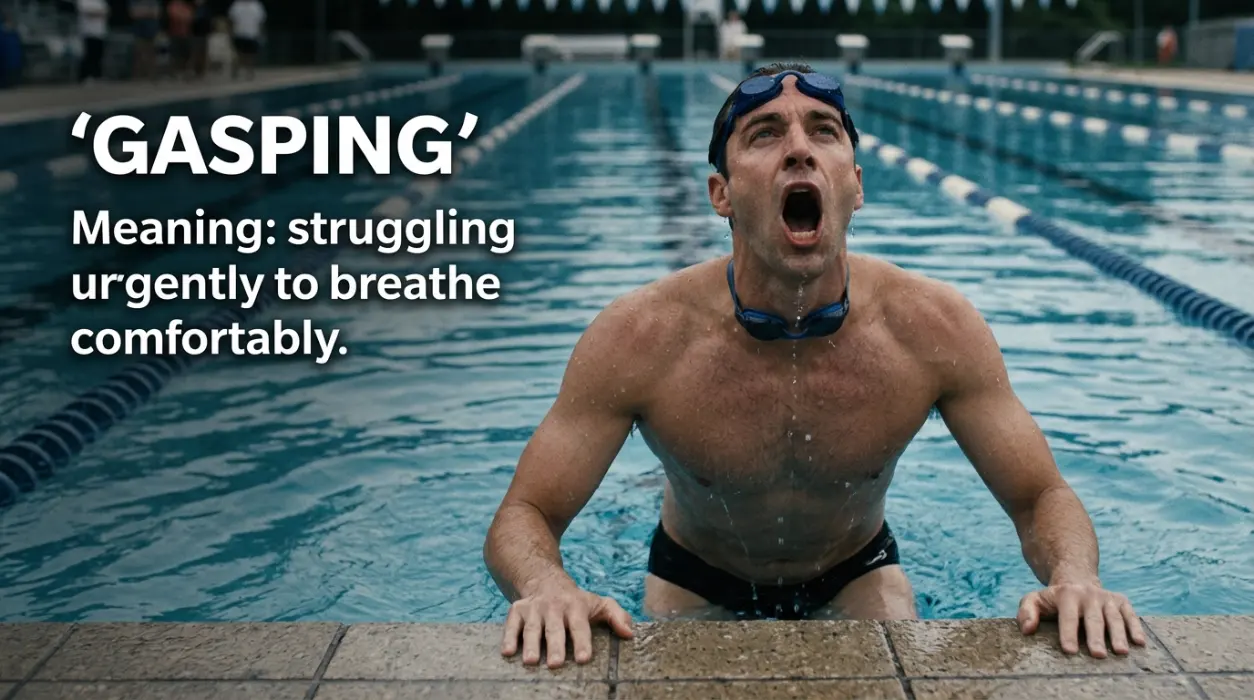
Clutching for Breath (Verb Phrase) — US /ˈklʌtʃ.ɪŋ fər breθ/ — UK /ˈklʌtʃ.ɪŋ fə breθ/
Meaning: Struggling urgently to breathe comfortably.
Tone/Register: Literary, dramatic.
Example:
The exhausted character was clutching for breath.
He stumbled forward, clutching for breath.
Straining for Breath (Verb Phrase) — US /ˈstreɪ.nɪŋ fər breθ/ — UK /ˈstreɪ.nɪŋ fə breθ/
Meaning: Making a noticeable effort to breathe.
Tone/Register: Serious, descriptive.
Example:
She was straining for breath after the steep ascent.
The character sat down, straining for breath.
Fighting to Catch Your Breath (Verb Phrase) — US /ˈfaɪ.tɪŋ tə kætʃ jər breθ/ — UK /ˈfaɪ.tɪŋ tə kætʃ jə breθ/
Meaning: Making a strong effort to return to normal breathing.
Tone/Register: Informal, dramatic.
Example:
He was fighting to catch his breath after the race.
She reached the finish line, fighting to catch her breath.
Breathing in Bursts (Verb Phrase) — US /ˈbriː.ðɪŋ ɪn bɜːrsts/ — UK /ˈbriː.ðɪŋ ɪn bɜːsts/
Meaning: Taking breaths in short, irregular episodes.
Tone/Register: Descriptive, neutral.
Example:
His breathing came in bursts after the sprint.
She was breathing in short bursts while climbing.
Breathing in Short Bursts (Verb Phrase) — US /ˈbriː.ðɪŋ ɪn ʃɔːrt bɜːrsts/ — UK /ˈbriː.ðɪŋ ɪn ʃɔːt bɜːsts/
Meaning: Taking repeated quick breaths separated into brief cycles.
Tone/Register: Neutral, descriptive.
Example:
The runner was breathing in short bursts.
He slowed down because he was breathing in short bursts.
Panting for Air (Verb Phrase) — US /ˈpæn.tɪŋ fər er/ — UK /ˈpæn/.tɪŋ fə eə/
Meaning: Breathing rapidly because the body strongly needs more air.
Tone/Register: Informal, expressive.
Example:
The dog was panting for air after the chase.
He climbed the stairs, panting for air.
Panting Heavily (Verb Phrase) — US /ˈpæn.tɪŋ ˈhev.ə.li/ — UK /ˈpæn.tɪŋ ˈhev.ə.li/
Meaning: Breathing particularly quickly and forcefully.
Tone/Register: Neutral, descriptive.
Example:
The runner was panting heavily after the final lap.
The puppy was panting heavily in the heat.
Panting Hard (Verb Phrase) — US /ˈpæn.tɪŋ hɑːrd/ — UK /ˈpæn.tɪŋ hɑːd/
Meaning: Breathing very heavily after demanding activity.
Tone/Register: Informal.
Example:
He was panting hard after the hike.
She stopped, panting hard near the finish line.
Breathlessness (Noun) — US /ˈbreθ.ləs.nəs/ — UK /ˈbreθ.ləs.nəs/
Meaning: A state in which breathing feels difficult, unusually fast, or insufficient.
Tone/Register: Formal, medical, descriptive.
Example:
The climb caused temporary breathlessness.
She experienced breathlessness after the intense exercise.
Dyspnea (Noun) — US /dɪspˈniː.ə/ — UK /dɪspˈniː.ə/
Meaning: A medical term for difficult or uncomfortable breathing.
Tone/Register: Medical, technical.
Example:
The patient reported dyspnea during exercise.
Doctors assessed the cause of his dyspnea.
Air Hunger (Noun Phrase) — US /er ˈhʌŋ.ɡər/ — UK /eə ˈhʌŋ.ɡə/
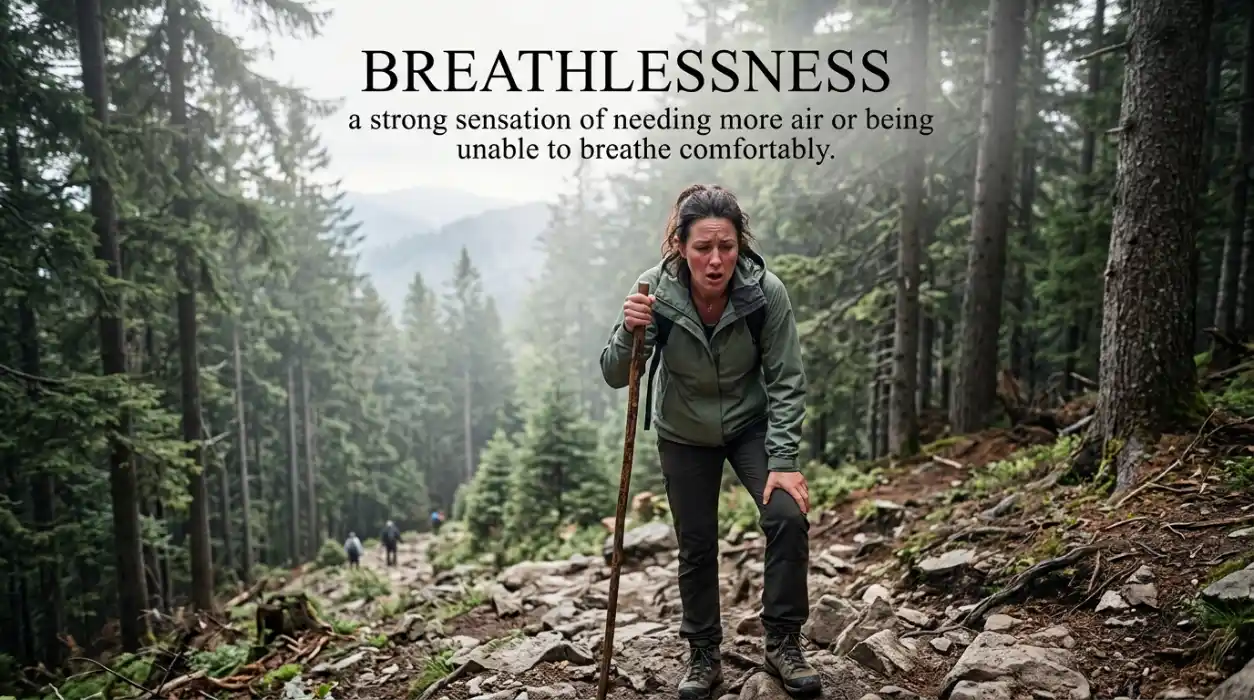
Meaning: A strong sensation of needing more air or being unable to breathe comfortably.
Tone/Register: Medical, descriptive.
Example:
The athlete experienced temporary air hunger after the sprint.
The sensation of air hunger can feel frightening.
Synonyms by Tone
The best synonym depends on the feeling you want to create.
Positive or Energetic
These alternatives can work well when breathing follows exercise, play, achievement, or excitement:
- puffing
- breathing hard
- breathless
- catching your breath
- recovering your breath
- regulating your breathing
- huffing and puffing
- panting happily
They can make physical activity sound energetic rather than alarming.
Neutral
These options describe breathing without adding a strong emotional judgment:
- breathing heavily
- breathing rapidly
- breathing fast
- rapid breathing
- fast breathing
- heavy breathing
- audible breathing
- taking quick breaths
- taking deep breaths
- out of breath
- winded
These are useful in everyday speech and straightforward writing.
Negative or Serious
These choices suggest difficulty, distress, or intense physical struggle:
- gasping
- struggling to breathe
- laboring to breathe
- fighting for breath
- choking for breath
- straining for breath
- labored breathing
- strained breathing
- air hunger
- dyspnea
Use them carefully because they can imply more than ordinary post-exercise panting.
Playful or Informal
For relaxed storytelling or conversation, these expressions sound natural:
- puffing
- huffing
- huffing and puffing
- puffing and panting
- panting hard
- sucking in air
- gulping for air
- catching your breath
The informal choices can make a scene feel more conversational.
Mini Comparison: “Panting” vs Close Alternatives
Panting vs Gasping
Panting usually describes repeated, rapid breathing.
Gasping suggests sudden, sharp breaths and often carries stronger emotional or physical urgency.
“The dog was panting after running.”
This sounds ordinary.
“He was gasping for breath.”
This sounds more urgent.
Panting vs Puffing
Panting is the more direct word for rapid, heavy breathing.
Puffing often sounds more casual and can suggest short bursts of breath after exercise.
“She was panting after the race.”
“She was puffing up the stairs.”
Both are natural, but puffing can sound lighter.
Panting vs Wheezing
Panting focuses on speed and effort.
Wheezing focuses on the sound of breathing, particularly a whistling or high-pitched sound.
Therefore, you should not automatically replace panting with wheezing.
How “Panting” Changes by Context
Daily Conversation
In everyday English, panting, breathing hard, out of breath, and catching your breath are especially useful.
For example:
“I’m out of breath.”
“Give me a second to catch my breath.”
These sound natural and conversational.
Writing and Blogging
Bloggers often need descriptive vocabulary.
Instead of repeating “panting,” you can choose breathing heavily, gasping, puffing, or heaving depending on the scene.
For example:
“The runner reached the finish line, breathing heavily.”
This is clear and easy to understand.
Professional and Academic English
Professional or academic writing requires greater precision.
Terms such as rapid breathing, labored breathing, rapid respiration, and dyspnea may be appropriate in technical contexts.
However, medical terms should not be used simply to make ordinary writing sound sophisticated.
Creative and Informal Use
Creative writing benefits from sensory detail.
Instead of:
“He was panting.”
You might write:
“He leaned against the wall, gulping for air.”
The second version gives readers a stronger physical image.
Common Mistakes Learners Make
Mistake 1: Treating Every Breathing Word as an Exact Synonym
Panting, gasping, and wheezing are related but different.
Panting emphasizes repeated fast breaths.
Gasping emphasizes sudden breaths.
Wheezing emphasizes a particular breathing sound.
Therefore, context matters.
Mistake 2: Using “Dyspnea” in Casual Conversation
Dyspnea is a medical term.
A person normally would not say:
“I have dyspnea after running to the bus.”
In everyday conversation, I’m out of breath is much more natural.
Mistake 3: Confusing “Breathless” With Only Physical Exhaustion
Breathless can describe physical exertion.
However, it can also describe strong emotion.
“The beautiful view left us breathless.”
Here, the word means deeply impressed or amazed.
Mistake 4: Using “Wheezing” for Normal Panting
Wheezing refers to a distinctive breathing sound.
If someone has simply finished running, panting or breathing heavily is usually better.
Mistake 5: Overusing Dramatic Expressions
Phrases such as fighting for breath and gulping for air are powerful.
However, they can make ordinary exercise sound dangerous.
Choose dramatic vocabulary only when the scene supports it.
Register Notes
Panting is a neutral and widely understood word.
It works in conversation, fiction, journalism, general articles, and descriptions of animals.
Gasping can be more dramatic.
Puffing is more informal.
Labored breathing is more technical.
Dyspnea belongs mainly to medical contexts.
Therefore, vocabulary choice should follow the audience, purpose, and situation.
Real-Life Mini Scenarios
Workplace
Imagine an employee rushing up four flights of stairs before an important meeting.
A natural sentence is:
“He arrived at the meeting room, slightly out of breath.”
This sounds professional and restrained.
A casual colleague might say:
“You look like you were puffing all the way up here!”
Social Situations
A friend finishes a challenging hike.
You might say:
“Take a minute and catch your breath.”
This is natural and friendly.
Media and Pop Culture
Action films often use stronger descriptions.
A character escaping danger might be:
“gasping for breath”
or
“fighting for breath.”
These phrases increase suspense.
Writing and Storytelling
A novelist can choose a synonym based on the scene.
A tired athlete might be panting.
A frightened character might be gasping.
An exhausted climber might be heaving.
A character in medical distress might have labored breathing.
The distinction makes the writing more vivid.
How to Choose the Best Synonym for Panting
When choosing an alternative, first identify why the person or animal is breathing heavily.
If the cause is exercise, consider:
- panting
- breathing hard
- puffing
- huffing
- out of breath
- winded
If the cause is shock or fear, consider:
- gasping
- fighting for breath
- gulping for air
- grabbing for air
Practice Exercise
1. A runner has just finished a race and is breathing quickly. Which word fits best?
A. Panting
B. Whispering
C. Smiling
D. Staring
2. Someone suddenly sees a frightening scene and takes a sharp breath. Which word is best?
A. Gasping
B. Puffing
C. Sighing
D. Relaxing
3. A person climbs many stairs and breathes heavily in casual conversation. Which phrase sounds natural?
A. Breathing hard
B. Experiencing dyspnea
C. Having rapid respiration
D. Laboring to breathe
4. A horse makes a rough explosive sound through its nose after running. Which word fits?
A. Snorting
B. Sighing
C. Whispering
D. Gasping
5. A doctor describes difficult breathing in a formal report. Which expression is most suitable?
A. Labored breathing
B. Huffing and puffing
C. Puffing hard
D. Catching your breath
6. A friend has finished exercising and needs a moment. What would you naturally tell them?
A. Catch your breath
B. Conquer your breathing
C. Defeat your breath
D. Overtake your breath
7. A character is breathing with a whistling sound. Which word is most precise?
A. Wheezing
B. Panting
C. Puffing
D. Sighing
8. A casual writer wants a playful expression for heavy breathing after exercise. Which is best?
A. Huffing and puffing
B. Labored respiration
C. Dyspnea
D. Rapid respiration
9. A person is temporarily unable to breathe comfortably after a sprint. Which adjective fits?
A. Winded
B. Silent
C. Motionless
D. Relaxed
10. A medical writer needs a technical term for difficult breathing. Which word is appropriate?
A. Dyspnea
B. Puffing
C. Hopping
D. Huffing
Reflection task:
Write one original sentence using a synonym for panting. Then ask yourself: does your chosen word show speed, effort, sound, emotion, or physical difficulty?
Answer key:
1-A, 2-A, 3-A, 4-A, 5-A, 6-A, 7-A, 8-A, 9-A, 10-A,
Conclusion
Understanding panting can help you describe rapid or heavy breathing clearly in different situations. Learning its synonyms, meaning, and examples can also make your English vocabulary more varied and effective.
The word panting is commonly used when someone breathes quickly after exercise, running, excitement, fear, or physical effort. Using suitable synonyms can help you express the same idea with greater accuracy and variety.
By practicing panting in sentences and exploring related words, you can improve both your speaking and writing skills. A strong understanding of this word will make your English more natural, precise, and expressive.
Frequently Asked Questions
1. What is the best synonym for panting after exercise?
For ordinary exercise, the closest natural alternatives are breathing heavily, breathing hard, puffing, being out of breath, and being winded. The best choice depends on your sentence. “Breathing hard” is especially natural in conversation, while “winded” emphasizes the temporary effect of strenuous activity.
2. What is the difference between panting and gasping?
Panting usually means repeated, rapid breathing caused by exertion, heat, excitement, or another physical condition. Gasping generally suggests sudden, sharp breaths and can imply surprise, fear, pain, or an urgent need for air. Therefore, a tired runner may be panting, while a shocked person may be gasping.
3. What are good synonyms for panting in creative writing?
Creative writers can use gasping, heaving, gulping for air, fighting for breath, sucking in air, breathing in short bursts, or straining for breath. However, each creates a different image. Choose a word based on whether you want the scene to feel energetic, frightening, exhausting, dramatic, or medically serious.
4. What is a formal word for panting or difficult breathing?
In formal or medical contexts, useful terms include rapid breathing, labored breathing, labored respiration, rapid respiration, breathlessness, and dyspnea. These expressions are more technical than ordinary words such as “panting.” In particular, dyspnea refers to difficult or uncomfortable breathing and should mainly be used in appropriate medical contexts.
5. Can panting describe people as well as animals?
Yes. Panting can describe both people and animals. Dogs commonly pant after exercise or in hot conditions. People may pant after running, climbing, exercising, or experiencing intense emotion. The word is therefore not limited to animals, although animal panting is a particularly familiar use in everyday English.

Hasnain Ali is an SEO Content Strategist and the founder of wordvora.com, a trusted vocabulary platform that helps writers, students, professionals, and English learners find accurate synonyms, antonyms, word meanings, and real-life usage examples. He specializes in keyword research, on-page SEO, topical authority, and creating search-first content that aligns with Google’s latest Search Quality and E-E-A-T guidelines. His work focuses on producing clear, well-structured, and reader-friendly resources that satisfy search intent while maintaining high editorial standards.
Through extensive hands-on experience with SEO tools such as Google Search Console, Google Analytics, SEMrush, and Ahrefs, Hasnain researches user search behavior and develops content that is both informative and easy to understand. Every article published on wordvora.com is carefully reviewed for accuracy, readability, and contextual relevance before publication. His mission is to build one of the web’s most reliable English vocabulary resources by providing practical language guidance, trustworthy explanations, and content that helps readers improve their writing, communication, and vocabulary with confidence.