
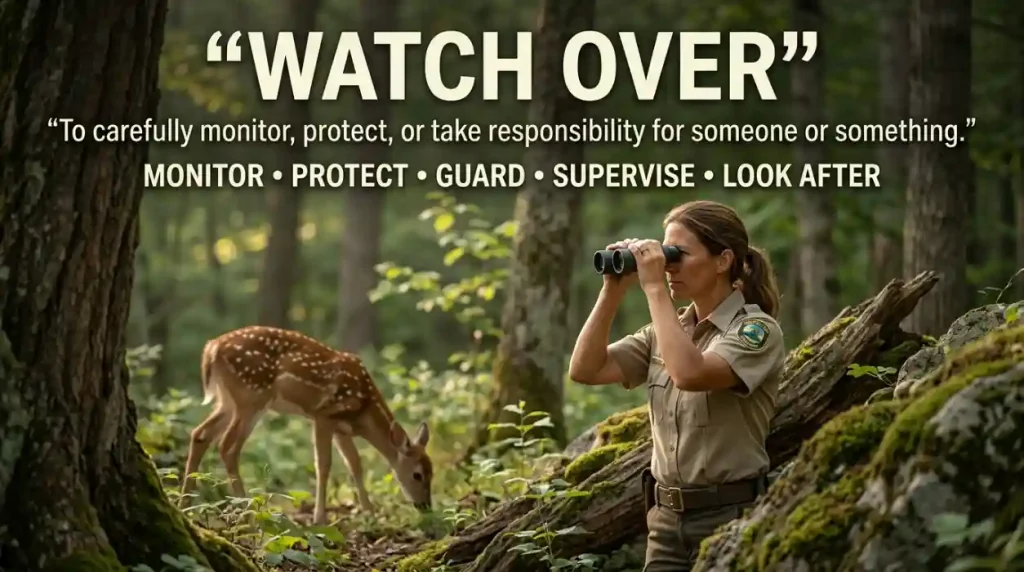
synonym for watch over usually means a word or phrase used instead of “watch over” when you mean to protect, guard, supervise, or carefully look after someone or something. Common alternatives include protect, guard, look after, supervise, oversee, monitor, and keep an eye on.
Imagine a parent asking a friend to watch over a child for an hour. The meaning is simple: keep the child safe and pay attention.
Learning a synonym for watch over helps you avoid repetition and choose words that match your exact meaning, from friendly speech to formal writing.
The phrase is common because English speakers often need to describe care, protection, or supervision. A synonym for watch over makes everyday communication more precise.
For students, bloggers, content writers, and daily English users, learning these alternatives makes sentences sound clearer, more natural, and more flexible.
What Does “Synonym for Watch Over” Really Mean?
“Watch over” is a phrasal verb. It means to carefully observe, protect, guard, or take care of someone or something so that they remain safe.
For example:
A nurse watched over the patient during the night.
The phrase suggests more than simply looking at someone. It normally carries an idea of care, responsibility, protection, or vigilance.
Native speakers may use “watch over” for children, pets, people who are sick, valuable objects, buildings, animals, or even abstract things such as traditions and responsibilities.
It can sound caring:
Her grandmother watched over the children while their parents worked.
It can also sound protective:
Security officers watched over the building overnight.
Part of Speech
Watch over is a phrasal verb.
Its common structure is:
watch over + person/thing
Examples:
- Please watch over my dog while I am away.
- The guards watched over the entrance.
- She watched over her younger brother.
Cambridge defines “watch over someone” as protecting them and making sure they are safe, while Oxford gives the related sense of taking care of, guarding, and protecting someone or something.
Connotative Meaning
Connotation (the feeling, attitude, or association a word carries beyond its basic dictionary meaning) can change how a synonym sounds.
Positive Tone
“Watch over” can suggest care, kindness, responsibility, protection, and affection.
Her older sister watched over her during a difficult time.
Words such as care for, look after, protect, safeguard, and tend can carry a similar positive feeling.
Negative Tone
Some alternatives can suggest strict control, constant checking, or unwanted observation.
For example, monitor, surveil, police, and keep tabs on may sound controlling depending on the situation.
His manager constantly monitored his work.
The action may be neutral, but the context can make it feel intrusive.
Neutral Tone
Words such as observe, supervise, oversee, inspect, and monitor can be neutral when the purpose is simply to describe responsibility or attention.
Etymology
The key word in the phrase is watch.
The verb “watch” comes from Old English wæccan, meaning “keep watch” or “be awake.” It is related to the older idea of staying awake and alert. The sense of being vigilant appeared around the Middle English period, while the sense of guarding someone or somewhere developed later.
Old English: 450–1100
Old English wæccan carried the idea of remaining awake or keeping watch.
The basic concept was vigilance: staying awake so that danger could be noticed.
Middle English: 1100–1500
The word developed through Middle English forms such as wacchen.
By around the 13th century, “watch” had developed a clearer sense of being vigilant. By the late 14th century, it could also mean guarding a person or place.
Modern English: 1500–Present
Modern English expanded “watch” into several meanings, including observing something, guarding something, supervising people, and viewing entertainment.
The phrase watch over developed as a natural combination expressing protective attention.
Pronunciation
US IPA
watch: /wɑtʃ/
over: /ˈoʊvər/
Watch over: /wɑtʃ ˈoʊvər/
UK IPA
watch: /wɒtʃ/
over: /ˈəʊvə/
Watch over: /wɒtʃ ˈəʊvə/
Cambridge lists /wɑtʃ/ and /wɒtʃ/ for the American and British pronunciations of “watch.”
Syllables
watch-over
The phrase contains three syllables:
watch / o-ver
Affixation Pattern of “Watch Over”
Root: watch
Prefix: none
Suffix: none
“Watch over” is a phrasal verb rather than a prefixed or suffixed word.
Synonyms List
Not all alternatives below are perfect replacements in every sentence. Some are direct synonyms, while others are highly useful alternatives for particular situations such as childcare, security, professional supervision, or formal writing.
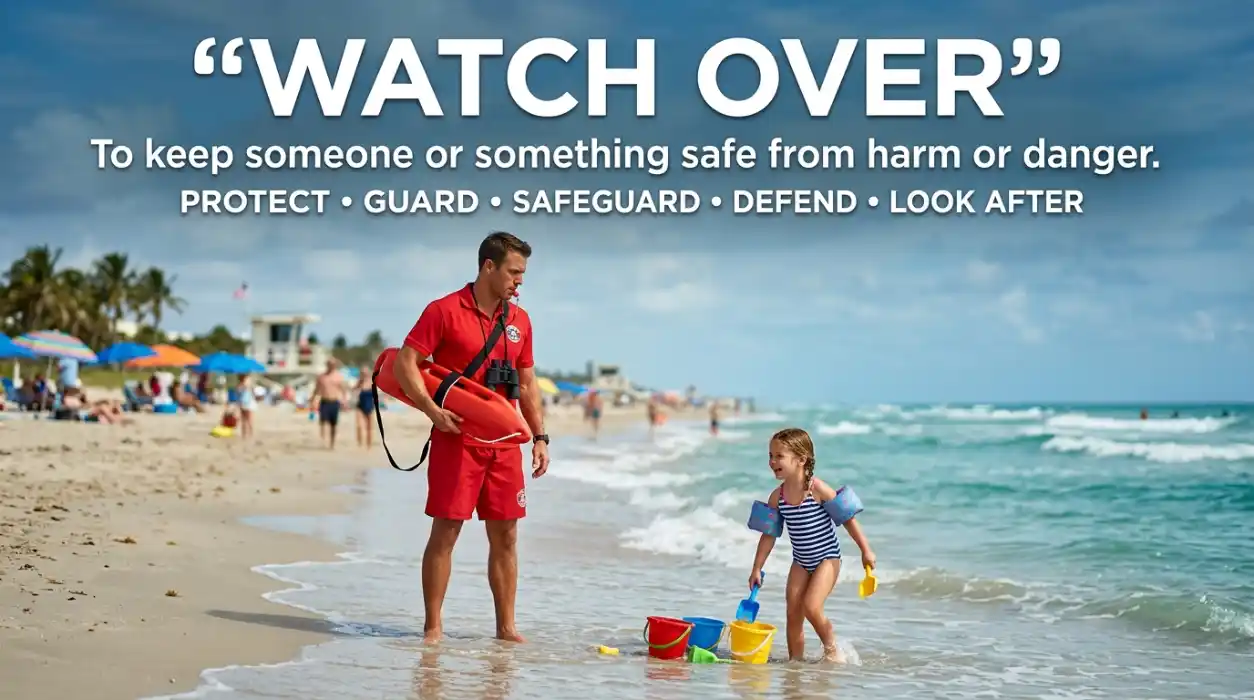
1. Protect (Verb) — US /prəˈtɛkt/ | UK /prəˈtekt/
Meaning: To keep someone or something safe from harm or danger.
Tone/Register: Neutral, widely used.
Examples:
Parents naturally want to protect their children.
The helmet helps protect workers from injury.
2. Guard (Verb) — US /ɡɑrd/ | UK /ɡɑːd/
Meaning: To watch a person, place, or thing carefully to prevent danger, damage, or attack.
Tone/Register: Neutral to formal.
Examples:
Two officers guard the entrance at night.
A security team guards the museum.
3. Look After (Phrasal Verb) — US /lʊk ˈæftər/ | UK /lʊk ˈɑːftə/
Meaning: To take care of someone or something and make sure they are safe or well.
Tone/Register: Everyday, friendly.
Examples: Can you look after my dog this weekend?
She looks after her younger brother after school.
4. Take Care of (Verb Phrase) — US /teɪk ker əv/ | UK /teɪk keə əv/
Meaning: To care for someone or something and handle their needs.
Tone/Register: Everyday, neutral.
Examples:
She takes care of her older father.
Please take care of the plants while I am away.
5. Supervise (Verb) — US /ˈsuːpərvaɪz/ | UK /ˈsuːpəvaɪz/
Meaning: To watch people or activities to ensure that work or behavior is safe and appropriate.
Tone/Register: Professional, academic.
Examples:
A teacher supervised the students during the experiment.
Managers supervise new employees during training.
6. Oversee (Verb) — US /ˌoʊvərˈsiː/ | UK /ˌəʊvəˈsiː/
Meaning: To be responsible for a process or activity and make sure it is properly managed.
Tone/Register: Formal, professional.
Examples:
Maya oversees the department’s daily operations.
He oversees the project from beginning to end.
7. Monitor (Verb) — US /ˈmɑːnətər/ | UK /ˈmɒnɪtə/
Meaning: To observe something regularly to check its condition, progress, or safety.
Tone/Register: Neutral, professional.
Examples:
Doctors monitored the patient’s condition overnight.
The team monitors the equipment for problems.
8. Keep an Eye On (Idiom) — US /kiːp ən aɪ ɑːn/ | UK /kiːp ən aɪ ɒn/
Meaning: To watch or check someone or something carefully for a period of time.
Tone/Register: Informal, conversational.
Examples:
Can you keep an eye on my bag?
I’ll keep an eye on the children while you cook.
9. Keep Watch Over (Verb Phrase) — US /kiːp wɑtʃ ˈoʊvər/ | UK /kiːp wɒtʃ ˈəʊvə/
Meaning: To remain alert while protecting or observing someone or something.
Tone/Register: Neutral to formal.
Examples:
The guards kept watch over the gate.
Someone must keep watch over the campsite.
10. Stand Guard Over (Verb Phrase) — US /stænd ɡɑrd ˈoʊvər/ | UK /stænd ɡɑːd ˈəʊvə/
Meaning: To remain in a protective position near a person or place.
Tone/Register: Formal, security-related.
Examples:
Soldiers stood guard over the building.
A guard stood over the valuable equipment.
11. Safeguard (Verb) — US /ˈseɪfɡɑrd/ | UK /ˈseɪfɡɑːd/
Meaning: To protect something important from harm, loss, or damage.
Tone/Register: Formal, professional.
Examples:
The policy safeguards children’s privacy.
Strong passwords help safeguard personal information.
12. Defend (Verb) — US /dɪˈfend/ | UK /dɪˈfend/
Meaning: To protect someone or something against attack, criticism, or harm.
Tone/Register: Neutral to formal.
Examples:
The soldiers defended the village.
She defended her younger brother during the argument.
13. Shield (Verb) — US /ʃiːld/ | UK /ʃiːld/
Meaning: To protect someone or something from an unpleasant or harmful influence.
Tone/Register: Neutral, sometimes literary.
Examples:
The umbrella shielded us from the rain.
Parents sometimes try to shield children from stressful news.
14. Care For (Verb Phrase) — US /ker fɔr/ | UK /keə fɔː/
Meaning: To look after someone or something with attention to their needs.
Tone/Register: Neutral to warm.
Examples:
Nurses care for patients throughout the night.
She cares for three rescue cats.
15. Tend (Verb) — US /tend/ | UK /tend/
Meaning: To care for a person, animal, plant, or situation that needs attention.
Tone/Register: Neutral, slightly formal.
Examples:
The farmer tends the animals every morning.
A nurse tended to the injured traveler.
16. Attend To (Phrasal Verb) — US /əˈtend tuː/ | UK /əˈtend tuː/
Meaning: To give attention or care to someone or something that needs it.
Tone/Register: Formal.
Examples:
A nurse attended to the patient immediately.
Staff members attended to the injured guests.
17. Safekeep (Verb) — US /ˌseɪfˈkiːp/ | UK /ˌseɪfˈkiːp/
Meaning: To keep something safe while it is in your care.
Tone/Register: Formal or specialized.
Examples:
The documents were given to the lawyer to safekeep.
The museum safekeeps several valuable artifacts.
18. Secure (Verb) — US /sɪˈkjʊr/ | UK /sɪˈkjʊə/
Meaning: To make or keep something safe from danger, loss, or unauthorized access.
Tone/Register: Professional, neutral.
Examples:
The staff secured the building before leaving.
Please secure the gate before sunset.
19. Observe (Verb) — US /əbˈzɜrv/ | UK /əbˈzɜːv/
Meaning: To watch someone or something carefully, especially to notice changes or behavior.
Tone/Register: Neutral to academic.
Examples:
Researchers observed the animals for several hours.
The teacher observed the students during the activity.
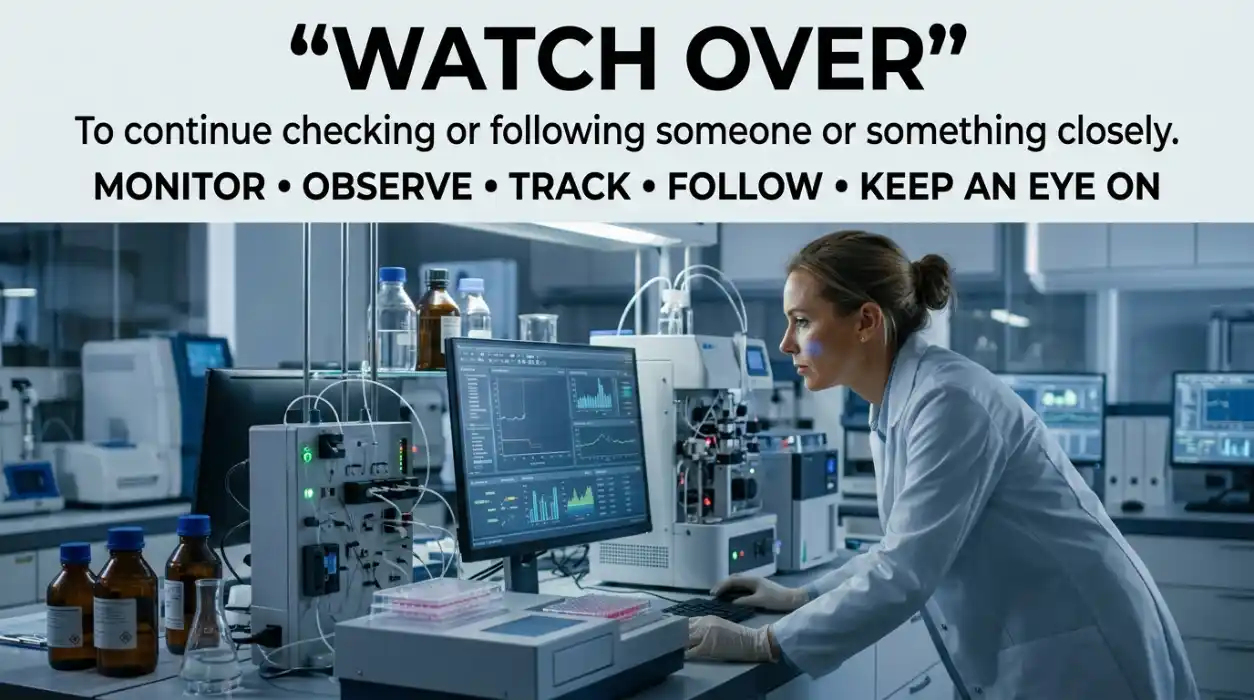
20. Keep Tabs On (Idiom) — US /kiːp tæbz ɑːn/ | UK /kiːp tæbz ɒn/
Meaning: To continue checking or following someone or something closely.
Tone/Register: Informal.
Examples:
I keep tabs on the garden when the weather is dry.
She keeps tabs on her team’s progress.
21. Keep Track Of (Verb Phrase) — US /kiːp træk əv/ | UK /kiːp træk əv/
Meaning: To follow information, movement, progress, or changes carefully.
Tone/Register: Neutral.
Examples:
I keep track of my children’s school activities.
The app helps us keep track of deliveries.
22. Check On (Phrasal Verb) — US /tʃek ɑːn/ | UK /tʃek ɒn/
Meaning: To visit or examine someone or something to make sure everything is all right.
Tone/Register: Everyday, neutral.
Examples:
I’ll check on the baby before I go downstairs.
She checked on the plants after the storm.
23. Look Out For (Phrasal Verb) — US /lʊk aʊt fɔr/ | UK /lʊk aʊt fə/
Meaning: To remain alert for possible problems or to care about someone’s safety.
Tone/Register: Informal, conversational.
Examples:
Look out for your little brother at the party.
Can you look out for my bag?
24. Watchful (Adjective) — US /ˈwɑːtʃfəl/ | UK /ˈwɒtʃfəl/
Meaning: Carefully observing and ready to notice possible danger or problems.
Tone/Register: Neutral, descriptive.
Examples:
A watchful parent noticed the child near the road.
The dog remained watchful all night.
25. Vigil (Noun) — US /ˈvɪdʒəl/ | UK /ˈvɪdʒɪl/
Meaning: A period of staying awake and watching over someone or something.
Tone/Register: Formal, literary.
Examples:
The family kept a vigil beside the patient.
The guards maintained a long vigil.
26. Keep Vigil Over (Verb Phrase) — US /kiːp ˈvɪdʒəl ˈoʊvər/ | UK /kiːp ˈvɪdʒɪl ˈəʊvə/
Meaning: To remain awake or attentive while protecting or caring for someone or something.
Tone/Register: Formal, literary.
Examples:
The relatives kept vigil over the injured man.
The guards kept vigil over the historic site.
27. Maintain Surveillance Over (Verb Phrase) — US /meɪnˈteɪn sərˈveɪləns ˈoʊvər/ | UK /meɪnˈteɪn səˈveɪləns ˈəʊvə/
Meaning: To observe someone or something continuously for security or investigative purposes.
Tone/Register: Formal, technical.
Examples:
Security teams maintained surveillance over the area.
The facility maintains surveillance over restricted zones.
28. Surveil (Verb) — US /sərˈveɪl/ | UK /səˈveɪl/
Meaning: To watch or monitor someone or somewhere, usually for security or investigative reasons.
Tone/Register: Formal, technical.
Examples:
Authorities surveilled the location for several days.
The system is designed to surveil restricted areas.
29. Patrol (Verb) — US /pəˈtroʊl/ | UK /pəˈtrəʊl/
Meaning: To move around an area regularly while watching for danger or problems.
Tone/Register: Security, military, professional.
Examples:
Guards patrol the campus at night.
Police officers patrol the neighborhood regularly.
30. Chaperone (Verb) — US /ˈʃæpəroʊn/ | UK /ˈʃæpərəʊn/
Meaning: To accompany and supervise someone, especially a child or young person.
Tone/Register: Neutral, formal.
Examples:
Two teachers chaperoned the school trip.
Parents volunteered to chaperone the students.
31. Babysit (Verb) — US /ˈbeɪbisɪt/ | UK /ˈbeɪbisɪt/
Meaning: To care for a child temporarily while the usual caregiver is away.
Tone/Register: Informal, everyday.
Examples:
My sister babysits the children on Fridays.
Can you babysit tonight?
32. Mind (Verb) — US /maɪnd/ | UK /maɪnd/
Meaning: To take responsibility for watching or caring for someone or something temporarily.
Tone/Register: Informal, especially British English.
Examples:
Can you mind my bag for a minute?
She minded the children while her friend went shopping.
33. Shepherd (Verb) — US /ˈʃepərd/ | UK /ˈʃepəd/
Meaning: To guide, manage, or carefully lead people through a process or situation.
Tone/Register: Figurative, literary, professional.
Examples:
She shepherded the new employees through training.
He shepherded the children safely across the road.
34. Steward (Verb) — US /ˈstuːərd/ | UK /ˈstjuːəd/
Meaning: To responsibly care for and protect something valuable or important.
Tone/Register: Formal, professional.
Examples:
The organization stewards the historic property.
Good leaders steward shared resources carefully.
35. Preserve (Verb) — US /prɪˈzɜrv/ | UK /prɪˈzɜːv/
Meaning: To protect something from damage or loss so that it remains in good condition.
Tone/Register: Formal, academic.
Examples:
The museum works to preserve ancient manuscripts.
These rules help preserve local traditions.
36. Conserve (Verb) — US /kənˈsɜrv/ | UK /kənˈsɜːv/
Meaning: To protect something from being wasted, damaged, or used up.
Tone/Register: Formal, environmental.
Examples:
The project helps conserve endangered habitats.
We must conserve clean water.
37. Husband (Verb) — US /ˈhʌzbənd/ | UK /ˈhʌzbənd/
Meaning: To use and manage something carefully because it is valuable or limited.
Tone/Register: Formal, uncommon in everyday speech.
Examples:
The team husbanded its limited resources.
The organization carefully husbanded its supplies.
38. Administer (Verb) — US /ədˈmɪnəstər/ | UK /ədˈmɪnɪstə/
Meaning: To manage or oversee a system, program, or responsibility.
Tone/Register: Formal, professional.
Examples:
She administers the school safety program.
The office administers several community services.
39. Manage (Verb) — US /ˈmænɪdʒ/ | UK /ˈmænɪdʒ/
Meaning: To control, organize, or take responsibility for something.
Tone/Register: Neutral, professional.
Examples:
He manages the team’s daily activities.
She manages the care of several animals.
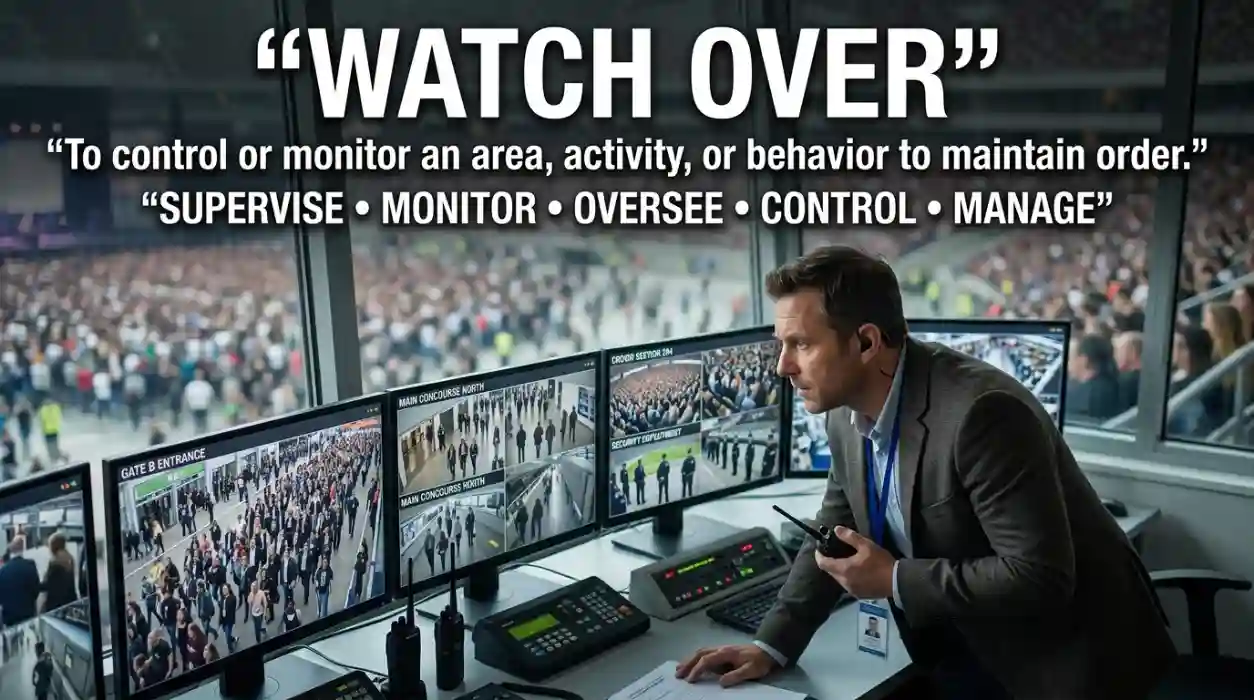
40. Police (Verb) — US /pəˈliːs/ | UK /pəˈliːs/
Meaning: To control or monitor an area, activity, or behavior to maintain order.
Tone/Register: Formal, institutional.
Examples:
Officers police the area during large events.
The organization polices its own professional standards.
41. Inspect (Verb) — US /ɪnˈspekt/ | UK /ɪnˈspekt/
Meaning: To examine something carefully to identify problems or confirm its condition.
Tone/Register: Professional, technical.
Examples:
Engineers inspect the bridge every year.
The supervisor inspected the equipment before use.
42. Check (Verb) — US /tʃek/ | UK /tʃek/
Meaning: To examine or verify something to make sure it is safe, correct, or working.
Tone/Register: Neutral, everyday.
Examples:
Please check on the children before bedtime.
The technician checked the system for errors.
43. Follow (Verb) — US /ˈfɑːloʊ/ | UK /ˈfɒləʊ/
Meaning: To continue observing or tracking someone or something over time.
Tone/Register: Neutral.
Examples:
Doctors followed the patient’s recovery closely.
The team followed the situation throughout the week.
44. Track (Verb) — US /træk/ | UK /træk/
Meaning: To monitor the movement, progress, development, or location of something.
Tone/Register: Neutral, professional.
Examples:
Researchers track the animals’ movements.
We track the project’s progress every Friday.
45. Keep Safe (Verb Phrase) — US /kiːp seɪf/ | UK /kiːp seɪf/
Meaning: To protect someone or something from danger or harm.
Tone/Register: Everyday, warm.
Examples:
Please keep the children safe near the pool.
She kept the documents safe in a locked drawer.
46. Have Someone’s Back (Idiom) — US /hæv ˈsʌmwʌnz bæk/ | UK /hæv ˈsʌmwʌnz bæk/
Meaning: To support and protect someone when they need help.
Tone/Register: Informal, conversational.
Examples:
Don’t worry; I’ve got your back.
Her teammates always have her back.
47. Look Out for Someone (Verb Phrase) — US /lʊk aʊt fər/ | UK /lʊk aʊt fə/
Meaning: To care about someone’s safety or interests and help protect them.
Tone/Register: Informal, warm.
Examples:
My older brother always looks out for me.
Look out for your friends when you travel.
48. Be on Guard Over (Verb Phrase) — US /bi ɑːn ɡɑrd ˈoʊvər/ | UK /bi ɒn ɡɑːd ˈəʊvə/
Meaning: To remain alert and ready to protect a person, place, or thing.
Tone/Register: Formal, security-related.
Examples:
Guards were on guard at the entrance.
The team remained on guard throughout the night.
49. Keep Under Observation (Verb Phrase) — US /kiːp ˈʌndər ˌɑːbzərˈveɪʃən/ | UK /kiːp ˈʌndə ˌɒbzəˈveɪʃən/
Meaning: To watch someone or something carefully over a period of time.
Tone/Register: Formal, medical, technical.
Examples:
The patient was kept under observation overnight.
The damaged machine was kept under observation.
50. Stand By (Phrasal Verb) — US /stænd baɪ/ | UK /stænd baɪ/
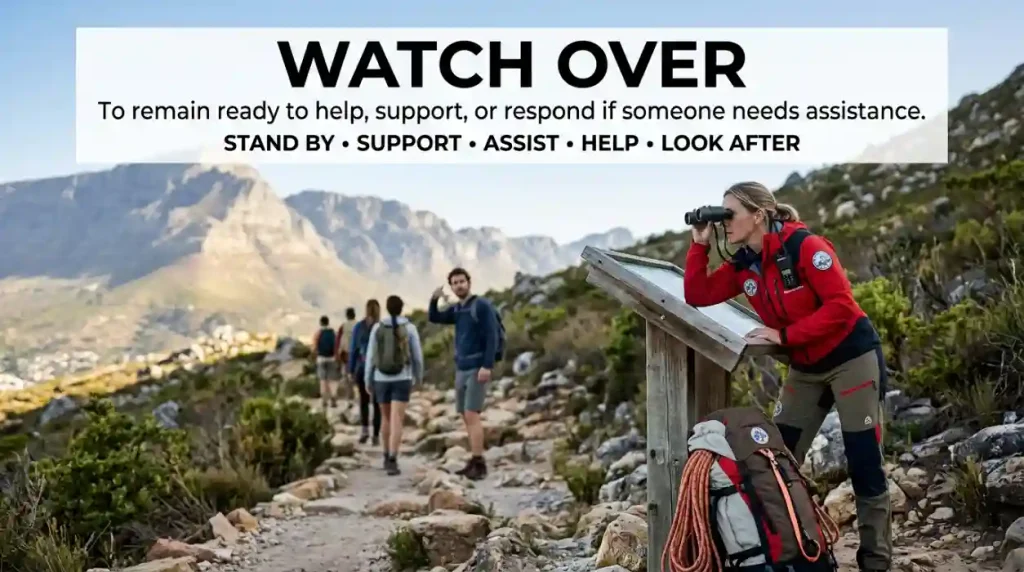
Meaning: To remain ready to help, support, or respond if someone needs assistance.
Tone/Register: Neutral to informal.
Examples:
A trained nurse stood by during the procedure.
Her friends stood by her during the difficult period.
Synonyms by Tone
Positive
These alternatives often carry warmth, care, or supportive responsibility:
- look after
- take care of
- care for
- tend
- protect
- safeguard
- look out for
- have someone’s back
- keep safe
Use these when the relationship involves genuine care.
Neutral
These are useful when you simply want to describe attention or responsibility:
- watch
- observe
- monitor
- supervise
- oversee
- check on
- track
- follow
- manage
They work especially well in professional and educational writing.
More Protective or Formal
These can suggest stronger security or responsibility:
- guard
- defend
- shield
- secure
- stand guard over
- keep vigil over
- patrol
- safeguard
- maintain surveillance over
Choose these when protection is central to the situation.
Playful or Informal
These expressions are common in friendly conversation:
- keep an eye on
- keep tabs on
- mind
- babysit
- have someone’s back
- look out for
Tone matters because synonyms do not always carry the same emotional message. “Care for” sounds warmer than “surveil,” while “keep tabs on” sounds more casual than “maintain surveillance.”
“Watch Over” vs Close Alternatives
| Expression | Main Meaning | Typical Tone | Best Use |
|---|---|---|---|
| Watch over | Protect and pay attention | Caring, neutral | People, animals, places |
| Protect | Prevent harm | Strong, direct | Safety and danger |
| Look after | Take care of | Warm, everyday | Children, pets, people |
| Supervise | Watch to ensure proper behavior | Professional | Work, school, activities |
Protect vs Watch Over
“Watch over” focuses on continued attention and care.
“Protect” focuses more directly on preventing harm.
The nurse watched over the patient.
The medicine protects the patient from infection.
Watch Over vs Look After
“Look after” is often more focused on practical care.
Can you look after my dog?
“Watch over” can sound slightly more protective or vigilant.
She watched over her younger brother during the trip.
Watch Over vs Supervise
“Supervise” usually involves authority or responsibility.
The teacher supervised the students.
“Watch over” sounds more natural when the idea is personal care or protection.
How “Watch Over” Changes by Context
Daily Conversation
In casual English, look after, keep an eye on, mind, and check on are often more natural than formal alternatives.
Can you keep an eye on my kids?
I’ll check on Grandma later.
These expressions sound relaxed and conversational.
Writing and Blogging
Writers can use protect, safeguard, preserve, oversee, monitor, and care for to avoid repeating “watch over.”
For example:
Communities must safeguard local traditions.
That sentence sounds more precise than repeatedly saying communities “watch over” traditions.
Professional or Academic English
Professional writing often benefits from supervise, monitor, oversee, inspect, administer, track, and maintain surveillance.
Researchers monitored the participants throughout the study.
“Watch over” is understandable, but “monitor” is usually more precise in academic contexts.
Creative or Informal English
Creative writing has more freedom.
Words such as watch over, keep vigil over, shepherd, shield, and stand guard over can create stronger imagery.
The ancient mountains watched over the quiet town.
This gives the sentence a poetic quality.
Common Mistakes Learners Make
Mistake 1: Using “watch” when protection is important
“I watched the baby” can simply mean you observed the baby.
“I watched over the baby” suggests that you were responsible for the baby’s safety.
Mistake 2: Treating every synonym as interchangeable
“Surveil” is not a friendly replacement for “look after.”
“Babysit” is not suitable for supervising employees.
“Preserve” usually works with valuable things, traditions, resources, or environments rather than ordinary childcare.
Mistake 3: Using “supervise” in an overly personal situation
I supervised my grandmother.
This may sound clinical unless you mean that you were formally responsible for her care.
I looked after my grandmother.
This sounds warmer in everyday conversation.
Mistake 4: Confusing “watch over” with “watch out for”
Watch over means protect or care for.
Watch out for means stay alert for someone or something, often to notice danger.
She watched over the children.
Watch out for the wet floor.
Oxford specifically distinguishes “watch out for” as making an effort to notice something potentially bad or unusual.
Register Notes
Informal: keep an eye on, keep tabs on, mind, babysit, have someone’s back.
Neutral: watch over, protect, check on, observe, monitor, track.
Formal: oversee, safeguard, administer, maintain surveillance, keep under observation.
Literary: keep vigil over, shepherd, shield.
Real-Life Mini Scenarios
Workplace
A supervisor may oversee a project while a security guard watches over the building.
Maria oversees the new training program.
Security staff watch over the office at night.
Social Situations
Friends often look out for one another.
Don’t worry. I’ll look out for you at the concert.
This sounds warmer than a formal expression such as “maintain surveillance.”
Media and Pop Culture
Fantasy stories frequently use expressions such as guard, protect, shield, or watch over.
The ancient guardian watches over the kingdom.
These phrases create a protective, dramatic image.
Writing and Storytelling
Writers can select a synonym based on the mood.
The old lighthouse watched over the harbor.
A more formal version could be:
The lighthouse stood as a guardian over the harbor.
The choice changes the atmosphere without changing the central idea of protection.
Practice Quiz
1. Your friend asks you to watch her dog while she is away. Which phrase sounds most natural?
A. Look after
B. Police
C. Surveil
D. Administer
2. A teacher is responsible for students during a science experiment. Which word fits best?
A. Babysit
B. Supervise
C. Shield
D. Husband
3. Security officers remain outside a building overnight. Which phrase is most appropriate?
A. Stand guard over
B. Look after
C. Have someone’s back
D. Tend
4. A scientist regularly checks an animal’s condition during a study. Which word is most precise?
A. Babysit
B. Monitor
C. Mind
D. Shield
5. Which expression sounds most conversational?
A. Maintain surveillance
B. Keep an eye on
C. Administer
D. Preserve
6. A museum works to protect an ancient manuscript from damage. Which verb fits best?
A. Preserve
B. Babysit
C. Follow
D. Mind
7. A parent asks a teenager to care for a younger child for two hours. Which word is natural?
A. Patrol
B. Babysit
C. Surveil
D. Police
8. Which phrase means supporting someone when they need help?
A. Have someone’s back
B. Inspect
C. Administer
D. Track
9. Which word is especially suitable for formal project responsibility?
A. Mind
B. Keep tabs on
C. Oversee
D. Babysit
10. A nurse checks a patient regularly during the night. Which expression fits?
A. Keep under observation
B. Have someone’s back
C. Police
D. Shepherd
Answer Key: 1-A | 2-B | 3-A | 4-B | 5-B | 6-A | 7-B | 8-A | 9-C | 10-A
Reflection Task
Write one sentence about a real person, pet, place, project, or responsibility you watch over. Then rewrite the sentence using a different synonym. Notice how the tone changes.
External sources
Cambridge Dictionary — “watch over” · Oxford Learner’s Dictionaries — “watch over” · Etymonline — “watch” etymology
Conclusion
Learning a synonym for watch over gives you more control over tone, helping your writing sound natural instead of repetitive while making your meaning easier to understand.
For speaking and everyday communication, simple choices like “look after” and “keep an eye on” can make your English feel warmer and more natural.
For essays, blogs, and professional writing, words like “supervise,” “monitor,” “oversee,” and “safeguard” can make your ideas more precise and polished.
Practice these alternatives in emails, essays, stories, and daily conversations. Choose one new expression today and use it in your own sentence.
Frequently Asked Questions
What is the closest synonym for “watch over” in everyday English?
The closest everyday alternatives are look after, take care of, protect, and keep an eye on. The best choice depends on context. “Look after” usually emphasizes care, “protect” emphasizes safety, and “keep an eye on” emphasizes temporary observation. “Watch over” can combine both care and protection, which makes it especially flexible.
Is “watch over” formal or informal English?
“Watch over” is natural and widely understood in both spoken and written English. It is not strongly informal, although it can sound warmer than technical words such as “monitor” or “surveil.” Oxford labels the phrasal verb “watch over” as formal in its dictionary entry, while everyday speakers also use it naturally in personal situations.
What is the difference between “watch over” and “look after”?
Both expressions can mean taking care of someone or something, but “look after” often emphasizes practical care. “Watch over” can place more emphasis on continued attention, protection, or vigilance. For example, you might “look after a child” during the day, while a nurse might “watch over a patient” during the night.
Can “watch over” be used for things as well as people?
Yes. “Watch over” can describe protection or careful attention toward people, animals, places, objects, and some abstract things. You might watch over a child, a sick patient, a building, a valuable collection, or a community. The object normally needs to be something that can reasonably receive protection, supervision, or careful attention.
What is a formal synonym for “watch over”?
Useful formal alternatives include supervise, oversee, safeguard, monitor, maintain surveillance over, and keep under observation. However, these words are not identical. “Supervise” usually involves responsibility for people or activities, “oversee” emphasizes management, and “safeguard” focuses strongly on protection. Choose the word that matches the exact purpose of the sentence.
Is “keep an eye on” the same as “watch over”?
They overlap, but they are not always identical. “Keep an eye on” usually means watching or checking something for a period of time. “Watch over” more strongly suggests care or protection. For example, “keep an eye on my bag” mainly means monitoring it, while “watch over the children” can imply responsibility for their safety.

Hasnain Ali is an SEO Content Strategist and the founder of wordvora.com, a trusted vocabulary platform that helps writers, students, professionals, and English learners find accurate synonyms, antonyms, word meanings, and real-life usage examples. He specializes in keyword research, on-page SEO, topical authority, and creating search-first content that aligns with Google’s latest Search Quality and E-E-A-T guidelines. His work focuses on producing clear, well-structured, and reader-friendly resources that satisfy search intent while maintaining high editorial standards.
Through extensive hands-on experience with SEO tools such as Google Search Console, Google Analytics, SEMrush, and Ahrefs, Hasnain researches user search behavior and develops content that is both informative and easy to understand. Every article published on wordvora.com is carefully reviewed for accuracy, readability, and contextual relevance before publication. His mission is to build one of the web’s most reliable English vocabulary resources by providing practical language guidance, trustworthy explanations, and content that helps readers improve their writing, communication, and vocabulary with confidence.