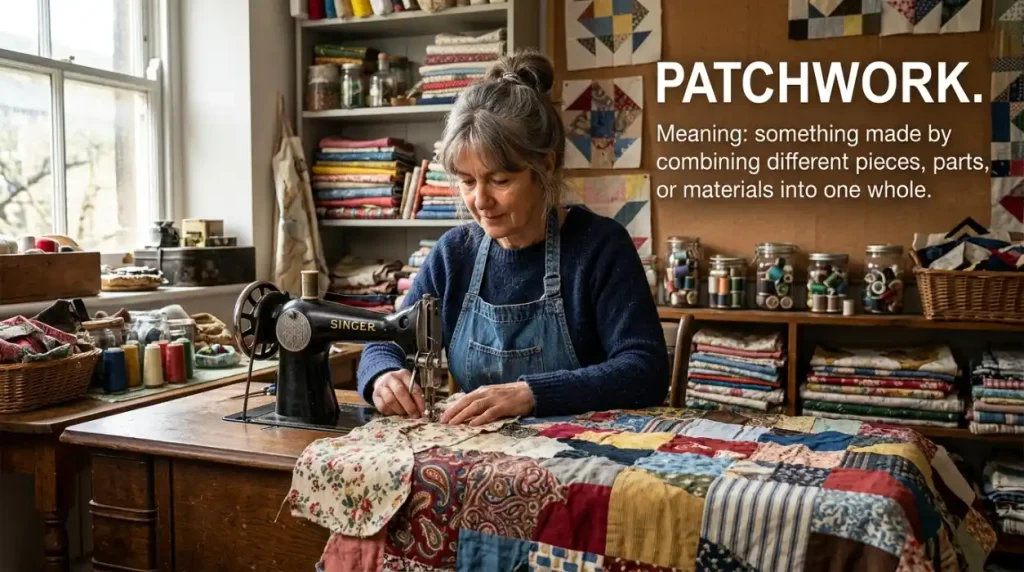
Synonyms for patchwork can make your vocabulary more colorful when you describe something built from different pieces. Imagine a quilt made from scraps of many fabrics.
A school project might also become a patchwork of ideas, images, and borrowed information. In that case, words like mosaic, mixture, or collage may fit better.
The word patchwork is common because it describes both physical objects and mixed ideas. Learning alternatives helps students, bloggers, writers, and speakers choose words with greater precision.
With the right synonyms for patchwork, your writing becomes clearer and more expressive. You can describe a creative blend positively or criticize something as poorly assembled.
What Does “Patchwork” Really Mean?
Patchwork is mainly a noun. It can also function as an adjective when it describes something made from different pieces or parts.
In its literal sense, patchwork refers to something created by sewing or joining pieces of material together.
A classic example is a quilt made from many small pieces of fabric.
In a figurative sense, patchwork describes something formed from different, often unrelated elements.
For example:
The policy is a patchwork of old and new rules.
Here, nobody is talking about fabric. The expression suggests that different pieces have been combined into one system.
Simple definition
Patchwork: something made by combining different pieces, parts, ideas, materials, or elements into one whole.
The word can have either a positive or negative connotation, depending on context.
A patchwork quilt can sound beautiful and carefully crafted. A patchwork solution can suggest something temporary, inconsistent, or poorly organized.
Connotative Meaning of Patchwork
Connotation (the feeling, association, or emotional meaning that a word carries beyond its basic dictionary definition) is especially important with patchwork.
Positive tone
Patchwork can suggest creativity, craftsmanship, diversity, resourcefulness, and individuality.
Words such as mosaic, collage, blend, tapestry, and assemblage can create similarly positive impressions.
Negative tone
In critical writing, patchwork can suggest something fragmented, inconsistent, improvised, or badly organized.
Words such as hodgepodge, jumble, mishmash, and hotchpotch can carry a stronger negative feeling.
Neutral tone
Words such as mixture, combination, collection, composition, and amalgamation can describe a combination without strongly praising or criticizing it.
Therefore, the best synonym depends on what you want your reader to feel.
Etymology of “Patchwork”
The word patchwork is a compound formed from patch + work.
The noun patch developed in Middle English and has been connected with words referring to a piece or small area of material used to cover or repair something.
The word work comes from Old English weorc, meaning an act, activity, labor, or something produced through effort.
Old English: 450–1100
The exact compound patchwork was not established in Old English.
However, work was already an important Old English word, appearing as weorc. English speakers already had vocabulary for making, repairing, joining, and producing objects.
Middle English: 1100–1500
During Middle English, words related to patch entered and developed within English.
The idea of using a piece of material to repair or cover another area gradually supported the literal concept behind patchwork.
Modern English: 1500–Present
Patchwork developed into a familiar compound describing objects made from multiple pieces.
Over time, its figurative meaning became increasingly common.
Today, people use patchwork for quilts, clothing, policies, systems, stories, research, traditions, communities, and collections of ideas.
Pronunciation
- US: /ˈpætʃwɜrk/
- UK: /ˈpætʃwɜːk/
Syllables
patch-work
Affixation Pattern of “Patchwork”
Root: patch + work
Prefix: None
Suffix: None
Word formation: Compound noun
The word is formed by combining two independent English words rather than adding a conventional prefix or suffix.
Synonyms List.
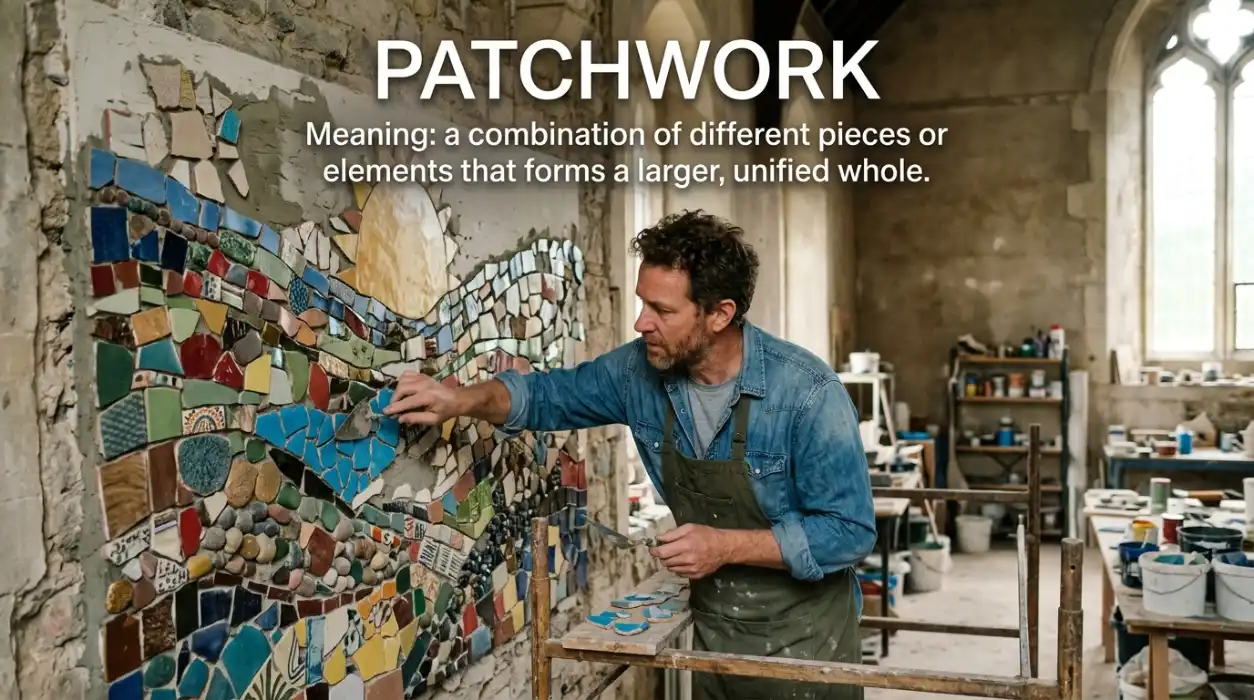
Mosaic (Noun) — US /moʊˈzeɪɪk/; UK /məʊˈzeɪɪk/
Meaning: A combination of different pieces or elements that forms a larger, unified whole.
Tone/Register: Neutral to positive; literary and academic.
Example:
The city is a mosaic of cultures and traditions.
Her memories formed a colorful mosaic of childhood experiences.
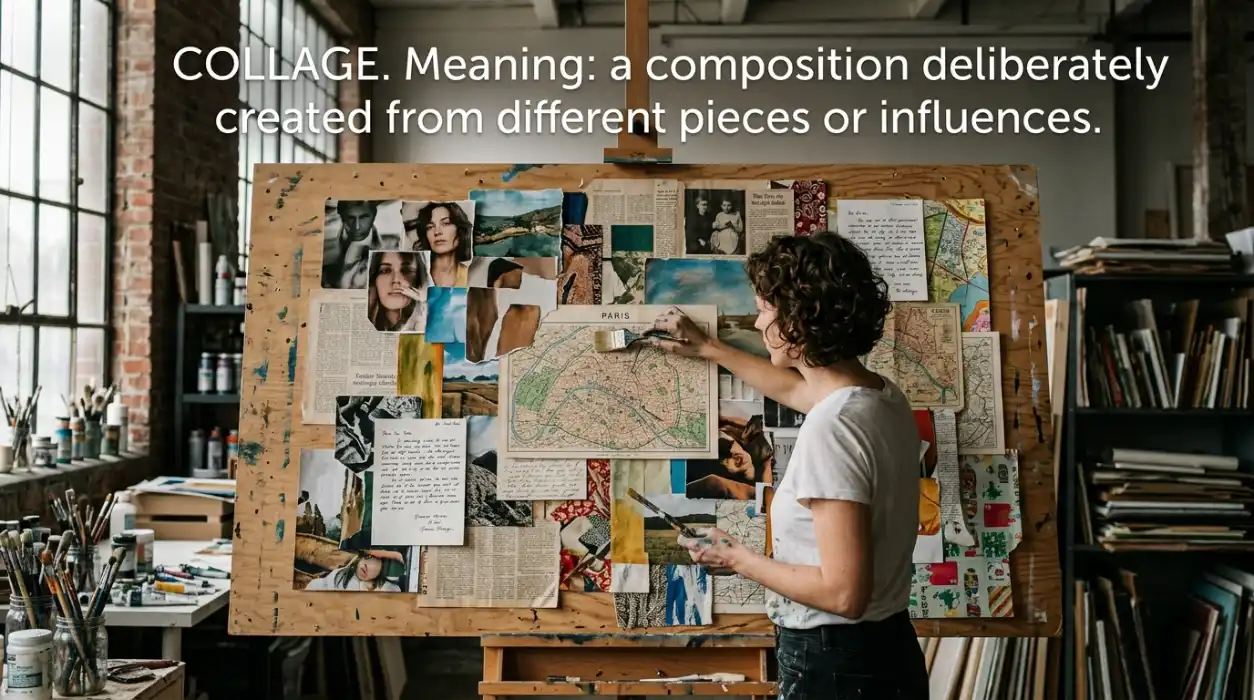
Collage (Noun) — US /kəˈlɑːʒ/; UK /ˈkɒlɑːʒ/
Meaning: A composition created by combining different images, materials, or elements.
Tone/Register: Artistic; neutral to positive.
Example:
The artist created a collage from old photographs.
The magazine cover looked like a digital collage.
Tapestry (Noun) — US /ˈtæpəstri/; UK /ˈtæpɪstri/
Meaning: A complex mixture of different elements woven or combined into a meaningful whole.
Tone/Register: Literary; positive.
Example:
The festival reflects a rich tapestry of cultures.
The novel creates a tapestry of family memories.
Assemblage (Noun) — US /əˈsemblɑːʒ/; UK /əˈsemblɑːʒ/
Meaning: A collection of separate objects or parts brought together into one arrangement.
Tone/Register: Formal; artistic or academic.
Example:
The sculpture is an assemblage of recycled objects.
The exhibition features an unusual assemblage of materials.
Mixture (Noun) — US /ˈmɪkstʃər/; UK /ˈmɪkstʃə/
Meaning: A combination of different things that remain together.
Tone/Register: Neutral; extremely common.
Example:
The report contains a mixture of facts and opinions.
The neighborhood has a mixture of old and new buildings.
Blend (Noun) — US /blend/; UK /blend/
Meaning: A combination in which different elements work together smoothly.
Tone/Register: Neutral to positive.
Example:
The restaurant offers a blend of traditional and modern flavors.
The design is a blend of classic and contemporary styles.
Combination (Noun) — US /ˌkɑːmbəˈneɪʃən/; UK /ˌkɒmbɪˈneɪʃən/
Meaning: Two or more different things joined or used together.
Tone/Register: Neutral; academic and professional.
Example:
The project uses a combination of old and new methods.
The final design is a clever combination of several ideas.
Amalgamation (Noun) — US /əˌmælɡəˈmeɪʃən/; UK /əˌmælɡəˈmeɪʃən/
Meaning: A merging of different elements into one larger whole.
Tone/Register: Formal; academic or business.
Example:
The new organization is an amalgamation of several local groups.
The book is an amalgamation of historical accounts.
Composite (Noun) — US /kəmˈpɑːzɪt/; UK /ˈkɒmpəzɪt/
Meaning: Something made by combining several different parts.
Tone/Register: Formal; technical or academic.
Example:
The portrait is a composite of several photographs.
The final score was a composite of multiple assessments.
Compilation (Noun) — US /ˌkɑːmpəˈleɪʃən/; UK /ˌkɒmpɪˈleɪʃən/
Meaning: A collection created by bringing together material from different sources.
Tone/Register: Neutral to formal.
Example:
The album is a compilation of earlier recordings.
She published a compilation of useful study notes.
Collection (Noun) — US /kəˈlekʃən/; UK /kəˈlekʃən/
Meaning: A group of different items gathered together.
Tone/Register: Neutral.
Example:
The museum has a collection of handmade textiles.
His article includes a collection of historical photographs.
Medley (Noun) — US /ˈmedli/; UK /ˈmedli/
Meaning: A mixture or sequence of different pieces, especially songs or sounds.
Tone/Register: Informal to neutral; artistic.
Example:
The band performed a medley of popular songs.
The soundtrack is a medley of different musical styles.
Potpourri (Noun) — US /ˌpoʊpʊˈriː/; UK /ˌpəʊpʊˈriː/
Meaning: A varied mixture of things, especially ideas, styles, or subjects.
Tone/Register: Literary; sometimes playful.
Example:
The program was a potpourri of music and comedy.
The essay contains a potpourri of cultural references.
Hodgepodge (Noun) — US /ˈhɑːdʒpɑːdʒ/; UK /ˈhɒdʒpɒdʒ/
Meaning: A confusing mixture of unrelated things.
Tone/Register: Informal; negative.
Example:
The drawer was a hodgepodge of cables and papers.
The website feels like a hodgepodge of unrelated ideas.
Hotchpotch (Noun) — US /ˈhɑːtʃpɑːtʃ/; UK /ˈhɒtʃpɒtʃ/
Meaning: A confused mixture of different things.
Tone/Register: British English; informal.
Example:
The room contained a hotchpotch of furniture.
The article became a hotchpotch of unrelated arguments.
Mishmash (Noun) — US /ˈmɪʃmæʃ/; UK /ˈmɪʃmæʃ/
Meaning: An untidy or confusing mixture of different things.
Tone/Register: Informal; negative.
Example:
The presentation was a mishmash of facts and guesses.
His desk was a mishmash of books, receipts, and gadgets.
Jumble (Noun) — US /ˈdʒʌmbəl/; UK /ˈdʒʌmbəl/
Meaning: A confused mixture in which things are poorly arranged.
Tone/Register: Informal to neutral.
Example:
The notes were a jumble of unfinished thoughts.
The old storage room was a jumble of boxes.
Medley (Noun) — US /ˈmedli/; UK /ˈmedli/
Meaning: A varied combination of pieces or elements presented together.
Tone/Register: Artistic; neutral.
Example:
The performance included a medley of folk songs.
The cookbook is a medley of regional recipes.
Hodgepodge (Noun) — US /ˈhɑːdʒpɑːdʒ/; UK /ˈhɒdʒpɒdʒ/
Meaning: A collection made from many different and often poorly connected parts.
Tone/Register: Informal; negative.
Example:
The proposal looked like a hodgepodge of old suggestions.
The room was a hodgepodge of mismatched chairs.
Jumble (Noun) — US /ˈdʒʌmbəl/; UK /ˈdʒʌmbəl/
Meaning: A disorganized combination of different pieces.
Tone/Register: Informal.
Example:
The paragraph became a jumble of competing ideas.
The child’s toy box was a colorful jumble.
Mélange (Noun) — US /meɪˈlɑːnʒ/; UK /meɪˈlɑːnʒ/
Meaning: A mixture of different elements, especially when the combination is interesting or unusual.
Tone/Register: Literary; sophisticated.
Example:
The neighborhood offers a mélange of architectural styles.
The film is a mélange of comedy, drama, and mystery.
Medley (Noun) — US /ˈmedli/; UK /ˈmedli/
Meaning: A varied sequence or combination of different elements.
Tone/Register: Neutral; artistic.
Example:
The singer ended the show with a medley.
The speech contained a medley of personal stories.
Fusion (Noun) — US /ˈfjuːʒən/; UK /ˈfjuːʒən/
Meaning: The process or result of joining different elements into one.
Tone/Register: Neutral to positive; modern.
Example:
The restaurant specializes in fusion cuisine.
The design is a fusion of local and international influences.

Synthesis (Noun) — US /ˈsɪnθəsɪs/; UK /ˈsɪnθəsɪs/
Meaning: A combination of different ideas or elements into a new whole.
Tone/Register: Academic; formal.
Example:
The essay provides a synthesis of several theories.
Her conclusion is a synthesis of the research findings.
Integration (Noun) — US /ˌɪntəˈɡreɪʃən/; UK /ˌɪntɪˈɡreɪʃən/
Meaning: The process of combining separate parts so they function as one system.
Tone/Register: Formal; professional.
Example:
The project requires the integration of several systems.
Cultural integration can take many years.
Interweaving (Noun) — US /ˌɪntərˈwiːvɪŋ/; UK /ˌɪntəˈwiːvɪŋ/
Meaning: The act of combining separate elements so they become closely connected.
Tone/Register: Literary; neutral.
Example:
The novel uses the interweaving of several storylines.
The film shows the interweaving of past and present.
Patchiness (Noun) — US /ˈpætʃinəs/; UK /ˈpætʃinəs/
Meaning: A condition in which something is uneven or incomplete across different areas.
Tone/Register: Neutral to negative.
Example:
The report suffered from patchiness in its coverage.
Patchiness in the data made the conclusion uncertain.
Fragmentation (Noun) — US /ˌfræɡmənˈteɪʃən/; UK /ˌfræɡmenˈteɪʃən/
Meaning: The state of being divided into separate or disconnected pieces.
Tone/Register: Formal; academic.
Example:
The fragmentation of the industry created new challenges.
The story reflects the fragmentation of modern life.
Fragmentary (Adjective) — US /ˈfræɡmənteri/; UK /ˈfræɡməntri/
Meaning: Existing only in separate pieces rather than as a complete whole.
Tone/Register: Formal; academic or literary.
Example:
The historian had only fragmentary evidence.
Her memories of the event were fragmentary.
Disjointed (Adjective) — US /dɪsˈdʒɔɪntɪd/; UK /dɪsˈdʒɔɪntɪd/
Meaning: Lacking a clear connection between its different parts.
Tone/Register: Neutral to formal; usually negative.
Example:
His explanation was disjointed and difficult to follow.
The article presents a disjointed account of events.
Disparate (Adjective) — US /ˈdɪspərət/; UK /ˈdɪspərət/
Meaning: Consisting of very different elements that do not naturally belong together.
Tone/Register: Formal; academic.
Example:
The study combines disparate sources.
The committee brought together people from disparate backgrounds.
Assorted (Adjective) — US /əˈsɔːrtɪd/; UK /əˈsɔːtɪd/
Meaning: Consisting of different types or varieties collected together.
Tone/Register: Neutral.
Example:
The box contained assorted pieces of fabric.
She bought assorted snacks for the guests.
Varied (Adjective) — US /ˈverid/; UK /ˈveərid/
Meaning: Including many different types, forms, or qualities.
Tone/Register: Neutral to positive.
Example:
The exhibition features a varied collection of artwork.
Her experience is varied and extensive.
Diverse (Adjective) — US /daɪˈvɜrs/; UK /daɪˈvɜːs/
Meaning: Containing many different kinds of people, things, ideas, or qualities.
Tone/Register: Neutral to positive; common in formal writing.
Example:
The city has a diverse cultural identity.
The team draws on diverse areas of expertise.
Eclectic (Adjective) — US /ɪˈklektɪk/; UK /ɪˈklektɪk/
Meaning: Combining ideas, styles, or influences from many different sources.
Tone/Register: Neutral to positive; sophisticated.
Example:
Her home has an eclectic interior style.
The playlist has an eclectic mix of genres.
Heterogeneous (Adjective) — US /ˌhetərəˈdʒiːniəs/; UK /ˌhetərəˈdʒiːniəs/
Meaning: Made up of different kinds of people, things, or elements.
Tone/Register: Academic; scientific and formal.
Example:
The sample was heterogeneous in age and background.
The material contains a heterogeneous mixture of particles.
Composite (Adjective) — US /kəmˈpɑːzɪt/; UK /ˈkɒmpəzɪt/
Meaning: Made by combining several different parts into one.
Tone/Register: Formal; technical.
Example:
The image is a composite photograph.
The report gives a composite picture of the market.
Hybrid (Noun) — US /ˈhaɪbrɪd/; UK /ˈhaɪbrɪd/
Meaning: Something created by combining features from different types or sources.
Tone/Register: Neutral; academic and everyday.
Example:
The building is a hybrid of modern and traditional design.
The course is a hybrid of theory and practical work.
Amalgam (Noun) — US /əˈmælɡəm/; UK /əˈmælɡəm/
Meaning: A mixture or combination of different elements forming one whole.
Tone/Register: Formal; literary.
Example:
The culture is an amalgam of many traditions.
The book is an amalgam of memoir and history.
Conglomeration (Noun) — US /kənˌɡlɑːməˈreɪʃən/; UK /kənˌɡlɒməˈreɪʃən/
Meaning: A collection of different things grouped.
Tone/Register: Formal; often neutral or mildly negative.
Example:
The archive is a conglomeration of documents from different periods.
The neighborhood became a conglomeration of unrelated businesses.
Hodgepodge (Noun) — US /ˈhɑːdʒpɑːdʒ/; UK /ˈhɒdʒpɒdʒ/
Meaning: A disorderly collection of unrelated things.
Tone/Register: Informal; negative.
Example:
The website is a hodgepodge of outdated information.
His argument became a hodgepodge of claims.
Assortment (Noun) — US /əˈsɔːrtmənt/; UK /əˈsɔːtmənt/
Meaning: A group containing different kinds or varieties of things.
Tone/Register: Neutral.
Example:
The craft box contained an assortment of fabrics.
She brought an assortment of books to the workshop.
Array (Noun) — US /əˈreɪ/; UK /əˈreɪ/
Meaning: A large or impressive range of different things.
Tone/Register: Neutral to formal.
Example:
The gallery displayed an array of handmade objects.
The website offers an array of perspectives.
Medley (Noun) — US /ˈmedli/; UK /ˈmedli/
Meaning: A combination of different pieces presented together.
Tone/Register: Artistic; neutral.
Example:
The performance ended with a medley of classic songs.
The recipe creates a medley of contrasting flavors.
Potpourri (Noun) — US /ˌpoʊpʊˈriː/; UK /ˌpəʊpʊˈriː/
Meaning: A varied collection or mixture of different things.
Tone/Register: Literary; playful.
Example:
The book is a potpourri of travel stories.
The event offered a potpourri of cultural performances.
Mélange (Noun) — US /meɪˈlɑːnʒ/; UK /meɪˈlɑːnʒ/
Meaning: An unusual or attractive mixture of different elements.
Tone/Register: Literary; sophisticated.
Example:
The menu is a mélange of regional influences.
The city has a fascinating mélange of languages.

Medley of Ideas (Noun Phrase) — US /ˈmedli əv aɪˈdiəz/; UK /ˈmedli əv aɪˈdɪəz/
Meaning: A varied collection of ideas brought together.
Tone/Register: Neutral to literary.
Example:
The chapter presents a medley of ideas about education.
Her speech was a lively medley of personal observations.
Tangle (Noun) — US /ˈtæŋɡəl/; UK /ˈtæŋɡəl/
Meaning: A confused mixture of interconnected things.
Tone/Register: Informal to neutral; negative.
Example:
The story became a tangle of conflicting explanations.
The paperwork was a tangle of old and new forms.
Hodgepodge-Like (Adjective) — US /ˈhɑːdʒpɑːdʒ laɪk/; UK /ˈhɒdʒpɒdʒ laɪk/
Meaning: Resembling a confused mixture of unrelated elements.
Tone/Register: Informal.
Example:
The final design looked hodgepodge-like rather than coordinated.
The collection feels hodgepodge-like without a clear theme.
Mixed Bag (Noun Phrase) — US /mɪkst bæɡ/; UK /mɪkst bæɡ/
Meaning: A group containing a mixture of good, bad, different, or unrelated things.
Tone/Register: Informal; very common.
Example:
The reviews were a mixed bag of praise and criticism.
The new features are a mixed bag.
Mixed-Up Collection (Noun Phrase) — US /mɪkst ʌp kəˈlekʃən/; UK /mɪkst ʌp kəˈlekʃən/
Meaning: A collection whose different elements are combined without much organization.
Tone/Register: Informal.
Example:
The folder was a mixed-up collection of old files.
His notes became a mixed-up collection of ideas.
Grab Bag (Noun) — US /ˈɡræb bæɡ/; UK /ˈɡræb bæɡ/
Meaning: A varied collection containing many different things.
Tone/Register: Informal; playful.
Example:
The podcast covers a grab bag of unusual topics.
The newsletter is a grab bag of recommendations.
Assortment of Pieces (Noun Phrase) — US /əˈsɔːrtmənt əv ˈpiːsɪz/; UK /əˈsɔːtmənt əv ˈpiːsɪz/
Meaning: A group of different pieces brought together to form or support something.
Tone/Register: Neutral.
Example:
The quilt began as an assortment of fabric pieces.
The project uses an assortment of recycled pieces.
Collection of Fragments (Noun Phrase) — US /kəˈlekʃən əv ˈfræɡmənts/; UK /kəˈlekʃən əv ˈfræɡmənts/
Meaning: Separate incomplete parts gathered into one larger collection.
Tone/Register: Literary or academic.
Example:
The memoir is a collection of fragments from the author’s past.
The archive preserves a collection of fragments from the period.
Patchwork Composition (Noun Phrase) — US /ˈpætʃwɜrk ˌkɑːmpəˈzɪʃən/; UK /ˈpætʃwɜːk ˌkɒmpəˈzɪʃən/
Meaning: A composition deliberately created from different pieces or influences.
Tone/Register: Artistic; formal.
Example:
The mural is a patchwork composition of local stories.
The designer created a patchwork composition from recycled material.
Synonyms by Tone
Tone matters because patchwork can praise creativity or criticize poor organization.
Positive
- Mosaic
- Collage
- Tapestry
- Assemblage
- Blend
- Fusion
- Synthesis
- Integration
- Eclectic
- Diverse
- Montage
- Hybrid
- Mélange
These alternatives often emphasize variety, creativity, or successful combination.
Neutral
- Mixture
- Combination
- Collection
- Assortment
- Array
- Compilation
- Composite
- Varied
- Composite work
- Collection of fragments
These words describe multiple elements without strongly judging them.
Negative
- Hodgepodge
- Hotchpotch
- Mishmash
- Jumble
- Tangle
- Fragmentation
- Disjointed
- Fragmentary
- Patchiness
- Conglomeration
These choices can imply disorder, inconsistency, incompleteness, or poor organization.
Playful or Informal
- Mixed bag
- Grab bag
- Potpourri
- Mishmash
- Hodgepodge
- Mixed-up collection
These work particularly well in conversation, blogs, reviews, and informal writing.
“Patchwork” vs Close Alternatives
Patchwork vs Mosaic
Both describe a whole made from different parts.
However, mosaic often has a more positive and artistic feeling. It suggests that separate pieces create a coherent and attractive whole.
Patchwork can be positive, but it can also suggest something assembled from whatever pieces were available.
Use mosaic when emphasizing diversity and beauty. Use patchwork when emphasizing separate pieces or a mixed construction.
Patchwork vs Collage
A collage usually refers to an artistic composition made by combining images, paper, photographs, or other materials.
Patchwork has a stronger association with fabric and sewn pieces.
Therefore, a designer might create a collage from photographs but a patchwork quilt from fabric.
Patchwork vs Hodgepodge
Both can describe a mixture.
The difference is tone.
Patchwork can be neutral or positive. Hodgepodge is usually critical and suggests disorder.
Compare:
The city is a patchwork of cultures.
This can sound appreciative.
The report is a hodgepodge of unrelated claims.
This clearly suggests poor organization.
How “Patchwork” Changes by Context
Daily Conversation
In ordinary conversation, patchwork is easy to understand when describing fabric, repairs, or mixed arrangements.
You might say:
“Her blanket is a beautiful patchwork of old clothes.”
For a messy collection, however, jumble or hodgepodge may sound more natural.
Writing and Blogging
Bloggers often use patchwork figuratively.
For example, a travel article might describe a city as a patchwork of neighborhoods.
A technology writer might describe a system as a patchwork of older solutions.
The word gives readers an immediate image of separate parts joined together.
Professional and Academic Writing
In formal writing, choose the alternative that expresses your exact criticism or observation.
Synthesis is suitable when different research findings are thoughtfully combined.
Fragmentation works when parts remain disconnected.
Amalgamation emphasizes merging.
Disjointed emphasizes poor connection.
Creative or Informal Use
Creative writing gives you more freedom.
Words such as tapestry, mosaic, collage, montage, and mélange can create vivid imagery.
For humorous criticism, hodgepodge, mishmash, or mixed bag may work better.
Common Mistakes and Native Usage
Mistake 1: Assuming every synonym means “patchwork”
They do not.
Mosaic can describe cultural diversity.
Collage is strongly connected with art.
Hodgepodge implies disorder.
Synthesis suggests intelligent combination.
Choosing the wrong word can change the intended meaning.
Mistake 2: Using “hodgepodge” as a positive word
Native speakers usually understand hodgepodge negatively.
If you admire the variety of something, use mosaic, tapestry, blend, or eclectic instead.
Mistake 3: Confusing “mixture” with “patchwork”
A mixture can mean that different things have been physically combined.
Patchwork more strongly suggests distinct pieces that retain their individual identity.
Mistake 4: Using “collage” for every mixed collection
Collage has a strong artistic association.
For a mixed policy, use patchwork, combination, amalgamation, or mixture depending on the intended meaning.
Mistake 5: Assuming “patchwork” always means poor quality
It does not.
A patchwork quilt can require considerable skill and care.
A patchwork of cultures can be beautiful and meaningful.
The negative sense usually appears when the surrounding context emphasizes inconsistency or incomplete planning.
Register Notes
Formal: synthesis, amalgamation, integration, fragmentation, heterogeneous, disparate, assemblage
Neutral: mixture, combination, collection, assortment, composite, varied, diverse
Informal: hodgepodge, mishmash, jumble, mixed bag, grab bag
Literary: tapestry, mosaic, mélange, interweaving, potpourri
Artistic: collage, montage, assemblage, composite, tapestry
For related vocabulary practice, a companion article on synonyms for mixture can help you distinguish these overlapping terms more precisely.
Real-Life Mini Scenarios
Workplace
A company combines several outdated systems without fully replacing them.
You could call it a patchwork system.
If you want to criticize the lack of consistency, fragmented, disjointed, or hodgepodge may be stronger.
Social Situations
A neighborhood contains families from many cultural backgrounds.
A mosaic of cultures sounds warm and appreciative.
A patchwork of communities is also natural and descriptive.
Media and Pop Culture
A movie combines comedy, science fiction, romance, and documentary elements.
A genre-blending hybrid, mélange, or collage may describe it effectively.
Writing and Storytelling
A memoir is built from letters, diary entries, interviews, and photographs.
It could be described as a patchwork of memories or a collection of fragments.
The choice depends on whether you want to emphasize unity or incompleteness.
Practice Quiz
1. A beautiful city contains many cultures, languages, and traditions.
A. Hodgepodge
B. Mosaic
C. Jumble
D. Tangle
2. An artist combines newspaper photographs and colored paper into one artwork.
A. Collage
B. Fragmentation
C. Assortment
D. Conglomeration
3. A report contains unrelated ideas with no clear structure.
A. Tapestry
B. Fusion
C. Hodgepodge
D. Synthesis
4. A researcher combines findings from several studies into one argument.
A. Synthesis
B. Jumble
C. Grab bag
D. Mishmash
5. A restaurant combines Japanese and Mexican cooking styles.
A. Fusion
B. Fragmentation
C. Patchiness
D. Disjointedness
6. A box contains many different types of buttons.
A. Assortment
B. Synthesis
C. Tapestry
D. Integration
7. A story contains separate scenes that do not connect smoothly.
A. Blend
B. Disjointed
C. Mosaic
D. Fusion
8. A documentary contains many short scenes arranged together.
A. Montage
B. Hodgepodge
C. Fragmentation
D. Patchiness
9. A neighborhood contains old houses, modern apartments, shops, and historic buildings.
A. Mosaic
B. Jumble
C. Mishmash
D. Tangle
10. A drawer contains random cables, receipts, keys, and old batteries.
A. Tapestry
B. Hodgepodge
C. Synthesis
D. Fusion
Reflection task:
Write one sentence using patchwork. Then replace it with mosaic, collage, mixture, hodgepodge, or another synonym. Notice how the emotional tone changes.
Answer key:
1-B | 2-A | 3-C | 4-A | 5-A | 6-A | 7-B | 8-A | 9-A | 10-B
Conclusion
Learning synonyms for patchwork gives you more than extra vocabulary. It helps you describe combinations with greater accuracy, whether you are discussing fabric, ideas, cultures, art, or systems.
Words such as mosaic, collage, and tapestry can make descriptions vivid and positive. Meanwhile, hodgepodge, mishmash, and jumble can clearly express disorder.
For students and writers, these distinctions improve essays, blogs, stories, and everyday communication. The right word makes your meaning sharper without making your sentence unnecessarily complicated.
Keep practicing by replacing patchwork with different alternatives in your own sentences. Try them in emails, essays, conversations, and creative writing, and notice how each choice changes the tone.
Frequently Asked Questions
1. What is the best synonym for patchwork in writing?
The best synonym depends on the type of combination you are describing. Mosaic works well for a diverse and meaningful whole. Collage suits visual or artistic combinations. Synthesis fits academic ideas. Hodgepodge is appropriate when the combination feels messy or poorly organized. There is no single synonym that works perfectly in every context.
2. What is a positive word for patchwork?
Positive alternatives include mosaic, tapestry, collage, blend, fusion, eclectic, and assemblage. These words can highlight creativity, diversity, or thoughtful combination. For example, “a tapestry of cultures” sounds appreciative, while “a hodgepodge of cultures” can sound dismissive. The surrounding context therefore matters as much as the synonym itself.
3. What is a negative synonym for patchwork?
When patchwork suggests poor organization, useful alternatives include hodgepodge, mishmash, jumble, hotchpotch, tangle, fragmentation, and disjointed. These words emphasize confusion, inconsistency, or disconnected parts. For example, calling a report a “hodgepodge of unrelated claims” clearly communicates criticism.
4. Is mosaic a synonym for patchwork?
Yes, mosaic can be a close figurative synonym for patchwork, especially when something consists of many different elements that form a larger whole. However, mosaic usually has a more positive and artistic tone. Patchwork can be neutral, positive, or mildly critical depending on context.
5. What is the difference between patchwork and collage?
Patchwork traditionally involves pieces of fabric or other material joined together, often by sewing. Collage usually describes an artistic work made by combining photographs, paper, images, or other materials. Both can be figurative, but collage has a stronger connection with visual art.

Hasnain Ali is an SEO Content Strategist and the founder of wordvora.com, a trusted vocabulary platform that helps writers, students, professionals, and English learners find accurate synonyms, antonyms, word meanings, and real-life usage examples. He specializes in keyword research, on-page SEO, topical authority, and creating search-first content that aligns with Google’s latest Search Quality and E-E-A-T guidelines. His work focuses on producing clear, well-structured, and reader-friendly resources that satisfy search intent while maintaining high editorial standards.
Through extensive hands-on experience with SEO tools such as Google Search Console, Google Analytics, SEMrush, and Ahrefs, Hasnain researches user search behavior and develops content that is both informative and easy to understand. Every article published on wordvora.com is carefully reviewed for accuracy, readability, and contextual relevance before publication. His mission is to build one of the web’s most reliable English vocabulary resources by providing practical language guidance, trustworthy explanations, and content that helps readers improve their writing, communication, and vocabulary with confidence.