

Synonyms for peace of mind can help when “I feel calm” sounds too plain. Imagine finally solving a problem that kept you awake all night. Suddenly, you feel lighter.
You might tell a friend, “I finally have peace of mind.” However, you could also say you feel reassured, secure, relaxed, or at ease, depending on the situation.
Learning synonyms for peace of mind makes your English more flexible. Students, bloggers, writers, and daily English users can choose words that match each emotion.
The phrase is common because everyone understands the feeling. Whether life feels uncertain or safe again, peace of mind describes that quiet sense that everything is okay.
What Does “Peace of Mind” Really Mean?
Peace of mind means a calm and worry-free mental state.
In simple English, it describes the feeling you get when you are no longer troubled by fear, doubt, stress, or uncertainty.
For example:
“Knowing my family arrived safely gave me peace of mind.”
The speaker is not necessarily happy or excited. Instead, a source of worry has disappeared.
Native speakers commonly use peace of mind when discussing safety, health, relationships, money, decisions, work, travel, and personal security.
It is especially useful when someone wants to emphasize relief from worry.
Part of Speech
Peace of mind is a noun phrase.
It usually appears after verbs such as:
- have
- give
- provide
- bring
- restore
- find
- enjoy
- gain
Examples:
“The backup gave me peace of mind.”
“She finally found peace of mind.”
Easy Definition
Peace of mind = a calm feeling that comes from having little or nothing to worry about.
Connotative Meaning
Connotation means the emotional feeling or association that a word carries beyond its basic dictionary meaning.
Positive Tone
“Peace of mind” is strongly positive in most situations. It suggests safety, relief, emotional comfort, confidence, or calm.
Words such as reassurance, security, comfort, tranquility, and serenity can carry similarly positive feelings.
Negative Tone
The phrase itself is rarely negative. However, some related alternatives can suggest that worry, anxiety, or uncertainty existed before calm was restored.
For example, relief often implies that something stressful has recently ended.
Neutral Tone
Words such as assurance, certainty, stability, and confidence can sound more neutral and practical.
They are useful when the speaker wants to focus on facts rather than emotion.
Etymology of “Peace of Mind”
The word peace comes from Old French pais/paix, from Latin pax, meaning “peace,” “agreement,” or “freedom from conflict.”
Mind comes from Old English gemynd, referring to memory, thought, or mental awareness.
The expression peace of mind developed in English as a figurative description of mental calm and freedom from worry.
Old English: 450–1100
The modern phrase did not exist in its present form in Old English.
However, both of its core ideas were already present. Old English had words connected with peace, thought, memory, and mental awareness.
Middle English: 1100–1500
After the Norman Conquest, English absorbed many French and Latin words.
The vocabulary surrounding peace, comfort, thought, and emotional states expanded. The foundations for later expressions about mental calm became stronger.
Modern English: 1500–Present
The expression peace of mind became established as a figurative phrase describing freedom from mental worry.
Today, it is common in everyday conversation, literature, journalism, professional communication, and personal writing.

Pronunciation
US: /piːs əv maɪnd/
UK: /piːs əv maɪnd/
In natural speech, of is often reduced, so it may sound like “peace-uhv-mind.”
Syllables
peace-of-mind
The phrase contains three spoken syllables in careful pronunciation.
Affixation Pattern
“Peace of mind” is a fixed noun phrase, not an affixed word.
Root
- Peace: from Latin pax, through French
- Mind: from Old English gemynd
- Prefix: none
- Suffix: none
The meaning comes from the combination of the two nouns rather than from prefixes or suffixes.
Synonyms List.
Tranquility (Noun) — US /ˈtræŋˈkwɪləti/ | UK /træŋˈkwɪləti/
Meaning: Tranquility is a deep state of calm without disturbance or stress.
Tone/Register: Formal, literary, reflective.
Example:
The quiet garden gave her a sense of tranquility.
She enjoyed the tranquility of the countryside.
Serenity (Noun) — US /səˈrɛnəti/ | UK /səˈrɛnəti/
Meaning: Serenity describes peaceful emotional calm, especially during difficult circumstances.
Tone/Register: Formal, literary, wellness-related.
Example:
Meditation brought him a surprising sense of serenity.
The lake created an atmosphere of serenity.
Calm (Noun) — US /kɑːm/ | UK /kɑːm/
Meaning: Calm is a relaxed state in which worry or excitement is controlled.
Tone/Register: Neutral, everyday.
Example:
She felt a wave of calm after the meeting ended.
A few quiet minutes restored his calm.
Calmness (Noun) — US /ˈkɑːmnəs/ | UK /ˈkɑːmnəs/
Meaning: Calmness is the quality of remaining mentally relaxed and untroubled.
Tone/Register: Neutral, descriptive.
Example:
His calmness helped everyone handle the emergency.
Her calmness made the conversation easier.
Composure (Noun) — US /kəmˈpoʊʒər/ | UK /kəmˈpəʊʒə/
Meaning: Composure is the ability to remain calm and controlled under pressure.
Tone/Register: Formal, professional.
Example:
She kept her composure during the difficult interview.
His composure reassured the rest of the team.
Equanimity (Noun) — US /ˌɛkwəˈnɪməti/ | UK /ˌɛkwəˈnɪməti/
Meaning: Equanimity is a balanced mental state that remains steady during stress.
Tone/Register: Formal, academic, literary.
Example:
She faced the criticism with remarkable equanimity.
Years of experience had given him greater equanimity.
Reassurance (Noun) — US /ˌriːəˈʃʊrəns/ | UK /ˌriːəˈʃʊərəns/
Meaning: Reassurance is comfort or confidence that reduces doubt and worry.
Tone/Register: Neutral, everyday, professional.
Example:
The doctor’s explanation gave him reassurance.
A quick message from home provided reassurance.
Assurance (Noun) — US /əˈʃʊrəns/ | UK /əˈʃʊərəns/
Meaning: Assurance is a confident statement or guarantee that removes uncertainty.
Tone/Register: Formal, professional, business.
Example:
Her manager gave her assurance that the project was safe.
We received assurance that the records were protected.
Security (Noun) — US /səˈkjʊrəti/ | UK /sɪˈkjʊərəti/
Meaning: Security is the feeling of being protected from danger, loss, or uncertainty.
Tone/Register: Neutral, professional.
Example:
A reliable emergency plan gave the family security.
The locked door provided a feeling of security.
Safety (Noun) — US /ˈseɪfti/ | UK /ˈseɪfti/
Meaning: Safety is the condition of being protected from harm or danger.
Tone/Register: Neutral, everyday.
Example:
Knowing the children were inside gave her peace and safety.
Their safe arrival brought immediate comfort.
Comfort (Noun) — US /ˈkʌmfərt/ | UK /ˈkʌmfət/
Meaning: Comfort is a feeling of emotional ease that reduces distress.
Tone/Register: Neutral, warm.
Example:
Her friend’s presence gave her comfort.
The familiar room brought him emotional comfort.
Relief (Noun) — US /rɪˈliːf/ | UK /rɪˈliːf/
Meaning: Relief is the pleasant feeling that comes when worry, pain, or pressure decreases.
Tone/Register: Neutral, everyday.
Example:
He felt enormous relief when the test results arrived.
The news was followed by a deep sense of relief.
Ease (Noun) — US /iːz/ | UK /iːz/
Meaning: Ease is a relaxed condition free from difficulty, tension, or worry.
Tone/Register: Neutral, versatile.
Example:
The clear instructions put everyone at ease.
She finally returned to a state of ease.
Contentment (Noun) — US /kənˈtɛntmənt/ | UK /kənˈtɛntmənt/
Meaning: Contentment is a quiet feeling of satisfaction with the present situation.
Tone/Register: Neutral, reflective.
Example:
He found contentment in a slower lifestyle.
Simple routines gave her a sense of contentment.
Satisfaction (Noun) — US /ˌsætɪsˈfækʃən/ | UK /ˌsætɪsˈfækʃən/
Meaning: Satisfaction is the feeling that something has been completed or resolved well enough.
Tone/Register: Neutral, professional.
Example:
Finishing the assignment brought her satisfaction.
The successful repair gave the owner satisfaction.
Confidence (Noun) — US /ˈkɑːnfədəns/ | UK /ˈkɒnfɪdəns/
Meaning: Confidence is a belief that a person, plan, or outcome can be trusted.
Tone/Register: Neutral, professional.
Example:
The backup system gave the team confidence.
His preparation restored her confidence in the plan.
Certainty (Noun) — US /ˈsɜːrtənti/ | UK /ˈsɜːtənti/
Meaning: Certainty is the feeling of being sure that something is true or reliable.
Tone/Register: Neutral, formal.
Example:
The official confirmation gave everyone certainty.
She wanted certainty before making the decision.
Stability (Noun) — US /stəˈbɪləti/ | UK /stəˈbɪləti/
Meaning: Stability is a dependable condition that reduces unexpected change or risk.
Tone/Register: Professional, academic, neutral.
Example:
A stable routine brought him emotional stability.
The new arrangement gave the family greater stability.
Dependability (Noun) — US /dɪˌpɛndəˈbɪləti/ | UK /dɪˌpɛndəˈbɪləti/
Meaning: Dependability is the quality of being reliable and trustworthy.
Tone/Register: Neutral, professional.
Example:
Her colleague’s dependability made the workload easier.
The car was valued for its dependability.
Reliability (Noun) — US /rɪˌlaɪəˈbɪləti/ | UK /rɪˌlaɪəˈbɪləti/
Meaning: Reliability is the quality of consistently working or behaving as expected.
Tone/Register: Professional, neutral.
Example:
The reliability of the system reduced everyone’s concerns.
His reliability made delegation much easier.
Trust (Noun) — US /trʌst/ | UK /trʌst/
Meaning: Trust is a firm belief that someone or something is dependable.
Tone/Register: Neutral, emotional, professional.
Example:
Open communication helped rebuild trust.
Their honesty gave her trust in the relationship.
Faith (Noun) — US /feɪθ/ | UK /feɪθ/
Meaning: Faith is strong confidence or belief in a person, process, or outcome.
Tone/Register: Neutral, personal, sometimes spiritual.
Example:
She had faith that the situation would improve.
His faith in his team helped him stay calm.

Hope (Noun) — US /hoʊp/ | UK /həʊp/
Meaning: Hope is a positive expectation about a future possibility.
Tone/Register: Neutral, emotional.
Example:
The conversation gave him hope about the future.
She held on to hope during the difficult week.
Optimism (Noun) — US /ˈɑːptəmɪzəm/ | UK /ˈɒptɪmɪzəm/
Meaning: Optimism is a tendency to expect favorable outcomes.
Tone/Register: Neutral, professional.
Example:
Her optimism helped reduce the team’s anxiety.
A little optimism made the future feel manageable.
Mindfulness (Noun) — US /ˈmaɪndfəlnəs/ | UK /ˈmaɪndfəlnəs/
Meaning: Mindfulness is attentive awareness of the present moment without excessive judgment.
Tone/Register: Modern, wellness, academic.
Example:
Mindfulness helped him stop worrying about tomorrow.
She used mindfulness to stay focused during stressful days.
Inner Calm (Noun Phrase) — US /ˈɪnər kɑːm/ | UK /ˈɪnə kɑːm/
Meaning: Inner calm is a personal sense of emotional quiet and balance.
Tone/Register: Reflective, informal, wellness-related.
Example:
A morning walk gave her inner calm.
He was searching for more inner calm.
Inner Peace (Noun Phrase) — US /ˈɪnər piːs/ | UK /ˈɪnə piːs/
Meaning: Inner peace is a deep personal state of emotional balance.
Tone/Register: Reflective, literary, wellness.
Example:
She found inner peace after accepting the situation.
Time alone helped him reconnect with his inner peace.
Emotional Security (Noun Phrase) — US /ɪˈmoʊʃənəl səˈkjʊrəti/ | UK /ɪˈməʊʃənəl sɪˈkjʊərəti/
Meaning: Emotional security is the feeling that your emotional needs and relationships are safe.
Tone/Register: Psychological, professional.
Example:
Consistent support gave the child emotional security.
Honest communication can strengthen emotional security.
Mental Calm (Noun Phrase) — US /ˈmɛntl kɑːm/ | UK /ˈmentl kɑːm/
Meaning: Mental calm is a quiet state of thought without excessive worry.
Tone/Register: Neutral, reflective.
Example:
Reading before bed gave her mental calm.
He needed some mental calm after a busy day.
Mental Ease (Noun Phrase) — US /ˈmɛntl iːz/ | UK /ˈmentl iːz/
Meaning: Mental ease is freedom from troubling thoughts or persistent concern.
Tone/Register: Neutral, slightly formal.
Example:
The clear answer brought mental ease.
Knowing the plan reduced his mental tension.
Emotional Relief (Noun Phrase) — US /ɪˈmoʊʃənəl rɪˈliːf/ | UK /ɪˈməʊʃənəl rɪˈliːf/
Meaning: Emotional relief is the release of emotional pressure after a stressful experience.
Tone/Register: Neutral, psychological.
Example:
Talking openly brought her emotional relief.
The apology provided emotional relief.
Stress Relief (Noun Phrase) — US /strɛs rɪˈliːf/ | UK /stres rɪˈliːf/
Meaning: Stress relief is a reduction in physical or mental pressure.
Tone/Register: Everyday, wellness.
Example:
A short walk became his favorite form of stress relief.
Music offered useful stress relief after work.
Worry-Free Feeling (Noun Phrase) — US /ˈwɜːri friː ˈfiːlɪŋ/ | UK /ˈwʌri friː ˈfiːlɪŋ/
Meaning: A worry-free feeling describes a temporary state without troubling concerns.
Tone/Register: Informal, conversational.
Example:
The finished project gave her a worry-free feeling.
A quiet weekend created that rare worry-free feeling.
Freedom from Worry (Noun Phrase) — US /ˈfriːdəm frəm ˈwɜːri/ | UK /ˈfriːdəm frəm ˈwʌri/
Meaning: Freedom from worry describes being released from persistent concern.
Tone/Register: Neutral, descriptive.
Example:
The confirmed reservation gave us freedom from worry.
Clear instructions can provide freedom from worry.
Lack of Concern (Noun Phrase) — US /læk əv kənˈsɜːrn/ | UK /læk əv kənˈsɜːn/
Meaning: Lack of concern describes a situation in which someone has little reason to worry.
Tone/Register: Neutral, formal.
Example:
The safety inspection created a sense of lack of concern.
Her calm response showed a lack of concern.
Absence of Anxiety (Noun Phrase) — US /ˈæbsəns əv æŋˈzaɪəti/ | UK /ˈæbsəns əv æŋˈzaɪəti/
Meaning: Absence of anxiety means that anxious feelings are not present.
Tone/Register: Academic, clinical.
Example:
The quiet setting encouraged an absence of anxiety.
He noticed an unusual absence of anxiety before the presentation.
Absence of Stress (Noun Phrase) — US /ˈæbsəns əv strɛs/ | UK /ˈæbsəns əv stres/
Meaning: Absence of stress refers to a condition with little mental or emotional pressure.
Tone/Register: Neutral, descriptive.
Example:
The flexible schedule created an absence of stress.
She appreciated the absence of stress during the holiday.
Repose (Noun) — US /rɪˈpoʊz/ | UK /rɪˈpəʊz/
Meaning: Repose means a state of rest and quietness.
Tone/Register: Formal, literary.
Example:
The cabin offered a welcome sense of repose.
He enjoyed a few hours of repose by the lake.
Stillness (Noun) — US /ˈstɪlnəs/ | UK /ˈstɪlnəs/
Meaning: Stillness describes a peaceful absence of movement, noise, or mental disturbance.
Tone/Register: Literary, reflective.
Example:
The early morning brought a beautiful stillness.
She valued the stillness of the empty house.
Quietude (Noun) — US /ˈkwaɪətuːd/ | UK /ˈkwaɪətuːd/
Meaning: Quietude is a state of peaceful quiet and calm.
Tone/Register: Formal, literary.
Example:
The village was known for its quietude.
He sought quietude after a demanding week.
Untroubledness (Noun) — US /ʌnˈtrʌbəldnəs/ | UK /ʌnˈtrʌbəldnəs/
Meaning: Untroubledness is the condition of being free from worry or disturbance.
Tone/Register: Formal, uncommon.
Example:
She remembered the untroubledness of childhood summers.
The peaceful setting encouraged a sense of untroubledness.
Restfulness (Noun) — US /ˈrɛstfəlnəs/ | UK /ˈrestfəlnəs/
Meaning: Restfulness is a peaceful condition that allows the body and mind to relax.
Tone/Register: Neutral, wellness.
Example:
The soft lighting created a feeling of restfulness.
The room was designed for restfulness.
Relaxation (Noun) — US /ˌriːlækˈseɪʃən/ | UK /ˌriːlækˈseɪʃən/
Meaning: Relaxation is the process or state of becoming less tense.
Tone/Register: Neutral, everyday.
Example:
Gardening is her favorite form of relaxation.
The weekend gave him time for genuine relaxation.
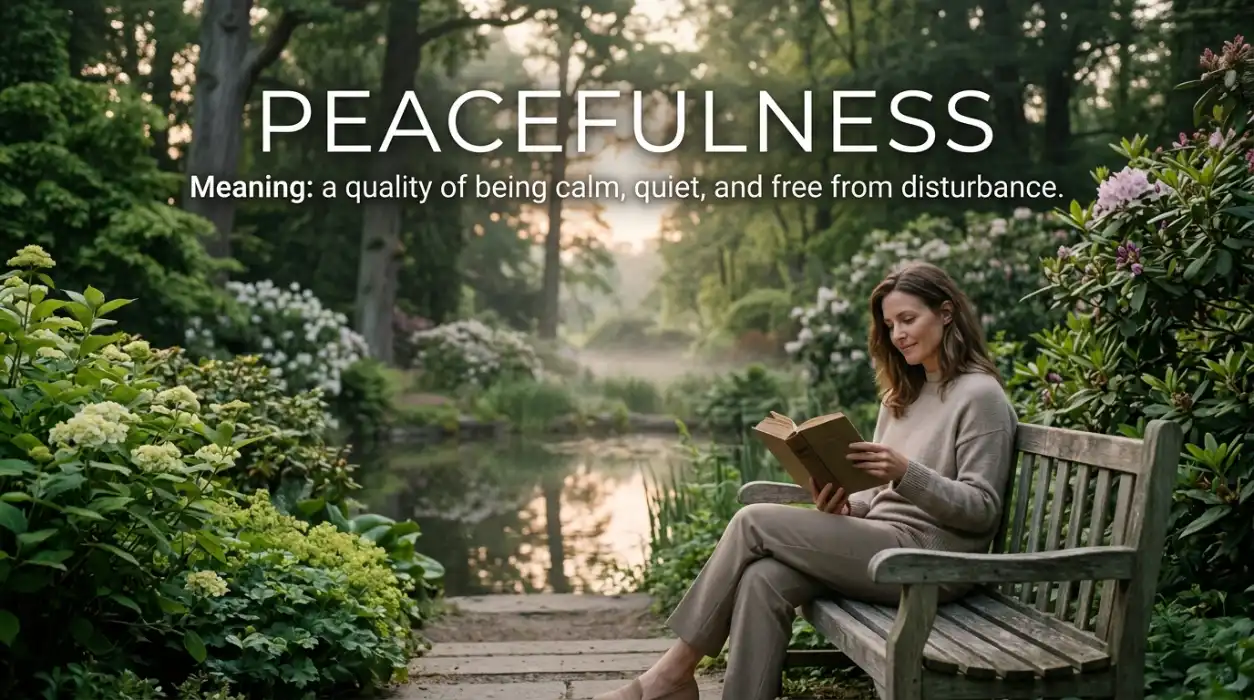
Peacefulness (Noun) — US /ˈpiːsfəlnəs/ | UK /ˈpiːsfəlnəs/
Meaning: Peacefulness is a quality of being calm, quiet, and free from disturbance.
Tone/Register: Neutral, descriptive.
Example:
The beach had a remarkable peacefulness at dawn.
Its peacefulness made the place feel special.
Harmony (Noun) — US /ˈhɑːrməni/ | UK /ˈhɑːməni/
Meaning: Harmony is a state of balance and agreement that can create emotional calm.
Tone/Register: Neutral, literary.
Example:
The couple worked hard to restore harmony at home.
The new routine brought harmony to the household.
Balance (Noun) — US /ˈbæləns/ | UK /ˈbæləns/
Meaning: Balance is a stable state in which competing pressures are kept under control.
Tone/Register: Neutral, professional, wellness.
Example:
She wanted more balance between work and family life.
A balanced routine brought him greater peace.
Groundedness (Noun) — US /ˈɡraʊndɪdnəs/ | UK /ˈɡraʊndɪdnəs/
Meaning: Groundedness is a stable feeling of being emotionally centered and realistic.
Tone/Register: Modern, informal, wellness.
Example:
Spending time outdoors gave him a sense of groundedness.
Her groundedness helped during uncertain moments.
Centeredness (Noun) — US /ˈsɛntərdnəs/ | UK /ˈsentədnəs/
Meaning: Centeredness is a feeling of emotional balance and inner stability.
Tone/Register: Reflective, wellness.
Example:
Breathing exercises improved her sense of centeredness.
He returned to work with greater centeredness.
Assurance of Safety (Noun Phrase) — US /əˈʃʊrəns əv ˈseɪfti/ | UK /əˈʃʊərəns əv ˈseɪfti/
Meaning: Assurance of safety is confidence that someone or something is protected from harm.
Tone/Register: Formal, professional.
Example:
The inspection assured safety.
Parents wanted clear assurance of safety before the trip.
Sense of Security (Noun Phrase) — US /sɛns əv səˈkjʊrəti/ | UK /sens əv sɪˈkjʊərəti/
Meaning: A sense of security is the emotional feeling that one is safe and protected.
Tone/Register: Neutral, psychological.
Example:
The familiar neighborhood gave him a sense of security.
Stable routines can create a strong sense of security.
Synonyms by Tone
Tone matters because two words can share a basic meaning while creating different emotional effects.
Positive
- serenity
- tranquility
- inner peace
- contentment
- reassurance
- comfort
- harmony
- emotional well-being
- groundedness
- centeredness
These choices work well when you want your writing to feel warm, hopeful, or uplifting.
Neutral
- calm
- calmness
- security
- safety
- confidence
- certainty
- stability
- reliability
- ease
- relaxation
- peace
These are flexible choices for everyday communication.
Negative or Stress-Related
There are few genuinely negative synonyms because peace of mind itself is positive. However, words such as relief, solace, consolation, and stress relief can imply that the speaker has recently experienced difficulty.
For example, “relief” often suggests that something worrying has finally ended.
Playful or Informal
For casual conversation, phrases such as:
- a worry-free feeling
- some quiet
- inner calm
- mental ease
- a clear head
can sound more natural than highly formal words such as equanimity or quietude.
Peace of Mind vs Close Alternatives
| Expression | Main Meaning | Tone | Best Use |
|---|---|---|---|
| Peace of mind | Freedom from worry | Neutral, positive | General conversation |
| Reassurance | Something that reduces doubt | Neutral, practical | Advice, relationships, professional writing |
| Serenity | Deep, undisturbed calm | Formal, reflective | Personal writing, literature |
| Relief | Worry has recently decreased | Emotional | Stressful situations |
| Security | Feeling protected and safe | Practical | Safety, relationships, finance, work |
| Contentment | Quiet satisfaction | Reflective | Lifestyle and personal writing |
How “Peace of Mind” Changes by Context
Daily Conversation
In everyday English, peace of mind is extremely natural.
“Knowing you’re home safely gives me peace of mind.”
You can also use simpler expressions such as calm, relief, comfort, or a sense of security.
For casual speech, shorter alternatives often sound more natural.
Writing and Blogging
Bloggers can use alternatives to prevent repetitive wording.
Instead of writing:
“This habit gives you peace of mind.”
you could write:
“This habit can create a sense of calm.”
Or:
“This routine may bring emotional ease.”
The choice depends on the message and audience.
Professional or Academic English
Professional writing often benefits from more precise vocabulary.
For example:
“The procedure provides reassurance to employees.”
sounds more specific than:
“The procedure gives employees peace of mind.”
In academic writing, psychological safety, emotional well-being, stability, and equanimity may be suitable when their meanings fit the research context.
Creative or Informal Use
Creative writing allows more expressive alternatives.
You might describe a character experiencing:
- inner peace
- stillness
- quietude
- solace
- serenity
- a worry-free feeling
These expressions can create atmosphere as well as meaning.
Common Mistakes Learners Make
Mistake 1: Treating Every Alternative as Identical
“Peace of mind,” “relief,” and “security” overlap, but they are not interchangeable in every sentence.
For example:
“The police report gave her security.”
may work in a specific context, but:
“The police report gave her peace of mind.”
is usually more natural when the focus is reduced worry.
Mistake 2: Using “Serenity” in Casual Situations
“Serenity” is correct, but it can sound poetic.
A friend might say:
“I finally feel calm.”
They are less likely to say:
“I have achieved profound serenity.”
The second sentence sounds much more literary.
Mistake 3: Confusing Relief with Peace
Relief normally follows stress or uncertainty.
“I felt relief when the doctor called.”
Peace of mind can describe an ongoing state.
“Regular checkups give me peace of mind.”
Mistake 4: Using “Security” Only for Physical Safety
Security can be physical, emotional, financial, digital, or social.
Therefore, context determines its exact meaning.
Mistake 5: Overusing the Phrase
“Peace of mind” is natural, but repeating it several times in one paragraph can make writing dull.
Instead, alternate carefully with reassurance, calm, security, relief, comfort, or ease.
Register Notes
Peace of mind is neutral and widely understood.
It works in:
- spoken English
- emails
- blogs
- essays
- professional communication
- personal stories
- everyday conversation
Words such as equanimity, quietude, and repose are more formal or literary.
Words such as calm, quiet, and relief are more conversational.
For related vocabulary, you can also explore a broader guide to emotional and psychological expressions.
Real-Life Mini Scenarios Using “Peace of Mind”
Workplace
A manager confirms that a major deadline has been moved.
“That confirmation gave the team peace of mind.”
Here, reassurance and relief could also work.
Social Situation
A parent receives a message that their teenager arrived safely.
“The message gave her peace of mind.”
Here, security or reassurance may also fit.
Media and Pop Culture
A character finally discovers the truth after years of uncertainty.
“The truth gave him peace of mind.”
A writer could instead use closure, relief, or inner peace, depending on the scene.
Writing and Storytelling
A character leaves a stressful city and moves to the countryside.
“For the first time in years, she felt a deep sense of tranquility.”
The word tranquility creates a stronger visual and literary mood than ordinary “calm.”
Why Choosing the Right Synonym Matters
Good vocabulary is not about using the most complicated word.
Instead, it is about choosing the most accurate word for the situation.
For example, security highlights protection.
Relief highlights the end of worry.
Contentment highlights satisfaction.
Serenity highlights deep calm.
Reassurance highlights reduced doubt.
That distinction makes writing more precise.
It also makes speech more natural because native speakers choose words based on context, emotion, and register.

Interactive Practice Quiz
1. Your friend confirms that your lost passport has been found. Which word best describes your immediate feeling?
A. Serenity
B. Relief
C. Harmony
D. Contentment
2. A meditation session leaves you deeply calm. Which word fits best?
A. Serenity
B. Certainty
C. Reliability
D. Safety
3. A company installs a dependable backup system. Employees feel more ______.
A. Solace
B. Security
C. Quietude
D. Consolation
4. Your teacher tells you that your exam preparation is on the right track. What did the teacher provide?
A. Reassurance
B. Stillness
C. Repose
D. Harmony
5. Someone is satisfied with their simple life. Which word is most appropriate?
A. Relief
B. Contentment
C. Safety
D. Assurance
6. A person stays calm while everyone else is panicking. Which quality do they show?
A. Composure
B. Hope
C. Quietude
D. Solace
7. A peaceful countryside scene is being described in a novel. Which word sounds most literary?
A. Quietude
B. Security
C. Confidence
D. Reliability
8. A child feels safe because a trusted parent is nearby. Which expression fits best?
A. Emotional security
B. Certainty
C. Satisfaction
D. Repose
9. You want a simple phrase for “I don’t have to worry anymore.” Which is best?
A. Peace of mind
B. Consolation
C. Equanimity
D. Harmony
10. A difficult problem has finally been solved. Which word emphasizes the release of stress?
A. Relief
B. Groundedness
C. Stillness
D. Faith
Answer key: 1-B | 2-A | 3-B | 4-A | 5-B | 6-A | 7-A | 8-A | 9-A | 10-A
Reflection Task
Write three short sentences about your own life.
Use peace of mind, reassurance, and one more synonym from the list.
Then ask yourself: Does each word express the same kind of calm, or does its emotional shade change?
Conclusion
Understanding peace of mind can help you express feelings of calmness, comfort, and freedom from worry. Learning its synonyms, meaning, and examples can also improve your English vocabulary and make your communication more effective.
The phrase peace of mind is commonly used when talking about emotional comfort, reassurance, and a sense of security. Using suitable synonyms can help you describe these feelings in different and more natural ways.
By practicing peace of mind in sentences and exploring related expressions, you can communicate your thoughts with greater clarity and confidence. A strong understanding of this phrase can make your English more natural and expressive.
FAQs
1. What is the best synonym for peace of mind in formal writing?
Reassurance, security, certainty, and emotional well-being can work well in formal writing, depending on context. “Reassurance” is useful when something reduces doubt. “Security” works when protection is important. “Certainty” focuses on confidence in facts or outcomes. For academic writing, choose the alternative that describes the exact idea rather than simply replacing the phrase.
2. Is “peace of mind” the same as “inner peace”?
Not exactly. Peace of mind usually means freedom from worry or uncertainty about a particular situation. Inner peace suggests a deeper and more personal state of emotional balance. For example, receiving confirmation that your family is safe can give you peace of mind, while accepting yourself may contribute to inner peace.
3. What is a good synonym for peace of mind in an email?
The best choice depends on the purpose of the email. Reassurance works well when discussing confirmation or support. Confidence is useful for professional decisions. Security fits safety-related topics. For example, “The updated procedure provides reassurance” sounds natural and professional without being overly emotional.
4. What can I say instead of “this gives me peace of mind”?
You can say “this reassures me,” “this makes me feel secure,” “this puts me at ease,” or “this gives me confidence.” If the worry has just disappeared, “this is a relief” may be better. In casual conversation, “I feel much calmer now” is also natural and easy to understand.
5. Which synonym for peace of mind sounds the most sophisticated?
Equanimity, serenity, tranquility, and quietude sound more sophisticated because they are less common in everyday speech. However, sophistication should not replace accuracy. “Serenity” suggests deep calm, while “equanimity” suggests emotional balance under pressure. Choose based on meaning rather than trying to sound overly formal.
6. What is the difference between peace of mind and contentment?
Peace of mind focuses mainly on freedom from worry. Contentment focuses on satisfaction with your present circumstances. Someone can have peace of mind about a difficult decision without feeling completely satisfied with life. Conversely, a person may feel content with a simple lifestyle even while worrying about a particular problem.
7. Can “peace of mind” be used in academic essays?
Yes. The phrase is grammatically correct and widely understood, but academic writing may sometimes benefit from a more precise term. Depending on the subject, alternatives such as psychological safety, emotional well-being, perceived security, or reduced anxiety may communicate the intended idea more specifically. Always choose the term that matches your evidence and context.

Hasnain Ali is an SEO Content Strategist and the founder of wordvora.com, a trusted vocabulary platform that helps writers, students, professionals, and English learners find accurate synonyms, antonyms, word meanings, and real-life usage examples. He specializes in keyword research, on-page SEO, topical authority, and creating search-first content that aligns with Google’s latest Search Quality and E-E-A-T guidelines. His work focuses on producing clear, well-structured, and reader-friendly resources that satisfy search intent while maintaining high editorial standards.
Through extensive hands-on experience with SEO tools such as Google Search Console, Google Analytics, SEMrush, and Ahrefs, Hasnain researches user search behavior and develops content that is both informative and easy to understand. Every article published on wordvora.com is carefully reviewed for accuracy, readability, and contextual relevance before publication. His mission is to build one of the web’s most reliable English vocabulary resources by providing practical language guidance, trustworthy explanations, and content that helps readers improve their writing, communication, and vocabulary with confidence.