

Synonyms for resulted in become useful when you are explaining why something happened. A student writes, “The change resulted in better grades,” and wants a fresher phrase.
You might instead write “The change led to better grades” or “The change caused better grades.” The meaning stays similar, but the tone can change.
The phrase resulted in appears often in essays, reports, news writing, and everyday explanations. Learning alternatives makes your English more precise and less repetitive.
For students, bloggers, content writers, and daily English users, synonyms for resulted in make cause-and-effect writing clearer. The right choice depends on context.
What Does “Resulted In” Really Mean?
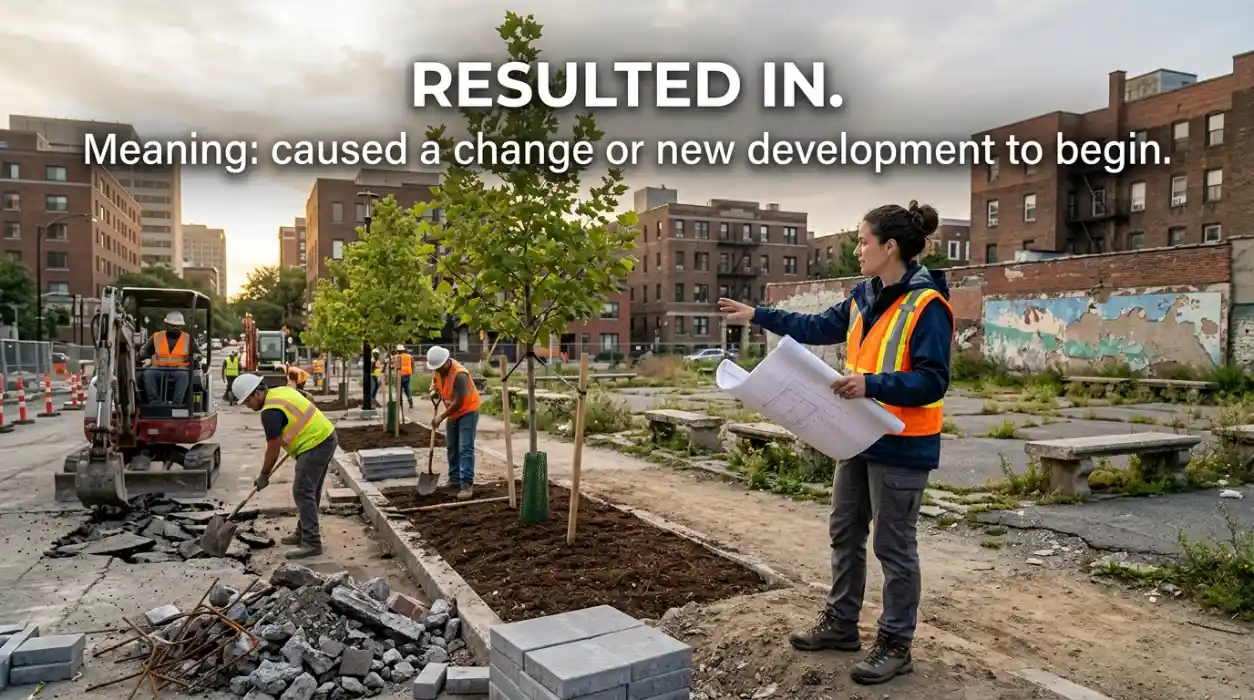
Resulted in means caused something to happen or produced a particular outcome.
It describes a cause-and-effect relationship.
For example:
Heavy rain resulted in flooding.
Here, heavy rain is the cause, while flooding is the result.
Part of Speech
Resulted in is a verb phrase.
The verb result means to happen as an outcome of something. When followed by in, the construction identifies the outcome.
Basic pattern:
Cause + resulted in + outcome
Examples:
- The new policy resulted in higher attendance.
- Poor planning resulted in delays.
- Regular practice resulted in better performance.
Native speakers understand resulted in as relatively neutral and clear. It works especially well when the writer wants to explain consequences without sounding overly emotional.
Connotative Meaning
Connotation (the feeling or association a word carries beyond its basic literal meaning) can affect your choice of synonym.
Positive Tone
Words such as improved, contributed to, produced, generated, brought about, and led to can describe favorable outcomes when the context is positive.
Negative Tone
Words such as caused, triggered, provoked, created, and gave rise to may describe unwanted consequences.
The words themselves are not always negative. Their tone depends heavily on the result they introduce.
Neutral Tone
Led to, resulted in, produced, brought about, caused, and ended in can all sound neutral when the context is factual.
Etymology of “Resulted In”
The word result comes through Middle English and Anglo-French from Latin resultare, meaning “to spring back” or “to rebound.”
The modern meaning developed toward the idea of an outcome or consequence produced by an action or event.
Old English: 450–1100
The exact modern construction result in did not exist in Old English. Native English used other expressions to describe consequences, outcomes, and effects.
Middle English: 1100–1500
English adopted many French and Latin words after the Norman Conquest. The family of words associated with result gradually entered English usage.
Modern English: 1500–Present
Result became firmly established as both a noun and a verb. The construction result in developed as a standard way to express causation and consequence.
Today, resulted in is common in academic, professional, journalistic, and general explanatory writing.

Pronunciation
Resulted
- US: /rɪˈzʌltɪd/
- UK: /rɪˈzʌltɪd/
Resulted in
- US: /rɪˈzʌltɪd ɪn/
- UK: /rɪˈzʌltɪd ɪn/
Syllables
re-sult-ed-in
Affixation Pattern of “Resulted”
- Root: result
- Prefix: none
- Suffix: -ed
The -ed ending marks the simple past tense or past participle form.
The word result itself does not function as a simple prefix-plus-root construction in modern English.
Synonyms List
Led to (Verb Phrase) — US /lɛd tuː/; UK /lɛd tuː/
Meaning: Shows that one event or action caused another outcome.
Tone/Register: Neutral, very common.
Example:
The training led to better customer service.
A small design change led to faster loading times.
Caused (Verb) — US /kɔːzd/; UK /kɔːzd/
Meaning: States directly that one thing made another thing happen.
Tone/Register: Neutral, direct.
Example:
The storm caused several delays.
His mistake confused the team.
Produced (Verb) — US /prəˈduːst/; UK /prəˈdjuːst/
Meaning: Indicates that an action or process generated a particular outcome.
Tone/Register: Neutral, academic, professional.
Example:
The experiment produced unexpected results.
The campaign produced a noticeable increase in responses.
Created (Verb) — US /kriˈeɪtɪd/; UK /kriˈeɪtɪd/
Meaning: Indicates that an action or situation brought a new condition into existence.
Tone/Register: Neutral.
Example:
The merger created new opportunities.
The delay created problems for travelers.
Generated (Verb) — US /ˈdʒɛnəreɪtɪd/; UK /ˈdʒɛnəreɪtɪd/
Meaning: Indicates that something produced an effect, response, or outcome.
Tone/Register: Formal, academic, business.
Example:
The article generated thousands of responses.
The new system generated useful data.
Brought About (Verb Phrase) — US /brɔːt əˈbaʊt/; UK /brɔːt əˈbaʊt/
Meaning: Means to cause a change or event to happen.
Tone/Register: Formal, neutral.
Example:
The reform brought about major changes.
Better communication brought about a calmer workplace.
Gave Rise To (Verb Phrase) — US /ɡeɪv raɪz tuː/; UK /ɡeɪv raɪz tuː/
Meaning: Means that something caused a new situation, idea, or problem to develop.
Tone/Register: Formal, academic.
Example:
The discovery gave rise to new questions.
The decision gave rise to public debate.
Triggered (Verb) — US /ˈtrɪɡərd/; UK /ˈtrɪɡəd/
Meaning: Means that something started a particular event or reaction.
Tone/Register: Neutral, journalistic.
Example:
The announcement triggered a strong reaction.
The warning triggered an emergency review.
Prompted (Verb) — US /ˈprɑːmptɪd/; UK /ˈprɒmptɪd/
Meaning: Means that something encouraged or caused a response or action.
Tone/Register: Formal, neutral.
Example:
The complaint prompted an investigation.
Her question prompted a useful discussion.
Provoked (Verb) — US /prəˈvoʊkt/; UK /prəˈvəʊkt/
Meaning: Means that something caused a strong reaction or response.
Tone/Register: Formal, often negative.
Example:
The decision provoked criticism.
His comment provoked an angry response.
Induced (Verb) — US /ɪnˈduːst/; UK /ɪnˈdjuːst/
Meaning: Means that something caused a particular condition or response.
Tone/Register: Formal, academic, medical.
Example:
The medication induced sleep.
The procedure induced a temporary reaction.
Generated From (Verb Phrase) — US /ˈdʒɛnəreɪtɪd frəm/; UK /ˈdʒɛnəreɪtɪd frəm/
Meaning: Indicates that an outcome developed from a particular source or process.
Tone/Register: Academic, technical.
Example:
The report was generated from survey data.
The insights were generated from several interviews.
Developed Into (Verb Phrase) — US /dɪˈvɛləpt ˈɪntuː/; UK /dɪˈvɛləpt ˈɪntuː/
Meaning: Describes something gradually becoming a particular outcome or state.
Tone/Register: Neutral.
Example:
The small project developed into a major initiative.
Their conversation developed into a long discussion.
Turned Into (Verb Phrase) — US /tɜːrnd ˈɪntuː/; UK /tɜːnd ˈɪntuː/
Meaning: Describes a change from one state or situation into another.
Tone/Register: Informal, everyday.
Example:
The short meeting turned into a long debate.
The simple idea turned into a successful project.
Evolved Into (Verb Phrase) — US /ɪˈvɑːlvd ˈɪntuː/; UK /ɪˈvɒlvd ˈɪntuː/
Meaning: Describes gradual development into a new form or situation.
Tone/Register: Neutral, academic.
Example:
The hobby evolved into a career.
The discussion evolved into a detailed plan.
Culminated In (Verb Phrase) — US /ˈkʌlməˌneɪtɪd ɪn/; UK /ˈkʌlmɪneɪtɪd ɪn/
Meaning: Means that a series of events eventually reached an outcome.
Tone/Register: Formal, academic.
Example:
Months of research culminated in a published study.
The negotiations culminated in an agreement.
Ended In (Verb Phrase) — US /ˈɛndɪd ɪn/; UK /ˈɛndɪd ɪn/
Meaning: Describes the outcome of an event, process, or situation.
Tone/Register: Neutral.
Example:
The argument ended in an apology.
Their discussion ended in a practical solution.
Concluded With (Verb Phrase) — US /kənˈkluːdɪd wɪð/; UK /kənˈkluːdɪd wɪð/
Meaning: Indicates that an event or process finished with a particular result.
Tone/Register: Formal.
Example:
The meeting concluded with a clear decision.
The event concluded with a short speech.
Followed (Verb) — US /ˈfɑːloʊd/; UK /ˈfɒləʊd/
Meaning: Shows that one event happened after another and may imply a connection.
Tone/Register: Neutral.
Example:
A period of uncertainty followed the announcement.
Several improvements followed the review.
Ensued (Verb) — US /ɪnˈsuːd/; UK /ɪnˈsjuːd/
Meaning: Means that something happened afterward as a consequence or development.
Tone/Register: Formal.
Example:
A heated discussion ensued.
Confusion ensued after the announcement.
Stemmed From (Verb Phrase) — US /stɛmd frəm/; UK /stɛmd frəm/
Meaning: Shows the source or underlying cause of a situation.
Tone/Register: Neutral, formal.
Example:
The disagreement stemmed from poor communication.
The problem stemmed from an outdated process.

Originated From (Verb Phrase) — US /əˈrɪdʒəneɪtɪd frəm/; UK /əˈrɪdʒəneɪtɪd frəm/
Meaning: Indicates the source from which something began.
Tone/Register: Formal.
Example:
The idea originated from a classroom discussion.
The proposal originated from customer feedback.
Emerged From (Verb Phrase) — US /ɪˈmɜːrdʒd frəm/; UK /ɪˈmɜːrdʒd frəm/
Meaning: Describes something becoming visible or developing from an earlier situation.
Tone/Register: Neutral, formal.
Example:
The solution emerged from several team meetings.
A new pattern emerged from the research.
Arose From (Verb Phrase) — US /əˈroʊz frəm/; UK /əˈrəʊz frəm/
Meaning: Means that a situation or problem developed from another circumstance.
Tone/Register: Formal.
Example:
The problem arose from a communication gap.
Several questions arose from the study.
Derived From (Verb Phrase) — US /dɪˈraɪvd frəm/; UK /dɪˈraɪvd frəm/
Meaning: Means that something was obtained or developed from a particular source.
Tone/Register: Academic, formal.
Example:
The conclusion was derived from the available evidence.
The estimate was derived from recent data.
Originated In (Verb Phrase) — US /əˈrɪdʒəneɪtɪd ɪn/; UK /əˈrɪdʒəneɪtɪd ɪn/
Meaning: Indicates where or when something began.
Tone/Register: Formal.
Example:
The movement originated in the region.
The idea originated in a university project.
Was Due To (Phrase) — US /wəz duː tuː/; UK /wəz djuː tuː/
Meaning: Identifies the cause responsible for an outcome.
Tone/Register: Neutral, formal.
Example:
The delay was due to heavy traffic.
The improvement was due to better planning.
Was Caused By (Passive Verb Phrase) — US /wəz kɔːzd baɪ/; UK /wəz kɔːzd baɪ/
Meaning: Directly identifies the cause of an outcome.
Tone/Register: Neutral.
Example:
The outage was caused by a technical fault.
The error was caused by incorrect data.
Was Brought About By (Passive Phrase) — US /wəz brɔːt əˈbaʊt baɪ/; UK /wəz brɔːt əˈbaʊt baɪ/
Meaning: States that a person, event, or action caused a change.
Tone/Register: Formal.
Example:
The change was brought about by new regulations.
The improvement was brought about by careful planning.
Was Triggered By (Passive Phrase) — US /wəz ˈtrɪɡərd baɪ/; UK /wəz ˈtrɪɡəd baɪ/
Meaning: Indicates that a particular event started a reaction or process.
Tone/Register: Neutral, journalistic.
Example:
The alert was triggered by unusual activity.
The review was triggered by several complaints.
Was Prompted By (Passive Phrase) — US /wəz ˈprɑːmptɪd baɪ/; UK /wəz ˈprɒmptɪd baɪ/
Meaning: Indicates that something caused another action or response.
Tone/Register: Formal.
Example:
The investigation was prompted by new evidence.
The update was prompted by user feedback.
Was Driven By (Passive Phrase) — US /wəz ˈdrɪvən baɪ/; UK /wəz ˈdrɪvən baɪ/
Meaning: Shows that a strong factor or force contributed to an outcome.
Tone/Register: Business, academic.
Example:
The growth was driven by increased demand.
The change was driven by customer needs.
Was Influenced By (Passive Phrase) — US /wəz ˈɪnfluənst baɪ/; UK /wəz ˈɪnfluənst baɪ/
Meaning: Indicates that something affected the development of an outcome.
Tone/Register: Neutral, academic.
Example:
The decision was influenced by new evidence.
The design was influenced by local traditions.
Was Shaped By (Passive Phrase) — US /wəz ʃeɪpt baɪ/; UK /wəz ʃeɪpt baɪ/
Meaning: Indicates that a factor had an important role in forming an outcome.
Tone/Register: Neutral, descriptive.
Example:
The policy was shaped by public feedback.
Her career was shaped by early experiences.
Was Associated With (Passive Phrase) — US /wəz əˈsoʊsieɪtɪd wɪð/; UK /wəz əˈsəʊsieɪtɪd wɪð/
Meaning: Shows a relationship between two things without necessarily proving direct causation.
Tone/Register: Academic, cautious.
Example:
The change was associated with higher attendance.
The pattern was associated with seasonal demand.
Was Linked To (Passive Phrase) — US /wəz lɪŋkt tuː/; UK /wəz lɪŋkt tuː/
Meaning: Indicates a connection between two things without always claiming direct causation.
Tone/Register: Neutral, academic.
Example:
The increase was linked to changing habits.
The issue was linked to a shortage of staff.
Was Connected To (Passive Phrase) — US /wəz kəˈnɛktɪd tuː/; UK /wəz kəˈnɛktɪd tuː/
Meaning: Shows that two events, factors, or outcomes had a relationship.
Tone/Register: Neutral.
Example:
The delay was connected to a supply problem.
The improvement was connected to better training.
Contributed To (Verb Phrase) — US /kənˈtrɪbjuːtɪd tuː/; UK /kənˈtrɪbjuːtɪd tuː/
Meaning: Indicates that something helped produce an outcome without necessarily being the only cause.
Tone/Register: Neutral, academic.
Example:
Regular exercise contributed to better sleep.
Several factors contributed to the final decision.
Played A Role In (Phrase) — US /pleɪd ə roʊl ɪn/; UK /pleɪd ə rəʊl ɪn/
Meaning: Indicates that something was one factor involved in producing an outcome.
Tone/Register: Neutral.
Example:
Timing played a role in the outcome.
Experience played a role in her decision.
Accounted For (Verb Phrase) — US /əˈkaʊntɪd fɔːr/; UK /əˈkaʊntɪd fɔː/
Meaning: Indicates that something explains or helps explain an outcome.
Tone/Register: Academic, analytical.
Example:
The new data accounted for the difference.
Higher demand accounted for most of the increase.
Determined (Verb) — US /dɪˈtɜːrmɪnd/; UK /dɪˈtɜːmɪnd/
Meaning: Means that something directly influenced or established an outcome.
Tone/Register: Formal.
Example:
Several factors determined the final result.
The market conditions determined the outcome.
Shaped (Verb) — US /ʃeɪpt/; UK /ʃeɪpt/
Meaning: Means that something influenced how an outcome developed.
Tone/Register: Neutral.
Example:
Early experiences shaped his career.
The discussion shaped the final proposal.
Influenced (Verb) — US /ˈɪnfluənst/; UK /ˈɪnfluənst/
Meaning: Means that something affected an outcome without necessarily causing it alone.
Tone/Register: Neutral, academic.
Example:
The weather influenced attendance.
Her teacher influenced her choice of subject.

Affected (Verb) — US /əˈfɛktɪd/; UK /əˈfɛktɪd/
Meaning: Means that something produced a change in another situation or condition.
Tone/Register: Neutral.
Example:
The shortage affected production.
The announcement affected investor confidence.
Determined The Outcome (Verb Phrase) — US /dɪˈtɜːrmɪnd ði ˈaʊtkaʊm/; UK /dɪˈtɜːmɪnd ði ˈaʊt kʌm/
Meaning: Means that something played a decisive role in what eventually happened.
Tone/Register: Formal, analytical.
Example:
Strong teamwork determined the outcome.
The final vote determined the outcome.
Resulted From (Verb Phrase) — US /rɪˈzʌltɪd frəm/; UK /rɪˈzʌltɪd frəm/
Meaning: Shows the source or cause of something rather than its consequence.
Tone/Register: Neutral.
Example:
The error resulted from a misunderstanding.
The improvement resulted from months of practice.
Followed From (Verb Phrase) — US /ˈfɑːloʊd frəm/; UK /ˈfɒləʊd frəm/
Meaning: Indicates that an outcome logically developed from an earlier fact or event.
Tone/Register: Formal.
Example:
The conclusion followed from the evidence.
The recommendation followed from the research findings.
Arguably Led To (Verb Phrase) — US /ˈɑːrɡjuəbli lɛd tuː/; UK /ˈɑːɡjuəbli lɛd tuː/
Meaning: Presents a proposed causal relationship with some caution.
Tone/Register: Academic.
Example:
The change arguably led to higher participation.
The policy arguably led to a shift in behavior.
Ultimately Led To (Verb Phrase) — US /ˈʌltəmətli lɛd tuː/; UK /ˈʌltəmətli lɛd tuː/
Meaning: Emphasizes that a series of events eventually produced an outcome.
Tone/Register: Neutral, formal.
Example:
Several small changes ultimately led to success.
The early decision ultimately led to a new strategy.
Eventually Produced (Verb Phrase) — US /ɪˈvɛntʃuəli prəˈduːst/; UK /ɪˈvɛntʃuəli prəˈdjuːst/
Meaning: Shows that an outcome appeared after a period of development.
Tone/Register: Neutral.
Example:
The experiments eventually produced useful findings.
Their efforts eventually produced a workable solution.
Ultimately Resulted In (Verb Phrase) — US /ˈʌltəmətli rɪˈzʌltɪd ɪn/; UK /ˈʌltəmətli rɪˈzʌltɪd ɪn/
Meaning: Emphasizes the final consequence of a longer process.
Tone/Register: Formal, neutral.
Example:
The negotiations ultimately resulted in an agreement.
Years of preparation ultimately resulted in a successful launch.
Contributed To The Outcome (Verb Phrase) — US /kənˈtrɪbjuːtɪd tuː ði ˈaʊtkaʊm/; UK /kənˈtrɪbjuːtɪd tuː ði ˈaʊtkʌm/
Meaning: Indicates that a factor helped produce the outcome.
Tone/Register: Academic, analytical.
Example:
Better communication contributed to the outcome.
Several small decisions contributed to the outcome.
Accounted For The Result (Verb Phrase) — US /əˈkaʊntɪd fɔːr ðə rɪˈzʌlt/; UK /əˈkaʊntɪd fɔː ðə rɪˈzʌlt/
Meaning: Means that something helped explain why an outcome occurred.
Tone/Register: Academic, analytical.
Example:
The weather accounted for the result.
The difference in preparation accounted for the result.
Was Responsible For (Phrase) — US /wəz rɪˈspɑːnsəbəl fɔːr/; UK /wəz rɪˈspɒnsəbəl fɔː/
Meaning: Identifies something as a direct or important cause.
Tone/Register: Neutral, direct.
Example:
A software error was responsible for the delay.
Poor planning was responsible for the extra work.
Was A Factor In (Phrase) — US /wəz ə ˈfæktər ɪn/; UK /wəz ə ˈfæktə ɪn/
Meaning: Identifies something as one contributing cause rather than the sole cause.
Tone/Register: Neutral, analytical.
Example:
Cost was a factor in the decision.
Timing was a factor in the outcome.
Had The Effect Of (Phrase) — US /hæd ði ɪˈfɛkt əv/; UK /hæd ði ɪˈfɛkt əv/
Meaning: Describes the consequence produced by an action or event.
Tone/Register: Formal.
Example:
The rule had the effect of reducing delays.
The change had the effect of improving access.
Caused A Change In (Verb Phrase) — US /kɔːzd ə tʃeɪndʒ ɪn/; UK /kɔːzd ə tʃeɪndʒ ɪn/
Meaning: Explicitly states that something produced a change.
Tone/Register: Neutral.
Example:
The policy caused a behavior change.
The new schedule caused a change in attendance.
Made Possible (Verb Phrase) — US /meɪd ˈpɑːsəbəl/; UK /meɪd ˈpɒsəbəl/
Meaning: Indicates that a factor enabled a particular outcome.
Tone/Register: Neutral, positive.
Example:
The scholarship made higher education possible.
New technology made remote collaboration possible.
Enabled (Verb) — US /ɪˈneɪbəld/; UK /ɪˈneɪbəld/
Meaning: Means that something provided the ability or opportunity for an outcome to occur.
Tone/Register: Formal, technical.
Example:
The update enabled faster processing.
Better funding enabled the team to expand.
Facilitated (Verb) — US /fəˈsɪləteɪtɪd/; UK /fəˈsɪlɪteɪtɪd/
Meaning: Means that something made an outcome easier to achieve.
Tone/Register: Formal, academic, business.
Example:
The workshop facilitated better communication.
The new process facilitated faster decisions.
Paved The Way For (Phrase) — US /peɪvd ðə weɪ fɔːr/; UK /peɪvd ðə weɪ fɔː/
Meaning: Means that something created conditions that made a later development possible.
Tone/Register: Neutral, figurative.
Example:
Early research paved the way for new treatments.
The agreement paved the way for future cooperation.
Set In Motion (Phrase) — US /sɛt ɪn ˈmoʊʃən/; UK /sɛt ɪn ˈməʊʃən/
Meaning: Means that an action started a chain of events.
Tone/Register: Neutral, figurative.
Example:
The announcement set a major change in motion.
One decision set the entire process in motion.
Sparked (Verb) — US /spɑːrkt/; UK /spɑːkt/
Meaning: Means that something quickly started an activity, reaction, or discussion.
Tone/Register: Informal to neutral.
Example:
The article sparked a lively debate.
Her question sparked new ideas.
Inspired (Verb) — US /ɪnˈspaɪərd/; UK /ɪnˈspaɪəd/
Meaning: Means that something encouraged a person to create, act, or think differently.
Tone/Register: Positive, neutral.
Example:
The documentary inspired a community project.
His story inspired many students to volunteer.
Encouraged (Verb) — US /ɪnˈkɜːrɪdʒd/; UK /ɪnˈkʌrɪdʒd/
Meaning: Means that something supported or increased the likelihood of an outcome.
Tone/Register: Neutral, positive.
Example:
The new policy encouraged participation.
Positive feedback encouraged her to continue.
Prompted A Change (Verb Phrase) — US /ˈprɑːmptɪd ə tʃeɪndʒ/; UK /ˈprɒmptɪd ə tʃeɪndʒ/
Meaning: Means that something caused a change to begin.
Tone/Register: Formal.
Example:
The survey prompted a change in policy.
Customer feedback prompted a change in the design.
Synonyms by Tone
Choosing the proper tone ensures your writing hits the right note. For instance, using casual expressions in academic papers harms authority, while using overly heavy legal phrasing in friendly emails feels distant.
Positive Tone
These terms express constructive progress, goal achievement, and rewarding outcomes:
- Yielded
- Fostered
- Promoted
- Paved the way for
- Bearing fruit
- Brought about change
- Culminated in victory
Neutral Tone
These options state cause-and-effect relationships objectively without emotional bias:
- Led to
- Caused
- Produced
- Generated
- Developed into
- Translated into
- Ended in
Negative Tone
These words highlight unintended accidents, failures, or troubling consequences:
- Precipitated
- Provoked
- Triggered
- Induced
- Bred
- Ended in failure
- Caused damage
Playful / Informal
These express sudden turns, creative outcomes, or casual results lightly:
- Sparked
- Spawned
- Set off
- Turned into
- Ended up with
- Turned out to be
Mini Comparison
Resulted In vs. Caused vs. Led To
- Meaning Difference:
- Resulted in focuses heavily on the outcome or conclusion of a process.
- Caused emphasizes the immediate, direct reason or trigger that produced the effect.
- Led to highlights a gradual progression, chain of events, or development over time.
- Tone Difference:
- Resulted in carries a formal, objective, or analytical tone.
- Caused feels direct, plain, and neutral.
- Led to sounds conversational, natural, and widely flexible.
- When to Use Each:
- Use resulted in when writing corporate summaries, scientific reports, or formal essays.
- Use caused when identifying a clear physical driver, such as a storm causing a power outage.
- Use led to when describing long-term developments, career journeys, or historical trends.
Context-Based Usage
Daily Conversation
In casual chats, native speakers prefer simple expressions like led to, turned into, set off, or ended up with. For instance, you might say a wrong turn “led to” finding a great local coffee shop. These choices keep everyday dialogue flowing comfortably.
Writing or Blogging
Bloggers and content writers benefit from descriptive options like sparked, brought about, or paved the way for. These expressive choices build engaging narratives that hold reader attention naturally across online articles.
Professional or Academic Tone
In formal research, business updates, or academic papers, choose precise vocabulary like yielded, generated, precipitated, or culminated in. These choices convey analytical rigor and high authority effortlessly.
Creative or Informal Use
When writing fiction or casual prose, reach for dynamic choices like spawned, gave birth to, or turned out to be. These vivid options add color and movement to story plots.
Common Mistakes & Native Usage
Common Mistakes Learners Make
- Misusing prepositions: A frequent mistake is using “resulted to” instead of “resulted in.” Native speakers always pair resulted with in when showing consequences.
- Confusing cause and effect direction: Remember that “resulted from” points back to the origin, while “resulted in” points forward to the outcome.
- Overusing the focus phrase: Repeating “resulted in” across consecutive paragraphs makes writing sound repetitive and rigid. Swap in led to, yielded, or generated to keep prose varied.
Register Notes
- Spoken English: Rely on led to, turned into, ended up with, and caused.
- Written English: Utilize yielded, precipitated, engendered, and culminated in.
- For additional phrasing advice to polish your grammar, explore our detailed writing guides on sentence structure.
Real-Life Mini Scenarios
Workplace
When the engineering team introduced automated testing tools, software bugs dropped significantly within weeks. Consequently, this simple upgrade yielded impressive time savings during release cycles.
Social Situations
During a neighborhood planning meeting, a casual conversation about green space grew into an inspiring project. Ultimately, the ideas shared paved the way for a community garden park.
Media / Pop Culture
When an independent film received unexpected praise at a summer festival, audience interest surged overnight. This viral excitement spawned global distribution deals and award nominations.
Writing or Storytelling
A novelist describes a small disagreement between rival leaders in a kingdom. Over time, poor communication bred suspicion, which eventually precipitated a kingdom-wide conflict.
Practice Quiz
1. Which phrase is grammatically correct when describing an outcome?
A) Resulted to
B) Resulted in
C) Resulted at
D) Resulted for
2. Which synonym best fits an academic paper reporting positive research data?
A) Ended up with
B) Spawned
C) Yielded
D) Set off
3. What is the key difference between “resulted from” and “resulted in”?
A) “Resulted from” points to the cause; “resulted in” points to the outcome
B) “Resulted in” points to the cause; “resulted from” points to the outcome
C) Both phrases share the same direction
D) “Resulted from” is only used in informal dialogue
4. Which option carries a negative, urgent tone suggesting a sudden forced event?
A) Fostered
B) Precipitated
C) Promoted
D) Lay the groundwork for
5. What is an informal, everyday alternative to “resulted in”?
A) Occasioned
B) Engendered
C) Ended up with
D) Terminated in
6. If a long, month-long effort ends with a grand final celebration, it:
A) Bred
B) Precipitated
C) Culminated in
D) Induced
7. Which choice fits best when describing a physical trigger like a smoke alarm?
A) Fostered
B) Set off
C) Begot
D) Cultivated
8. What phrase implies preparing early groundwork so future success comes easier?
A) Ended in failure
B) Paved the way for
C) Resulted in loss
D) Terminated in
Application Task
Write one short, original sentence describing a successful study routine using one of the synonyms above (such as yielded, led to, or paved the way for).
Answer Key
1: B | 2: C | 3: A | 4: B | 5: C | 6: C | 7: B | 8: B
Conclusion
Understanding resulted in can help you describe a situation where one action, event, or condition caused a particular outcome. Learning its synonyms, meaning, and examples can improve your English vocabulary and make your communication clearer.
The phrase resulted in is commonly used to explain cause-and-effect relationships in everyday conversations, academic writing, and professional communication. Knowing its related synonyms can help you express outcomes in different ways and make your writing more varied.
Practicing resulted in in sentences and exploring related expressions, you can strengthen your vocabulary and writing skills. A clear understanding of this phrase will help you describe causes and effects more naturally and confidently.
Frequently Asked Questions
1. What is the closest synonym for “resulted in”?
The closest everyday synonym for resulted in is usually led to. Both expressions describe a connection between a cause and an outcome. Caused can also be close, but it often sounds more direct and stronger. In academic writing, contributed to may be more accurate when several factors produced the final result.
2. What can I use instead of “resulted in” in an essay?
In an essay, useful alternatives include led to, caused, contributed to, produced, generated, brought about, gave rise to, and culminated in. Choose according to the relationship you mean. Use caused for a direct relationship and contributed to when the factor represents only part of the explanation.
3. What is the difference between “resulted in” and “resulted from”?
Resulted in introduces an outcome, while resulted from introduces a cause. For example, “Heavy rain resulted in flooding” means rain caused flooding. “The flooding resulted from heavy rain” means flooding was caused by rain. Remember the direction: resulted in = cause to outcome, while resulted from = outcome to cause.
4. Is “led to” more natural than “resulted in”?
Both are natural, but led to is often more conversational and flexible. Resulted in frequently appears in academic, professional, and analytical writing. For example, “The changes led to better results” sounds natural in everyday English, while “The changes resulted in improved outcomes” has a more formal analytical tone.
5. What is a cautious alternative to “caused”?
Contributed to, was associated with, and was linked to can be useful when the evidence does not establish direct causation. These expressions allow you to describe a relationship without claiming that one factor alone produced the outcome. This distinction is especially important in research, journalism, and evidence-based writing.

Hasnain Ali is an SEO Content Strategist and the founder of wordvora.com, a trusted vocabulary platform that helps writers, students, professionals, and English learners find accurate synonyms, antonyms, word meanings, and real-life usage examples. He specializes in keyword research, on-page SEO, topical authority, and creating search-first content that aligns with Google’s latest Search Quality and E-E-A-T guidelines. His work focuses on producing clear, well-structured, and reader-friendly resources that satisfy search intent while maintaining high editorial standards.
Through extensive hands-on experience with SEO tools such as Google Search Console, Google Analytics, SEMrush, and Ahrefs, Hasnain researches user search behavior and develops content that is both informative and easy to understand. Every article published on wordvora.com is carefully reviewed for accuracy, readability, and contextual relevance before publication. His mission is to build one of the web’s most reliable English vocabulary resources by providing practical language guidance, trustworthy explanations, and content that helps readers improve their writing, communication, and vocabulary with confidence.