
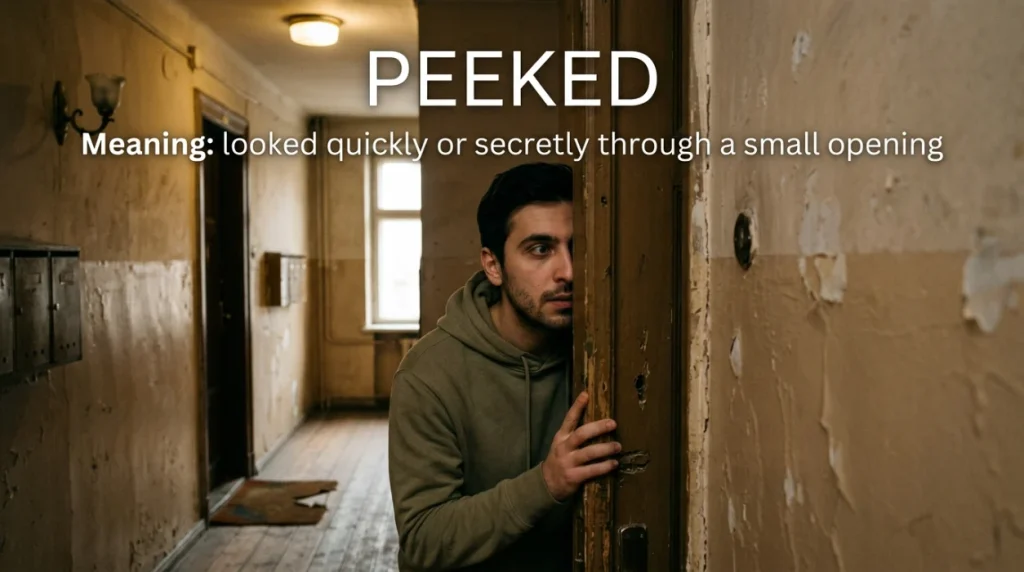
Synonyms for peeked can make a simple scene more vivid. Imagine opening a door slightly and looking inside before anyone notices. That tiny action is a peek.
When you say, “I peeked through the door,” the word suggests a quick or secret look. However, words like glanced, peered, and peeped add different shades.
Learning synonyms for peeked helps you choose words that match your exact meaning. This matters in essays, stories, blogs, emails, and everyday conversations.
Students, bloggers, content writers, and daily English users can all benefit. Instead of repeating peeked, you can describe curiosity, secrecy, speed, or careful attention.
What Does “Peeked” Really Mean?
Peeked is the past tense and past participle of the verb peek.
It means looked quickly, briefly, or secretly, often through a small opening or without wanting someone to notice.
For example:
She peeked through the curtains.
This tells us that she looked briefly, probably because she wanted to see something without being fully seen.
Native speakers usually understand peeked as a light, brief, and sometimes playful action. The word often carries an idea of curiosity.
It can appear in several common situations:
- Looking through a door
- Looking around a corner
- Looking inside a box
- Checking something secretly
- Taking a quick look at a screen
- Looking through curtains
- Seeing what is happening nearby
Part of speech: Verb, specifically the past tense or past participle of peek.
Simple definition: Peeked means looked quickly, briefly, or secretly at something.
Connotative Meaning
Connotation (the feeling or emotional association connected with a word beyond its basic dictionary meaning) can change how peeked feels in a sentence.
Positive Tone
Peeked can sound curious, playful, innocent, or excited.
The child peeked into the gift box with a huge smile.
Here, the action feels harmless and cheerful.
Negative Tone
The word can also suggest secrecy, nosiness, or a lack of privacy.
He peeked at his colleague’s private message.
In this context, the action feels intrusive.
Neutral Tone
Sometimes peeked simply describes a quick visual action.
Maya peeked through the window to see if the rain had stopped.
There is no strong positive or negative judgment.
Etymology of “Peeked”
The word peeked comes from the verb peek, which is an English word associated with taking a quick or secret look.
Its exact historical origin is not completely certain. It is generally connected with Middle English and later English forms expressing looking briefly or secretly.
Old English: 450–1100
There is no firmly established Old English ancestor that directly corresponds to the modern verb peek. Old English used other verbs for seeing, looking, watching, and observing.
Therefore, it is more accurate not to claim that peek directly comes from a specific Old English word.
Middle English: 1100–1500
Forms related to quick or secret looking became more recognizable during later medieval English. Dialectal and expressive forms helped develop vocabulary for brief visual actions.
Modern English: 1500–Present
Over time, peek became established as a familiar English verb meaning to take a quick or secret look.
Today, peek is common in everyday speech, children’s language, fiction, social media writing, and casual descriptions.
The past form peeked follows the regular English pattern:
peek + -ed = peeked
Pronunciation of “Peeked”
- US: /piːkt/
- UK: /piːkt/
The final -ed is pronounced /t/, not /ɪd/.
Syllables
peeked
It has one syllable.
Affixation Pattern of “Peeked”
Root: peek
Prefix: None
Suffix: -ed
The structure is:
peek + -ed → peeked
The suffix -ed marks the simple past or past participle form.
Synonyms List
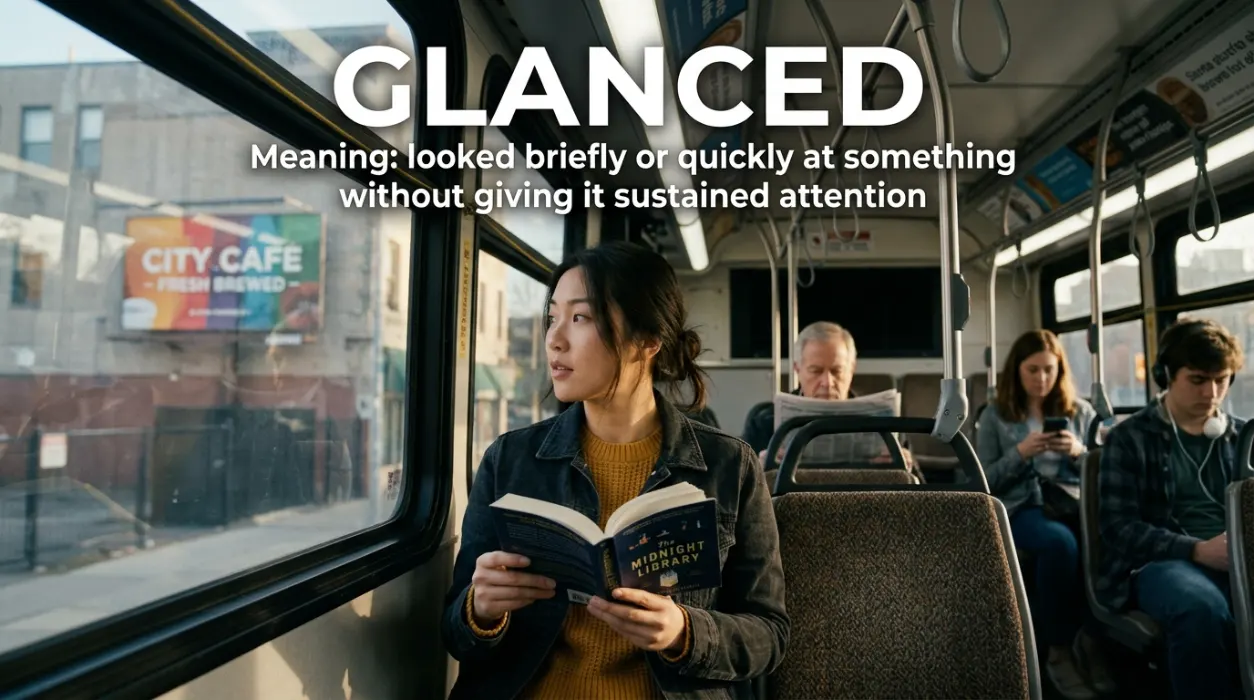
Glanced (Verb) — US /ɡlænst/ — UK /ɡlɑːnst/
Meaning: Looked briefly or quickly at something without giving it sustained attention.
Tone/Register: Neutral; extremely common in everyday and written English.
Example:
She glanced at the clock during the meeting.
He glanced toward the door when he heard a noise.
Peered (Verb) — US /pɪrd/ — UK /pɪəd/
Meaning: Looked closely or carefully, often because something was difficult to see.
Tone/Register: Neutral to formal.
Example:
He peered through the fog for a road sign.
She peered into the dark room before entering.
Peeped (Verb) — US /piːpt/ — UK /piːpt/
Meaning: Looked quickly or secretly, especially through a small opening.
Tone/Register: Informal; playful; sometimes British.
Example:
The toddler peeped through the gap in the curtains.
She peeped inside the package before wrapping it.
Glimpsed (Verb) — US /ɡlɪmpst/ — UK /ɡlɪmpst/
Meaning: Saw something briefly, often without getting a complete view.
Tone/Register: Neutral; common in descriptive writing.
Example:
I glimpsed the actor as the car drove away.
She glimpsed a familiar face in the crowd.
Spied (Verb) — US /spaɪd/ — UK /spaɪd/
Meaning: Noticed or caught sight of something, sometimes unexpectedly or secretly.
Tone/Register: Neutral to literary.
Example:
She spied a quiet café across the street.
He spied his friend waiting near the entrance.
Looked (Verb) — US /lʊkt/ — UK /lʊkt/
Meaning: Directed your eyes toward something.
Tone/Register: Neutral; universal.
Example:
She looked through the doorway.
He looked inside the box for the missing key.
Took a Peek (Verb Phrase) — US /tʊk ə piːk/ — UK /tʊk ə piːk/
Meaning: Made a quick or brief look at something.
Tone/Register: Informal and conversational.
Example:
I took a peek inside the new bookstore.
She took a peek at the invitation.
Had a Peek (Verb Phrase) — US /hæd ə piːk/ — UK /hæd ə piːk/
Meaning: Looked briefly at something, usually in a casual situation.
Tone/Register: Informal; conversational.
Example:
He had a peek inside the refrigerator.
We had a peek at the room before choosing it.
Sneaked a Look (Verb Phrase) — US /sniːkt ə lʊk/ — UK /sniːkt ə lʊk/
Meaning: Took a quick look while trying not to be noticed.
Tone/Register: Informal.
Example:
She sneaked a look at the answer sheet.
He sneaked a look at his phone during class.
Snuck a Look (Verb Phrase) — US /snʌk ə lʊk/ — UK /snʌk ə lʊk/
Meaning: Took a secret or unnoticed look.
Tone/Register: Informal; especially common in American English.
Example:
I snuck a look at the surprise decorations.
He snuck a look behind the curtain.
Sneaked a Peek (Verb Phrase) — US /sniːkt ə piːk/ — UK /sniːkt ə piːk/
Meaning: Took a secret and usually very brief look.
Tone/Register: Informal.
Example:
She sneaked a peek at the birthday cake.
The student sneaked a peek at the clock.
Snuck a Peek (Verb Phrase) — US /snʌk ə piːk/ — UK /snʌk ə piːk/
Meaning: Looked secretly or quickly at something.
Tone/Register: Informal; common in American English.
Example:
He snuck a peek at the gift.
She snuck a peek through the doorway.
Stole a Glance (Verb Phrase) — US /stoʊl ə ɡlæns/ — UK /stəʊl ə ɡlɑːns/
Meaning: Looked briefly and discreetly when you did not want the look to be obvious.
Tone/Register: Neutral to literary.
Example:
She stole a glance at her friend during dinner.
He stole a glance at the scoreboard.
Stole a Look (Verb Phrase) — US /stoʊl ə lʊk/ — UK /stəʊl ə lʊk/
Meaning: Took a quick, secret look.
Tone/Register: Informal to literary.
Example:
He stole a look at the note on the desk.
She stole a look toward the stage.
Stole a Peek (Verb Phrase) — US /stoʊl ə piːk/ — UK /stəʊl ə piːk/
Meaning: Looked briefly and secretly at something.
Tone/Register: Informal; expressive.
Example:
The children stole a peek at the presents.
I stole a peek at the menu before we sat down.
Cast a Glance (Verb Phrase) — US /kæst ə ɡlæns/ — UK /kɑːst ə ɡlɑːns/
Meaning: Directed a quick look toward someone or something.
Tone/Register: Formal to literary.
Example:
The manager cast a glance at the report.
She cast a glance toward the window.
Cast a Look (Verb Phrase) — US /kæst ə lʊk/ — UK /kɑːst ə lʊk/
Meaning: Directed your eyes toward something for a brief moment.
Tone/Register: Neutral to formal.
Example:
He cast a look at the crowded hallway.
She cast a look over the document.
Cast a Furtive Glance (Verb Phrase) — US /kæst ə ˈfɝːtɪv ɡlæns/ — UK /kɑːst ə ˈfɜːtɪv ɡlɑːns/
Meaning: Took a quick, secret look while trying not to attract attention.
Tone/Register: Formal; literary.
Example:
He cast a furtive glance at the open envelope.
She cast a furtive glance toward her rival.
Took a Furtive Look (Verb Phrase) — US /tʊk ə ˈfɝːtɪv lʊk/ — UK /tʊk ə ˈfɜːtɪv lʊk/
Meaning: Looked secretly because you wanted to avoid being noticed.
Tone/Register: Formal to literary.
Example:
She took a furtive look at the test paper.
He took a furtive look behind him.
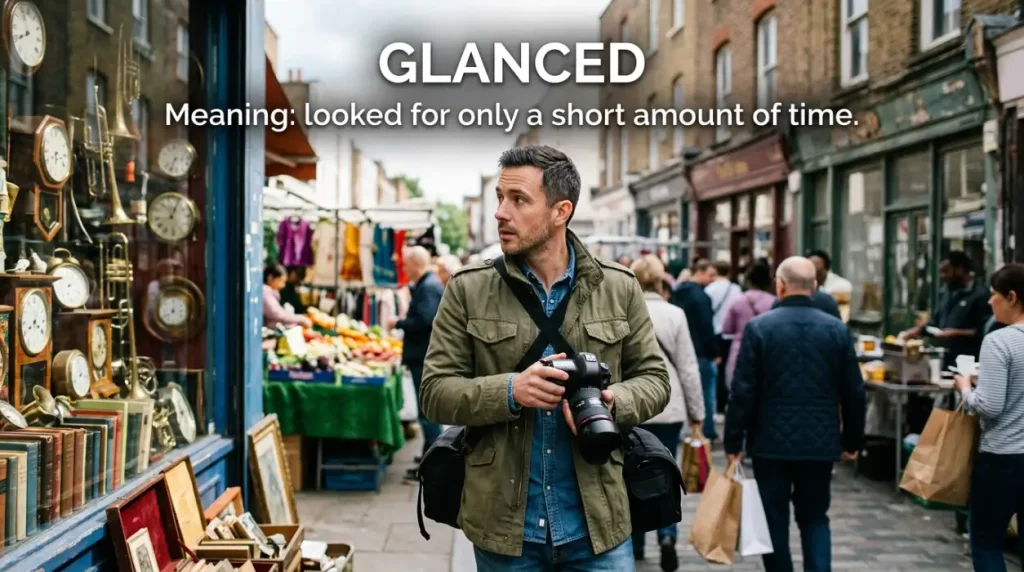
Looked Briefly (Verb Phrase) — US /lʊkt ˈbriːfli/ — UK /lʊkt ˈbriːfli/
Meaning: Looked for only a short amount of time.
Tone/Register: Neutral.
Example:
She looked briefly at the map.
He looked briefly through the window.
Took a Brief Look (Verb Phrase) — US /tʊk ə briːf lʊk/ — UK /tʊk ə briːf lʊk/
Meaning: Examined something for a very short time.
Tone/Register: Neutral.
Example:
I took a brief look at the schedule.
She took a brief look inside the folder.
Had a Quick Look (Verb Phrase) — US /hæd ə kwɪk lʊk/ — UK /hæd ə kwɪk lʊk/
Meaning: Looked at something for a short time.
Tone/Register: Informal to neutral.
Example:
Can I have a quick look at your notes?
He had a quick look outside.
Got a Quick Look (Verb Phrase) — US /ɡɑːt ə kwɪk lʊk/ — UK /ɡɒt ə kwɪk lʊk/
Meaning: Managed to see something briefly.
Tone/Register: Informal.
Example:
I got a quick look at the new design.
She got a quick look inside before leaving.
Got a Glimpse (Verb Phrase) — US /ɡɑːt ə ɡlɪmps/ — UK /ɡɒt ə ɡlɪmps/
Meaning: Managed to see something for a short moment.
Tone/Register: Neutral.
Example:
We got a glimpse of the mountains from the train.
He got a glimpse of the performer backstage.
Caught a Glimpse (Verb Phrase) — US /kɔːt ə ɡlɪmps/ — UK /kɔːt ə ɡlɪmps/
Meaning: Saw someone or something briefly, often unexpectedly.
Tone/Register: Neutral.
Example:
She caught a glimpse of herself in the mirror.
I caught a glimpse of the parade from the window.
Caught a Quick Glimpse (Verb Phrase) — US /kɔːt ə kwɪk ɡlɪmps/ — UK /kɔːt ə kwɪk ɡlɪmps/
Meaning: Saw something for only a very short moment.
Tone/Register: Neutral.
Example:
He caught a quick glimpse of the headline.
She caught a quick glimpse of the puppy.
Sneaked a Glimpse (Verb Phrase) — US /sniːkt ə ɡlɪmps/ — UK /sniːkt ə ɡlɪmps/
Meaning: Secretly managed to see something for a short moment.
Tone/Register: Informal.
Example:
She sneaked a glimpse at the surprise card.
He sneaked a glimpse through the open door.
Snuck a Glimpse (Verb Phrase) — US /snʌk ə ɡlɪmps/ — UK /snʌk ə ɡlɪmps/
Meaning: Secretly got a brief view of something.
Tone/Register: Informal; especially common in American English.
Example:
I snuck a glimpse of the decorations.
She snuck a glimpse at the final page.
Shot a Glance (Verb Phrase) — US /ʃɑːt ə ɡlæns/ — UK /ʃɒt ə ɡlɑːns/
Meaning: Looked very quickly, often with a sudden or sharp movement.
Tone/Register: Neutral to expressive.
Example:
He shot a glance at the clock.
She shot a glance toward the noisy table.
Shot a Look (Verb Phrase) — US /ʃɑːt ə lʊk/ — UK /ʃɒt ə lʊk/
Meaning: Directed a fast look that may also communicate an emotion or attitude.
Tone/Register: Informal to neutral.
Example:
Dad shot me a look when I laughed.
She shot a look toward the open door.
Darted a Glance (Verb Phrase) — US /ˈdɑːrtɪd ə ɡlæns/ — UK /ˈdɑːtɪd ə ɡlɑːns/
Meaning: Moved your eyes quickly toward something for a moment.
Tone/Register: Literary; descriptive.
Example:
She darted a glance at the stranger.
He darted a glance toward the exit.
Looked Over (Phrasal Verb) — US /lʊkt ˈoʊvər/ — UK /lʊkt ˈəʊvə/
Meaning: Looked at something quickly or generally rather than studying every detail.
Tone/Register: Neutral.
Example:
She looked over the menu before ordering.
He looked over the report during lunch.
Glanced Over (Phrasal Verb) — US /ɡlænst ˈoʊvər/ — UK /ɡlɑːnst ˈəʊvə/
Meaning: Looked over something quickly without careful examination.
Tone/Register: Neutral.
Example:
I glanced over the email before replying.
She glanced over the notes before class.
Looked Inside (Phrasal Verb) — US /lʊkt ɪnˈsaɪd/ — UK /lʊkt ɪnˈsaɪd/
Meaning: Directed your eyes into the interior of something.
Tone/Register: Neutral.
Example:
He looked inside the drawer for his keys.
She looked inside the box before moving it.
Looked Through (Phrasal Verb) — US /lʊkt θruː/ — UK /lʊkt θruː/
Meaning: Used your eyes to see through or examine something.
Tone/Register: Neutral.
Example:
She looked through the curtains.
He looked through the gap in the fence.
Peeped Through (Phrasal Verb) — US /piːpt θruː/ — UK /piːpt θruː/
Meaning: Looked secretly through a narrow opening or barrier.
Tone/Register: Informal; playful.
Example:
The boy peeped through the keyhole.
She peeped through the blinds at the street.
Peeped In (Phrasal Verb) — US /piːpt ɪn/ — UK /piːpt ɪn/
Meaning: Looked briefly into a room or enclosed space.
Tone/Register: Informal.
Example:
I peeped in to see whether anyone was home.
She peeped in through the open doorway.
Peeped Out (Phrasal Verb) — US /piːpt aʊt/ — UK /piːpt aʊt/
Meaning: Looked briefly outward from a hidden or enclosed position.
Tone/Register: Informal; descriptive.
Example:
The cat peeped out from behind the sofa.
She peeped out through the curtains.
Looked Around (Phrasal Verb) — US /lʊkt əˈraʊnd/ — UK /lʊkt əˈraʊnd/
Meaning: Looked in several directions to see what was nearby.
Tone/Register: Neutral.
Example:
He looked around before crossing the street.
She looked around the room for an empty chair.
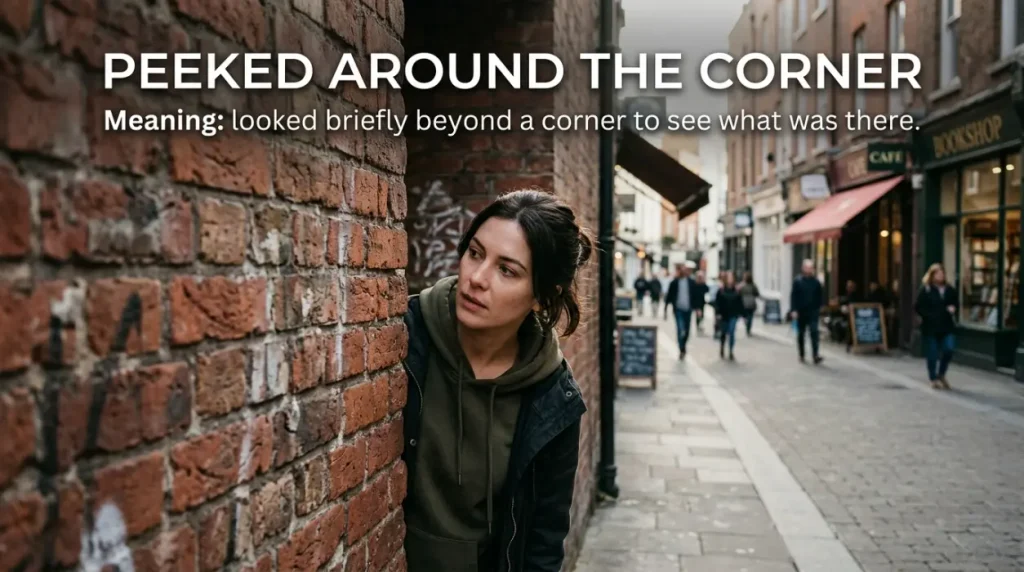
Looked Around the Corner (Phrase) — US /lʊkt əˈraʊnd ðə ˈkɔːrnər/ — UK /lʊkt əˈraʊnd ðə ˈkɔːnə/
Meaning: Looked briefly beyond a corner to see what was there.
Tone/Register: Neutral; descriptive.
Example:
She looked around the corner before entering the hall.
He looked around the corner and saw a parked car.
Looked Over the Edge (Phrase) — US /lʊkt ˈoʊvər ði ɛdʒ/ — UK /lʊkt ˈəʊvə ði edʒ/
Meaning: Directed your eyes downward or beyond the edge of something.
Tone/Register: Neutral.
Example:
He looked over the edge of the balcony.
She looked over the edge of the box.
Looked from Behind (Phrase) — US /lʊkt frəm bɪˈhaɪnd/ — UK /lʊkt frəm bɪˈhaɪnd/
Meaning: Looked at something while remaining partly hidden behind an object.
Tone/Register: Neutral; descriptive.
Example:
The child looked from behind the curtain.
She looked from behind the door before stepping out.
Looked Through a Gap (Phrase) — US /lʊkt θruː ə ɡæp/ — UK /lʊkt θruː ə ɡæp/
Meaning: Looked through a small open space between objects.
Tone/Register: Neutral; descriptive.
Example:
He looked through a gap in the fence.
She looked through a gap between the boxes.
Looked Through a Crack (Phrase) — US /lʊkt θruː ə kræk/ — UK /lʊkt θruː ə kræk/
Meaning: Looked through a narrow opening or split.
Tone/Register: Neutral; descriptive.
Example:
She looked through a crack in the door.
He looked through a crack in the blinds.
Looked Discreetly (Verb Phrase) — US /lʊkt dɪˈskriːtli/ — UK /lʊkt dɪˈskriːtli/
Meaning: Looked without drawing attention to the action.
Tone/Register: Formal; professional.
Example:
She looked discreetly at the clock during the presentation.
He looked discreetly toward the entrance.
Looked Cautiously (Verb Phrase) — US /lʊkt ˈkɔːʃəsli/ — UK /lʊkt ˈkɔːʃəsli/
Meaning: Looked carefully because you were uncertain or concerned about what you might see.
Tone/Register: Neutral; descriptive.
Example:
He looked cautiously around the abandoned building.
She looked cautiously through the doorway.
Looked Curiously (Verb Phrase) — US /lʊkt ˈkjʊriəsli/ — UK /lʊkt ˈkjʊəriəsli/
Meaning: Looked because you wanted to know or understand something.
Tone/Register: Neutral to positive.
Example:
The child looked curiously at the strange machine.
She looked curiously inside the colorful box.
Looked Secretly (Verb Phrase) — US /lʊkt ˈsiːkrətli/ — UK /lʊkt ˈsiːkrətli/
Meaning: Looked while deliberately trying to keep the action hidden.
Tone/Register: Neutral to negative.
Example:
He looked secretly at the gift on the table.
She looked secretly through the open notebook.
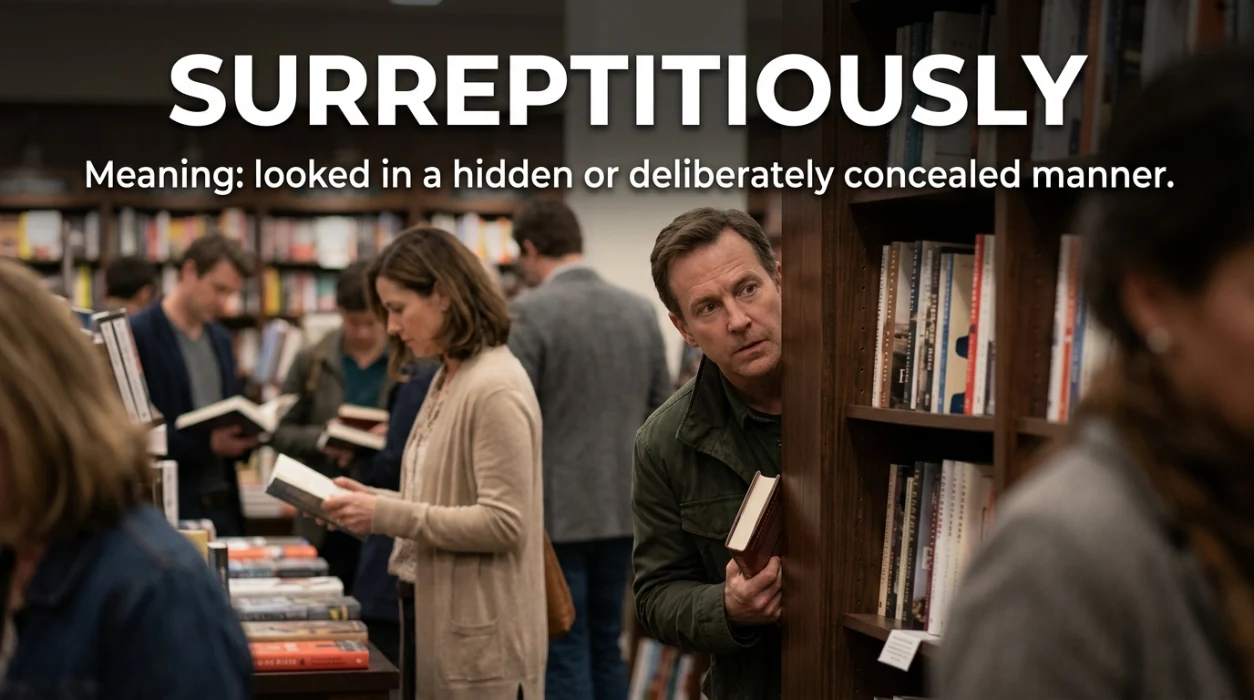
Looked Surreptitiously (Verb Phrase) — US /lʊkt ˌsɜːrəpˈtɪʃəsli/ — UK /lʊkt ˌsʌrəpˈtɪʃəsli/
Meaning: Looked secretly while attempting to avoid being noticed.
Tone/Register: Formal; literary.
Example:
He looked surreptitiously at the message.
She looked surreptitiously toward the manager.
Looked Covertly (Verb Phrase) — US /lʊkt ˈkoʊvərtli/ — UK /lʊkt ˈkəʊvətli/
Meaning: Looked in a hidden or deliberately concealed manner.
Tone/Register: Formal; serious.
Example:
The investigator looked covertly toward the suspect.
She looked covertly at the document.
Synonyms by Tone
Positive
These choices can suggest curiosity, excitement, innocence, or gentle interest:
- glimpsed
- looked curiously
- had a peek
- took a peek
- peeped
- caught a glimpse
- got a glimpse
For example, peeked works well when describing a child opening a birthday present. In that situation, the word sounds warm and playful.
Neutral
These choices usually describe visual actions without strong emotional judgment:
- glanced
- looked
- peered
- looked briefly
- took a brief look
- had a quick look
- looked over
- glanced over
- looked inside
- looked through
- looked around
These are useful in academic, workplace, and everyday communication.
Negative or Secretive
Some alternatives highlight secrecy, suspicion, intrusion, or deliberate concealment:
- sneaked a look
- snuck a look
- sneaked a peek
- snuck a peek
- stole a glance
- stole a look
- looked secretly
- looked covertly
- looked surreptitiously
- took a secret look
The context creates the negative feeling. The word itself is not always negative.
Playful or Informal
These are especially useful in friendly conversation and storytelling:
- took a peek
- had a peek
- peeped
- peeped in
- peeped out
- snuck a peek
- sneaked a peek
- checked out
Why Tone Matters
Two words can describe nearly the same action but create different impressions.
Glanced sounds neutral. Peered suggests careful attention. Sneaked a peek suggests secrecy. Cast a glance sounds more literary.
Therefore, choosing a synonym is not simply about avoiding repetition. It is about controlling meaning and mood.
“Peeked” vs Close Alternatives
| Word | Main Difference | Tone | Best Use |
|---|---|---|---|
| Peeked | Quick, brief, or secret look | Casual, curious | Doors, windows, gifts, hidden views |
| Glanced | Very brief look | Neutral | Conversations, work, daily actions |
| Peered | Careful look, often with difficulty | Neutral/formal | Darkness, distance, unclear objects |
| Glimpsed | Briefly saw something | Neutral/descriptive | Unexpected or incomplete views |
How “Peeked” Changes by Context
Daily Conversation
In everyday speech, peeked sounds natural and relaxed.
“I peeked inside the fridge, but there was nothing good.”
For ordinary conversation, alternatives such as looked, glanced, had a quick look, and took a peek are also common.
Writing and Blogging
In blogs and articles, synonym choice helps prevent repetitive writing.
Instead of writing:
She peeked at the screen. She peeked through the window. She peeked inside the box.
You can write:
She glanced at the screen, peered through the window, and took a quick look inside the box.
Each verb now gives the reader a slightly different image.
Professional or Academic English
Formal writing generally favors words such as glanced, observed, examined, or reviewed, depending on the intended meaning.
However, do not replace peeked automatically. If a research participant literally looked through a narrow opening, peeked may still be the clearest word.
Creative and Informal Writing
Fiction often benefits from vivid choices.
Liam peeped through the doorway.
This creates a stronger image than:
Liam looked through the doorway.
Similarly, cast a furtive glance can create tension in a mystery scene.
Common Mistakes Learners Make
Mistake 1: Treating Every Looking Verb as a Synonym
Watched, stared, gazed, and examined are not interchangeable with peeked.
They describe different kinds or durations of looking.
Mistake 2: Using “Peeked” for Long Observation
This sounds unnatural:
She peeked at the movie for two hours.
A better sentence is:
She watched the movie for two hours.
Peeked normally suggests a short visual action.
Mistake 3: Confusing “Peek,” “Peak,” and “Pique”
These three words sound alike but have different meanings.
- Peek: a quick look
- Peak: the highest point
- Pique: stimulate interest or cause irritation
For example:
I peeked through the window.
Not:
I peaked through the window.
Mistake 4: Using “Peered” When You Mean “Peeked”
Peered usually suggests careful or difficult looking.
He peered through the fog.
That does not simply mean he took a secret glance.
Mistake 5: Overusing Secretive Alternatives
Words such as surreptitiously, covertly, and furtively can sound too dramatic in casual writing.
For an ordinary situation, glanced or took a quick look may sound much more natural.
Register Notes
Peeked is mostly neutral and conversational.
Glanced works across almost every register.
Peered is slightly more descriptive.
Cast a glance is more literary.
Surreptitiously and covertly are formal.
Snuck a peek is highly conversational.
If you are building related vocabulary, an internal guide on synonyms for looked can also help you compare these visual verbs.
Real-Life Mini Scenarios
Workplace
During a meeting, Sara peeked at her phone because she was waiting for an important message.
In a more neutral professional style, you could write:
Sara glanced at her phone during the meeting.
Social Situation
At a friend’s birthday party, Daniel peeked at the wrapped box before the host opened it.
Here, peeked sounds playful rather than suspicious.
Media and Pop Culture
A fan caught a glimpse of a famous singer leaving a studio.
Here, caught a glimpse works better than peeked because the fan saw the person briefly rather than intentionally looking through an opening.
Writing and Storytelling
The detective peered through the narrow gap in the door.
If secrecy is more important, you could write:
The detective took a furtive look through the gap.
The second version emphasizes concealment.
Practice Exercise
1. You quickly look at your watch during a meeting. Which word fits best?
A. Stared
B. Glanced
C. Watched
D. Examined
2. A child secretly looks through a keyhole. Which verb is most natural?
A. Peeped
B. Observed
C. Gazed
D. Studied
3. You struggle to see a sign because it is far away. Which word fits best?
A. Peeked
B. Peered
C. Glimpsed
D. Stared
4. You unexpectedly see your old teacher for one second in a crowd.
A. Glimpsed
B. Examined
C. Watched
D. Inspected
5. You secretly look at someone’s answer sheet.
A. Snuck a look
B. Gazed
C. Observed
D. Watched
6. You want a literary phrase for a discreet, quick look.
A. Cast a furtive glance
B. Watched carefully
C. Examined closely
D. Stared briefly
7. Which word is most casual for looking inside a gift?
A. Took a peek
B. Observed
C. Inspected
D. Scrutinized
8. Which verb suggests careful looking because visibility is poor?
A. Glanced
B. Peered
C. Peeked
D. Looked briefly
9. Which phrase sounds most professional?
A. Snuck a peek
B. Had a peek
C. Took a discreet look
D. Peeped in
10. Which sentence uses “peeked” naturally?
A. She peeked at the film for three hours.
B. She peeked through the doorway.
C. She peeked at the lecture all afternoon.
D. She peeked at the report carefully.
Answer Key: 1-B | 2-A | 3-B | 4-A | 5-A | 6-A | 7-A | 8-B | 9-C | 10-B
Reflection Task:
Write one sentence about a real situation in which you peeked, glanced, peered, or caught a glimpse of something. Then replace your chosen word with a different synonym and notice how the tone changes.
Conclusion
Understanding peeked can help you describe the action of looking quickly or secretly at something. Learning its synonyms, meaning, and examples can make your English vocabulary more varied and improve your ability to express ideas clearly.
The word peeked is often used when someone takes a brief or cautious look at a person, place, or object. Exploring its related synonyms can help you choose the right word for different situations and make your writing more natural.
By practicing peeked in sentences and understanding its different uses, you can strengthen your vocabulary and communication skills. A clear knowledge of this word will help you use it confidently in everyday English and writing.
FAQs
1. What is the best synonym for peeked in everyday English?
Glanced is often the best general alternative when you mean “looked quickly.” However, it does not always carry the secretive or curious feeling of peeked. If someone intentionally looks through a small opening, peeped or took a peek may be more accurate. The best synonym depends on whether speed, secrecy, curiosity, or difficulty seeing matters most.
2. Is “glanced” the same as “peeked”?
Not exactly. Both can describe a short look, but peeked often suggests curiosity, secrecy, or looking through a limited opening. Glanced mainly emphasizes brevity. For example, “She glanced at the clock” is neutral, while “She peeked through the door” suggests a more deliberate and limited view.
3. What is a formal synonym for peeked?
A formal alternative depends on the context. Took a discreet look, cast a glance, or looked surreptitiously can work when secrecy matters. However, formal writing should not replace peeked simply to sound sophisticated. If peeked accurately describes the action, it may still be the clearest choice.
4. What is the difference between peeked and peered?
Peeked usually describes a quick or secret look. Peered suggests a careful look, often because something is distant, dark, small, or difficult to see. For example, you might peek through a door, but you might peer through the fog to identify something in the distance.
5. What are good synonyms for peeked in creative writing?
Creative writing benefits from precise alternatives such as peeped, stole a glance, cast a furtive glance, darted a glance, and looked cautiously. These choices create different moods. Peeped can sound playful, while cast a furtive glance can create suspense or secrecy.

Hasnain Ali is an SEO Content Strategist and the founder of wordvora.com, a trusted vocabulary platform that helps writers, students, professionals, and English learners find accurate synonyms, antonyms, word meanings, and real-life usage examples. He specializes in keyword research, on-page SEO, topical authority, and creating search-first content that aligns with Google’s latest Search Quality and E-E-A-T guidelines. His work focuses on producing clear, well-structured, and reader-friendly resources that satisfy search intent while maintaining high editorial standards.
Through extensive hands-on experience with SEO tools such as Google Search Console, Google Analytics, SEMrush, and Ahrefs, Hasnain researches user search behavior and develops content that is both informative and easy to understand. Every article published on wordvora.com is carefully reviewed for accuracy, readability, and contextual relevance before publication. His mission is to build one of the web’s most reliable English vocabulary resources by providing practical language guidance, trustworthy explanations, and content that helps readers improve their writing, communication, and vocabulary with confidence.