
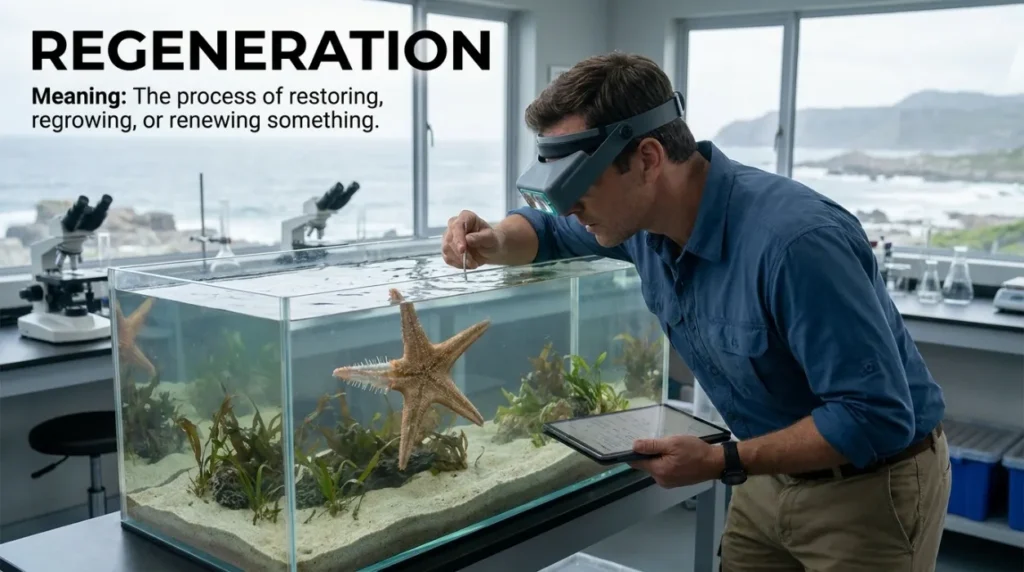
Synonyms for regeneration can help you describe renewal, recovery, revival, or growth with greater precision. Imagine a tired garden becoming green again after weeks of rain. That simple change is a form of regeneration.
In everyday English, we often use regeneration when something becomes fresh, active, healthy, or useful again. However, the best alternative depends on the context and intended tone.
Learning synonyms improves vocabulary because it helps you avoid repeating the same word. For students, bloggers, content writers, and daily English users, this makes writing clearer, richer, and more natural.
This guide explains synonyms for regeneration in simple English. You will find 55 useful alternatives, pronunciation guides, examples, tone notes, context tips, and a practical quiz.
What Does “Regeneration” Really Mean?
Regeneration is a noun that means the process of becoming new, fresh, active, healthy, or complete again.
In simple English, regeneration means renewal or restoration after damage, decline, loss, or inactivity.
The word is commonly used in several fields. These include biology, medicine, environmental science, urban planning, technology, business, spirituality, and personal development.
For example:
- A damaged plant may undergo regeneration.
- A neglected neighborhood may experience regeneration.
- A person may describe spiritual regeneration as a new beginning.
- A forest can show natural regeneration after disturbance.
Native speakers usually understand the word as fairly formal and positive. It often suggests that something has regained strength, function, life, or quality.
Part of Speech
Regeneration is a noun.
Simple definition:
The process of becoming healthy, active, useful, or new again.
Connotative Meaning
Connotation (the feelings or ideas that a word suggests beyond its basic dictionary meaning) can change how regeneration sounds.
Positive Tone
Regeneration often suggests hope, improvement, recovery, and fresh potential.
The regeneration of the old park gave the community a new place to gather.
Negative Tone
The word itself is rarely negative. However, the surrounding context can create a negative feeling.
The regeneration project forced several old buildings to be demolished.
Neutral Tone
In scientific or technical writing, regeneration can simply describe a biological or physical process.
Tissue regeneration can occur under suitable conditions.
Etymology of “Regeneration”
The word regeneration comes through Latin from regeneratio, meaning “a bringing forth again” or “renewal.” It is related to the Latin verb regenerare, meaning “to generate again” or “to produce anew.”
The prefix re- means “again,” while the base relates to generate, meaning “to produce, create, or bring into being.”
Historical Development
Old English (450–1100):
The modern word regeneration was not a common Old English vocabulary item. English writers used native Germanic expressions for ideas such as renewal, restoration, and becoming new.
Middle English (1100–1500):
Latin- and French-influenced vocabulary became increasingly important in English. Religious and scholarly writing helped introduce and develop learned terms connected with rebirth and renewal.
Modern English (1500–Present):
Regeneration became established in religious, literary, scientific, and later environmental and social vocabulary. Today, it is used for everything from tissue repair to urban renewal.

Pronunciation
US: /rɪˌdʒɛnəˈreɪʃən/
UK: /rɪˌdʒɛnəˈreɪʃən/
Syllables
re-gen-er-a-tion
Affixation Pattern
Root: generate
Prefix: re-
Suffix: -ion
The pattern can be understood roughly as:
re- + generate + -ion → regeneration
The prefix indicates repetition or return, while the suffix turns the process into a noun.
Synonyms List
Renewal (Noun) — US /ˈnuːəl/ | UK /rɪˈnjuːəl/
Meaning: Renewal means making something fresh, active, strong, or effective again.
Tone/Register: Neutral, formal, everyday.
Example:
The city plans the renewal of several neglected public spaces.
A short break gave her a sense of mental renewal.
Revival (Noun) — US /rɪˈvaɪvəl/ | UK /rɪˈvaɪvəl/
Meaning: Revival describes a return to life, popularity, activity, or strength after decline.
Tone/Register: Neutral, cultural, formal.
Example:
The festival helped bring a revival to the historic district.
The old music style is enjoying a revival among younger listeners.
Restoration (Noun) — US /ˌrɛstəˈreɪʃən/ | UK /ˌrestəˈreɪʃən/
Meaning: Restoration means returning something to an earlier, better, or functioning condition.
Tone/Register: Formal, academic, technical.
Example:
The restoration of the wetlands took several years.
Experts completed the restoration of the damaged artwork.
Rebirth (Noun) — US /ˈriːbɝːθ/ | UK /ˈriːbɜːθ/
Meaning: Rebirth describes a powerful new beginning after an earlier stage has ended.
Tone/Register: Literary, emotional, spiritual.
Example:
The community described the project as a rebirth for the neighborhood.
After leaving her old job, she felt a personal rebirth.
Rejuvenation (Noun) — US /rɪˌdʒuːvəˈneɪʃən/ | UK /rɪˌdʒuːvəˈneɪʃən/
Meaning: Rejuvenation means restoring freshness, energy, or vitality.
Tone/Register: Formal, wellness, descriptive.
Example:
The park received a major rejuvenation after years of neglect.
A quiet weekend gave him a sense of rejuvenation.
Revitalization (Noun) — US /ˌriːvaɪtələˈzeɪʃən/ | UK /ˌriːvaɪtəlaɪˈzeɪʃən/
Meaning: Revitalization means giving new energy, activity, or life to something that has weakened.
Tone/Register: Formal, business, urban planning.
Example:
The council announced a revitalization plan for the waterfront.
Small businesses supported the revitalization of the area.
Resurgence (Noun) — US /rɪˈsɝːdʒəns/ | UK /rɪˈsɜːdʒəns/
Meaning: Resurgence means a strong return of activity, strength, or popularity.
Tone/Register: Formal, news, academic.
Example:
The region has seen a resurgence in local tourism.
There was a sudden resurgence of interest in the old tradition.
Reawakening (Noun) — US /ˌriːəˈweɪkənɪŋ/ | UK /ˌriːəˈweɪkənɪŋ/
Meaning: Reawakening describes becoming active, aware, interested, or emotionally alive again.
Tone/Register: Literary, emotional, creative.
Example:
The trip sparked a reawakening of her interest in painting.
Spring brought a reawakening of life across the valley.
Reanimation (Noun) — US /riˌænəˈmeɪʃən/ | UK /riˌænɪˈmeɪʃən/
Meaning: Reanimation means bringing something back to activity or apparent life.
Tone/Register: Technical, medical, literary.
Example:
The treatment focused on the reanimation of damaged tissue.
The novel imagines the reanimation of a forgotten machine.
Resuscitation (Noun) — US /rɪˌsʌsɪˈteɪʃən/ | UK /rɪˌsʌsɪˈteɪʃən/
Meaning: Resuscitation means restoring breathing, circulation, or vital function.
Tone/Register: Medical, technical.
Example:
The patient required immediate resuscitation.
Emergency teams began resuscitation within minutes.
Recovery (Noun) — US /rɪˈkʌvəri/ | UK /rɪˈkʌvəri/
Meaning: Recovery means returning toward health, strength, normal function, or stability.
Tone/Register: Neutral, medical, everyday.
Example:
Her recovery after the injury was gradual.
The local economy showed signs of recovery.
Recuperation (Noun) — US /rɪˌkuːpəˈreɪʃən/ | UK /rɪˌkuːpəˈreɪʃən/
Meaning: Recuperation is the process of regaining health and strength after illness, stress, or exhaustion.
Tone/Register: Formal, medical.
Example:
He took two weeks for recuperation after surgery.
Rest was essential during her recuperation.
Restorationism (Noun) — US /ˌrɛstəˈreɪʃənɪzəm/ | UK /ˌrestəˈreɪʃənɪzəm/
Meaning: Restorationism refers to an approach focused on restoring an earlier condition, tradition, or system.
Tone/Register: Academic, historical, specialized.
Example:
The movement was influenced by religious restorationism.
Historians continue to debate the role of restorationism.
Resumption (Noun) — US /rɪˈzʌmpʃən/ | UK /rɪˈzʌmpʃən/
Meaning: Resumption means starting an activity again after a pause.
Tone/Register: Formal, business, academic.
Example:
The resumption of classes was announced on Monday.
Workers prepared for the resumption of production.
Reconstitution (Noun) — US /ˌriːˌkɑːnstəˈtuːʃən/ | UK /ˌriːˌkɒnstɪˈtjuːʃən/
Meaning: Reconstitution means forming something again by reorganizing or recombining its parts.
Tone/Register: Formal, scientific, institutional.
Example:
The committee began the reconstitution of its membership.
The solution required careful reconstitution in the laboratory.
Reconstruction (Noun) — US /ˌriːkənˈstrʌkʃən/ | UK /ˌriːkənˈstrʌkʃən/
Meaning: Reconstruction means rebuilding something after damage, destruction, or major change.
Tone/Register: Formal, technical, historical.
Example:
The reconstruction of the bridge took months.
Archaeologists created a reconstruction of the ancient building.
Rebuilding (Noun) — US /ˌriːˈbɪldɪŋ/ | UK /ˌriːˈbɪldɪŋ/
Meaning: Rebuilding means constructing something again after damage or loss.
Tone/Register: Neutral, practical.
Example:
The town began rebuilding after the storm.
The team focused on rebuilding public trust.
Reformation (Noun) — US /ˌrɛfərˈmeɪʃən/ | UK /ˌrefəˈmeɪʃən/
Meaning: Reformation means making major changes to improve or reform an existing system.
Tone/Register: Formal, historical, institutional.
Example:
The organization began a period of internal reformation.
Religious history contains several major examples of reformation.
Renewal (Noun) — US /rɪˈnuːəl/ | UK /rɪˈnjuːəl/
Meaning: Renewal also describes the restoration of energy, commitment, interest, or purpose.
Tone/Register: Formal, motivational.
Example:
The new project gave the team a sense of renewal.
She returned to her studies with renewed confidence.
Regrowth (Noun) — US /ˈriːɡroʊθ/ | UK /ˈriːɡrəʊθ/
Meaning: Regrowth means growing again after being cut, damaged, removed, or lost.
Tone/Register: Scientific, environmental, everyday.
Example:
The forest showed natural regrowth after the fire.
The doctor explained that hair regrowth could take time.
Replanting (Noun) — US /ˌriːˈplæntɪŋ/ | UK /ˌriːˈplɑːntɪŋ/
Meaning: Replanting means putting new plants into an area where vegetation was removed or lost.
Tone/Register: Environmental, practical.
Example:
Replanting helped restore the damaged hillside.
The project includes replanting native trees.
Replenishment (Noun) — US /rɪˈplɛnɪʃmənt/ | UK /rɪˈplenɪʃmənt/
Meaning: Replenishment means restoring something that has been used, reduced, or depleted.
Tone/Register: Formal, business, environmental.
Example:
The wetland depends on regular water replenishment.
The store ordered replenishment of its supplies.
Recuperation (Noun) — US /rɪˌkuːpəˈreɪʃən/ | UK /rɪˌkuːpəˈreɪʃən/
Meaning: Recuperation emphasizes the return of physical strength after illness, injury, or exhaustion.
Tone/Register: Formal, medical.
Example:
The athlete needed time for recuperation.
Quiet surroundings supported his recuperation.
Rehabilitation (Noun) — US /ˌriːəˌbɪləˈteɪʃən/ | UK /ˌriːəbɪlɪˈteɪʃən/
Meaning: Rehabilitation means restoring health, ability, function, or usefulness after damage or decline.
Tone/Register: Medical, professional, formal.
Example:
She entered rehabilitation after the accident.
The building underwent rehabilitation rather than complete demolition.
Reconditioning (Noun) — US /ˌriːkənˈdɪʃənɪŋ/ | UK /ˌriːkənˈdɪʃənɪŋ/
Meaning: Reconditioning means restoring something to a usable or improved condition.
Tone/Register: Technical, practical, business.
Example:
The equipment required careful reconditioning.
The workshop specializes in reconditioning old machinery.
Refurbishment (Noun) — US /rɪˈfɝːbɪʃmənt/ | UK /rɪˈfɜːbɪʃmənt/
Meaning: Refurbishment means improving or renewing an existing building, object, or space.
Tone/Register: Business, property, formal.
Example:
The library closed briefly for refurbishment.
The refurbishment gave the office a brighter appearance.

Renewal (Noun) — US /rɪˈnuːəl/ | UK /rɪˈnjuːəl/
Meaning: Renewal can describe the restoration of a relationship, commitment, contract, or sense of purpose.
Tone/Register: Formal, emotional, business.
Example:
The ceremony marked the renewal of their vows.
The contract is due for renewal next month.
Reinvigoration (Noun) — US /ˌriːɪnˌvɪɡəˈreɪʃən/ | UK /ˌriːɪnˌvɪɡəˈreɪʃən/
Meaning: Reinvigoration means giving new energy and strength to something that has become tired or weak.
Tone/Register: Formal, professional.
Example:
The new strategy brought reinvigoration to the organization.
The campaign created a sense of reinvigoration among staff.
Reenergization (Noun) — US /ˌriːˌɛnərdʒəˈzeɪʃən/ | UK /ˌriːˌenədʒaɪˈzeɪʃən/
Meaning: Reenergization means restoring energy, motivation, or activity.
Tone/Register: Professional, motivational.
Example:
The retreat supported the team’s reenergization.
The redesign led to the reenergization of the project.
Revivification (Noun) — US /rɪˌvɪvəfəˈkeɪʃən/ | UK /rɪˌvɪvɪfɪˈkeɪʃən/
Meaning: Revivification means making something lively, active, or alive again.
Tone/Register: Literary, formal, uncommon.
Example:
The poet uses spring as a symbol of revivification.
The restoration brought revivification to the neglected garden.
Reviviscence (Noun) — US /ˌriːvɪˈvɪsəns/ | UK /ˌriːvɪˈvɪsəns/
Meaning: Reviviscence means a return to life, activity, or vitality.
Tone/Register: Literary, specialized.
Example:
The novel presents nature as a cycle of reviviscence.
The scientist studied signs of cellular reviviscence.
Rejuvenescence (Noun) — US /rɪˌdʒuːvəˈnɛsəns/ | UK /rɪˌdʒuːvəˈnesəns/
Meaning: Rejuvenescence describes a process of becoming young, fresh, or vigorous again.
Tone/Register: Formal, literary, specialized.
Example:
The garden’s rejuvenescence was visible by early spring.
The writer describes cultural rejuvenescence after a long decline.
Resurgence (Noun) — US /rɪˈsɝːdʒəns/ | UK /rɪˈsɜːdʒəns/
Meaning: Resurgence emphasizes a noticeable return after a period of weakness or absence.
Tone/Register: News, formal, academic.
Example:
The city experienced a resurgence of interest in cycling.
The species showed a surprising resurgence in the region.
Renaissance (Noun) — US /ˈrɛnəsɑːns/ | UK /rɪˈneɪsəns/
Meaning: Renaissance describes a period of renewed cultural, artistic, intellectual, or social activity.
Tone/Register: Cultural, literary, historical.
Example:
The neighborhood is experiencing a creative renaissance.
Local artists hope to encourage a renaissance in public art.
Rekindling (Noun) — US /ˌriːˈkɪndlɪŋ/ | UK /ˌriːˈkɪndlɪŋ/
Meaning: Rekindling means bringing back an emotion, interest, relationship, or enthusiasm.
Tone/Register: Emotional, conversational.
Example:
The reunion led to a rekindling of their friendship.
The class inspired a rekindling of his love for science.
Reignition (Noun) — US /riˌɪɡˈnɪʃən/ | UK /riˌɪɡˈnɪʃən/
Meaning: Reignition means causing interest, passion, energy, or activity to start again.
Tone/Register: Creative, professional.
Example:
The documentary sparked a reignition of public interest.
The new coach brought a reignition of team spirit.
Rebirth (Noun) — US /ˈriːbɝːθ/ | UK /ˈriːbɜːθ/
Meaning: Rebirth strongly emphasizes a fresh beginning after a major ending or transformation.
Tone/Register: Literary, spiritual, emotional.
Example:
The artist viewed the new collection as a rebirth.
The village celebrated its cultural rebirth.
Reincarnation (Noun) — US /ˌriːɪnkɑːrˈneɪʃən/ | UK /ˌriːɪnkɑːˈneɪʃən/
Meaning: Reincarnation specifically refers to being born again in another body, usually in a religious or spiritual belief.
Tone/Register: Religious, spiritual.
Example:
The novel explores the idea of reincarnation.
Her story draws on beliefs about reincarnation.
Metamorphosis (Noun) — US /ˌmɛtəˈmɔːrfəsɪs/ | UK /ˌmetəˈmɔːfəsɪs/
Meaning: Metamorphosis means a major transformation from one form or state into another.
Tone/Register: Scientific, literary.
Example:
The butterfly undergoes a remarkable metamorphosis.
The company experienced a complete metamorphosis.
Transformation (Noun) — US /ˌtrænsfərˈmeɪʃən/ | UK /ˌtrænsfəˈmeɪʃən/
Meaning: Transformation means a significant change in form, appearance, character, or condition.
Tone/Register: Neutral, formal, broad.
Example:
The renovation transformed the empty building.
Her transformation began with a change in routine.
Renewalism (Noun) — US /rɪˈnuːəlɪzəm/ | UK /rɪˈnjuːəlɪzəm/
Meaning: Renewalism refers broadly to an emphasis on renewal or revitalization, especially in cultural or religious contexts.
Tone/Register: Specialized, academic.
Example:
The paper examines renewalism in modern religious movements.
The author connects renewalism with changing social values.
Resettlement (Noun) — US /ˌriːˈsɛtəlmənt/ | UK /ˌriːˈsetəlmənt/
Meaning: Resettlement means establishing people or communities in a new place after displacement or disruption.
Tone/Register: Formal, social policy.
Example:
The program supported the resettlement of displaced families.
Careful planning was required during the resettlement process.
Reorganization (Noun) — US /riˌɔːrɡənəˈzeɪʃən/ | UK /riˌɔːɡənaɪˈzeɪʃən/
Meaning: Reorganization means arranging a system or group differently to improve its operation.
Tone/Register: Business, formal, institutional.
Example:
The department underwent reorganization last year.
The reorganization created clearer responsibilities.
Reintegration (Noun) — US /ˌriːɪntəˈɡreɪʃən/ | UK /ˌriːɪntɪˈɡreɪʃən/
Meaning: Reintegration means bringing a person, group, or part back into a larger whole.
Tone/Register: Social, professional, formal.
Example:
The program supports the reintegration of former residents.
Successful reintegration can take patience and support.
Reestablishment (Noun) — US /ˌriːɪˈstæblɪʃmənt/ | UK /ˌriːɪˈstæblɪʃmənt/
Meaning: Reestablishment means creating or restoring something that previously existed.
Tone/Register: Formal, academic.
Example:
The project aims at the reestablishment of native habitats.
The treaty supported the reestablishment of diplomatic ties.
Resurgence (Noun) — US /rɪˈsɝːdʒəns/ | UK /rɪˈsɜːdʒəns/
Meaning: Resurgence is a renewed increase in strength, attention, or activity.
Tone/Register: Formal, media, academic.
Example:
The sport has experienced a resurgence among teenagers.
A resurgence of local crafts has attracted visitors.
Recuperation (Noun) — US /rɪˌkuːpəˈreɪʃən/ | UK /rɪˌkuːpəˈreɪʃən/
Meaning: Recuperation focuses on rest and recovery after physical or mental strain.
Tone/Register: Formal, medical.
Example:
The doctor recommended several days of recuperation.
He used the holiday for quiet recuperation.
Repair (Noun) — US /rɪˈpɛr/ | UK /rɪˈpeə/
Meaning: Repair means fixing damage so something can work or function properly again.
Tone/Register: Everyday, technical.
Example:
The repair restored the machine’s basic function.
The roof needs repair before winter.
Renewal (Noun) — US /rɪˈnuːəl/ | UK /rɪˈnjuːəl/
Meaning: Renewal can describe a fresh start in a personal, social, cultural, or institutional setting.
Tone/Register: Neutral to formal.
Example:
The new semester felt like a renewal for many students.
The ceremony represented a renewal of community spirit.
Reawakening (Noun) — US /ˌriːəˈweɪkənɪŋ/ | UK /ˌriːəˈweɪkənɪŋ/
Meaning: Reawakening emphasizes the return of awareness, feeling, curiosity, or activity.
Tone/Register: Literary, emotional.
Example:
The book caused a reawakening of her childhood memories.
Spring brought a reawakening of the countryside.
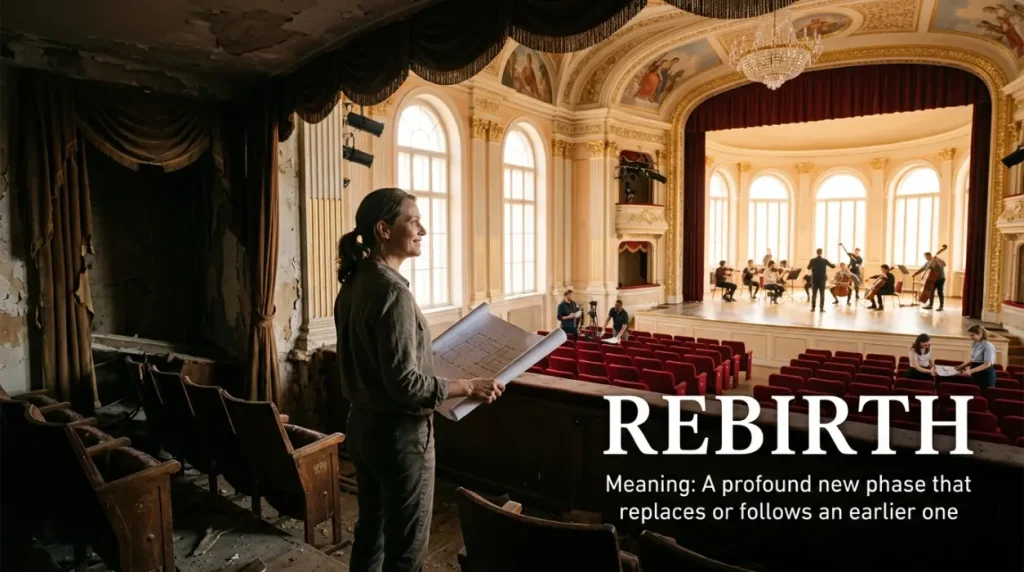
Rebirth (Noun) — US /ˈriːbɝːθ/ | UK /ˈriːbɜːθ/
Meaning: Rebirth suggests a profound new phase that replaces or follows an earlier one.
Tone/Register: Literary, emotional, spiritual.
Example:
The documentary presents the forest’s recovery as a rebirth.
He described learning a new language as a personal rebirth.
Revivalism (Noun) — US /rɪˈvaɪvəlɪzəm/ | UK /rɪˈvaɪvəlɪzəm/
Meaning: Revivalism describes an organized or strong emphasis on reviving an earlier tradition, belief, style, or movement.
Tone/Register: Academic, religious, cultural.
Example:
The historian studied revivalism in nineteenth-century culture.
The movement combined revivalism with modern artistic ideas.
Regeneration (Noun) — US /rɪˌdʒɛnəˈreɪʃən/ | UK /rɪˌdʒɛnəˈreɪʃən/
Meaning: Regeneration itself describes the process of renewal, regrowth, or restoration after loss or decline.
Tone/Register: Formal, scientific, environmental.
Example:
Natural regeneration is important for healthy forests.
The city invested in urban regeneration.
Revitalization (Noun) — US /ˌriːvaɪtələˈzeɪʃən/ | UK /ˌriːvaɪtəlaɪˈzeɪʃən/
Meaning: Revitalization emphasizes restoring energy or activity to something that has become weak or inactive.
Tone/Register: Professional, urban, business.
Example:
The revitalization of the market created new community activity.
Residents discussed plans for neighborhood revitalization.
Rebirth (Noun) — US /ˈriːbɝːθ/ | UK /ˈriːbɜːθ/
Meaning: Rebirth can describe an emotional, artistic, social, or cultural renewal that feels like a new beginning.
Tone/Register: Creative, emotional.
Example:
The gallery’s reopening marked a rebirth for the arts district.
The singer called the album a musical rebirth.
Resurgence (Noun) — US /rɪˈsɝːdʒəns/ | UK /rɪˈsɜːdʒəns/
Meaning: Resurgence highlights a noticeable increase after a period of decline or reduced activity.
Tone/Register: Formal, journalistic.
Example:
There has been a resurgence in interest in handwritten letters.
The craft saw a resurgence after years of decline.
Renewal (Noun) — US /rɪˈnuːəl/ | UK /rɪˈnjuːəl/
Meaning: Renewal is one of the broadest alternatives and often works when something becomes fresh or active again.
Tone/Register: Neutral, formal, everyday.
Example:
The rain brought renewal to the dry fields.
The workshop gave participants a feeling of renewal.
Reinvigoration (Noun) — US /ˌriːɪnˌvɪɡəˈreɪʃən/ | UK /ˌriːɪnˌvɪɡəˈreɪʃən/
Meaning: Reinvigoration focuses on restoring energy and enthusiasm.
Tone/Register: Formal, professional.
Example:
The new leadership brought reinvigoration to the project.
The team needed reinvigoration after a difficult quarter.
Regrowth (Noun) — US /ˈriːɡroʊθ/ | UK /ˈriːɡrəʊθ/
Meaning: Regrowth specifically describes biological growth that occurs again after loss or damage.
Tone/Register: Scientific, environmental, everyday.
Example:
The scientists observed rapid regrowth in the damaged plants.
Regrowth was visible within several months.
Replenishment (Noun) — US /rɪˈplɛnɪʃmənt/ | UK /rɪˈplenɪʃmənt/
Meaning: Replenishment focuses on restoring a supply or resource that has been reduced.
Tone/Register: Formal, environmental, business.
Example:
Groundwater replenishment is vital during dry seasons.
The reservoir needs natural replenishment.
Rehabilitation (Noun) — US /ˌriːəˌbɪləˈteɪʃən/ | UK /ˌriːəbɪlɪˈteɪʃən/
Meaning: Rehabilitation emphasizes restoring function, health, or usefulness after damage or decline.
Tone/Register: Medical, technical, formal.
Example:
The injured bird underwent rehabilitation before release.
The wetland needs long-term rehabilitation.
Reconditioning (Noun) — US /ˌriːkənˈdɪʃənɪŋ/ | UK /ˌriːkənˈdɪʃənɪŋ/
Meaning: Reconditioning means bringing an object or system back into a useful condition.
Tone/Register: Technical, practical.
Example:
The old engine required extensive reconditioning.
Reconditioning extended the machine’s useful life.
Refurbishment (Noun) — US /rɪˈfɝːbɪʃmənt/ | UK /rɪˈfɜːbɪʃmənt/
Meaning: Refurbishment usually means updating, repairing, or improving an existing physical space or item.
Tone/Register: Business, property, practical.
Example:
The school reopened after a major refurbishment.
The refurbishment included new lighting and flooring.
Reconstruction (Noun) — US /ˌriːkənˈstrʌkʃən/ | UK /ˌriːkənˈstrʌkʃən/
Meaning: Reconstruction emphasizes rebuilding after severe damage or destruction.
Tone/Register: Formal, technical, historical.
Example:
The bridge required complete reconstruction.
The museum created a reconstruction of the ancient street.
Restoration (Noun) — US /ˌrɛstəˈreɪʃən/ | UK /ˌrestəˈreɪʃən/
Meaning: Restoration emphasizes returning something toward a previous or intended condition.
Tone/Register: Formal, artistic, environmental.
Example:
The restoration of the river improved local biodiversity.
Experts documented every stage of the restoration.
Transformation (Noun) — US /ˌtrænsfərˈmeɪʃən/ | UK /ˌtrænsfəˈmeɪʃən/
Meaning: Transformation focuses on significant change rather than simply returning to an earlier condition.
Tone/Register: Neutral, professional, creative.
Example:
The transformation of the empty lot surprised residents.
Her transformation was visible in her new approach to work.
Reformation (Noun) — US /ˌrɛfərˈmeɪʃən/ | UK /ˌrefəˈmeɪʃən/
Meaning: Reformation refers to substantial reform that changes an existing system, belief, or practice.
Tone/Register: Formal, historical, institutional.
Example:
The institution began a period of reformation.
The essay examines political reformation in the region.
Reestablishment (Noun) — US /ˌriːɪˈstæblɪʃmənt/ | UK /ˌriːɪˈstæblɪʃmənt/
Meaning: Reestablishment means restoring something to existence or operation after it disappeared or stopped.
Tone/Register: Formal, academic.
Example:
The project supports the reestablishment of native species.
The agreement enabled the reestablishment of trade.
Reintegration (Noun) — US /ˌriːɪntəˈɡreɪʃən/ | UK /ˌriːɪntɪˈɡreɪʃən/
Meaning: Reintegration describes returning something or someone to a larger system or community.
Tone/Register: Social, professional, formal.
Example:
The program focuses on the reintegration of displaced workers.
Community support can make reintegration easier.
Reorganization (Noun) — US /riˌɔːrɡənəˈzeɪʃən/ | UK /riˌɔːɡənaɪˈzeɪʃən/
Meaning: Reorganization means restructuring parts of a system so it can operate differently or more effectively.
Tone/Register: Business, institutional.
Example:
The company’s reorganization changed several departments.
The reorganization created a simpler reporting structure.
Resumption (Noun) — US /rɪˈzʌmpʃən/ | UK /rɪˈzʌmpʃən/
Meaning: Resumption means an activity begins again after a temporary stop.
Tone/Register: Formal, academic, business.
Example:
The airline announced the resumption of service.
Students prepared for the resumption of classes.
Reconstitution (Noun) — US /ˌriːˌkɑːnstəˈtuːʃən/ | UK /ˌriːˌkɒnstɪˈtjuːʃən/
Meaning: Reconstitution means forming something again by putting its parts together in a new or restored arrangement.
Tone/Register: Technical, scientific, formal.
Example:
The researchers studied the reconstitution of the sample.
The committee required formal reconstitution.
Reanimation (Noun) — US /riˌænəˈmeɪʃən/ | UK /riˌænɪˈmeɪʃən/
Meaning: Reanimation emphasizes bringing activity or apparent life back to something inactive.
Tone/Register: Technical, medical, literary.
Example:
The film uses reanimation as a central theme.
The treatment aims at tissue reanimation.
Revivification (Noun) — US /rɪˌvɪvəfəˈkeɪʃən/ | UK /rɪˌvɪvɪfɪˈkeɪʃən/
Meaning: Revivification means restoring vitality or liveliness.
Tone/Register: Literary, formal.
Example:
The poem celebrates the revivification of nature.
The restoration brought revivification to the historic square.
Reinvigoration (Noun) — US /ˌriːɪnˌvɪɡəˈreɪʃən/ | UK /ˌriːɪnˌvɪɡəˈreɪʃən/
Meaning: Reinvigoration means restoring energy, confidence, or enthusiasm.
Tone/Register: Professional, formal.
Example:
The workshop provided reinvigoration after a difficult period.
The redesign brought reinvigoration to the brand’s identity.
Rejuvenation (Noun) — US /rɪˌdʒuːvəˈneɪʃən/ | UK /rɪˌdʒuːvəˈneɪʃən/
Meaning: Rejuvenation emphasizes freshness, youthfulness, energy, or renewed vitality.
Tone/Register: Descriptive, formal, wellness.
Example:
The landscape project brought rejuvenation to the garden.
A change of scenery gave the writer creative rejuvenation.
Synonyms by Tone
Tone matters because two words can have similar meanings but create very different impressions.
Positive
Words such as renewal, revival, rejuvenation, revitalization, resurgence, rebirth, renaissance, reinvigoration, reawakening, and rekindling often create a hopeful impression.
They work well when you want to emphasize improvement, energy, or a fresh beginning.
Neutral
Restoration, recovery, rehabilitation, regrowth, reconstruction, repair, resumption, replenishment, reorganization, and reconstitution can sound more factual.
These are useful in academic, technical, scientific, and professional writing.
Negative or Problem-Focused Context
Regeneration itself is not normally negative. However, words such as reconstruction, rehabilitation, and resettlement can appear in contexts involving damage, displacement, loss, or disruption.
The surrounding sentence determines the emotional effect.
Playful or Informal
Rekindling, reawakening, rebirth, and reignition can sound more expressive.
They suit personal writing, storytelling, lifestyle content, and creative articles.
Regeneration vs Close Alternatives
Renewal vs Regeneration
Regeneration often suggests a process of becoming active, healthy, or functional again.
Renewal is broader. It can describe energy, contracts, relationships, landscapes, or personal motivation.
Use regeneration for biological, environmental, urban, or technical contexts. Use renewal when you want a flexible everyday alternative.
Regeneration vs Restoration
Restoration usually suggests returning something toward a previous or intended condition.
Regeneration can suggest something more dynamic. It may involve new growth or renewed function.
For example, restoring an old building means repairing it. Regenerating a damaged ecosystem can involve new biological growth.
Regeneration vs Revival
Revival emphasizes a return after decline or inactivity.
It works especially well for culture, traditions, popularity, businesses, and movements.
By contrast, regeneration is more comfortable in scientific and environmental contexts.
How “Regeneration” Changes by Context
Daily Conversation
In casual speech, people often choose simpler words such as renewal, recovery, rebuilding, regrowth, or revival.
For example, instead of saying, “The garden underwent regeneration,” a speaker may say, “The garden grew back.”
The simpler version often sounds more natural in conversation.
Writing and Blogging
Bloggers can use regeneration when discussing nature, cities, personal growth, technology, or wellness.
However, variation improves readability. A paragraph can use regeneration once and then use renewal, revival, or rejuvenation where the meaning remains accurate.
This prevents keyword stuffing and makes the writing feel human.
Professional or Academic Writing
Academic writers often prefer precise terms.
Regeneration works particularly well in biology, ecology, medicine, environmental science, and urban studies.
For example:
“Natural forest regeneration can support ecosystem recovery.”
In this context, replacing the word with a casual alternative may reduce technical precision.
Creative or Informal Writing
Creative writing gives you more freedom.
Words such as rebirth, reawakening, rekindling, renaissance, and metamorphosis can create stronger imagery.
For example:
“Spring became a quiet rebirth for the sleeping garden.”
That sentence feels more emotional than:
“Spring caused plant regeneration.”
Both can work, but they serve different purposes.
Common Mistakes Learners Make
Mistake 1: Treating every synonym as interchangeable
This is the biggest problem.
Regrowth is appropriate for biological growth. Resumption is better for an activity that starts again. Restoration often concerns returning something to an earlier state.
Context always matters.
Mistake 2: Using “rebirth” in technical writing
Rebirth can sound emotional, spiritual, or literary.
In a scientific report, regeneration, restoration, or regrowth may be more precise.
Mistake 3: Confusing recovery with regeneration
Recovery often describes returning to health or stability.
Regeneration can imply actual new growth or renewed formation.
Therefore, a recovering patient and a regenerating tissue are related ideas, but they are not identical.
Mistake 4: Using “resurgence” for everything
A resurgence usually involves an increase after decline.
You can describe a resurgence in popularity. You would not normally describe every repaired object as experiencing a resurgence.
Mistake 5: Overusing sophisticated synonyms
Advanced vocabulary is useful only when it improves meaning.
A simple word such as renewal is often better than an obscure term if your audience may not know the obscure word.
Native Usage Tip
Native speakers usually choose the word that best matches the type of change.
Ask yourself:
- Did something grow again?
- Did something return to an earlier condition?
- Did activity restart?
- Did something become popular again?
- Did energy return?
- Did the entire thing change form?
Your answer will usually reveal the best synonym.
For related vocabulary practice, you can also build a personal synonym list around words such as renewal, recovery, and restoration.
Real-Life Mini Scenarios
Workplace
A tired team may experience reinvigoration after a successful project.
A company may undergo reorganization when its departments change.
A paused program may see resumption after funding or planning is completed.
Social Situations
A reunion may create a rekindling of friendship.
A community event may encourage revitalization in a quiet neighborhood.
A person returning to an old hobby may feel a reawakening of interest.
Media and Pop Culture
An older television series may receive a revival.
A music genre may experience a resurgence.
A cultural movement may enjoy a renaissance.
Writing and Storytelling
A character can experience a rebirth after a major life event.
A butterfly’s development can be described as a metamorphosis.
A damaged landscape can show regrowth.

Practice Exercise
1. Which word best describes a forest growing naturally after a fire?
A. Resumption
B. Regrowth
C. Reorganization
D. Reignition
2. Which word best fits a hospital patient’s return to health?
A. Recovery
B. Renaissance
C. Revival
D. Reconstitution
3. Which word suits a historic building being returned to its former condition?
A. Resurgence
B. Restoration
C. Rekindling
D. Resumption
4. Which word describes a paused activity starting again?
A. Rebirth
B. Rejuvenation
C. Resumption
D. Metamorphosis
5. Which word sounds most literary for a profound new beginning?
A. Rebirth
B. Repair
C. Reorganization
D. Reconditioning
6. Which term is most suitable for a renewed cultural movement?
A. Renaissance
B. Replenishment
C. Repair
D. Resuscitation
7. Which word best describes repairing an old machine so it becomes usable again?
A. Reconditioning
B. Reawakening
C. Reincarnation
D. Resurgence
8. Which word emphasizes a return of popularity after decline?
A. Revival
B. Reconstruction
C. Reconstitution
D. Rehabilitation
9. Which term best describes restoring a person’s physical ability after an injury?
A. Rehabilitation
B. Renaissance
C. Reignition
D. Rebirth
10. Which word describes bringing fresh energy to a tired organization?
A. Reinvigoration
B. Resettlement
C. Reincarnation
D. Reconstruction
Reflection Task:
Choose one synonym from this article and write your own sentence.
Try to make the sentence specific. Mention a person, place, object, activity, or natural process so that the meaning is clear.
Answer key: 1-B | 2-A | 3-B | 4-C | 5-A | 6-A | 7-A | 8-A | 9-A | 10-A
Conclusion
The best synonyms for regeneration depend on what is changing. Renewal, recovery, restoration, revival, and regrowth each highlight a different kind of return.
Strong vocabulary is not about choosing the longest word. It is about choosing the word that expresses your exact meaning clearly and naturally.
As you learn these alternatives, your essays, blogs, emails, stories, and conversations can become more precise. Small word choices can make a big difference.
Start with five words today. Use them in your own sentences, then practice them in emails, essays, and daily conversations to build lasting confidence.
FAQs
1. What is the closest synonym for regeneration in general English?
Renewal is usually one of the closest broad alternatives. It can describe something becoming fresh, active, or effective again. However, the best choice depends on context. For biological growth, regrowth may be more precise.
2. What is a good synonym for regeneration in academic writing?
The best academic alternative depends on the field. Restoration, regrowth, rehabilitation, reconstitution, and recovery are useful in different contexts. In ecology, regeneration and restoration can have distinct technical meanings. Therefore, academic writers should choose the term that describes the exact process rather than replacing the word simply for variety.
3. What is the difference between regeneration and rejuvenation?
Regeneration emphasizes becoming new, restored, or functional again, often through growth or renewal. Rejuvenation focuses more strongly on returning freshness, energy, or vitality. For example, damaged tissue may undergo regeneration, while a tired person may feel rejuvenated after rest. The words overlap, but their typical contexts are different.
4. Can “rebirth” replace “regeneration” in every sentence?
No. Rebirth usually has a stronger emotional, spiritual, or literary meaning. It works well when describing a profound new beginning. However, it may sound inappropriate in scientific or technical writing. In those settings, terms such as regeneration, regrowth, restoration, or recovery can provide greater precision.
5. Which synonym for regeneration is best for environmental writing?
Several terms can work, depending on the environmental process. Regeneration is common for natural biological recovery. Regrowth is useful when plants or vegetation grow again. Restoration often refers to deliberate efforts to repair ecosystems. Replenishment can describe the replacement of depleted natural resources.

Hasnain Ali is an SEO Content Strategist and the founder of wordvora.com, a trusted vocabulary platform that helps writers, students, professionals, and English learners find accurate synonyms, antonyms, word meanings, and real-life usage examples. He specializes in keyword research, on-page SEO, topical authority, and creating search-first content that aligns with Google’s latest Search Quality and E-E-A-T guidelines. His work focuses on producing clear, well-structured, and reader-friendly resources that satisfy search intent while maintaining high editorial standards.
Through extensive hands-on experience with SEO tools such as Google Search Console, Google Analytics, SEMrush, and Ahrefs, Hasnain researches user search behavior and develops content that is both informative and easy to understand. Every article published on wordvora.com is carefully reviewed for accuracy, readability, and contextual relevance before publication. His mission is to build one of the web’s most reliable English vocabulary resources by providing practical language guidance, trustworthy explanations, and content that helps readers improve their writing, communication, and vocabulary with confidence.