
Synonyms for restoration can sharpen your message when “restoration” feels too broad. Think of an old chair repaired at home or a historic building brought back to life.
Instead of repeating restoration, you can choose words that stress repair, renewal, recovery, or revival. This makes your English more precise and natural.
Students, bloggers, content writers, and daily English users can use these alternatives in essays, articles, emails, and conversations. Each choice adds a clearer shade.
Because restoration is common in history, art, nature, technology, and everyday speech, learning synonyms for restoration helps you describe change without sounding repetitive.
What Does “Restoration” Really Mean?
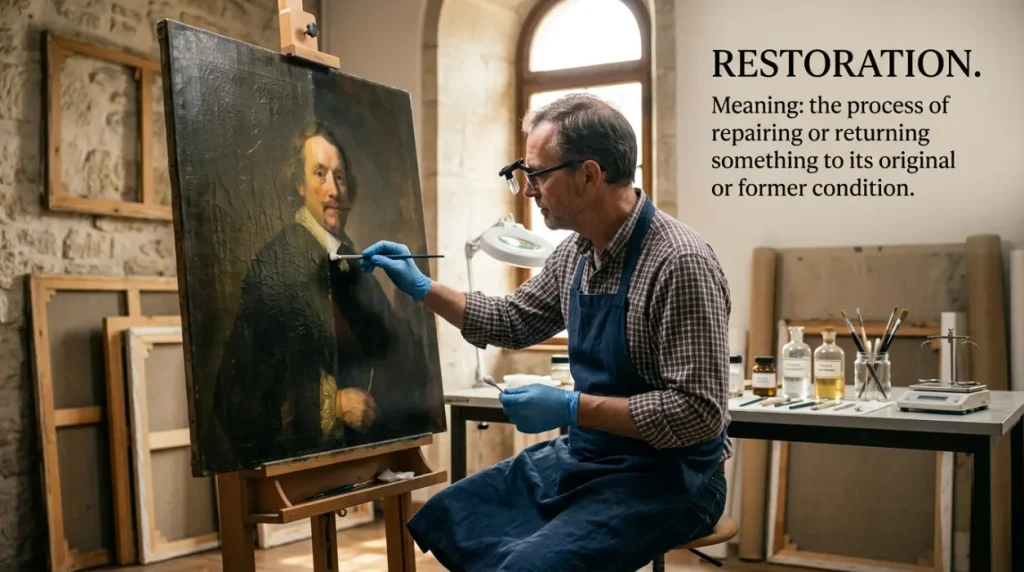
Restoration means returning something to a former, original, or desired condition after it has been damaged, changed, neglected, or lost.
The word is a noun. Its related verb is restore.
Native speakers usually understand restoration as more than simple fixing. It often suggests bringing something back to a previous state.
For example, a damaged painting may undergo restoration. A historic building may receive restoration. A deleted computer system may require restoration from a backup.
The word is also common in broader contexts. People talk about the restoration of forests, relationships, traditions, public services, health, and confidence.
Emotional Tone
Restoration often has a hopeful and constructive tone. It suggests that something valuable can be recovered or brought back.
However, the emotional effect depends on context. “Historic restoration” sounds positive, while “restoration after severe damage” may carry a more serious feeling.
Connotative Meaning
Connotation (the feeling or association a word creates beyond its basic dictionary meaning) can change how restoration sounds.
Positive tone: Restoration can suggest healing, renewal, preservation, recovery, and hope.
Negative tone: The word itself is not normally negative. However, restoration may appear in discussions of damage, loss, decline, or destruction.
Neutral tone: In technical, academic, historical, and professional writing, restoration can simply describe the process of returning something to a previous condition.
Etymology of “Restoration”
The word restoration comes through Old French and Middle English from Latin restauratio, meaning “renewal” or “repair.”
The Latin verb restaurare meant “to renew,” “rebuild,” or “restore.”
Old English: 450–1100
The modern word restoration was not an ordinary Old English vocabulary item in its present form. However, Old English had native words and expressions for repairing, renewing, rebuilding, and returning something to an earlier state.
Middle English: 1100–1500
After the Norman Conquest, French and Latin vocabulary became increasingly influential in English. Forms related to restore and restoration entered English through Anglo-French and scholarly Latin traditions.
Modern English: 1500–Present
The word became firmly established in Modern English. Today, restoration is used across art, architecture, ecology, history, medicine, computing, relationships, and public life.
Pronunciation of “Restoration”
US IPA: /ˌrɛstəˈreɪʃən/
UK IPA: /ˌrestəˈreɪʃən/
Syllables
res-tor-a-tion
Affixation Pattern of “Restoration”
Root: store / restor-
Prefix: re- — suggesting “again” or “back”
Suffix: -ation — forms a noun describing an action, process, or result
The word is related to restore, which means to bring something back.
Synonyms List
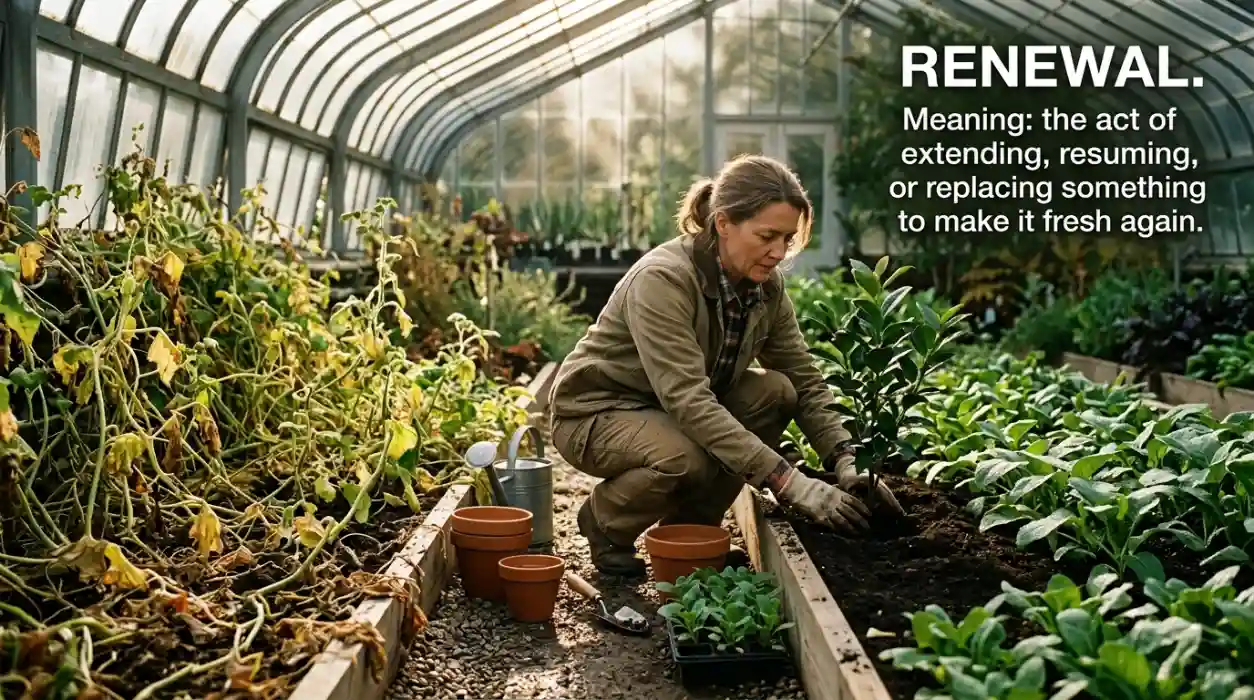
Renewal (Noun) — US: /rɪˈnuː.əl/ | UK: /rɪˈnjuː.əl/
Meaning: The act of extending, resuming, or replacing something to make it fresh again.
Tone/Register: Neutral, Professional
Example:
The town started an urban renewal project to improve public parks.
Her vacation brought a sense of mental renewal before the busy quarter.
Renewal Process (Noun Phrase) — US: /rɪˈnuː.əl ˈprɑː.ses/ | UK: /rɪˈnjuː.əl ˈprəʊ.ses/
Meaning: A structured sequence of actions that restores energy, purpose, or physical form.
Tone/Register: Formal, Business
Example:
The company initiated a complete renewal process for its main brand identity.
Spring brings a natural renewal process across the forest ecosystem.
Refurbishment (Noun) — US: /ˌriːˈfɝː.bɪʃ.mənt/ | UK: /ˌriːˈfɜː.bɪʃ.mənt/
Meaning: The process of cleaning, decorating, and re-equipping a structure or item.
Tone/Register: Professional, Technical
Example:
The historic hotel closed for six months for a major refurbishment.
He bought a used laptop that looked brand new after refurbishment.
Renovation (Noun) — US: /ˌren.əˈveɪ.ʃən/ | UK: /ˌren.əˈveɪ.ʃən/
Meaning: The act of updating or improving a building so it returns to good condition.
Tone/Register: Neutral, Everyday
Example:
They spent three months on the kitchen renovation before moving in.
The library closed briefly while workers finished the interior renovation.
Reconstruction (Noun) — US: /ˌriː.kənˈstrʌk.ʃən/ | UK: /ˌriː.kənˈstrʌk.ʃən/
Meaning: The process of building or assembling something again after severe damage.
Tone/Register: Formal, Serious
Example:
Engineers oversaw the reconstruction of the ancient stone bridge.
The city planned the immediate reconstruction of homes damaged by the storm.
Rebuilding (Noun) — US: /ˌriːˈbɪl.dɪŋ/ | UK: /ˌriːˈbɪl.dɪŋ/
Meaning: The physical or emotional task of constructing something that fell apart.
Tone/Register: Neutral, Emotional
Example:
Community members joined hands in rebuilding the local youth center.
He focused on rebuilding his confidence after making a major mistake.
Rehabilitation (Noun) — US: /ˌriː.hə.bɪl.əˈteɪ.ʃən/ | UK: /ˌriː.hə.bɪl.ɪˈteɪ.ʃən/
Meaning: The process of restoring health, working capability, or good repute through therapy.
Tone/Register: Formal, Medical
Example:
The athlete completed six weeks of knee rehabilitation after surgery.
The park service manages the rehabilitation of endangered wildlife areas.
Recovery (Noun) — US: /rɪˈkʌv.ɚ.i/ | UK: /rɪˈkʌv.ər.i/
Meaning: A return to a normal state of health, mind, or financial strength.
Tone/Register: Neutral, General
Example:
Economists predicted a steady recovery for local retail businesses.
She made a quick recovery after following her doctor’s advice.
Reinstatement (Noun) — US: /ˌriː.ɪnˈsteɪt.mənt/ | UK: /ˌriː.ɪnˈsteɪt.mənt/
Meaning: The act of restoring someone or something to a previous rank or position.
Tone/Register: Formal, Legal
Example:
The board approved the immediate reinstatement of the suspended manager.
He celebrated his reinstatement to the national athletic team.
Restitution (Noun) — US: /ˌres.təˈtuː.ʃən/ | UK: /ˌres.tɪˈtjuː.ʃən/
Meaning: The return of lost property or payment made for loss or injury.
Tone/Register: Legal, Formal
Example:
The court ordered the defendant to make full financial restitution.
They demanded the restitution of stolen artwork to the museum.
Reclaiming (Noun / Verb Form) — US: /rɪˈkleɪ.mɪŋ/ | UK: /rɪˈkleɪ.mɪŋ/
Meaning: The act of demanding or taking back something that was lost or taken.
Tone/Register: Expressive, Political
Example:
The city focused on reclaiming abandoned industrial land for public parks.
She spent her summer reclaiming her health through outdoor exercise.
Reclamation (Noun) — US: /ˌrek.ləˈmeɪ.ʃən/ | UK: /ˌrek.ləˈmeɪ.ʃən/
Meaning: The process of claiming back uncultivated or damaged land for productive use.
Tone/Register: Formal, Environmental
Example:
The government funded a large land reclamation project near the coast.
Water reclamation systems helped the farm survive the long drought.
Revamp (Noun / Verb) — US: /ˌriːˈvæmp/ | UK: /ˌriːˈvæmp/
Meaning: A complete update or makeover designed to improve appearance or function.
Tone/Register: Informal, Business
Example:
The website received a modern revamp to enhance the mobile experience.
Our team gave the old marketing strategy a thorough revamp.
Overhaul (Noun) — US: /ˈoʊ.vɚ.hɑːl/ | UK: /ˈəʊ.və.hɔːl/
Meaning: A thorough examination and complete repair of a complex system or machine.
Tone/Register: Professional, Technical
Example:
Mechanics performed a complete engine overhaul before the race.
The school system requires a major overhaul to meet modern standards.
Modernization (Noun) — US: /ˌmɑː.dɚ.nəˈzeɪ.ʃən/ | UK: /ˌmɒd.ən.aɪˈzeɪ.ʃən/
Meaning: The process of updating systems or structures to match current standards.
Tone/Register: Formal, Technical
Example:
The airport announced a multi-million-dollar modernization plan.
Digital modernization helped the agency serve citizens faster.
Regeneration (Noun) — US: /rɪˌdʒen.əˈreɪ.ʃən/ | UK: /rɪˌdʒen.əˈreɪ.ʃən/
Meaning: The process of renewing, growing, or restoring damaged biological tissue or areas.
Tone/Register: Scientific, Academic
Example:
Forest regeneration happens naturally after controlled fires clear dead brush.
Stem cell research explores tissue regeneration in medical therapy.
Revitalization (Noun) — US: /rɪˌvaɪ.t̬əl.əˈzeɪ.ʃən/ | UK: /rɪˌvaɪ.təl.aɪˈzeɪ.ʃən/
Meaning: The act of giving new life, vitality, or energy to something decaying.
Tone/Register: Formal, Community
Example:
The new art gallery contributed to the revitalization of downtown.
Yoga classes offered a complete revitalization for her tired body.
Resurgence (Noun) — US: /rɪˈsɝː.dʒəns/ | UK: /rɪˈsɜː.dʒəns/
Meaning: A dramatic increase or revival after a period of little activity.
Tone/Register: Formal, Analytical
Example:
Vinyl records experienced a major popularity resurgence this decade.
The neighborhood saw a sudden resurgence in local small businesses.
Reanimation (Noun) — US: /ˌriː.æn.əˈmeɪ.ʃən/ | UK: /ˌriː.æn.ɪˈmeɪ.ʃən/
Meaning: The act of restoring life, energy, or movement to something unconscious.
Tone/Register: Dramatic, Literary
Example:
The unexpected victory led to the reanimation of fan enthusiasm.
Medics focused on the reanimation of the patient using advanced tools.
Resuscitation (Noun) — US: /rɪˌsʌs.əˈteɪ.ʃən/ | UK: /rɪˌsʌs.ɪˈteɪ.ʃən/
Meaning: The emergency process of reviving someone from unconsciousness or apparent death.
Tone/Register: Medical, Formal
Example:
The emergency team performed successful cardiopulmonary resuscitation.
The business plan provided a financial resuscitation for the firm.
Repair (Noun) — US: /rɪˈper/ | UK: /rɪˈpeər/
Meaning: The action of fixing something broken, damaged, or torn.
Tone/Register: Neutral, Everyday
Example:
The plumber completed the pipe repair in less than an hour.
He made a quick repair on his bicycle chain using basic tools.
Fixing (Noun / Verb Form) — US: /ˈfɪk.sɪŋ/ | UK: /ˈfɪk.sɪŋ/
Meaning: The act of correcting a problem, error, or broken mechanical object.
Tone/Register: Informal, Practical
Example:
Fixing the broken fence took the entire Saturday afternoon.
She focuses on fixing errors in the software code before release.

Mending (Noun / Verb Form) — US: /ˈmen.dɪŋ/ | UK: /ˈmen.dɪŋ/
Meaning: The process of repairing torn clothes, broken objects, or damaged relationships.
Tone/Register: Casual, Traditional
Example:
She spent the evening mending torn jackets for her children.
Time helped in mending their long-standing personal disagreement.
Patching (Noun / Verb Form) — US: /ˈpætʃ.ɪŋ/ | UK: /ˈpætʃ.ɪŋ/
Meaning: Applying quick temporary repairs to cover holes, gaps, or software flaws.
Tone/Register: Informal, Practical
Example:
Road crews began patching deep potholes after the winter thaw.
Developers released a software security patch to fix bugs.
Retouching (Noun / Verb Form) — US: /ˌriːˈtʌtʃ.ɪŋ/ | UK: /ˌriːˈtʌtʃ.ɪŋ/
Meaning: Making small, subtle improvements or corrections to a photo or painting.
Tone/Register: Professional, Creative
Example:
The photographer spent hours retouching portraits before publishing.
Art conservators applied delicate retouching to the faded oil painting.
Touch-Up (Noun) — US: /ˈtʌtʃ.ʌp/ | UK: /ˈtʌtʃ.ʌp/
Meaning: A minor cosmetic repair made to improve the appearance of an object.
Tone/Register: Informal, Everyday
Example:
The wall needs a quick paint touch-up near the front door.
She did a minor touch-up on her makeup before stepping on stage.
Remediation (Noun) — US: /rɪˌmiː.diˈeɪ.ʃən/ | UK: /rɪˌmiː.diˈeɪ.ʃən/
Meaning: The action of remedying a problem, particularly environmental pollution.
Tone/Register: Academic, Formal
Example:
Soil remediation was required before building the new primary school.
The district implemented reading remediation programs for students.
Cure (Noun) — US: /kjʊr/ | UK: /kjʊər/
Meaning: A substance or treatment that relieves a disease or solves a problem.
Tone/Register: Neutral, Medical
Example:
Scientists continue searching for a universal cure for the virus.
Regular exercise proved to be a reliable cure for his back pain.
Healing (Noun) — US: /ˈhiː.lɪŋ/ | UK: /ˈhiː.lɪŋ/
Meaning: The natural process of becoming sound, healthy, or whole again.
Tone/Register: Warm, Emotional
Example:
Sleep plays a critical role in the physical healing of muscles.
Kind words contributed significantly to her emotional healing.
Recovery Period (Noun Phrase) — US: /rɪˈkʌv.ɚ.i ˈpɪr.i.əd/ | UK: /rɪˈkʌv.ər.i ˈpɪə.ri.əd/
Meaning: The specific duration needed to regain health or operational strength.
Tone/Register: Medical, Business
Example:
Doctors advised a rest period during her surgical recovery period.
The market experienced a brief recovery period after the shock.
Redress (Noun) — US: /rɪˈdres/ | UK: /rɪˈdres/
Meaning: Remedy or compensation for a wrong, injury, or unfair situation.
Tone/Register: Formal, Legal
Example:
Citizens sought legal redress for environmental damage to their town.
The company provided financial redress to affected customers.
Rectification (Noun) — US: /ˌrek.tə.fəˈkeɪ.ʃən/ | UK: /ˌrek.tɪ.fɪˈkeɪ.ʃən/
Meaning: The act of correcting an error, record, or improper situation.
Tone/Register: Formal, Official
Example:
The clerk made an immediate rectification of the accounting error.
Systematic rectification of safety defects prevented future accidents.
Correction (Noun) — US: /kəˈrek.ʃən/ | UK: /kəˈrek.ʃən/
Meaning: A change that makes an error accurate, right, or proper.
Tone/Register: Neutral, Practical
Example:
The newspaper published a formal correction on page two today.
She made a quick correction to her original math answer.
Righting (Noun / Verb Form) — US: /ˈraɪ.t̬ɪŋ/ | UK: /ˈraɪ.tɪŋ/
Meaning: Setting an overturned object upright or restoring balance and justice.
Tone/Register: Expressive, Literary
Example:
Righting past social wrongs requires steady long-term commitment.
The captain succeeded in righting the tilted boat in heavy waves.
Return (Noun) — US: /rɪˈtɝːn/ | UK: /rɪˈtɜːn/
Meaning: The act of coming or bringing something back to a former position.
Tone/Register: Neutral, Everyday
Example:
Neighbors celebrated the safe return of the lost dog.
The policy shift marked a return to traditional values.
Restoration of Order (Noun Phrase) — US: /ˌres.təˈreɪ.ʃən əv ˈɔːr.dɚ/ | UK: /ˌres.təˈreɪ.ʃən əv ˈɔː.də/
Meaning: Re-establishing peaceful stability and control after chaos or unrest.
Tone/Register: Formal, Political
Example:
Police forces ensured the quick restoration of order downtown.
Clear rules led to the restoration of order in the classroom.
Re-establishment (Noun) — US: /ˌriː.ɪˈstæb.lɪʃ.mənt/ | UK: /ˌriː.ɪˈstæb.lɪʃ.mənt/
Meaning: Bringing an institution, relationship, or custom back into existence.
Tone/Register: Formal, Diplomatic
Example:
Diplomats worked on the re-establishment of trade relations.
The city welcomed the re-establishment of annual cultural festivals.
Re-institution (Noun) — US: /ˌriː.ɪn.stəˈtuː.ʃən/ | UK: /ˌriː.ɪn.stɪˈtjuː.ʃən/
Meaning: Restoring a law, system, or formal practice that was discontinued.
Tone/Register: Formal, Administrative
Example:
The council voted for the re-institution of public bus service.
Faculty debated the re-institution of formal dress codes.
Re-creation (Noun) — US: /ˌriː.kriˈeɪ.ʃən/ | UK: /ˌriː.kriˈeɪ.ʃən/
Meaning: Creating a fresh version or representation of an original historical item.
Tone/Register: Creative, Academic
Example:
The museum featured a complete re-creation of an ancient market.
Her novel offered a vivid re-creation of nineteenth-century life.
Revival (Noun) — US: /rɪˈvaɪ.vəl/ | UK: /rɪˈvaɪ.vəl/
Meaning: An improvement in the condition, strength, or popularity of something.
Tone/Register: Neutral, Expressive
Example:
Folk music experienced an unexpected revival among young listeners.
Rain brought an immediate revival to the parched crops.
Reawakening (Noun) — US: /ˌriː.əˈweɪ.kən.ɪŋ/ | UK: /ˌriː.əˈweɪ.kən.ɪŋ/
Meaning: A renewed realization, spiritual feeling, or interest after dormancy.
Tone/Register: Literary, Emotional
Example:
The travel experience marked a spiritual reawakening for him.
The community saw a cultural reawakening through public art.
Resumption (Noun) — US: /rɪˈzʌmp.ʃən/ | UK: /rɪˈzʌmp.ʃən/
Meaning: The act of starting something again after a temporary pause.
Tone/Register: Formal, Business
Example:
Rail services announced the immediate resumption of normal train services.
Negotiations resumed following a short break for lunch.
Renewal of Health (Noun Phrase) — US: /rɪˈnuː.əl əv helθ/ | UK: /rɪˈnjuː.əl əv helθ/
Meaning: Regaining bodily vigor, wellness, and mental energy after sickness.
Tone/Register: Warm, Medical
Example:
Proper rest led to a rapid renewal of health for the patient.
Fresh air contributed to her complete renewal of health.
Back to Life (Idiomatic Phrase) — US: /bæk tuː laɪf/ | UK: /bæk tuː laɪf/
Meaning: Returning to active, vibrant, or functional existence from near ruin.
Tone/Register: Informal, Dramatic
Example:
The old rusty engine sprang back to life after fresh oil.
Her warm smile brought the dull conversation right back to life.
Clean Slate (Idiomatic Phrase) — US: /kliːn sleɪt/ | UK: /kliːn sleɪt/
Meaning: A fresh start where past mistakes or records are erased.
Tone/Register: Informal, Everyday
Example:
Moving to a new town offered him a completely clean slate.
The court agreement gave the young man a clean slate.

Fresh Start (Noun Phrase) — US: /freʃ stɑːrt/ | UK: /freʃ stɑːt/
Meaning: An opportunity to begin a project or life phase anew.
Tone/Register: Informal, Encouraging
Example:
New leadership provided a fresh start for the failing project.
Starting a new job gave her the fresh start she needed.
Makeover (Noun) — US: /ˈmeɪk.oʊ.vɚ/ | UK: /ˈmeɪk.əʊ.və/
Meaning: A set of changes designed to dramatically improve appearance.
Tone/Register: Informal, Casual
Example:
The home decor blog showed a dramatic living room makeover.
Our brand received a total visual makeover this spring.
Face-Lift (Noun) — US: /ˈfeɪs.lɪft/ | UK: /ˈfeɪs.lɪft/
Meaning: Alterations intended to make an old building or object look modern.
Tone/Register: Informal, Everyday
Example:
The old shopping mall got a modern facelift last year.
The website design needs a quick facelift to look current.
Tune-Up (Noun) — US: /ˈtuːn.ʌp/ | UK: /ˈtjuːn.ʌp/
Meaning: Minor adjustments made to an engine or system for smooth running.
Tone/Register: Informal, Practical
Example:
He took his car to the garage for a seasonal engine tune-up.
She completed a quick mental tune-up before taking her test.
Re-polishing (Noun / Verb Form) — US: /ˌriːˈpɑː.lɪʃ.ɪŋ/ | UK: /ˌriːˈpɒl.ɪʃ.ɪŋ/
Meaning: Polishing an object again to remove dullness and restore shine.
Tone/Register: Practical, Technical
Example:
Re-polishing antique silver restores its original brilliant luster.
The wood floor needed careful re-polishing after heavy foot traffic.
Clean-Up (Noun) — US: /ˈkliːn.ʌp/ | UK: /ˈkliːn.ʌp/
Meaning: The act of removing dirt, trash, or hazardous waste from an area.
Tone/Register: Informal, Practical
Example:
Volunteers organized a coastal beach clean-up over the weekend.
The toxic site required an extensive environmental clean-up.
Re-consecration (Noun) — US: /ˌriː.kɑːn.səˈkreɪ.ʃən/ | UK: /ˌriː.kɒn.sɪˈkreɪ.ʃən/
Meaning: Sacredly rededicating a religious building or space after repair.
Tone/Register: Formal, Religious
Example:
The bishop conducted the re-consecration of the ancient chapel.
Citizens gathered to witness the cathedral’s re-consecration ceremony.
Second Wind (Idiomatic Phrase) — US: /ˈsek.ənd wɪnd/ | UK: /ˈsek.ənd wɪnd/
Meaning: A renewed energy that allows someone to continue an effort.
Tone/Register: Informal, Conversational
Example:
After a brief rest, the runner found her second wind.
The tired team got a second wind and finished the report.
Re-equipping (Noun / Verb Form) — US: /ˌriː.ɪˈkwɪp.ɪŋ/ | UK: /ˌriː.ɪˈkwɪp.ɪŋ/
Meaning: Providing a person, team, or building with brand-new tools.
Tone/Register: Professional, Technical
Example:
Re-equipping the science lab improved research capabilities.
The army focused on re-equipping troops with modern gear.
Reset (Noun / Verb) — US: /ˈriː.set/ | UK: /ˈriː.set/
Meaning: Returning a system, clock, or mind back to its initial baseline state.
Tone/Register: Neutral, Technical
Example:
A weekend in the mountains offered a complete mental reset.
Pressing the red button forces a hard system reset.
Synonyms by Tone
Choosing the right tone is vital because using an overly formal word in casual conversation can sound awkward. Similarly, using informal slang in official reports reduces your authority.
Positive Tone
These terms carry inspiring, restorative, and optimistic associations:
- Renewal
- Rehabilitation
- Recovery
- Revitalization
- Resurgence
- Healing
- Renewal of Health
- Reawakening
- Revival
- Fresh Start
Neutral Tone
These words clearly describe physical repairs, system updates, or technical procedures without strong emotion:
- Refurbishment
- Renovation
- Reconstruction
- Rebuilding
- Repair
- Modernization
- Overhaul
- Correction
- Reset
- Return
- Resumption
Negative / Serious Tone
These terms appear in legal, judicial, or high-stakes contexts involving loss or damage:
- Restitution
- Redress
- Remediation
- Rectification
- Restoration of Order
Playful / Informal
These express casual, cosmetic, or lighthearted updates:
- Revamp
- Touch-Up
- Face-Lift
- Tune-Up
- Makeover
- Clean Slate
- Second Wind
- Back to Life
Mini Comparison
Restoration vs. Renovation vs. Rehabilitation
- Meaning Difference:
- Restoration focuses on returning a building, object, or system precisely to its original, historical state.
- Renovation involves updating, modernizing, or repairing a structure to improve its utility, often adding new features.
- Rehabilitation emphasizes restoring functionality, health, or usefulness, especially for individuals, wildlife, or damaged land.
- Tone Difference:
- Restoration carries an artistic, historical, or careful tone.
- Renovation sounds practical, commercial, and everyday.
- Rehabilitation feels formal, medical, or administrative.
- When to Use Each:
- Use restoration when preserving an 18th-century painting or ancient historic landmark.
- Use renovation when knocking down kitchen walls to install modern appliances.
- Use rehabilitation when describing an athlete recovering from surgery or reclaiming mined land.
Context-Based Usage
Daily Conversation
In casual chats, people lean on simple terms like repair, fixing, touch-up, or fresh start. For instance, you might say your old car needs a quick “tune-up” or that a short break gave you a “fresh start.” These terms sound natural and keep conversations flowing easily.
Writing or Blogging
For creative stories and blog posts, select descriptive language that paints a vivid image. Words like revitalization, resurgence, or reawakening add emotional depth to narratives. Consequently, your readers stay engaged without reading repetitive words.
Professional or Academic Tone
In business reports, legal papers, or scholarly articles, choose precise terms like remediation, rectification, reinstatement, or modernization. These options convey technical accuracy while maintaining professional authority.
Creative or Informal Use
When writing fiction or lighthearted articles, use makeover, facelift, or back to life. These dynamic terms describe visual changes and sudden energy turns effectively.
Common Mistakes & Native Usage
Common Mistakes Learners Make
- Confusing restoration with renovation: Remember that restoration brings something back to its original condition, while renovation makes it new or modern.
- Using medical terms in casual setups: Saying your old house underwent “rehabilitation” sounds too clinical; use “renovation” or “refurbishment” instead.
- Overusing the noun form: Repeating restoration in every sentence makes prose feel heavy. Switch to verb phrases like brought back to life or rebuilt.
Register Notes
- Spoken English: Focus on fixing, repair, touch-up, and fresh start.
- Written English: Utilize reinstatement, remediation, rectification, and revitalization.
- For additional guidance on expanding your descriptive vocabulary, check out our comprehensive language guides to sharpen your writing.
Real-Life Mini Scenarios
Workplace
When software errors disrupted the main database, IT technicians worked through the night. Instead of starting from scratch, they completed an immediate system rectification, restoring full access to all users.
Social Situations
After months of misunderstandings, two long-time friends sat down to talk over coffee. Their honest discussion led to the mending of their friendship, giving both a fresh start.
Media / Pop Culture
In urban design documentaries, filmmakers showcase how old industrial zones transform into thriving cultural hubs. Viewers watch the complete revitalization of forgotten neighborhoods into vibrant art districts.
Writing or Storytelling
A novelist describes an ancient castle standing ruined on a windy hill. As the new ruler arrives, workers begin a massive reconstruction, bringing back to life the majesty of past centuries.

Practice Exercise
1. Which word best describes returning an 18th-century oil painting to its exact original condition?
A) Renovation
B) Restoration
C) Face-lift
D) Makeover
2. If a company updates its website with modern colors and layout, it underwent a:
A) Remediation
B) Rectification
C) Revamp
D) Re-consecration
3. What is the main difference between restoration and renovation?
A) Restoration updates to modern standards, while renovation returns to the original state
B) Restoration returns to the original historical state, while renovation updates or modernizes
C) Both words have the same meaning in all contexts
D) Renovation is used only for medical treatments
4. Which term fits best in a legal context where a court orders compensation for a loss?
A) Touch-up
B) Tune-up
C) Restitution
D) Mending
5. What tone does the word “rehabilitation” usually carry?
A) Informal and casual
B) Medical, formal, or administrative
C) Playful and humorous
D) Poetic and fictional
6. When an athlete fully recovers strength after a severe injury, they experience physical:
A) Rectification
B) Healing
C) Retouching
D) Patching
7. Which phrase is an informal idiom meaning a completely fresh beginning?
A) Clean slate
B) Land reclamation
C) System reset
D) Soil remediation
8. What word best describes minor paint repairs on a wall near a doorway?
A) Reconstruction
B) Touch-up
C) Overhaul
D) Resurgence
9. If a city restores polluted soil so a park can be built, the process is called:
A) Re-polishing
B) Remediation
C) Face-lift
D) Makeover
Application Task
Write one short, original sentence describing a historic house using one of the synonyms above (such as renovation, refurbishment, or restoration).
Answer Key
1: B | 2: C | 3: B | 4: C | 5: B | 6: B | 7: A | 8: B | 9: B | 10: B
Conclusion
Understanding restoration can help you describe the process of returning something to its original, improved, or former condition. Learning its synonyms, meaning, and examples can enrich your English vocabulary and make your communication more precise.
The word restoration is commonly used in contexts involving buildings, artworks, nature, health, and damaged objects. Knowing its related synonyms can help you express ideas about repair, renewal, recovery, and improvement in different situations.
By practicing restoration in sentences and exploring related words, you can strengthen your vocabulary and writing skills. A clear understanding of this word will help you communicate ideas about repair and renewal more naturally and confidently.
FAQs
1. What is the best synonym for restoration in everyday English?
Repair is usually the best everyday alternative when you mean fixing something that is damaged or broken. However, the best choice depends on context. For a historic object, restoration is more precise. For a building that is being updated, renovation may fit better.
2. What is a synonym for restoration in a historical context?
In historical contexts, reconstruction, preservation, conservation, and heritage conservation can be useful alternatives. The correct choice depends on the goal. Reconstruction focuses on rebuilding. Preservation focuses on protecting what remains. Restoration usually emphasizes returning an object or place toward an earlier condition.
3. What word can replace restoration in academic writing?
Academic writing often benefits from precise terms such as reconstruction, rehabilitation, reclamation, conservation, or reconstitution. Avoid replacing restoration simply for stylistic variety. Instead, identify the exact process being described and select the term that communicates that process most accurately.
4. What is the difference between restoration and renovation?
Restoration usually aims to return something toward an earlier or original condition. Renovation generally means improving, updating, or modernizing an existing structure or space. For example, restoring a historic theater may preserve original details, while renovating an apartment may involve installing modern fixtures and changing its layout.
5. Which synonym for restoration means bringing something back to life?
Revival, reawakening, rejuvenation, and rebirth can express the idea of bringing something back to life or energy. Revival works well for culture and popularity. Reawakening sounds more expressive. Rejuvenation suggests freshness, while rebirth often suggests a major transformation or new beginning.

Hasnain Ali is an SEO Content Strategist and the founder of wordvora.com, a trusted vocabulary platform that helps writers, students, professionals, and English learners find accurate synonyms, antonyms, word meanings, and real-life usage examples. He specializes in keyword research, on-page SEO, topical authority, and creating search-first content that aligns with Google’s latest Search Quality and E-E-A-T guidelines. His work focuses on producing clear, well-structured, and reader-friendly resources that satisfy search intent while maintaining high editorial standards.
Through extensive hands-on experience with SEO tools such as Google Search Console, Google Analytics, SEMrush, and Ahrefs, Hasnain researches user search behavior and develops content that is both informative and easy to understand. Every article published on wordvora.com is carefully reviewed for accuracy, readability, and contextual relevance before publication. His mission is to build one of the web’s most reliable English vocabulary resources by providing practical language guidance, trustworthy explanations, and content that helps readers improve their writing, communication, and vocabulary with confidence.