

Synonyms for rushed can help when your morning starts late, your phone keeps ringing, and you race through breakfast just to reach work on time.
Imagine writing an email in five minutes because a meeting is about to start. Saying it was rushed tells readers that speed affected how carefully you worked.
Learning synonyms for rushed gives students, bloggers, and content writers more precise ways to describe speed, pressure, urgency, or careless haste.
The word is common because busy people often move quickly. With the right alternative, daily English, essays, reviews, and stories can sound much more natural.
What Does “Synonyms for Rushed” Really Mean?
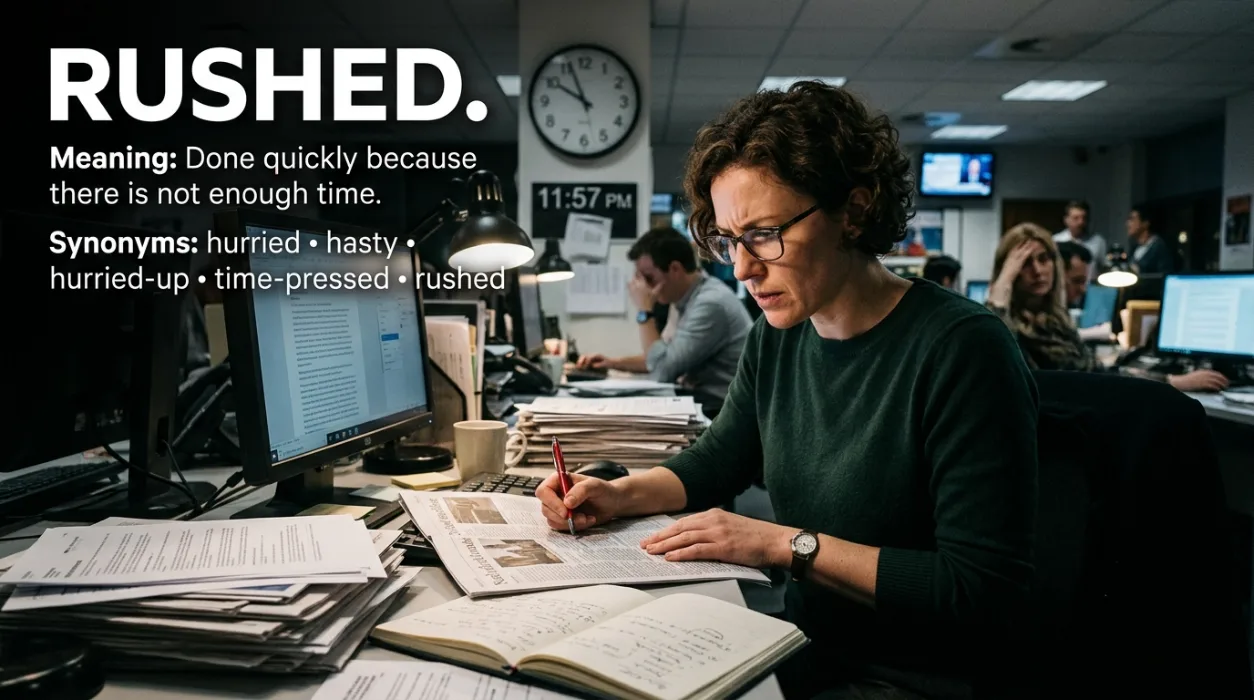
Rushed usually means done or completed too quickly because there is not enough time, or because someone feels pressure to act quickly. Cambridge defines rushed as something done in a hurry or something that makes a person feel they must act quickly. Oxford similarly defines it as something done too quickly or something done too quickly by necessity.
For example:
“It was a rushed decision.”
This suggests that the decision happened too quickly and may not have received enough thought.
However, rushed can also describe fast movement:
“She rushed out of the office.”
Here, the word means she moved quickly, usually because she was in a hurry.
Native speakers therefore understand rushed through context. A rushed meal suggests insufficient time. A rushed person suggests urgency or pressure.
Part of Speech
Rushed can function as:
- Verb: “She rushed home.”
- Adjective: “It was a rushed job.”
- Past participle: “He had rushed through the report.”
The adjective use is especially important when looking for synonyms such as hurried, hasty, hurriedly completed, or done in haste.
Connotative Meaning
Connotation means the emotional feeling or association that a word suggests beyond its basic dictionary meaning.
Positive Tone
Sometimes rushed can suggest energetic action.
“The volunteers rushed to help.”
Here, speed may be associated with enthusiasm, readiness, or immediate assistance.
Negative Tone
More often, rushed has a mildly negative connotation when something was completed without enough care.
“The rushed report contained several errors.”
The word can imply pressure, poor preparation, or insufficient attention.
Neutral Tone
When describing physical movement, rushed can simply mean moved quickly.
“The children rushed toward the playground.”
The sentence does not necessarily criticize them.
Etymology of “Rushed”
Rushed comes from the verb rush.
The history of rush is unusual because its earliest verbal meaning was not simply “move quickly.” Etymonline traces the verb to the mid-14th century, from Anglo-French russher and Old French ruser, with an older meaning connected to driving back or repelling. The modern “do something quickly” sense appeared in the 1650s.
Old English: 450–1100
The modern verb rush was not an established Old English verb with its present meaning.
There was, however, a separate Old English noun resc/risc/rysc, referring to the marsh plant called a rush. That plant is unrelated to the modern verb in the relevant etymological sense.
Middle English: 1100–1500
The verb emerged around the middle of the 14th century. Its early sense involved driving something back or down. It developed from Anglo-French and Old French forms.
Modern English: 1500–Present
By the 17th century, rush had developed the familiar sense of doing something quickly, often with excessive eagerness or without enough preparation. The related adjective rushed now commonly describes actions, decisions, meals, jobs, and schedules completed under time pressure.
Pronunciation of “Rushed”
- US: /rʌʃt/
- UK: /rʌʃt/
Cambridge gives the same pronunciation for American and British English.
Syllables
rushed
It has one syllable.
Affixation Pattern of “Rushed”
- Root: rush
- Prefix: none
- Suffix: -ed
The -ed ending forms the regular past-tense and past-participle form of rush.
Synonyms List
Hurried (Adjective) — US /ˈhɜːrid/ — UK /ˈhʌrid/
Meaning: Done quickly because there is not enough time.
Tone/Register: Neutral; very common in everyday and written English.
Example:
I ate a hurried breakfast before leaving.
She wrote a hurried note before the train arrived.
Oxford lists hurried as a synonym for rushed when something is done too quickly because there is not enough time.
Hasty (Adjective) — US /ˈheɪsti/ — UK /ˈheɪsti/
Meaning: Done too quickly, often without enough thought.
Tone/Register: Neutral to formal.
Example:
They made a hasty decision.
His hasty response created another problem.
Hastened (Verb) — US /ˈheɪsənd/ — UK /ˈheɪsənd/
Meaning: Made something happen or move faster.
Tone/Register: Formal.
Example:
The announcement hastened the team’s departure.
She hastened her steps when the rain began.
Hurrying (Verb/Adjective) — US /ˈhɜːriɪŋ/ — UK /ˈhʌriɪŋ/
Meaning: Moving or acting quickly because of limited time.
Tone/Register: Neutral and conversational.
Example:
I was hurrying to catch the bus.
She came in while hurrying between meetings.
Hurriedly (Adverb) — US /ˈhɜːridli/ — UK /ˈhʌridli/
Meaning: In a quick way because of time pressure.
Tone/Register: Neutral; more common in writing.
Example:
He hurriedly packed his bag.
She hurriedly signed the form and left.
Quickly (Adverb) — US /ˈkwɪkli/ — UK /ˈkwɪkli/
Meaning: At a fast speed or in a short amount of time.
Tone/Register: Neutral and highly common.
Example:
Please finish the form quickly.
She quickly grabbed her keys.
Rapidly (Adverb) — US /ˈræpɪdli/ — UK /ˈræpɪdli/
Meaning: At a very fast rate.
Tone/Register: Formal, academic, or professional.
Example:
Technology is changing rapidly.
The situation developed rapidly overnight.
Swiftly (Adverb) — US /ˈswɪftli/ — UK /ˈswɪftli/
Meaning: With great speed and little delay.
Tone/Register: Formal to literary.
Example:
The team responded swiftly to the emergency.
She swiftly moved the files to safety.
Speedily (Adverb) — US /ˈspiːdəli/ — UK /ˈspiːdɪli/
Meaning: Quickly or efficiently.
Tone/Register: Formal and somewhat less common.
Example:
The complaint was handled speedily.
The workers completed the repairs speedily.
Promptly (Adverb) — US /ˈprɑːmptli/ — UK /ˈprɒmptli/
Meaning: Without unnecessary delay.
Tone/Register: Professional and formal.
Example:
Please reply promptly to the request.
The doctor promptly returned the call.
Rapid (Adjective) — US /ˈræpɪd/ — UK /ˈræpɪd/
Meaning: Happening or moving very quickly.
Tone/Register: Formal and academic.
Example:
The patient showed rapid improvement.
The company experienced rapid growth.
Swift (Adjective) — US /swɪft/ — UK /swɪft/
Meaning: Happening or moving quickly.
Tone/Register: Neutral to formal.
Example:
The rescue required swift action.
She gave a swift reply.
Fast (Adjective/Adverb) — US /fæst/ — UK /fɑːst/
Meaning: Moving or happening at a high speed.
Tone/Register: Everyday and highly common.
Example:
We need to move fast.
He made a fast trip to the store.
Speedy (Adjective) — US /ˈspiːdi/ — UK /ˈspiːdi/
Meaning: Happening quickly or taking little time.
Tone/Register: Informal to neutral.
Example:
Thanks for the speedy response.
We received a speedy delivery.
Expedited (Adjective/Verb) — US /ˈekspədaɪtɪd/ — UK /ˈekspɪdaɪtɪd/
Meaning: Made faster than the normal process.
Tone/Register: Formal and business-oriented.
Example:
The office expedited the application.
Her request received expedited attention.
Accelerated (Verb/Adjective) — US /əkˈseləreɪtɪd/ — UK /əkˈseləreɪtɪd/
Meaning: Increased the speed or rate of something.
Tone/Register: Formal, academic, and technical.
Example:
The project accelerated after funding arrived.
The company accelerated its hiring process.
Sped Up (Phrasal Verb) — US /sped ʌp/ — UK /sped ʌp/
Meaning: Became faster or caused something to happen faster.
Tone/Register: Neutral and conversational.
Example:
We sped up the review process.
The car sped up as the road opened.
Hasted (Verb) — US /ˈheɪstɪd/ — UK /ˈheɪstɪd/
Meaning: Moved or acted with haste.
Tone/Register: Literary, archaic, or formal.
Example:
He hasted toward the waiting carriage.
The travelers hasted home before sunset.
Pressed (Adjective) — US /prest/ — UK /prest/
Meaning: Under pressure because of limited time.
Tone/Register: Neutral to formal.
Example:
We are pressed for time today.
She felt pressed to finish the report.
Time-Pressed (Adjective) — US /ˈtaɪm prest/ — UK /ˈtaɪm prest/
Meaning: Having very little time available.
Tone/Register: Professional and modern.
Example:
Time-pressed students often skip breakfast.
The time-pressed editor chose the shorter draft.
Under Pressure (Phrase) — US /ˌʌndər ˈpreʃər/ — UK /ˌʌndə ˈpreʃə/
Meaning: Having to act quickly because circumstances demand it.
Tone/Register: Neutral and widely used.
Example:
She chose under pressure.
Employees sometimes work under pressure before deadlines.
In a Hurry (Phrase) — US /ɪn ə ˈhɜːri/ — UK /ɪn ə ˈhʌri/
Meaning: Needing or wanting to do something quickly.
Tone/Register: Everyday and conversational.
Example:
I was in a hurry and forgot my umbrella.
He left in a hurry after the call.

In Haste (Phrase) — US /ɪn heɪst/ — UK /ɪn heɪst/
Meaning: With excessive speed or urgency.
Tone/Register: Formal or literary.
Example:
The letter was written in haste.
He left in haste without saying goodbye.
At Speed (Phrase) — US /ət spiːd/ — UK /ət spiːd/
Meaning: While moving quickly.
Tone/Register: Neutral; more common in British English.
Example:
The vehicle was traveling at speed.
The cyclist passed us at speed.
At a Fast Pace (Phrase) — US /ət ə fæst peɪs/ — UK /ət ə fɑːst peɪs/
Meaning: Happening or progressing quickly.
Tone/Register: Neutral and professional.
Example:
The project moved at a fast pace.
The students learned at a fast pace.
At Breakneck Speed (Phrase) — US /ət ˈbreɪknek spiːd/ — UK /ət ˈbreɪknek spiːd/
Meaning: At an extremely fast and potentially dangerous speed.
Tone/Register: Informal and dramatic.
Example:
The motorcycle disappeared at breakneck speed.
The story moves at breakneck speed.
Full Speed Ahead (Phrase) — US /fʊl spiːd əˈhed/ — UK /fʊl spiːd əˈhed/
Meaning: Moving forward with maximum energy or speed.
Tone/Register: Informal and motivational.
Example:
The team is moving full speed ahead.
After approval arrived, construction went full speed ahead.
Rushed Through (Phrasal Verb) — US /rʌʃt θruː/ — UK /rʌʃt θruː/
Meaning: Completed something too quickly without giving it enough attention.
Tone/Register: Neutral, often critical.
Example:
I rushed through the final questions.
She rushed through the report before lunch.
Hurried Through (Phrasal Verb) — US /ˈhɜːrid θruː/ — UK /ˈhʌrid θruː/
Meaning: Completed something quickly because of limited time.
Tone/Register: Neutral.
Example:
He hurried through his breakfast.
She hurried through the paperwork before closing.
Skimmed Through (Phrasal Verb) — US /skɪmd θruː/ — UK /skɪmd θruː/
Meaning: Looked at something quickly without detailed attention.
Tone/Register: Neutral and common.
Example:
I skimmed through the report before the meeting.
She skimmed through the article during lunch.
Whizzed Through (Phrasal Verb) — US /wɪzd θruː/ — UK /wɪzd θruː/
Meaning: Completed or moved through something very quickly.
Tone/Register: Informal and lively.
Example:
He whizzed through the assignment in an hour.
She whizzed through security before boarding.
Blazed Through (Phrasal Verb) — US /bleɪzd θruː/ — UK /bleɪzd θruː/
Meaning: Completed something extremely quickly and energetically.
Tone/Register: Informal.
Example:
She blazed through the reading list.
He blazed through the test and finished early.
Raced (Verb) — US /reɪst/ — UK /reɪst/
Meaning: Moved or acted very quickly, often because of urgency.
Tone/Register: Neutral and vivid.
Example:
I raced to the station after work.
She raced home before the storm arrived.
Dashed (Verb) — US /dæʃt/ — UK /dæʃt/
Meaning: Moved somewhere suddenly and quickly.
Tone/Register: Informal to neutral.
Example:
He dashed out to buy milk.
She dashed across the street before the light changed.
Hurled Forward (Phrase) — US /hɜːrld ˈfɔːrwərd/ — UK /hɜːld ˈfɔːwəd/
Meaning: Moved forward with great force and speed.
Tone/Register: Dramatic and literary.
Example:
The sudden impact hurled the vehicle forward.
The crowd was hurled forward by the surge.
Charged (Verb) — US /tʃɑːrdʒd/ — UK /tʃɑːdʒd/
Meaning: Moved forward quickly and forcefully.
Tone/Register: Vivid and neutral.
Example:
The players charged toward the goal.
The dog charged through the open gate.
Sprinted (Verb) — US /ˈsprɪntɪd/ — UK /ˈsprɪntɪd/
Meaning: Ran at top speed for a short distance.
Tone/Register: Neutral and specific.
Example:
He sprinted to catch the elevator.
She sprinted across the field.
Bolted (Verb) — US /ˈboʊltɪd/ — UK /ˈboʊltɪd/
Meaning: Moved away suddenly and very quickly.
Tone/Register: Informal and vivid.
Example:
The horse bolted when it heard the noise.
The child bolted toward the door.
Scuttled (Verb) — US /ˈskʌtəld/ — UK /ˈskʌtəld/
Meaning: Moved quickly with short, hurried steps.
Tone/Register: Informal and descriptive.
Example:
The waiter scuttled back to the kitchen.
She scuttled across the room to answer the phone.
Hurried Away (Phrase) — US /ˈhɜːrid əˈweɪ/ — UK /ˈhʌrid əˈweɪ/
Meaning: Left quickly because of urgency or limited time.
Tone/Register: Neutral.
Example:
He hurried away before anyone could stop him.
She hurried away to catch her train.
Flew (Verb) — US /fluː/ — UK /fluː/
Meaning: Moved extremely quickly, used figuratively for people or things.
Tone/Register: Informal and vivid.
Example:
She flew down the stairs when she heard the alarm.
He flew out of the office at five.
Hightailed It (Phrase) — US /ˈhaɪteɪld ɪt/ — UK /ˈhaɪteɪld ɪt/
Meaning: Left or moved away very quickly.
Tone/Register: Informal and idiomatic.
Example:
We hightailed it home before the rain started.
He hightailed it out of the store.
Made a Beeline (Phrase) — US /meɪd ə ˈbiːlaɪn/ — UK /meɪd ə ˈbiːlaɪn/
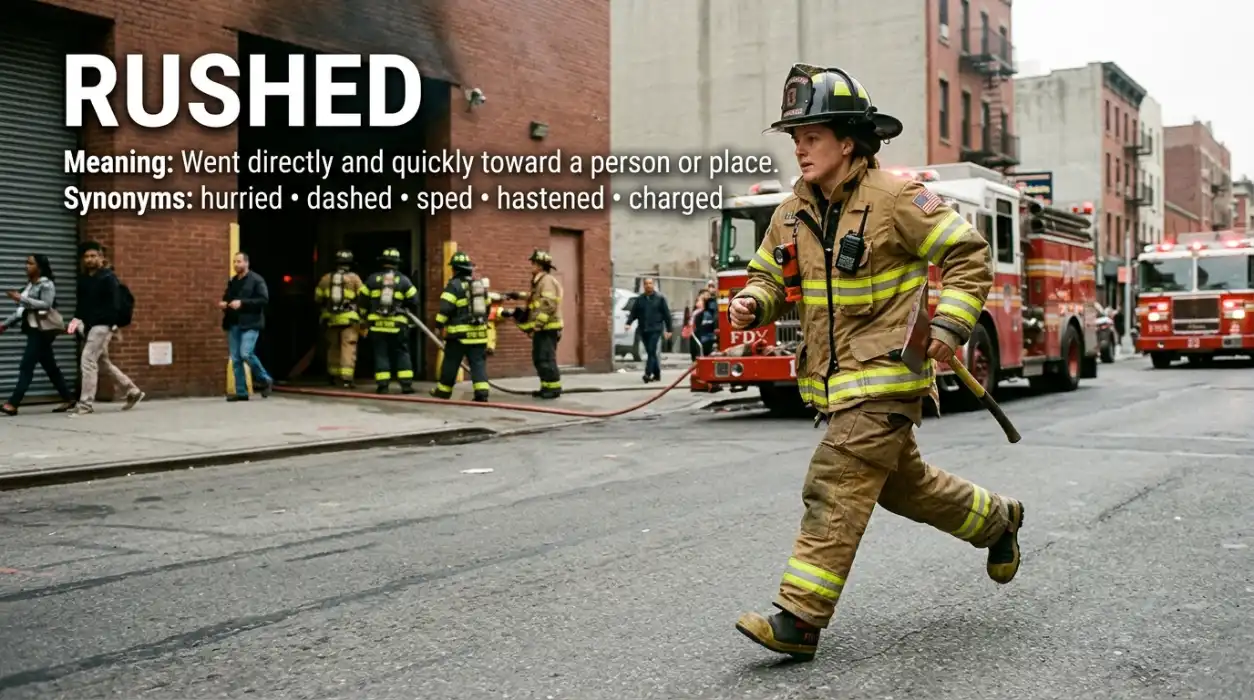
Meaning: Went directly and quickly toward a person or place.
Tone/Register: Informal.
Example:
She made a beeline for the coffee machine.
He made a beeline for the exit.
Scamped (Verb) — US /skæmpt/ — UK /skæmpt/
Meaning: Did something too quickly or carelessly by cutting corners.
Tone/Register: Formal to neutral; often critical.
Example:
The contractor scamped the final inspection.
They scamped the preparation and missed important details.
Slapped Together (Phrase) — US /slæpt təˈɡeðər/ — UK /slæpt təˈɡeðə/
Meaning: Made something quickly and without much care.
Tone/Register: Informal and critical.
Example:
The presentation was slapped together overnight.
He slapped together a quick meal before work.
Thrown Together (Phrase) — US /θroʊn təˈɡeðər/ — UK /θrəʊn təˈɡeðə/
Meaning: Created quickly with little planning or preparation.
Tone/Register: Neutral to informal.
Example:
We threw together a simple dinner.
The team threw together a short presentation.
Hastily Completed (Phrase) — US /ˈheɪstɪli kəmˈpliːtɪd/ — UK /ˈheɪstɪli kəmˈpliːtɪd/
Meaning: Finished quickly, often with insufficient care.
Tone/Register: Formal and academic.
Example:
The hastily completed report needed revision.
The proposal looked hastily completed.
Done in a Hurry (Phrase) — US /dʌn ɪn ə ˈhɜːri/ — UK /dʌn ɪn ə ˈhʌri/
Meaning: Completed quickly because there was little available time.
Tone/Register: Neutral and conversational.
Example:
The meal was done in a hurry.
The assignment was done in a hurry before class.
Done in Haste (Phrase) — US /dʌn ɪn heɪst/ — UK /dʌn ɪn heɪst/
Meaning: Completed too quickly and possibly without sufficient thought.
Tone/Register: Formal or literary.
Example:
The agreement was done in haste.
The decision was made in haste.
Impetuous (Adjective) — US /ɪmˈpetʃuəs/ — UK /ɪmˈpetʃuəs/
Meaning: Acting quickly because of emotion or impulse rather than careful thought.
Tone/Register: Formal and often critical.
Example:
His impetuous decision surprised the entire team.
She regretted her impetuous response.
Precipitous (Adjective) — US /prɪˈsɪpɪtəs/ — UK /prɪˈsɪpɪtəs/
Meaning: Happening too quickly and often without enough consideration.
Tone/Register: Formal and academic.
Example:
The company made a precipitous change in strategy.
His precipitous decision created new risks.
Precipitate (Adjective) — US /prɪˈsɪpɪtət/ — UK /prɪˈsɪpɪtət/
Meaning: Done suddenly and too quickly, especially without proper thought.
Tone/Register: Formal and literary.
Example:
The committee regretted its precipitate decision.
Her precipitate reaction made the situation worse.
Overhasty (Adjective) — US /ˌoʊvərˈheɪsti/ — UK /ˌəʊvəˈheɪsti/
Meaning: Excessively quick and insufficiently considered.
Tone/Register: Formal.
Example:
The judge warned against an overhasty conclusion.
An overhasty reply could damage the relationship.
Rash (Adjective) — US /ræʃ/ — UK /ræʃ/
Meaning: Done quickly without carefully considering the possible consequences.
Tone/Register: Neutral to formal; usually negative.
Example:
It would be rash to quit without another plan.
His rash choice caused unnecessary trouble.
Impulsive (Adjective) — US /ɪmˈpʌlsɪv/ — UK /ɪmˈpʌlsɪv/
Meaning: Done suddenly because of an immediate feeling rather than careful planning.
Tone/Register: Neutral; often mildly negative.
Example:
Buying the car was an impulsive decision.
She made an impulsive comment during the meeting.
Synonyms by Tone
Positive or Neutral
These words can describe speed without necessarily criticizing it:
- Quickly
- Swiftly
- Promptly
- Speedily
- Swift
- Fast
- Speedy
- Accelerated
- Raced
- Sprinted
- Charged
- Made a beeline
They work well when the main idea is efficient or fast action.
Negative
These alternatives often suggest insufficient thought, poor preparation, or excessive urgency:
- Hasty
- Rash
- Impetuous
- Impulsive
- Precipitate
- Precipitous
- Overhasty
- Scamped
- Slapped together
- Hastily completed
- Done in haste
Use them carefully because they often imply criticism.
Informal or Playful
These choices make everyday speech more vivid:
- Whizzed through
- Blazed through
- Dashed
- Bolted
- Flew
- Hightailed it
- Made a beeline
- Slapped together
- Thrown together
Formal or Academic
For essays, reports, and professional writing, consider:
- Hastened
- Rapidly
- Swiftly
- Promptly
- Accelerated
- Expedited
- Precipitous
- Precipitate
- Overhasty
- Hastily completed
Why Tone Matters
The difference between quick, hasty, and rash is important.
“Quick” mainly describes speed.
“Hasty” suggests insufficient time or thought.
“Rash” goes further and suggests poor judgment.
That small difference can completely change the message.
“Rushed” vs. Close Alternatives
| Word | Meaning Difference | Tone | When to Use |
|---|---|---|---|
| Hurried | Done quickly because of limited time | Neutral | Meals, writing, movement |
| Hasty | Done too quickly, often without enough thought | Critical | Decisions, conclusions, actions |
| Rushed | Done quickly because of urgency or pressure | Neutral to negative | Jobs, decisions, schedules, movement |
For example:
“I had a hurried breakfast.”
This focuses on limited time.
“It was a hasty decision.”
This focuses on insufficient thought.
“The report was rushed.”
This can suggest both time pressure and reduced quality.
How “Rushed” Changes by Context
Daily Conversation
In everyday English, rushed, hurried, in a hurry, and racing are natural choices.
“Sorry, I was rushed this morning.”
“I was in a hurry and forgot my wallet.”
These expressions sound normal in casual conversations.
Writing or Blogging
Writers often need more precise language.
Instead of saying:
“The article felt rushed.”
You might write:
“The article felt hastily completed.”
Or:
“The final section seemed underdeveloped because the writer was pressed for time.”
This gives readers more information about why the work feels rushed.
Professional or Academic Tone
Formal writing benefits from words such as hasty, expedited, accelerated, precipitate, and rapid.
For example:
“The committee reached a hasty conclusion.”
This sounds more precise than simply saying:
“The committee rushed the conclusion.”
However, rushed remains perfectly acceptable in professional English when the context calls for a direct, simple style.
Creative or Informal Use
Stories often benefit from vivid movement verbs.
Instead of:
“He rushed out.”
A writer could say:
“He dashed out.”
Or:
“He bolted toward the door.”
Each verb creates a slightly different mental image.
Common Mistakes & Native Usage
Mistake 1: Assuming “Rushed” Always Means Bad
Not every rushed action is careless.
“The paramedics rushed to the scene.”
This usually describes urgent action rather than poor quality.
But:
“The report was rushed.”
often suggests that the report lacked sufficient care.
Mistake 2: Confusing “Quick” With “Hasty”
Quick is mainly about speed.
Hasty often carries criticism.
Compare:
“She gave a quick answer.”
with:
“She gave a hasty answer.”
The second sentence suggests that she may not have thought carefully.
Mistake 3: Using “Rash” for Simple Speed
Rash does not simply mean “fast.”
It describes an action or decision that was too quick and potentially unwise.
So:
“He made a rash decision.”
works well.
But:
“He ran rashly to the bus.”
sounds unnatural in ordinary English.
Mistake 4: Using “Expedited” for Physical Movement
Expedited usually concerns making a process faster.
“The application was expedited.”
It is not a natural replacement for:
“She rushed down the street.”
Use raced, dashed, or sprinted for physical movement.
Mistake 5: Overusing “Rushed”
If every paragraph contains rushed, the writing may sound repetitive.
Use a more exact alternative when it adds meaning:
- hurried for limited time
- raced for fast movement
- hasty for poor deliberation
- promptly for quick response
- expedited for a faster process
- rash for poor judgment
Register Notes
Rushed is neutral and widely used in spoken and written English.
Hurried is similarly flexible.
Hasty, precipitate, and precipitous are more formal.
Hightailed it, whizzed through, and blazed through are informal.
Expedited and accelerated are especially useful in professional contexts.
For more vocabulary variety, an internal article about synonyms for hurried can complement this topic.
Real-Life Mini Scenarios Using
Workplace
A manager might say:
“The report felt rushed because we received the data late.”
A formal version could be:
“The report was hastily completed because the data arrived late.”
Social Situations
A friend might say:
“I rushed out this morning and forgot my phone.”
A more vivid version is:
“I dashed out this morning and forgot my phone.”
Media and Pop Culture
A reviewer might write:
“The final episode felt rushed.”
A more analytical version could be:
“The ending seemed hastily developed.”
The second version focuses more clearly on the writing quality.
Writing and Storytelling
A novelist might write:
“She raced down the stairs when she heard the alarm.”
The word raced creates a stronger visual sense of movement than the general verb rushed.

Practice Exercise
1. You completed an essay too quickly because the deadline was close.
A. Hasty
B. Decorative
C. Leisurely
D. Relaxed
2. Someone runs at top speed to catch a bus.
A. Sprinted
B. Prompted
C. Expedited
D. Considered
3. A formal report was completed very quickly.
A. Hastily completed
B. Hightailed it
C. Bolted
D. Flew
4. A company makes an application process faster.
A. Expedited
B. Dashed
C. Sprinted
D. Scuttled
5. Someone leaves suddenly and quickly.
A. Bolted
B. Accelerated
C. Hastened
D. Pressed
6. A person has almost no time available.
A. Time-pressed
B. Swift
C. Rapid
D. Speedy
7. A decision was made too quickly and without enough thought.
A. Rash
B. Fast
C. Prompt
D. Speedy
8. Someone looked through a document quickly without reading every detail.
A. Skimmed through
B. Commended
C. Accelerated
D. Hastened
9. A professional wants to say that something happened without delay.
A. Promptly
B. Rashly
C. Impulsively
D. Hastily
10. A child suddenly runs toward the door.
A. Bolts
B. Expedited
C. Accelerates
D. Precipitates
Answer key: 1-A | 2-A | 3-A | 4-A | 5-A | 6-A | 7-A | 8-A | 9-A | 10-A
Reflection Task
Write three original sentences using different alternatives for rushed.
Use one synonym for limited time, one for fast physical movement, and one for a decision made without enough thought.
Conclusion
Understanding rushed can help you describe moving, acting, or doing something very quickly, often because of urgency or limited time. Learning its synonyms, meaning, and examples can improve your English vocabulary and make your communication clearer.
The word rushed is commonly used in everyday conversations, stories, and written descriptions to show speed or urgency. Knowing its related synonyms can help you express quick actions in different ways and make your writing more natural and varied.
By practicing rushed in sentences and exploring related words, you can strengthen your vocabulary and communication skills. A clear understanding of this word will help you use it confidently and effectively in different English contexts.
FAQs
1. What is the best synonym for “rushed” in academic writing?
The best choice depends on what you mean. Hasty works well when a decision or conclusion happened too quickly. Rapid describes speed without necessarily criticizing it. Precipitate can describe an excessively quick decision in formal prose. For a simple academic sentence, done too quickly may be clearer than choosing an unusually sophisticated synonym.
2. What is a good synonym for “rushed” when describing a decision?
Use hasty, rash, impulsive, precipitate, or overhasty, depending on the intended meaning. Hasty suggests insufficient time or thought. Rash suggests poor judgment and possible consequences. Impulsive emphasizes emotion or sudden instinct. Precipitate is more formal and often highlights excessive speed in decision-making.
3. What is the difference between “rushed” and “hurried”?
Both words describe speed caused by limited time, and dictionaries treat hurried as a close synonym of rushed. However, rushed can sound slightly more critical when describing the quality of work. “A hurried breakfast” mainly describes limited time, while “a rushed report” can suggest that the report suffered because of the pressure.
4. Can “rushed” describe a very busy person?
Yes. English uses expressions such as rushed off your feet to describe someone who has too many things to do. Oxford specifically records this idiom for being extremely busy. In ordinary conversation, you can also say, “I’ve been rushed all day,” although “I’ve been really busy” may sound more natural in some contexts.
5. What is the difference between “rushed” and “rapid”?
Rapid mainly describes high speed or a fast rate. Rushed often adds the idea of pressure, urgency, or insufficient time. For example, “rapid growth” is neutral, while “a rushed decision” can suggest that someone did not think carefully enough. Therefore, the words overlap in speed but differ in emotional and contextual meaning.

Hasnain Ali is an SEO Content Strategist and the founder of wordvora.com, a trusted vocabulary platform that helps writers, students, professionals, and English learners find accurate synonyms, antonyms, word meanings, and real-life usage examples. He specializes in keyword research, on-page SEO, topical authority, and creating search-first content that aligns with Google’s latest Search Quality and E-E-A-T guidelines. His work focuses on producing clear, well-structured, and reader-friendly resources that satisfy search intent while maintaining high editorial standards.
Through extensive hands-on experience with SEO tools such as Google Search Console, Google Analytics, SEMrush, and Ahrefs, Hasnain researches user search behavior and develops content that is both informative and easy to understand. Every article published on wordvora.com is carefully reviewed for accuracy, readability, and contextual relevance before publication. His mission is to build one of the web’s most reliable English vocabulary resources by providing practical language guidance, trustworthy explanations, and content that helps readers improve their writing, communication, and vocabulary with confidence.