
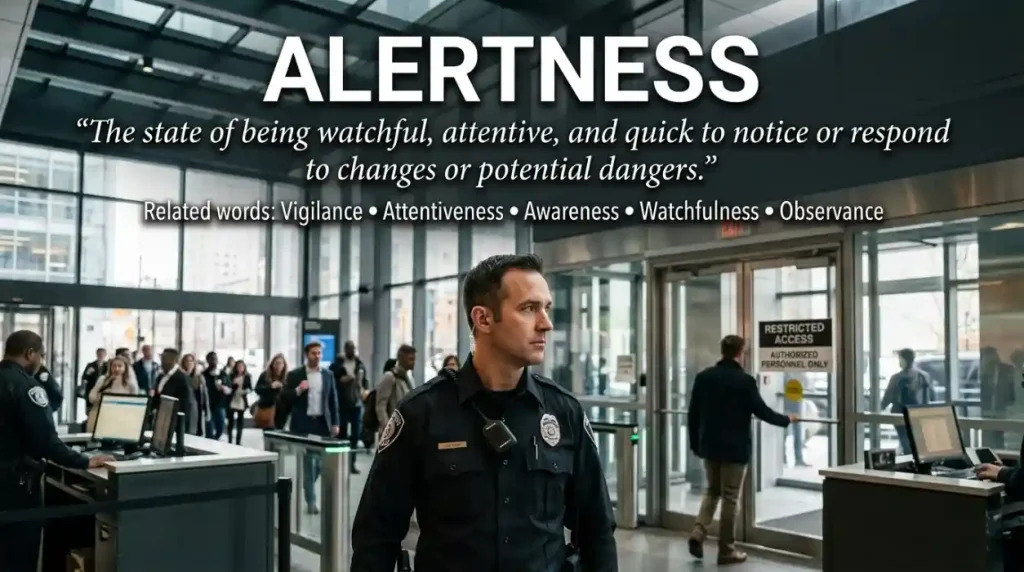
Looking for a synonym for alertness? Vigilance, awareness, and attentiveness are useful options, but each has a slightly different meaning. Vigilance suggests keeping an eye out for danger, while attentiveness means giving something your full attention. If you mean the ability to think clearly and react quickly, mental sharpness may be a better fit.
Imagine you are writing a report about a security guard who notices a problem before anyone else. Calling the guard “alert” works, but vigilant may describe the person’s careful watchfulness more precisely.
Alertness is useful in conversations about safety, learning, work, health, and everyday decision-making. It describes the ability to notice important details and respond when needed.
For students, bloggers, and content writers, learning alternatives helps avoid repetition and communicate specific ideas. Everyday English users can also choose words that sound natural in emails, conversations, and presentations.
A good synonym for alertness adds detail rather than simply replacing a word. Awareness emphasizes understanding, while vigilance suggests careful attention over time.
What Does “Alertness” Really Mean?
Alertness is the state of being awake, attentive, and ready to notice or respond to changes. It can describe mental sharpness, awareness of surroundings, or readiness to act when something requires attention.
Native English speakers use the word in several settings. A teacher might discuss students’ alertness during a lesson. A safety manager might emphasize alertness on a busy worksite. A doctor might use the term when discussing a person’s level of consciousness.
Part of Speech
Noun: Alertness names a state or quality.
- The driver’s alertness helped prevent an accident.
- A short break improved her alertness during the afternoon.
The related adjective is alert. The adverb is alertly, although it is less common in everyday speech.
Simple Definition
Alertness means being mentally awake, attentive to your surroundings, and ready to notice or respond to something important.
Connotative Meaning
(Connotation is the feeling, attitude, or association that a word carries beyond its basic definition.)
- Positive tone: Sharpness, attentiveness, and readiness can suggest competence and quick thinking.
- Neutral tone: Awareness, attention, and consciousness can describe a state without praising or criticizing it.
- Negative tone: Hypervigilance can suggest excessive monitoring or difficulty relaxing, particularly in psychological contexts.
The word alertness itself is usually neutral or positive. Its exact meaning depends on the context.
Etymology:
The word alert entered English through French alerte, influenced by Italian all’erta, meaning roughly “on the lookout” or “on high ground.” The English noun alertness developed from alert by adding the suffix -ness, which forms nouns describing states or qualities.
A Brief History Across English Periods
Old English (450–1100): The modern word alertness was not part of ordinary Old English vocabulary. Speakers used other words to express wakefulness, care, and readiness.
Middle English (1100–1500): English continued to develop vocabulary through French influence. The modern form alert became established later, so it should not be treated as a native Old English word.
Modern English (1500–present): Alert became widely used for readiness and quick awareness. Alertness came to describe this quality as a noun, appearing in everyday, military, medical, educational, and professional contexts.

Pronunciation, Syllables, and Word Structure
- US pronunciation: /əˈlɝːtnəs/
- UK pronunciation: /əˈlɜːtnəs/
- Syllables: a-lert-ness
- Root: alert
- Prefix: None
- Suffix: -ness, which turns the adjective alert into a noun
The main stress falls on the second syllable: a-LERT-ness.
Synonyms List
These alternatives overlap with alertness, but each emphasizes a slightly different quality. Some describe focused attention, others describe awareness or readiness. Choose according to the context.
1. Vigilance (noun) — US: /ˈvɪdʒələns/ | UK: /ˈvɪdʒɪləns/
Meaning: Vigilance is careful, sustained attention to possible danger, problems, or changes.
Tone/Register: Formal, professional, safety-related.
Examples:
The security team maintained vigilance throughout the event.
Constant vigilance helped the staff identify unusual activity.
2. Attentiveness (noun) — US: /əˈtɛntɪvnəs/ | UK: /əˈtentɪvnəs/
Meaning: Attentiveness is the quality of paying careful attention to people, tasks, or information.
Tone/Register: Neutral, educational, professional.
Examples:
Her attentiveness during training impressed the instructor.
Good listening begins with attentiveness.
3. Awareness (noun) — US: /əˈwɛrnəs/ | UK: /əˈweənəs/
Meaning: Awareness is knowledge or understanding of what is happening around you or of a particular issue.
Tone/Register: Neutral, academic, everyday.
Examples:
The campaign increased awareness of road safety.
He showed awareness of the changing conditions.
4. Watchfulness (noun) — US: /ˈwɑːtʃfəlnəs/ | UK: /ˈwɒtʃfəlnəs/
Meaning: Watchfulness is the habit of observing for something that may happen.
Tone/Register: Neutral, formal, safety-related.
Examples:
The lifeguard’s watchfulness reassured the parents.
A little watchfulness can help prevent small problems from growing.
5. Attentiveness of Mind (noun phrase) — US: /əˈtɛntɪvnəs əv maɪnd/ | UK: /əˈtentɪvnəs əv maɪnd/
Meaning: Attentiveness of mind describes careful mental engagement with a task or idea.
Tone/Register: Formal, reflective.
Examples:
The exercise requires attentiveness of mind.
She approached the difficult passage with attentiveness of mind.
6. Wakefulness (noun) — US: /ˈweɪkfəlnəs/ | UK: /ˈweɪkfəlnəs/
Meaning: Wakefulness is the state of being awake rather than asleep, though it does not always mean being attentive.
Tone/Register: Neutral, medical, everyday.
Examples:
The noise interrupted his wakefulness late at night.
Wakefulness alone does not guarantee good concentration.
7. Mental Sharpness (noun phrase) — US: /ˈmɛntəl ˈʃɑːrpnəs/ | UK: /ˈmentəl ˈʃɑːpnəs/
Meaning: Mental sharpness is the ability to think clearly, notice details, and respond quickly.
Tone/Register: Neutral, educational, professional.
Examples:
The puzzle tested her mental sharpness.
He feels more mentally sharp after a restful night.
8. Presence of Mind (noun phrase) — US: /ˌprɛzəns əv ˈmaɪnd/ | UK: /ˌprezəns əv ˈmaɪnd/
Meaning: Presence of mind is the ability to think clearly and act sensibly during a sudden or difficult situation.
Tone/Register: Formal, positive.
Examples:
She showed remarkable presence of mind during the emergency.
His presence of mind helped everyone stay calm.
9. Readiness (noun) — US: /ˈrɛdinəs/ | UK: /ˈredinəs/
Meaning: Readiness is the state of being prepared to act, respond, or begin something.
Tone/Register: Neutral, professional, practical.
Examples:
The team demonstrated readiness for the drill.
Her readiness to respond made the handover smoother.
10. Perceptiveness (noun) — US: /pərˈsɛptɪvnəs/ | UK: /pəˈseptɪvnəs/
Meaning: Perceptiveness is the ability to notice subtle details and understand their significance.
Tone/Register: Positive, professional, academic.
Examples:
His perceptiveness helped him notice the client’s concern.
The editor’s perceptiveness improved the final draft.
11. Observance (noun) — US: /əbˈzɝːvəns/ | UK: /əbˈzɜːvəns/
Meaning: Observance can mean careful watching, but it more often refers to the practice of following a rule or custom.
Tone/Register: Formal, legal, traditional.
Examples:
The report stresses observance of safety procedures.
Usage note: Observance is not a general synonym for alertness. Use it when the context concerns following rules or customs.
12. Concentration (noun) — US: /ˌkɑːnsənˈtreɪʃən/ | UK: /ˌkɒnsənˈtreɪʃən/
Meaning: Concentration is the ability to direct mental effort toward one task or subject.
Tone/Register: Neutral, educational, professional.
Examples:
The quiet room helped her concentration.
He turned off notifications to improve concentration.
13. Focus (noun) — US: /ˈfoʊkəs/ | UK: /ˈfəʊkəs/
Meaning: Focus is directed attention toward a particular task, goal, or subject.
Tone/Register: Neutral, everyday, business.
Examples:
She regained her focus after a short walk.
The meeting needs more focus and fewer distractions.
14. Mindfulness (noun) — US: /ˈmaɪndfəlnəs/ | UK: /ˈmaɪndfəlnəs/
Meaning: Mindfulness is deliberate attention to present experiences, often with an attitude of openness rather than judgment.
Tone/Register: Reflective, wellness, educational.
Examples:
Mindfulness helped him notice when his attention wandered.
The class practiced mindfulness before beginning the activity.
15. Consciousness (noun) — US: /ˈkɑːnʃəsnəs/ | UK: /ˈkɒnʃəsnəs/
Meaning: Consciousness is the state of being aware of oneself and one’s surroundings.
Tone/Register: Medical, philosophical, formal.
Examples:
The nurse checked the patient’s level of consciousness.
Consciousness and alertness are related, but they are not identical.
16. Acuteness (noun) — US: /əˈkjuːtnəs/ | UK: /əˈkjuːtnəs/
Meaning: Acuteness describes a high degree of sharpness in perception, thought, or the senses.
Tone/Register: Formal, academic.
Examples:
The detective’s acuteness helped reveal an overlooked clue.
Her acuteness of hearing made the faint sound easy to notice.
17. Sharpness (noun) — US: /ˈʃɑːrpnəs/ | UK: /ˈʃɑːpnəs/
Meaning: Sharpness can describe quick, clear thinking or keen perception.
Tone/Register: Neutral, professional, conversational.
Examples:
The discussion tested the team’s sharpness.
His mental sharpness impressed the interview panel.
18. Quick-Wittedness (noun) — US: /ˌkwɪkˈwɪtɪdnəs/ | UK: /ˌkwɪkˈwɪtɪdnəs/
Meaning: Quick-wittedness is the ability to understand situations and produce clever responses quickly.
Tone/Register: Positive, conversational, descriptive.
Examples:
Her quick-wittedness made the interview lively.
He answered the unexpected question with quick-wittedness.
19. Alertness of Mind (noun phrase) — US: /əˈlɝːtnəs əv maɪnd/ | UK: /əˈlɜːtnəs əv maɪnd/
Meaning: Alertness of mind refers to mental readiness and the ability to respond promptly to information.
Tone/Register: Formal, descriptive.
Examples:
The activity encouraged alertness of mind.
The instructor noticed a clear improvement in his alertness of mind.
20. Responsiveness (noun) — US: /rɪˈspɑːnsɪvnəs/ | UK: /rɪˈspɒnsɪvnəs/
Meaning: Responsiveness is the ability or tendency to react promptly and appropriately to a person, signal, or situation.
Tone/Register: Professional, medical, neutral.
Examples:
The test measured the patient’s responsiveness to sound.
Her responsiveness to customer questions built trust.
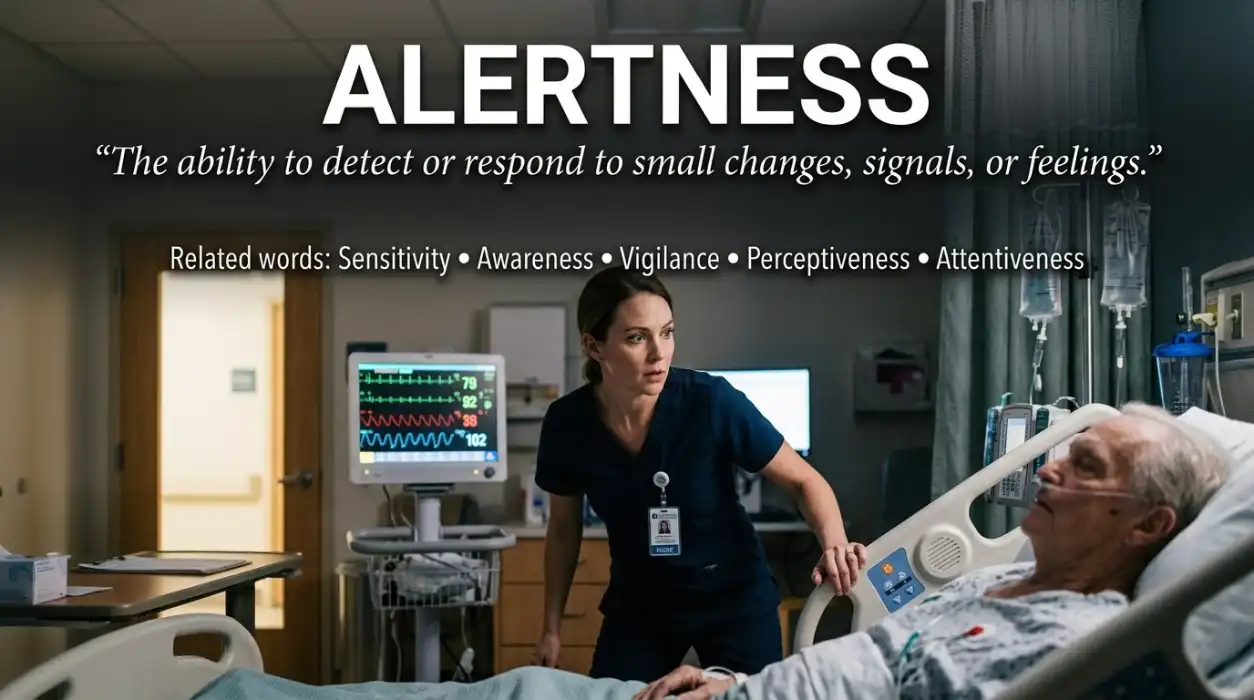
21. Sensitivity (noun) — US: /ˌsɛnsəˈtɪvəti/ | UK: /ˌsensɪˈtɪvəti/
Meaning: Sensitivity is the ability to detect or respond to small changes, signals, or feelings.
Tone/Register: Neutral, scientific, interpersonal.
Examples:
The sensor has high sensitivity to movement.
His sensitivity to changes in tone made him a thoughtful listener.
22. Acuity (noun) — US: /əˈkjuːəti/ | UK: /əˈkjuːəti/
Meaning: Acuity is sharpness of perception or thought, often used in medical and professional settings.
Tone/Register: Formal, technical, academic.
Examples:
The screening assessed her visual acuity.
The role requires strong analytical acuity.
23. Discernment (noun) — US: /dɪˈsɝːnmənt/ | UK: /dɪˈsɜːnmənt/
Meaning: Discernment is the ability to judge carefully and distinguish important differences.
Tone/Register: Formal, positive, professional.
Examples:
The editor showed discernment when selecting evidence.
Good discernment helps readers evaluate conflicting claims.
24. Heedfulness (noun) — US: /ˈhiːdfəlnəs/ | UK: /ˈhiːdfəlnəs/
Meaning: Heedfulness is the quality of paying careful attention to advice, warnings, or instructions.
Tone/Register: Formal, somewhat uncommon.
Examples:
Her heedfulness of the warning prevented a mistake.
The guide encourages heedfulness around moving machinery.
25. Carefulness (noun) — US: /ˈkɛrfəlnəs/ | UK: /ˈkeəfəlnəs/
Meaning: Carefulness is the habit of acting with attention to detail to avoid errors or harm.
Tone/Register: Neutral, everyday, professional.
Examples:
His carefulness kept the records accurate.
A little carefulness matters when checking figures.
26. Caution (noun) — US: /ˈkɔːʃən/ | UK: /ˈkɔːʃən/
Meaning: Caution is care taken to avoid danger or mistakes; it can accompany alertness but is not the same as being mentally awake.
Tone/Register: Neutral, safety-related, formal.
Examples:
Drivers should use caution in heavy rain.
She approached the unfamiliar equipment with caution.
27. Prudence (noun) — US: /ˈpruːdəns/ | UK: /ˈpruːdəns/
Meaning: Prudence is the ability to make sensible decisions by considering risks and likely consequences.
Tone/Register: Formal, positive, professional.
Examples:
Financial prudence helped the family prepare for unexpected expenses.
The manager used prudence before approving the change.
28. Care (noun) — US: /kɛr/ | UK: /keə/
Meaning: Care is attention given to a person, task, or possible risk.
Tone/Register: Neutral, everyday, professional.
Examples:
Please handle the glassware with care.
She reviewed the figures with great care.
29. Diligence (noun) — US: /ˈdɪlɪdʒəns/ | UK: /ˈdɪlɪdʒəns/
Meaning: Diligence is steady, careful effort applied to a task or responsibility.
Tone/Register: Formal, positive, academic.
Examples:
His diligence helped the team finish the audit.
She checked each reference with diligence.
30. Vigil (noun) — US: /ˈvɪdʒəl/ | UK: /ˈvɪdʒɪl/
Meaning: A vigil is a period spent keeping watch, often for safety, remembrance, or a special purpose.
Tone/Register: Formal, solemn, literary.
Examples:
Volunteers kept a vigil outside the hospital.
The night watch became a quiet vigil for the missing hiker.
Usage note: A vigil is a period of watching, not a direct substitute for the general quality of alertness.
31. Watchfulness of Mind (noun phrase) — US: /ˈwɑːtʃfəlnəs əv maɪnd/ | UK: /ˈwɒtʃfəlnəs əv maɪnd/
Meaning: Watchfulness of mind describes mental readiness to notice relevant information or unexpected changes.
Tone/Register: Formal, literary.
Examples:
The task required watchfulness of mind throughout the exercise.
The author praised her watchfulness of mind in difficult situations.
32. Mental Agility (noun phrase) — US: /ˈmɛntəl əˈdʒɪləti/ | UK: /ˈmentəl əˈdʒɪləti/
Meaning: Mental agility is the ability to shift thinking quickly and handle new information effectively.
Tone/Register: Positive, educational, professional.
Examples:
The debate called for mental agility.
Her mental agility helped her adapt when the plan changed.
33. Alertness of Senses (noun phrase) — US: /əˈlɝːtnəs əv ˈsɛnsɪz/ | UK: /əˈlɜːtnəs əv ˈsensɪz/
Meaning: Alertness of senses describes a heightened readiness to notice sounds, sights, smells, or other sensory signals.
Tone/Register: Descriptive, literary, educational.
Examples:
The hiker’s alertness of the senses helped him hear movement nearby.
The scene depends on the character’s alertness of the senses.
34. Keen Awareness (noun phrase) — US: /kiːn əˈwɛrnəs/ | UK: /kiːn əˈweənəs/
Meaning: Keen awareness is a strong ability to notice and understand details or changes.
Tone/Register: Positive, professional, descriptive.
Examples:
The coach showed keen awareness of the players’ energy.
Keen awareness of your audience can improve a presentation.
35. Situational Awareness (noun phrase) — US: /ˌsɪtʃuˈeɪʃənəl əˈwɛrnəs/ | UK: /ˌsɪtʃuˈeɪʃənəl əˈweənəs/
Meaning: Situational awareness is understanding what is happening in your surroundings and how events may develop.
Tone/Register: Professional, safety, technical.
Examples:
Pilots receive training in situational awareness.
The cyclist maintained situational awareness at the busy junction.
36. Mental Readiness (noun phrase) — US: /ˈmɛntəl ˈrɛdinəs/ | UK: /ˈmentəl ˈredinəs/
Meaning: Mental readiness is being prepared to think, decide, or respond.
Tone/Register: Professional, educational, sports.
Examples:
A short review improved the team’s mental readiness.
The exam requires mental readiness as well as knowledge.
37. Cognitive Alertness (noun phrase) — US: /ˈkɑːɡnətɪv əˈlɝːtnəs/ | UK: /ˈkɒɡnətɪv əˈlɜːtnəs/
Meaning: Cognitive alertness refers to the mind’s readiness to process information, notice changes, and respond.
Tone/Register: Scientific, medical, academic.
Examples:
The study examined cognitive alertness after a rest period.
The task was designed to measure cognitive alertness.
38. Mental Clarity (noun phrase) — US: /ˈmɛntəl ˈklærəti/ | UK: /ˈmentəl ˈklærəti/
Meaning: Mental clarity is the ability to think and understand information clearly, though it does not always imply watchfulness.
Tone/Register: Neutral, reflective, professional.
Examples:
Writing a short plan gave her mental clarity.
He waited until he had mental clarity before deciding.
39. Attentive Awareness (noun phrase) — US: /əˈtɛntɪv əˈwɛrnəs/ | UK: /əˈtentɪv əˈweənəs/
Meaning: Attentive awareness combines active attention with recognition of what is happening around you.
Tone/Register: Formal, educational.
Examples:
The exercise developed attentive awareness during group discussions.
Attentive awareness helped the student catch a subtle change in the instructions.
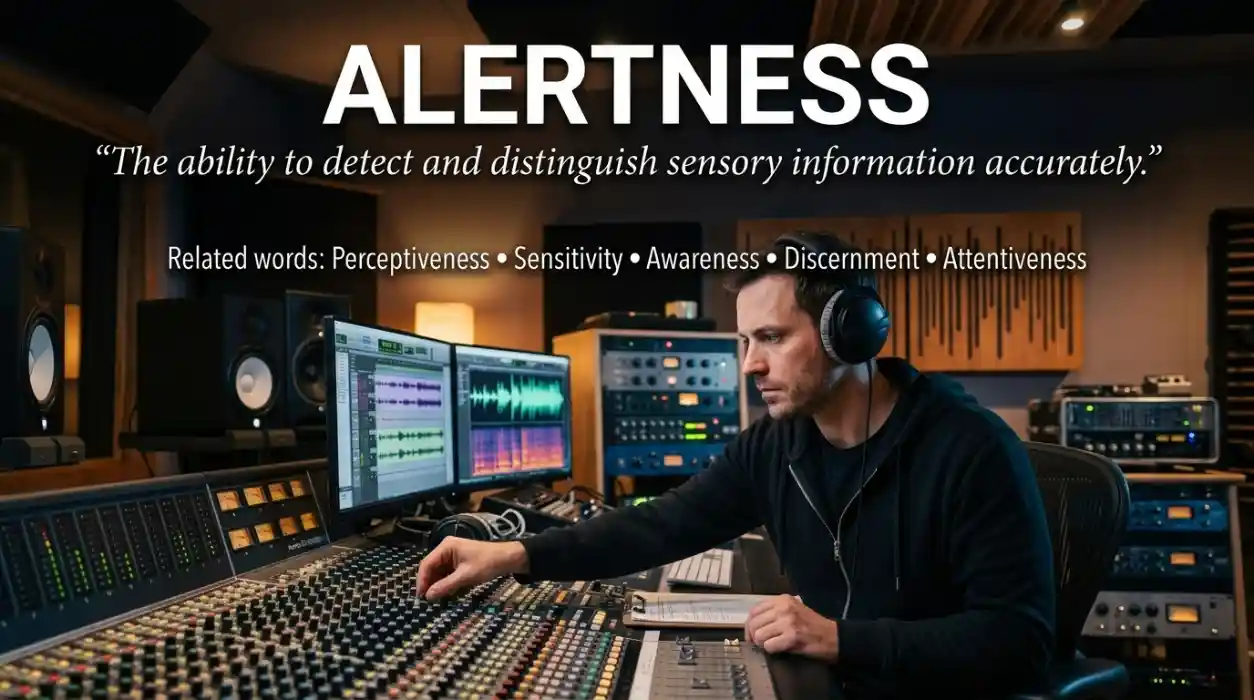
40. Perceptual Acuity (noun phrase) — US: /pərˈsɛptʃuəl əˈkjuːəti/ | UK: /pəˈseptʃuəl əˈkjuːəti/
Meaning: Perceptual acuity is the ability to detect and distinguish sensory information accurately.
Tone/Register: Scientific, technical, academic.
Examples:
The experiment tested perceptual acuity under different lighting conditions.
A designer needs perceptual acuity when comparing subtle colors.
41. Mental Vigilance (noun phrase) — US: /ˈmɛntəl ˈvɪdʒələns/ | UK: /ˈmentəl ˈvɪdʒɪləns/
Meaning: Mental vigilance is sustained mental attention to information, changes, or possible risks.
Tone/Register: Formal, professional, safety-related.
Examples:
Air traffic control demands mental vigilance.
The long monitoring shift tested everyone’s mental vigilance.
42. Quickness of Mind (noun phrase) — US: /ˈkwɪknəs əv maɪnd/ | UK: /ˈkwɪknəs əv maɪnd/
Meaning: Quickness of mind is the ability to understand a situation and think of a response rapidly.
Tone/Register: Neutral, descriptive, literary.
Examples:
Her quickness of mind impressed the interviewers.
The game rewards quickness of mind more than memorization.
43. Nimbleness of Mind (noun phrase) — US: /ˈnɪmbəlnəs əv maɪnd/ | UK: /ˈnɪmbəlnəs əv maɪnd/
Meaning: Nimbleness of mind is the ability to adapt one’s thinking quickly when circumstances change.
Tone/Register: Literary, positive, formal.
Examples:
The negotiator’s nimbleness of mind kept the discussion moving.
The puzzle requires nimbleness of mind and patience.
44. Observation (noun) — US: /ˌɑːbzərˈveɪʃən/ | UK: /ˌɒbzəˈveɪʃən/
Meaning: Observation is the act of watching carefully and noticing details.
Tone/Register: Neutral, academic, professional.
Examples:
Careful observation revealed a small change in the pattern.
The class practiced observation during the nature walk.
Usage note: Observation is an activity, while alertness is a state or quality.
45. Perceptivity (noun) — US: /ˌpɝːsɛpˈtɪvəti/ | UK: /ˌpɜːsepˈtɪvəti/
Meaning: Perceptivity is the ability to notice and understand things that others may overlook.
Tone/Register: Formal, positive, less common.
Examples:
Her perceptiveness helped the team understand the client’s unspoken concern.
The reviewer praised the perceptiveness of the analysis.
46. Attentiveness to Detail (noun phrase) — US: /əˈtɛntɪvnəs tə ˈdiːteɪl/ | UK: /əˈtentɪvnəs tə ˈdiːteɪl/
Meaning: Attentiveness to detail is careful focus on small but potentially important parts of a task.
Tone/Register: Professional, academic, business.
Examples:
The role requires attentiveness to detail.
His attentiveness to detail caught an error in the final document.
47. Readiness of Mind (noun phrase) — US: /ˈrɛdinəs əv maɪnd/ | UK: /ˈredinəs əv maɪnd/
Meaning: Readiness of mind describes mental preparedness to understand information or act when needed.
Tone/Register: Formal, literary.
Examples:
The exercise encouraged readiness of mind before each decision.
Her readiness of mind helped her respond to an unexpected question.
48. Alertness to Danger (noun phrase) — US: /əˈlɝːtnəs tə ˈdeɪndʒər/ | UK: /əˈlɜːtnəs tə ˈdeɪndʒə/
Meaning: Alertness to danger is the ability to notice possible threats and respond appropriately.
Tone/Register: Safety-related, neutral, professional.
Examples:
Hikers need alertness to danger in changing weather.
The training improved workers’ alertness to danger around heavy machinery.
49. Hypervigilance (noun) — US: /ˌhaɪpərˈvɪdʒələns/ | UK: /ˌhaɪpəˈvɪdʒɪləns/
Meaning: Hypervigilance is an unusually heightened state of monitoring for possible threats, which can become exhausting or distressing.
Tone/Register: Psychological, clinical.
Examples:
The therapist discussed how hypervigilance can affect sleep.
After the stressful event, he found it difficult to stop scanning his surroundings.
Usage note: Hypervigilance is not simply a stronger, better form of alertness. It can be unwanted and disruptive.
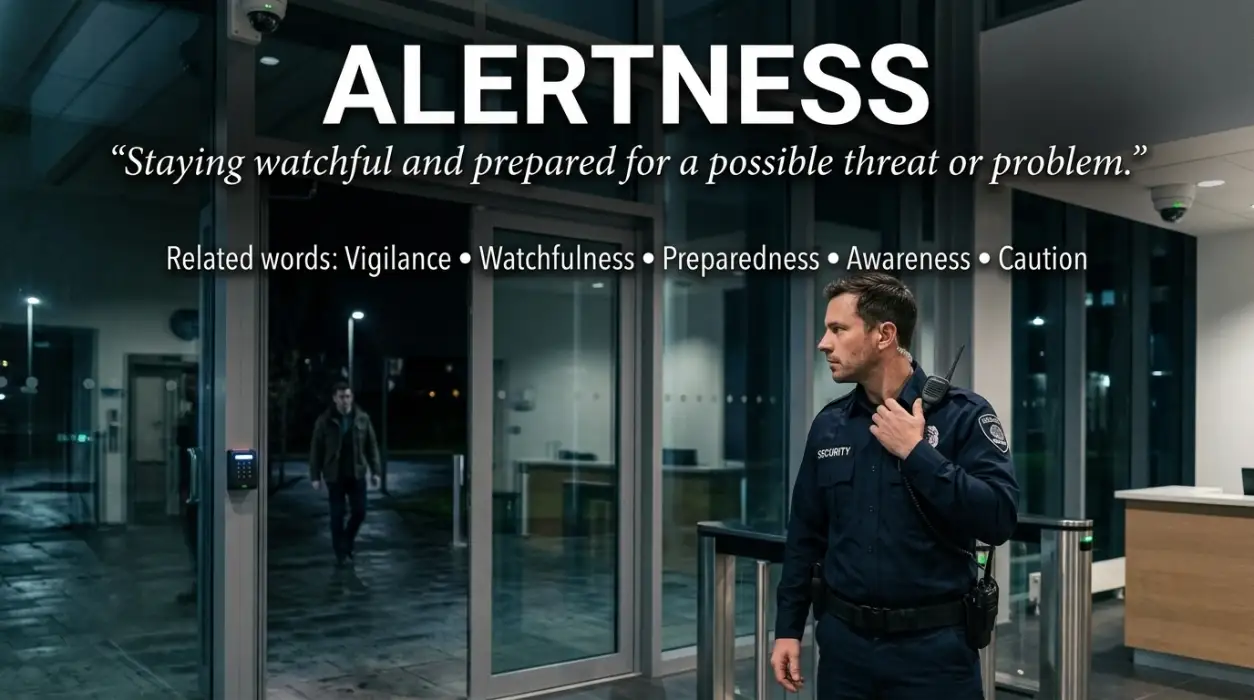
50. On Guard (adjective phrase) — US: /ɑːn ˈɡɑːrd/ | UK: /ɒn ˈɡɑːd/
Meaning: Being on guard means staying watchful and prepared for a possible threat or problem.
Tone/Register: Everyday, safety-related, sometimes military.
Examples:
The staff remained on guard during the busy event.
She stayed on guard after receiving an unusual message.
Usage note: On guard describes a state of watchfulness rather than the noun alertness itself, so grammar may require a sentence change.
Synonyms by Tone
The most effective synonym reflects both the meaning and the feeling you want to communicate. Some words describe calm attention, while others suggest rapid thinking or concern about danger.
Positive Tone
Use these words to praise someone’s awareness, thinking, or ability to notice details.
- Attentiveness — careful attention to people or tasks.
- Perceptiveness — ability to notice subtle information.
- Mental sharpness — clear, quick thinking.
- Presence of mind — calm thinking under pressure.
- Discernment — sound judgment and the ability to recognize differences.
- Mental agility — flexible, quick thinking.
- Keen awareness — strong awareness of details.
Neutral Tone
These alternatives describe attention or awareness without necessarily expressing approval.
- Awareness
- Wakefulness
- Concentration
- Focus
- Consciousness
- Observation
- Responsiveness
- Situational awareness
- Mental clarity
Cautionary or Negative Tone
These terms emphasize risk, excessive monitoring, or the need to avoid mistakes.
- Vigilance — sustained attention to potential danger.
- Caution — care in the face of risk.
- Watchfulness — observing for possible changes or threats.
- Hypervigilance — excessive monitoring that can become distressing.
- Alertness to danger — readiness to notice threats.
Playful or Informal Tone
There is no widely used playful slang word that perfectly replaces alertness. In conversation, people may instead say someone is sharp, switched on, or wide awake.
- Sharp — quick to understand or notice.
- Switched on — informal expression for being mentally engaged or capable.
- Wide awake — fully awake, sometimes implying readiness.
- On the ball — alert, competent, and quick to respond.
These expressions are not exact grammatical substitutes for the noun alertness. You may need to rewrite the sentence.
Why tone matters: “The employee showed vigilance” emphasizes careful monitoring. “The employee was switched on” sounds casual and may suggest general competence. Choose a phrase that fits your audience.
“Alertness” vs. Close Alternatives
| Word | Main difference | Best use |
|---|---|---|
| Alertness | General readiness to notice and respond | Everyday, workplace, and health contexts |
| Vigilance | Sustained watchfulness, often for danger | Security, safety, monitoring |
| Awareness | Knowledge or recognition of a situation | Education, communication, public information |
| Attentiveness | Careful attention to a person or task | Listening, learning, customer service |
| Concentration | Mental effort directed at one task | Studying, reading, problem-solving |
Which One Should You Choose?
Use alertness when you mean a general state of mental readiness. Choose vigilance when someone must remain watchful over time. Use awareness when the focus is understanding a situation or recognizing a fact.
Choose attentiveness when someone listens or pays careful attention. Use concentration when the person directs mental effort toward a particular task.
How Alertness Vocabulary Changes by Context
Daily Conversation
In ordinary conversation, alert, awake, sharp, and focused often sound more natural than formal nouns such as vigilance or perceptiveness.
For example, “I feel more alert after a short walk” is natural. “My vigilance has improved after a short walk” sounds more formal and may suggest that you are monitoring for danger.
Writing and Blogging
Writers can use synonyms to make descriptions more specific. A blog about studying might discuss concentration and mental clarity. An article about road safety might focus on vigilance and situational awareness.
Avoid adding synonyms only to repeat the same idea. Explain a distinct aspect of attention each time.
Professional and Academic Writing
Professional reports often use vigilance, attentiveness, responsiveness, or situational awareness. Scientific writing may use more specific terms such as cognitive alertness when the subject involves mental processing.
Define technical terms when your audience may not know them. Precision matters more than choosing the longest or most impressive-sounding word.
Creative and Informal Writing
In stories, expressions such as on guard, wide awake, and on the ball can give dialogue a natural voice. A character who is “on guard” may feel threatened, while someone who is “on the ball” seems capable and quick.
Use these expressions to reveal personality, mood, or circumstances rather than inserting them as decorative alternatives.
Common Mistakes Learners Make
1. Treating Awareness and Alertness as Identical
Awareness means knowing or recognizing something. Alertness adds a sense of readiness to notice or respond.
A person can be aware of a rule without being especially alert to a sudden change.
2. Confusing Wakefulness With Mental Sharpness
Being awake does not guarantee that someone is attentive. A tired person may remain awake but struggle to focus.
Use wakefulness when sleep is the main issue. Use mental sharpness when clear, quick thinking is the focus.
3. Using Vigilance for Every Kind of Attention
Vigilance often implies sustained monitoring for a risk or important event. It may sound overly serious when describing ordinary listening.
For a student who listens carefully, attentiveness is usually more natural.
4. Using Hypervigilance as a Compliment
Hypervigilance is not simply excellent alertness. It can describe persistent threat-monitoring that causes distress or interferes with daily life.
Avoid using it to praise someone for being observant unless the psychological meaning is genuinely intended.
5. Repeating Synonyms Without Adding Meaning
Changing alertness to awareness in every sentence may create repetition rather than improve the writing.
Choose a term based on what you actually mean: attention, perception, readiness, careful monitoring, or quick thinking.
Register Notes
- Formal: vigilance, discernment, acuity, perceptiveness.
- Everyday: awareness, focus, carefulness, mental sharpness.
- Scientific or clinical: consciousness, cognitive alertness, hypervigilance.
- Informal expressions: wide awake, switched on, on the ball, on guard.
For more vocabulary practice, an internal article about synonyms for attention can help you compare closely related words.
Real-Life Mini Scenarios
Workplace: A warehouse supervisor reminds staff to maintain vigilance around moving equipment. The word emphasizes ongoing attention to potential hazards.
Social situations: During a conversation, attentive listening helps someone notice a friend’s concern even when it is not stated directly.
Media and public safety: A road-safety report highlights situational awareness because drivers must notice pedestrians, traffic signals, and changing road conditions.
Writing and storytelling: A mystery writer describes a detective’s perceptiveness to show how the character notices a detail that others overlook.
Practice Quiz
1. A security guard carefully monitors a building for possible threats. Which word fits best?
A. Wakefulness
B. Vigilance
C. Mental clarity
D. Quick-wittedness
2. A student listens carefully to every instruction in class. Which word describes this quality?
A. Attentiveness
B. Hypervigilance
C. Caution
D. Consciousness
3. A person understands what is happening around them at a busy intersection. Which phrase is most suitable?
A. Mental agility
B. Situational awareness
C. Quickness of mind
D. Wakefulness
4. A person remains calm and thinks clearly during an emergency. What quality are they showing?
A. Presence of mind
B. Concentration
C. Sensitivity
D. Observance
5. Which word describes the state of being awake rather than asleep?
A. Discernment
B. Wakefulness
C. Vigilance
D. Prudence
6. A researcher wants to describe the ability to notice subtle differences. Which word is best?
A. Perceptiveness
B. Readiness
C. Caution
D. Carefulness
7. A student struggles to keep their mind on a difficult assignment. Which word describes the ability they need to improve?
A. Vigil
B. Concentration
C. Responsiveness
D. Consciousness
8. Someone constantly scans for possible threats and finds it difficult to relax after a stressful event. Which term may describe this experience?
A. Mental clarity
B. Mindfulness
C. Hypervigilance
D. Quick-wittedness
9. A company needs an employee who notices small errors in documents. Which phrase is most appropriate?
A. Attentiveness to detail
B. Presence of mind
C. Wakefulness
D. Mental readiness
Reflection Task
Write three short sentences about a real situation in which someone needed to stay alert. Use vigilance, attentiveness, and situational awareness once each. Explain how the meaning changes.
Answer key: 1-B, 2-A, 3-B, 4-A, 5-B, 6-A, 7-B, 8-C, 9-A
External Sources
- Merriam-Webster Dictionary — for definitions, usage, and related words.
- Cambridge Dictionary — for learner-friendly meanings and US/UK pronunciation.
- Oxford Learner’s Dictionaries — for example sentences, collocations, and word usage.
Conclusion
Learning a synonym for alertness helps you express subtle differences in attention, awareness, and readiness. The right word makes your meaning clearer and your English more natural.
These alternatives can strengthen essays, blog posts, reports, and daily conversations. Words such as vigilance and perceptiveness add precision when a general term feels too broad.
You do not need to memorize all 50 expressions today. Start with a few useful words and notice how native speakers use them in different situations.
Try using three new synonyms in an email, an essay, or a daily conversation this week. Practice choosing the word that best matches your meaning and audience.
Frequently Asked Questions
1. What is the best synonym for alertness in a professional report?
Vigilance, attentiveness, and situational awareness can work well, depending on the task. Use vigilance when monitoring for risk is important. Choose attentiveness for careful listening or task performance. Use situational awareness when a person needs to understand what is happening around them. The most accurate choice depends on the report’s subject.
2. What is the difference between alertness and attentiveness?
Alertness describes being awake and ready to notice or respond to something. Attentiveness focuses more directly on paying careful attention to a person, task, or piece of information. Someone can be alert to a sudden noise without listening attentively to a conversation. The words overlap, but they emphasize different aspects of attention.
3. Which synonym for alertness is best for academic writing?
The best choice depends on the research topic. Cognitive alertness may suit a discussion of mental processing, while vigilance can describe sustained monitoring. Perceptual acuity is more specific when the subject involves detecting sensory details. Academic writers should define specialized terms and use the same term consistently when discussing a particular concept.
4. Is mental sharpness the same as alertness?
Not exactly. Mental sharpness describes clear, quick thinking and the ability to understand information efficiently. Alertness emphasizes being awake and ready to notice or respond to changes. These qualities often occur together, but they are distinct. A person may be awake and alert yet still need more time to solve a complex problem.
5. What is a positive word for someone who is always alert?
Perceptive, attentive, and sharp can describe someone who notices details and responds well. Vigilant is especially suitable when the person carefully monitors possible problems. In everyday conversation, on the ball is a friendly expression for someone quick and capable. Choose based on whether you mean observation, attention, or fast thinking.

Hasnain Ali is an SEO Content Strategist and the founder of wordvora.com, a trusted vocabulary platform that helps writers, students, professionals, and English learners find accurate synonyms, antonyms, word meanings, and real-life usage examples. He specializes in keyword research, on-page SEO, topical authority, and creating search-first content that aligns with Google’s latest Search Quality and E-E-A-T guidelines. His work focuses on producing clear, well-structured, and reader-friendly resources that satisfy search intent while maintaining high editorial standards.
Through extensive hands-on experience with SEO tools such as Google Search Console, Google Analytics, SEMrush, and Ahrefs, Hasnain researches user search behavior and develops content that is both informative and easy to understand. Every article published on wordvora.com is carefully reviewed for accuracy, readability, and contextual relevance before publication. His mission is to build one of the web’s most reliable English vocabulary resources by providing practical language guidance, trustworthy explanations, and content that helps readers improve their writing, communication, and vocabulary with confidence.