

Synonyms for potentially can save a sentence when “potentially” feels repetitive. Imagine saying, “This could potentially happen,” when a simpler “This could happen” sounds better.
In everyday English, potentially often appears when we discuss possibilities, risks, opportunities, or future results. Its meaning is useful but easy to overuse.
Learning synonyms for potentially gives students, bloggers, writers, and English learners more control over tone. Words like “possibly,” “perhaps,” and “conceivably” create different effects.
With the right alternative, your sentence can sound natural, precise, formal, cautious, or conversational. That is why synonyms for potentially matter in real communication.
What Does “Potentially” Really Mean?
Potentially is an adverb that means possibly or with the capacity to happen, develop, become something, or produce a particular result.
In simple English:
Potentially means “possibly” or “it could happen or develop in the future.”
For example:
This decision could potentially save the company time.
The sentence suggests that saving time is possible, but it is not guaranteed.
Another example is:
She is potentially the strongest candidate.
Here, potentially suggests that she may become or prove to be the strongest candidate.
Part of Speech
Potentially is an adverb.
It usually modifies:
- A verb
- An adjective
- An entire clause
- A statement about possibility or future outcomes
Common patterns include:
potentially useful
potentially dangerous
potentially successful
could potentially improve
potentially one of the best options
The word is especially common in discussions about possibility, risk, opportunity, consequences, ability, and future development.
How Native Speakers Understand “Potentially”
Native English speakers usually hear potentially as a cautious word.
It does not say that something definitely will happen.
Instead, it leaves room for uncertainty.
Compare:
The plan will work.
The plan may work.
The plan could potentially work.
The first statement sounds confident. The second expresses possibility. The third emphasizes that a possible outcome exists.
However, native speakers often remove potentially when another word already expresses possibility.
For example:
It could potentially happen.
is understandable, but:
It could happen.
is often cleaner.
This is one reason learning alternatives is valuable.
Connotative Meaning
Connotation (the feeling, association, or implied meaning connected to a word beyond its basic dictionary definition) matters when choosing an alternative.
Positive Tone
Potentially can sound positive when it describes opportunity or promise.
This is a potentially exciting opportunity.
Here, the word suggests something promising.
Alternatives such as possibly, promisingly, or with the potential to can emphasize opportunity.
Negative Tone
The word can also introduce danger or concern.
The chemical is potentially harmful.
In this context, potentially signals a possible negative outcome without claiming certainty.
Words such as possibly, conceivably, or with the risk of may fit depending on the sentence.
Neutral Tone
Most uses of potentially are neutral.
The new method could potentially reduce errors.
The speaker is simply identifying a possible result.
Etymology of “Potentially”
Potentially comes from the adjective potential, which ultimately traces back to Latin potentia, meaning power, ability, or capacity.
The Latin root is connected with potens, meaning powerful, capable, or able.
English developed potential through French and Latin influence.
The basic idea has remained connected to what is possible because something has the capacity to happen or develop.
Old English: 450–1100
The modern word potentially did not exist in Old English.
Old English expressed possibility through other constructions involving verbs and expressions of ability, possibility, or uncertainty.
Middle English: 1100–1500
After the Norman Conquest, English absorbed many French and Latin-derived terms.
Vocabulary related to power, ability, possibility, and capacity gradually became more established.
Modern English: 1500–Present
Potential developed into a common English term for unrealized ability or possibility.
The adverb potentially later became a natural way to describe something that may happen, develop, or produce an effect.
Today, it appears frequently in academic, professional, journalistic, scientific, and everyday English.

Pronunciation of “Potentially”
US: /pəˈtenʃəli/
UK: /pəˈtenʃəli/
The strongest stress falls on -ten-.
Syllables
po-ten-tial-ly
There are usually four syllables in standard pronunciation.
Affixation Pattern of “Potentially”
Root: potent
Related adjective: potential
Suffix: -ly
The basic structure is:
potential + -ly = potentially
The suffix -ly commonly changes an adjective into an adverb.
For example:
potential → potentially
actual → actually
possible → possibly
Synonyms List
Possibly (Adverb) — US /ˈpɑːsəbli/ | UK /ˈpɒsəbli/
Meaning: In a way that may happen or be true.
Tone/Register: Neutral, very common.
Example:
The meeting could finish early.
She may join us later.
Perhaps (Adverb) — US /pərˈhæps/ | UK /pəˈhæps/
Meaning: Maybe something is true or may happen.
Tone/Register: Neutral, conversational, and written.
Example:
Perhaps we should wait another day.
Perhaps the results will change.
Maybe (Adverb) — US /ˈmeɪbi/ | UK /ˈmeɪbi/
Meaning: It is possible but not certain.
Tone/Register: Informal, conversational.
Example:
Maybe I’ll call you tonight.
Maybe the weather will improve.
Conceivably (Adverb) — US /kənˈsiːvəbli/ | UK /kənˈsiːvəbli/
Meaning: In a way that can reasonably be imagined as possible.
Tone/Register: Formal, academic.
Example:
The discovery could conceivably change the field.
The plan could conceivably work.
Feasibly (Adverb) — US /ˈfiːzəbli/ | UK /ˈfiːzəbli/
Meaning: In a way that is realistically possible.
Tone/Register: Formal, professional.
Example:
The project could feasibly finish this year.
The team can feasibly reduce the processing time.
Hypothetically (Adverb) — US /ˌhaɪpəˈθetɪkli/ | UK /ˌhaɪpəˈθetɪkli/
Meaning: In a situation that is imagined rather than confirmed.
Tone/Register: Academic, analytical.
Example:
Hypothetically, the plan could solve the problem.
The system could hypothetically serve thousands of users.
Theoretically (Adverb) — US /ˌθiːəˈretɪkli/ | UK /ˌθɪəˈretɪkli/
Meaning: According to theory rather than confirmed practical experience.
Tone/Register: Academic, formal.
Example:
The approach could theoretically reduce waste.
The machine should theoretically work under these conditions.
In Theory (Phrase) — US /ɪn ˈθɪəri/ | UK /ɪn ˈθɪəri/
Meaning: According to an idea or principle, although practical results may differ.
Tone/Register: Neutral, academic.
Example:
In theory, the system should prevent delays.
In theory, the method could produce better results.
In Principle (Phrase) — US /ɪn ˈprɪnsəpəl/ | UK /ɪn ˈprɪnsəpəl/
Meaning: As a general possibility according to basic principles.
Tone/Register: Formal, professional.
Example:
The proposal is possible in principle.
The changes could work in principle.
Plausibly (Adverb) — US /ˈplɔːzəbli/ | UK /ˈplɔːzəbli/
Meaning: In a way that seems reasonably believable or possible.
Tone/Register: Formal, analytical.
Example:
The explanation could plausibly account for the results.
The suspect could plausibly have been elsewhere.
Arguably (Adverb) — US /ˈɑːrɡjuəbli/ | UK /ˈɑːɡjuəbli/
Meaning: In a way that can reasonably be supported as an argument.
Tone/Register: Formal, academic.
Example:
This is arguably the strongest argument.
The change is arguably beneficial.
Seemingly (Adverb) — US /ˈsiːmɪŋli/ | UK /ˈsiːmɪŋli/
Meaning: Apparently or according to how something appears.
Tone/Register: Neutral, formal.
Example:
The seemingly simple change caused major problems.
The solution is seemingly effective.
Apparently (Adverb) — US /əˈpærəntli/ | UK /əˈpærəntli/
Meaning: According to available information or what appears to be true.
Tone/Register: Neutral.
Example:
Apparently, the event may be postponed.
The policy apparently affects several departments.
Presumably (Adverb) — US /prɪˈzuːməbli/ | UK /prɪˈzjuːməbli/
Meaning: Probably or according to a reasonable assumption.
Tone/Register: Formal, neutral.
Example:
Presumably, they will arrive tomorrow.
The change was presumably made for safety reasons.
Maybesoo (Phrase) — US /ˈmeɪbi soʊ/ | UK /ˈmeɪbi səʊ/
Meaning: An informal way to accept that something may be true.
Tone/Register: Informal.
Example:
Maybe so, but we need more evidence.
Maybe so, although I remain uncertain.
It May Be (Phrase) — US /ɪt meɪ biː/ | UK /ɪt meɪ biː/
Meaning: A formal or neutral way to introduce a possibility.
Tone/Register: Neutral, formal.
Example:
It may be difficult to change the schedule.
It may be the best solution available.
It Might Be (Phrase) — US /ɪt maɪt biː/ | UK /ɪt maɪt biː/
Meaning: It is possible that something is true or will happen.
Tone/Register: Neutral.
Example:
It might be worth trying again.
It might be the right moment to leave.
It Could Be (Phrase) — US /ɪt kʊd biː/ | UK /ɪt kʊd biː/
Meaning: Something is one possible explanation, result, or outcome.
Tone/Register: Neutral.
Example:
It could be a simple misunderstanding.
It could be an important breakthrough.
Could (Modal Verb) — US /kʊd/ | UK /kʊd/
Meaning: Expresses a possible event, condition, or result.
Tone/Register: Neutral.
Example:
The change could improve productivity.
This decision could affect everyone.
Might (Modal Verb) — US /maɪt/ | UK /maɪt/
Meaning: Expresses a possible but uncertain event or result.
Tone/Register: Neutral, cautious.
Example:
The plan might succeed.
She might arrive after lunch.
May (Modal Verb) — US /meɪ/ | UK /meɪ/
Meaning: Expresses possibility or uncertainty.
Tone/Register: Neutral, formal.
Example:
The results may differ slightly.
The decision may affect future research.
Can (Modal Verb) — US /kæn/ | UK /kæn/
Meaning: In certain contexts, expresses a possible outcome or tendency.
Tone/Register: Neutral.
Example:
Small errors can potentially create larger problems.
Stress can affect concentration.
Could Possibly (Phrase) — US /kʊd ˈpɑːsəbli/ | UK /kʊd ˈpɒsəbli/
Meaning: Emphasizes that something is one possible outcome.
Tone/Register: Neutral.
Example:
Could this possibly be the answer?
The change could help.

Might Possibly (Phrase) — US /maɪt ˈpɑːsəbli/ | UK /maɪt ˈpɒsəbli/
Meaning: Expresses a particularly uncertain possibility.
Tone/Register: Cautious, conversational.
Example:
She might join us later.
The delay might continue tomorrow.
May Possibly (Phrase) — US /meɪ ˈpɑːsəbli/ | UK /meɪ ˈpɒsəbli/
Meaning: Expresses formal or cautious possibility.
Tone/Register: Formal, cautious.
Example:
The findings may require further review.
The policy may change next year.
Could Be That (Phrase) — US /kʊd biː ðæt/ | UK /kʊd biː ðæt/
Meaning: Introduces one possible explanation.
Tone/Register: Conversational.
Example:
It could be that we misunderstood the instructions.
It could be that the train is delayed.
There Is a Chance (Phrase) — US /ðer ɪz ə tʃæns/ | UK /ðeər ɪz ə tʃɑːns/
Meaning: Something may happen or be true.
Tone/Register: Neutral, conversational.
Example:
There is a chance the event will move indoors.
There is a chance we will finish early.
There Is a Possibility (Phrase) — US /ðer ɪz ə ˌpɑːsəˈbɪləti/ | UK /ðeər ɪz ə ˌpɒsəˈbɪləti/
Meaning: Something may happen or exist.
Tone/Register: Formal, neutral.
Example:
There is a possibility of further delays.
There is a possibility that the plan will change.
There Is Some Possibility (Phrase) — US /ðer ɪz sʌm ˌpɑːsəˈbɪləti/ | UK /ðeər ɪz sʌm ˌpɒsəˈbɪləti/
Meaning: Indicates that an outcome is possible but uncertain.
Tone/Register: Formal.
Example:
There is some possibility of success.
There is some possibility that prices will fall.
It Is Possible (Phrase) — US /ɪt ɪz ˈpɑːsəbəl/ | UK /ɪt ɪz ˈpɒsəbəl/
Meaning: States directly that something can happen or be true.
Tone/Register: Neutral, formal.
Example:
The results may be incomplete.
It is possible to finish the work today.
It Is Conceivable (Phrase) — US /ɪt ɪz kənˈsiːvəbəl/ | UK /ɪt ɪz kənˈsiːvəbəl/
Meaning: States that something can reasonably be imagined as possible.
Tone/Register: Formal, academic.
Example:
It is conceivable that technology will change the process.
It is conceivable that the error came from the original data.
It Is Feasible (Phrase) — US /ɪt ɪz ˈfiːzəbəl/ | UK /ɪt ɪz ˈfiːzəbəl/
Meaning: States that something is realistically achievable.
Tone/Register: Professional, business.
Example:
It is feasible to complete the project early.
It is feasible to reduce the workload.
In All Likelihood (Phrase) — US /ɪn ɔːl ˈlaɪklihʊd/ | UK /ɪn ɔːl ˈlaɪklihʊd/
Meaning: Very probably, based on the available evidence.
Tone/Register: Formal.
Example:
In all likelihood, the meeting will be postponed.
In all likelihood, she already knows.
Likely (Adjective/Adverb) — US /ˈlaɪkli/ | UK /ˈlaɪkli/
Meaning: Probable or expected to happen.
Tone/Register: Neutral.
Example:
The team is likely to succeed.
The weather will likely improve tomorrow.
Usage note: “Likely” is stronger than “potentially” because it suggests greater probability.
Probably (Adverb) — US /ˈprɑːbəbli/ | UK /ˈprɒbəbli/
Meaning: Very likely, although not certain.
Tone/Register: Neutral.
Example:
She will probably call later.
The results will probably improve.
Usage note: This is usually more confident than “potentially.”
Prospectively (Adverb) — US /prəˈspektɪvli/ | UK /prəˈspektɪvli/
Meaning: With reference to the future or to what may happen later.
Tone/Register: Formal, technical.
Example:
The policy will be evaluated prospectively.
The researchers examined the effects prospectively.
Usage note: This is related to future possibility but is not a direct synonym in every context.
In Future Terms (Phrase) — US /ɪn ˈfjuːtʃər tɜːrmz/ | UK /ɪn ˈfjuːtʃə tɜːmz/
Meaning: With attention to possible future development or results.
Tone/Register: Neutral, analytical.
Example:
The decision matters in future terms.
The investment could be valuable in future terms.
In the Future (Phrase) — US /ɪn ðə ˈfjuːtʃər/ | UK /ɪn ðə ˈfjuːtʃə/
Meaning: At a later time.
Tone/Register: Neutral.
Example:
This technology may become common in the future.
The approach could prove useful in the future.
Going Forward (Phrase) — US /ˈɡoʊɪŋ ˈfɔːrwərd/ | UK /ˈɡəʊɪŋ ˈfɔːwəd/
Meaning: From now onward, especially when discussing future possibilities.
Tone/Register: Business, professional.
Example:
The change could help us go forward.
We may need a different strategy going forward.
At Some Point (Phrase) — US /ət sʌm pɔɪnt/ | UK /ət sʌm pɔɪnt/
Meaning: At an unspecified time in the future.
Tone/Register: Neutral.
Example:
We may need to reconsider the plan at some point.
The issue could become important at some point.
In Time (Phrase) — US /ɪn taɪm/ | UK /ɪn taɪm/
Meaning: Eventually or after enough time has passed.
Tone/Register: Neutral.
Example:
The method may become more efficient over time.
The system could improve over time.
Eventually (Adverb) — US /ɪˈventʃuəli/ | UK /ɪˈventʃuəli/
Meaning: At some later point, after a period of development or events.
Tone/Register: Neutral.
Example:
The technology may eventually become affordable.
The idea could eventually influence education.
Usage note: “Eventually” refers to time, not simply possibility, so it cannot replace “potentially” in every sentence.
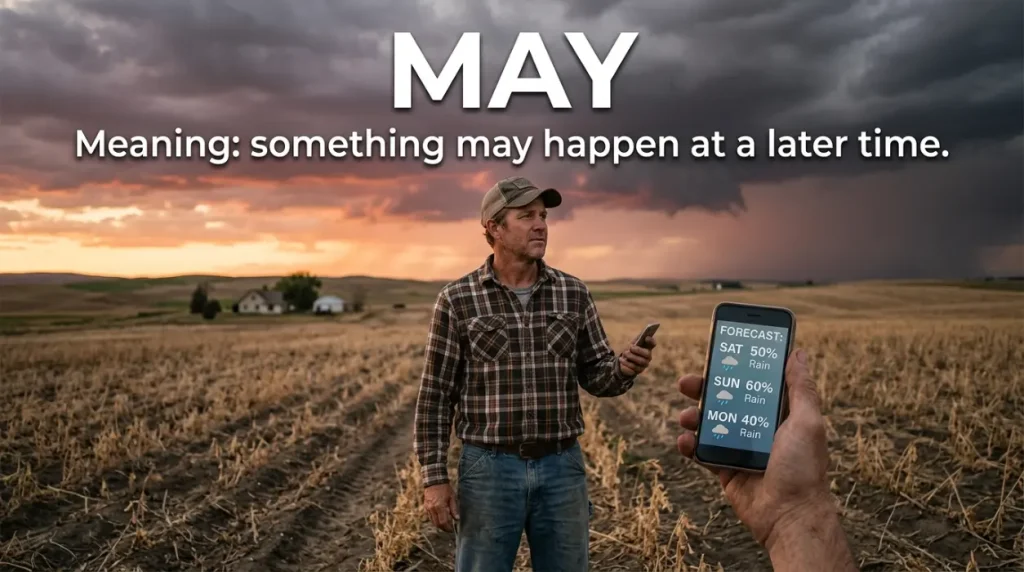
Possibly in the Future (Phrase) — US /ˈpɑːsəbli ɪn ðə ˈfjuːtʃər/ | UK /ˈpɒsəbli ɪn ðə ˈfjuːtʃə/
Meaning: Something may happen at a later time.
Tone/Register: Neutral.
Example:
The company could expand in the future.
The approach may be useful in the future.
At the Possibility of (Phrase) — US /ət ðə ˌpɑːsəˈbɪləti əv/ | UK /ət ðə ˌpɒsəˈbɪləti əv/
Meaning: Refers to a possible event or outcome.
Tone/Register: Formal.
Example:
The team is working on the possibility of expansion.
The discussion focused on the possibility of change.
Usage note: This is not normally a direct grammatical replacement for “potentially.”
With the Potential to (Phrase) — US /wɪð ðə pəˈtenʃəl tuː/ | UK /wɪð ðə pəˈtenʃəl tuː/
Meaning: Having the capacity to produce a future result.
Tone/Register: Professional, academic.
Example:
The discovery has the potential to transform medicine.
The method has the potential to reduce waste.
With a Chance of (Phrase) — US /wɪð ə tʃæns əv/ | UK /wɪð ə tʃɑːns əv/
Meaning: Having some possibility of a particular outcome.
Tone/Register: Neutral.
Example:
The team has a chance of winning.
The project has a chance of succeeding.
With Some Chance of (Phrase) — US /wɪð sʌm tʃæns əv/ | UK /wɪð sʌm tʃɑːns əv/
Meaning: Having a limited or uncertain possibility.
Tone/Register: Neutral.
Example:
There is some chance of improvement.
The proposal has some chance of approval.
With the Possibility of (Phrase) — US /wɪð ðə ˌpɑːsəˈbɪləti əv/ | UK /wɪð ðə ˌpɒsəˈbɪləti əv/
Meaning: Indicating that a particular result may occur.
Tone/Register: Formal.
Example:
The trial continues with the possibility of further research.
The plan moves ahead with the possibility of expansion.
Capable of (Phrase) — US /ˈkeɪpəbəl əv/ | UK /ˈkeɪpəbəl əv/
Meaning: Having the ability or capacity to do something.
Tone/Register: Neutral, formal.
Example:
The device is capable of storing large files.
The method is capable of producing consistent results.
Usage note: “Capable of” emphasizes ability rather than uncertainty.
Able to (Phrase) — US /ˈeɪbəl tuː/ | UK /ˈeɪbəl tuː/
Meaning: Having the ability to do something.
Tone/Register: Neutral.
Example:
The software is able to detect errors.
The team is able to respond quickly.
Apt to (Phrase) — US /æpt tuː/ | UK /æpt tə/
Meaning: Likely or inclined to behave in a particular way.
Tone/Register: Formal, literary.
Example:
Young children are apt to become distracted.
Older systems are apt to fail under heavy loads.
Liable to (Phrase) — US /ˈlaɪəbəl tuː/ | UK /ˈlaɪəbəl tə/
Meaning: Likely to experience or produce something, often something undesirable.
Tone/Register: Formal.
Example:
The road is liable to flood after heavy rain.
Old equipment is liable to break down.
Prone to (Phrase) — US /proʊn tuː/ | UK /prəʊn tə/
Meaning: Likely to experience or develop something repeatedly.
Tone/Register: Neutral, often negative.
Example:
This area is prone to flooding.
The device is prone to overheating.
Subject to (Phrase) — US /ˈsʌbdʒɪkt tuː/ | UK /ˈsʌbdʒɪkt tə/
Meaning: Likely to experience something depending on conditions.
Tone/Register: Formal, professional.
Example:
The schedule is subject to change.
The final result is subject to further review.
Open to the Possibility (Phrase) — US /ˈoʊpən tə ðə ˌpɑːsəˈbɪləti/ | UK /ˈəʊpən tə ðə ˌpɒsəˈbɪləti/
Meaning: Willing to consider that something may happen or be true.
Tone/Register: Neutral, professional.
Example:
We are open to the possibility of changing the plan.
She remains open to the possibility of another explanation.
A Possibility (Noun Phrase) — US /ə ˌpɑːsəˈbɪləti/ | UK /ə ˌpɒsəˈbɪləti/
Meaning: Something that may happen or be true.
Tone/Register: Neutral.
Example:
A delay is a possibility.
A promotion is certainly a possibility.
Synonyms by Tone
Choosing the right alternative depends on the situation.
Neutral and Everyday
Use these when you simply want to express possibility:
- Possibly
- Perhaps
- Maybe
- Could
- Might
- May
- It could be
- It might be
- It may be
- There is a chance
- It is possible
These are natural in everyday speech.
Formal and Academic
These choices work well in essays, reports, research discussions, and professional communication:
- Conceivably
- Feasibly
- Hypothetically
- Theoretically
- Plausibly
- In principle
- It is conceivable
- It is feasible
- There is a possibility
- Conditional possibility
These terms can make an argument more precise.
Stronger Probability
Some alternatives suggest that an outcome is more probable than “potentially”:
- Likely
- Probably
- Presumably
- In all likelihood
Be careful here. Potentially does not necessarily mean “probably.”
Future-Oriented
When the focus is development or future results, consider:
- Prospectively
- Eventually
- In the future
- Going forward
- Future possibility
- Prospective outcome
- Emerging possibility
These expressions emphasize time or development rather than pure uncertainty.
Informal and Conversational
For friendly speech, these sound natural:
- Maybe
- Perhaps
- Who knows
- For all we know
- If things work out
- If all goes well
- It could be that
Cautious and Conditional
When you want to avoid sounding too certain:
- Might
- Could
- May
- Conceivably
- Plausibly
- Under certain conditions
- Given the right conditions
- With the possibility of
Potentially vs. Close Alternatives
Potentially vs. Possibly
These are often interchangeable.
The decision could potentially affect everyone.
The decision could possibly affect everyone.
However, potentially can emphasize capacity or future impact, while possibly focuses more directly on uncertainty.
Potentially vs. Maybe
Maybe is more conversational.
Maybe we’ll go tomorrow.
Potentially sounds more analytical.
The change could potentially improve efficiency.
Use maybe in casual speech and potentially in analytical contexts.
Potentially vs. Probably
These words express different levels of certainty.
The plan could potentially work.
This says success is possible.
The plan will probably work.
This suggests success is more likely than not.
Replacing potentially with probably can therefore change the meaning.
How “Potentially” Changes by Context
Daily Conversation
In casual conversation, maybe, perhaps, could, and might often sound more natural.
Instead of:
I could potentially come later.
A friend might simply say:
I might come later.
The shorter version feels relaxed.
Writing and Blogging
Blog writers often use potentially when explaining possible benefits, risks, or outcomes.
For example:
This habit could potentially improve your concentration.
Still, avoid adding it automatically.
If “could” already communicates possibility, removing “potentially” may create a stronger sentence.
Professional and Academic Writing
Potentially works well when discussing uncertain results.
The findings could potentially influence future research.
It can also introduce risks:
The policy could potentially create additional costs.
In academic writing, alternatives such as conceivably, plausibly, and theoretically may provide more precise shades of meaning.
Creative and Informal Writing
Creative writing may prefer more expressive phrases.
Who knows what tomorrow might bring?
Perhaps the old house still remembers them.
These alternatives create mood instead of simply stating uncertainty.
Common Mistakes and Native Usage
Mistake 1: Using “Potentially” with Every “Could”
A common phrase is:
could potentially
This is grammatically acceptable.
However, it can become redundant because could already expresses possibility.
Compare:
The mistake could potentially cause problems.
The mistake could cause problems.
The second sentence is often cleaner.
Mistake 2: Treating “Potentially” as “Probably”
This is one of the most important distinctions.
Potentially means possible.
Probably means likely.
Do not use them as exact replacements.
Mistake 3: Using “Maybe” in Highly Formal Writing
“Maybe” is perfectly correct English.
However, in a formal research paper, possibly, conceivably, or it is possible that may sound more appropriate.
Mistake 4: Assuming “Feasibly” Means “Possibly”
These words overlap but differ.
Possibly asks whether something can happen.
Feasibly asks whether something can realistically be achieved.
It is possibly true.
It is feasibly achievable.
The second expression focuses on practical viability.
Mistake 5: Using “Eventually” as a Direct Synonym
Eventually means at a later time.
Potentially means possibly or with possible capacity.
The project could potentially succeed.
Does not mean:
The project could eventually succeed.
The first focuses on possibility. The second focuses on timing.
Register Notes
Potentially is versatile.
It appears in:
- Academic writing
- Business communication
- Journalism
- Scientific writing
- Everyday conversation
- Technical explanations
- Online content
It is more formal than maybe, but it is not excessively formal.
For polished writing, however, variety matters.
If a paragraph contains “potentially” several times, replace some instances with possibly, could, might, may, or a context-specific phrase.
Real-Life Mini Scenarios
Workplace
A manager says:
This change could potentially reduce delays.
A more concise version is:
This change could reduce delays.
The second sentence works especially well when the possibility is already clear.
Social Situation
A friend says:
Maybe I’ll join you later.
Here, maybe sounds much more natural than potentially.
Media and News
A journalist might write:
The decision could potentially affect thousands of workers.
The cautious wording avoids presenting an uncertain consequence as a fact.
Academic Writing
A researcher might write:
The findings could potentially support a new interpretation.
This signals that the interpretation remains uncertain.
Storytelling
A novelist may write:
Perhaps the letter contained the answer.
The word perhaps creates suspense and uncertainty.

Interactive Practice Quiz
1. You are chatting with a friend about weekend plans. Which word sounds most natural?
A. Maybe
B. Feasibly
C. Prospectively
D. Conceivably
2. You are writing a research paper about an uncertain result. Which option fits best?
A. Conceivably
B. Maybe
C. Who knows
D. Mayhap
3. Which word suggests a stronger probability than “potentially”?
A. Probably
B. Hypothetically
C. Maybe
D. Perchance
4. Which word focuses on practical possibility?
A. Feasibly
B. Eventually
C. Perhaps
D. Who knows
5. Which expression means “according to theory”?
A. Theoretically
B. Maybe
C. Eventually
D. For all we know
6. Which word is most informal?
A. Maybe
B. Conceivably
C. Feasibly
D. Hypothetically
7. Which word emphasizes an imagined situation?
A. Hypothetically
B. Probably
C. Eventually
D. Presumably
8. Which sentence suggests that something is possible but not certain?
A. The team will definitely win the match.
B. The team may win the match.
C. The team will certainly win the match.
D. The team is sure to win the match.
9. Which phrase emphasizes a condition?
A. Given the right conditions
B. Maybe
C. Probably
D. Perhaps
10. Which alternative is most suitable for formal writing?
A. Conceivably
B. Maybe
C. Who knows
D. Mayhap
Reflection task:
Write three sentences about one future event. Use maybe, possibly, and potentially. Then explain how the tone changes in each sentence.
Answer key: 1-A | 2-A | 3-A | 4-A | 5-A | 6-A | 7-A | 8-A | 9-A | 10-A
Conclusion
Understanding potentially can help you describe something that may happen, exist, or become possible under certain conditions. Learning its synonyms, meaning, and examples can improve your English vocabulary and make your communication clearer.
The word potentially is commonly used when discussing possibilities, future outcomes, risks, or opportunities. Knowing suitable synonyms can help you express the idea of possibility in different ways and make your writing more natural.
By practicing potentially in sentences and exploring related words, you can develop stronger vocabulary and communication skills. A clear understanding of this word will help you express possibilities accurately and confidently in everyday English and writing.
Frequently Asked Questions
1. What is the best synonym for potentially in everyday English?
The best everyday alternatives are usually possibly, maybe, perhaps, could, or might. The choice depends on the sentence. “Maybe” sounds casual, while “possibly” is more neutral. “Could” and “might” are especially natural when discussing future events or uncertain outcomes.
2. What is a formal synonym for potentially?
Useful formal alternatives include conceivably, feasibly, theoretically, plausibly, and it is possible that. However, they are not identical. “Feasibly” emphasizes realistic practicality, while “theoretically” refers to what should work according to theory. “Conceivably” simply suggests that an outcome can reasonably be imagined.
3. Is “possibly” the same as “potentially”?
They are often interchangeable when both words describe an uncertain event or outcome. However, “potentially” can emphasize capacity or future effect, while “possibly” focuses more directly on whether something may happen or be true. Context determines which word sounds more natural.
4. Is “maybe” a good replacement for potentially?
Yes, but mainly in informal or conversational English. “Maybe” expresses uncertainty in a simple, natural way. In academic, professional, or analytical writing, “possibly,” “potentially,” “conceivably,” or “it is possible that” may fit better.
5. What is the difference between potentially and probably?
“Potentially” means that something is possible, but it does not say how likely it is. “Probably” indicates a higher level of confidence. For example, “The plan could potentially succeed” means success is possible, while “The plan will probably succeed” suggests that success is expected.

Hasnain Ali is an SEO Content Strategist and the founder of wordvora.com, a trusted vocabulary platform that helps writers, students, professionals, and English learners find accurate synonyms, antonyms, word meanings, and real-life usage examples. He specializes in keyword research, on-page SEO, topical authority, and creating search-first content that aligns with Google’s latest Search Quality and E-E-A-T guidelines. His work focuses on producing clear, well-structured, and reader-friendly resources that satisfy search intent while maintaining high editorial standards.
Through extensive hands-on experience with SEO tools such as Google Search Console, Google Analytics, SEMrush, and Ahrefs, Hasnain researches user search behavior and develops content that is both informative and easy to understand. Every article published on wordvora.com is carefully reviewed for accuracy, readability, and contextual relevance before publication. His mission is to build one of the web’s most reliable English vocabulary resources by providing practical language guidance, trustworthy explanations, and content that helps readers improve their writing, communication, and vocabulary with confidence.