
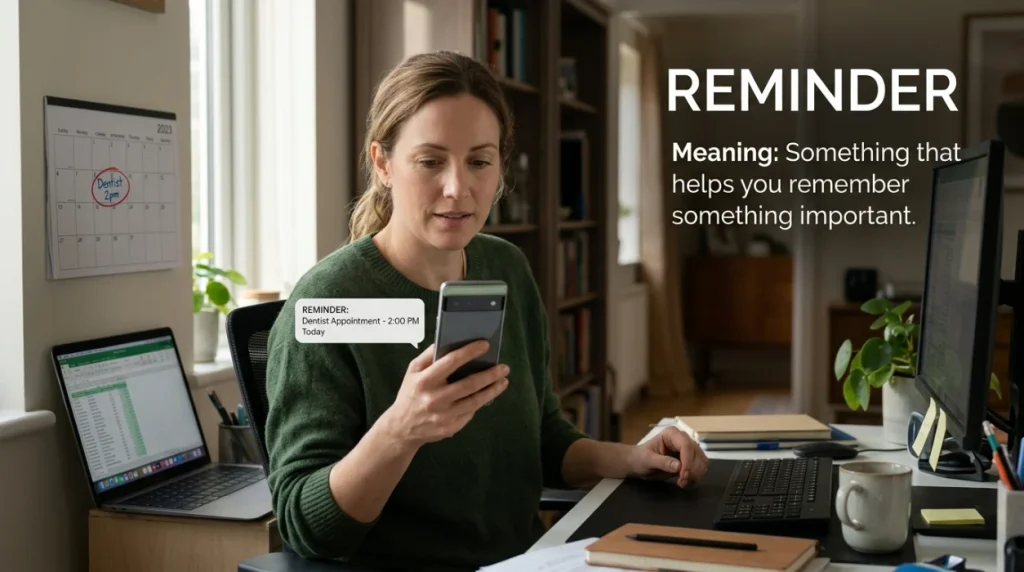
The word reminded is commonly used when someone causes another person to remember something from the past or recall an important fact. It is a useful term in everyday English and appears frequently in conversations and writing.
Understanding reminded can help you describe situations where someone brings an idea, memory, task, or event back to another person’s attention. Learning its synonyms can also give you more natural ways to express the same meaning.
Whether you are writing a story, having a conversation, or giving instructions, choosing the right words can make your communication clearer. Exploring related vocabulary can help you avoid repetition and express ideas with greater variety.
By learning reminded, its synonyms, meanings, and examples, you can strengthen your English vocabulary and improve your writing skills. This guide will help you understand how to use the word correctly in different contexts.
What Does “Reminded” Really Mean?
Reminded refers to the act of causing someone to remember something or bringing a forgotten thought back into conscious awareness. Native speakers understand it as a universal term for prompting memory, issuing a gentle warning, or triggering a past association. Additionally, it describes how objects or experiences can awaken forgotten emotions.
The primary emotional tone is neutral, but context shifts it easily. For instance, a quick notification carries a helpful tone, whereas a sudden warning carries a stern tone.
Part of speech: Past tense and past participle of the verb remind.
Definition: Caused someone to remember a fact, task, or past event, or brought a thought back into conscious awareness.
Connotative Meaning
(Connotation is the emotional or cultural idea associated with a word beyond its strict literal definition.)
- Positive tone: Expresses helpful guidance, warm nostalgic memories, or caring support.
- Negative tone: Suggests nagging, unwanted warnings, painful memories, or persistent pressure.
- Neutral tone: Acts as a plain functional cue that transfers information or triggers a memory.
Etymology
The term traces back to the early 17th century. It was created by combining the Latin prefix re- with the English noun mind.
- Old English (450–1100): The root noun gemynd existed, referring to memory, thought, or consciousness.
- Middle English (1100–1500): Evolved into mynd, which described the active power of thinking.
- Modern English (1500–Present): Formed the compound verb remind (c. 1660), meaning “to call back to mind.”
Pronunciation
- US: /rɪˈmaɪn.dɪd/
- UK: /rɪˈmaɪn.dɪd/
Syllables & Structure
- Syllable breakdown: re-mind-ed
- Root: mind
- Prefix: re- (meaning “again” or “back”)
- Suffix: -ed (past tense marker)
Synonyms List
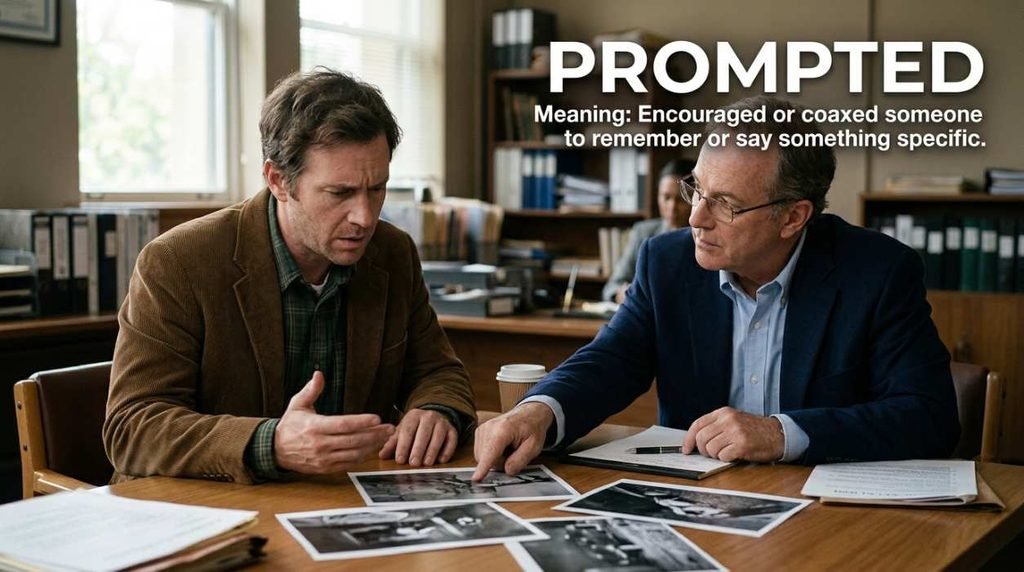
Prompted (Verb) — US: /ˈprɑːmp.tɪd/ | UK: /ˈprɒmp.tɪd/
Meaning: Encouraged or coaxed someone to remember or say something specific.
Tone/Register: Neutral, Professional
Example:
The teacher prompted the student when he froze during his oral presentation.
She was prompted by her calendar notification to join the morning call.
Advised (Verb) — US: /ədˈvaɪzd/ | UK: /ədˈvaɪzd/
Meaning: Offered formal guidance or brought an important duty to someone’s attention.
Tone/Register: Formal, Professional
Example:
The legal counsel advised the director of the upcoming deadline.
He was advised by his mentor to double-check his calculations.
Alerted (Verb) — US: /əˈlɝː.t̬ɪd/ | UK: /əˈlɜː.tɪd/
Meaning: Warned someone about an urgent situation or important requirement.
Tone/Register: Neutral, Urgent
Example:
The security system alerted the homeowner to an open window.
She was alerted by her assistant before the meeting began.
Notified (Verb) — US: /ˈnoʊ.t̬ə.faɪd/ | UK: /ˈnəʊ.tɪ.faɪd/
Meaning: Informed someone officially about a task, event, or change in status.
Tone/Register: Formal, Business
Example:
The team was notified about the venue change via email.
He notified the manager as soon as the project was finished.
Cautioned (Verb) — US: /ˈkɑː.ʃənid/ | UK: /ˈkɔː.ʃənid/
Meaning: Warned someone gently or sternly about potential risks or errors.
Tone/Register: Formal, Serious
Example:
The doctor cautioned the patient against skipping her medication.
He was cautioned by his supervisor to handle the fragile gear carefully.
Forewarned (Verb) — US: /fɔːrˈwɔːrnd/ | UK: /fɔːˈwɔːnd/
Meaning: Informed someone about a potential issue before it actually occurred.
Tone/Register: Formal, Serious
Example:
We were forewarned about the heavy storm heading toward the coast.
She forewarned her colleagues about the strict inspection guidelines.
Hinted (Verb) — US: /ˈhɪn.tɪd/ | UK: /ˈhɪn.tɪd/
Meaning: Suggested an idea indirectly without stating the fact clearly.
Tone/Register: Informal, Casual
Example:
He hinted that a big surprise was waiting for her at home.
She hinted about her favorite birthday gift throughout the week.
Cue (Verb) — US: /kjuːd/ | UK: /kjuːd/
Meaning: Gave a specific physical or verbal signal to trigger an action or memory.
Tone/Register: Neutral, Technical
Example:
The stage manager cued the actor right before his solo scene.
She was cued by her partner to jump into the ongoing debate.
Recalled (Verb) — US: /rɪˈkɑːld/ | UK: /rɪˈkɔːld/
Meaning: Brought a memory or fact back into conscious thought.
Tone/Register: Neutral, Reflective
Example:
She recalled her grandmother’s advice during the difficult situation.
He recalled the exact directions after looking at the old map.
Evoked (Verb) — US: /ɪˈvoʊkt/ | UK: /ɪˈvəʊkt/
Meaning: Called up a strong image, emotion, or memory from the past.
Tone/Register: Literary, Formal
Example:
The old photo album evoked happy memories of childhood summers.
His moving speech evoked a sense of unity among the listeners.
Kindled (Verb) — US: /ˈkɪn.dəlid/ | UK: /ˈkɪn.dəlid/
Meaning: Awakened or sparked a forgotten feeling, memory, or passion.
Tone/Register: Literary, Expressive
Example:
The classic song kindled fond memories of their college days.
Her story kindled an interest in history among the young students.
Awakened (Verb) — US: /əˈweɪ.kənd/ | UK: /əˈweɪ.kənd/
Meaning: Roused a dormant memory, feeling, or realization in someone.
Tone/Register: Literary, Emotional
Example:
The trip awakened his appreciation for ancient architectural design.
She was awakened to the urgency of the problem by the report.
Triggered (Verb) — US: /ˈtrɪɡ.ɚd/ | UK: /ˈtrɪɡ.əd/
Meaning: Caused a sudden memory or reaction to return instantly.
Tone/Register: Neutral, Modern
Example:
The familiar smell of rain triggered memories of his hometown.
That sudden noise triggered a brief moment of anxiety for him.
Resurfaced (Verb) — US: /ˌriːˈsɝː.fɪst/ | UK: /ˌriːˈsɜː.fɪst/
Meaning: Brought a forgotten memory back into view or thought.
Tone/Register: Neutral, Reflective
Example:
Old childhood stories resurfaced during the family dinner.
The long-forgotten issue resurfaced during the weekly team audit.
Revived (Verb) — US: /rɪˈvaɪvd/ | UK: /rɪˈvaɪvd/
Meaning: Restored a forgotten idea, tradition, or memory to active awareness.
Tone/Register: Formal, Positive
Example:
The museum exhibit revived interest in local heritage stories.
He revived an old family tradition during the holiday weekend.
Refreshed (Verb) — US: /rɪˈfreʃt/ | UK: /rɪˈfreʃt/
Meaning: Renewed a memory or detail so it became clear again.
Tone/Register: Neutral, Practical
Example:
She refreshed her memory by scanning her old presentation notes.
He refreshed his knowledge of the rules before starting the game.
Reawakened (Verb) — US: /ˌriː.əˈweɪ.kənd/ | UK: /ˌriː.əˈweɪ.kənd/
Meaning: Woke up a forgotten thought or emotion after a long period.
Tone/Register: Literary, Emotional
Example:
The melody reawakened feelings he had buried for many years.
Her visits to the coastal town reawakened her artistic passion.
Summoned (Verb) — US: /ˈsʌm.ənd/ | UK: /ˈsʌm.ənd/
Meaning: Called up a specific memory, courage, or mental image deliberately.
Tone/Register: Formal, Dramatic
Example:
He summoned the courage to speak up during the large town hall.
She summoned old memories of her travel adventures while writing.
Signaled (Verb) — US: /ˈsɪɡ.nəlid/ | UK: /ˈsɪɡ.nəlid/
Meaning: Directed someone’s attention to a fact or task using a clear sign.
Tone/Register: Neutral, Practical
Example:
The ringing alarm signaled that the baked bread was ready.
He signaled to his colleague that time was running out.
Motioned (Verb) — US: /ˈmoʊ.ʃənid/ | UK: /ˈməʊ.ʃənid/
Meaning: Used a physical movement to bring an action to someone’s mind.
Tone/Register: Casual, Visual
Example:
She motioned for him to remember to lock the front door.
He motioned toward his wrist to remind her of the time.
Tipped Off (Verb Phrase) — US: /tɪpt ɑːf/ | UK: /tɪpt ɒf/
Meaning: Gave secret or advance information to bring a task to mind.
Tone/Register: Informal, Casual
Example:
An anonymous source tipped off the reporter about the project.
He was tipped off about the sudden pop quiz by a friend.

Jogged (Verb) — US: /dʒɑːɡd/ | UK: /dʒɒɡd/
Meaning: Stimulated or nudged a person’s memory gently.
Tone/Register: Informal, Conversational
Example:
Seeing the old photograph jogged his memory about the trip.
She jogged her brother’s memory regarding their mother’s order.
Nudged (Verb) — US: /nʌdʒd/ | UK: /nʌdʒd/
Meaning: Gave a subtle or gentle push to bring a task to mind.
Tone/Register: Informal, Friendly
Example:
She nudged her roommate to pay the utility bill on time.
He was nudged by his team to submit his monthly report.
Nagged (Verb) — US: /næɡd/ | UK: /næɡd/
Meaning: Annoyed someone with persistent, repetitive reminders.
Tone/Register: Informal, Negative
Example:
His mother nagged him until he finally cleaned his bedroom.
She felt nagged by the constant phone app notifications.
Pestered (Verb) — US: /ˈpes.tɚd/ | UK: /ˈpes.təd/
Meaning: Bothered someone repeatedly with frequent requests or prompts.
Tone/Register: Informal, Negative
Example:
The client pestered the team for daily project updates.
He was pestered by emails until he completed the survey.
Harassed (Verb) — US: /həˈræst/ | UK: /ˈhær.əst/
Meaning: Intimidated or continuously pressured someone with intense demands.
Tone/Register: Formal, Negative
Example:
The worker felt harassed by the relentless deadline warnings.
They were harassed by debt collectors throughout the month.
Echoed (Verb) — US: /ˈek.oʊd/ | UK: /ˈek.əʊd/
Meaning: Mirrored or repeated a thought, bringing a past idea to mind.
Tone/Register: Literary, Reflective
Example:
Her words echoed the advice her mentor had given years ago.
The current economic trends echoed past historical events.
Parroted (Verb) — US: /ˈpær.ət.ɪd/ | UK: /ˈpær.ət.ɪd/
Meaning: Repeated someone’s words mechanically without original thought.
Tone/Register: Informal, Critical
Example:
He merely parroted the instructions given by his manager.
She parroted the safety warnings without understanding them.
Re-instated (Verb) — US: /ˌriː.ɪnˈsteɪ.t̬ɪŋ/ | UK: /ˌriː.ɪnˈsteɪ.tɪŋ/
Meaning: Brought back a rule, memory, or practice into active thought.
Tone/Register: Formal, Administrative
Example:
The committee reinstated the safety protocol for all staff.
Old guidelines were reinstated after the policy review.
Re-established (Verb) — US: /ˌriː.ɪˈstæb.lɪʃt/ | UK: /ˌriː.ɪˈstæb.lɪʃt/
Meaning: Restored a connection, habit, or memory to a firm position.
Tone/Register: Formal, Business
Example:
The meeting re-established clear communication across departments.
She re-established her morning routine to stay organized.
Re-introduced (Verb) — US: /ˌriː.ɪn.trəˈduːst/ | UK: /ˌriː.ɪn.trəˈdjuːst/
Meaning: Brought an idea or topic back into active discussion.
Tone/Register: Professional, Formal
Example:
The speaker re-introduced the core theme during his closing remarks.
They re-introduced traditional methods to improve their output.
Called Up (Verb Phrase) — US: /kɑːld ʌp/ | UK: /kɔːld ʌp/
Meaning: Retrieved stored information or memories into present thought.
Tone/Register: Neutral, Conversational
Example:
He called up the old file to double-check the client’s address.
She called up childhood memories while browsing the album.
Brought Back (Verb Phrase) — US: /brɑːt bæk/ | UK: /brɔːt bæk/
Meaning: Caused an experience, thought, or emotion to return.
Tone/Register: Neutral, Everyday
Example:
The classic film brought back great memories of high school.
Visiting his old neighborhood brought back forgotten stories.
Pointed Out (Verb Phrase) — US: /ˈpɔɪn.t̬ɪd aʊt/ | UK: /ˈpɔɪn.tɪd aʊt/
Meaning: Directed someone’s attention explicitly to a key fact or error.
Tone/Register: Neutral, Practical
Example:
The editor pointed out several spelling errors in the draft.
She pointed out that the meeting time had been shifted.
Brought to Mind (Verb Phrase) — US: /brɑːt tuː maɪnd/ | UK: /brɔːt tuː maɪnd/
Meaning: Caused a specific memory or association to appear in thought.
Tone/Register: Neutral, Literary
Example:
The cozy fireplace brought to mind cold winter nights at home.
His calm response brought to mind his father’s personality.
Kept in Mind (Verb Phrase) — US: /kept ɪn maɪnd/ | UK: /kept ɪn maɪnd/
Meaning: Held an important fact or instruction in active consciousness.
Tone/Register: Professional, Practical
Example:
She kept in mind the strict deadline while working on the draft.
He kept in mind his manager’s advice during negotiations.
Bear in Mind (Verb Phrase) — US: /ber ɪn maɪnd/ | UK: /beər ɪn maɪnd/
Meaning: Remember to consider a specific factor when making decisions.
Tone/Register: Formal, Advisory
Example:
Please bear in mind that the office will be closed on Friday.
You should bear in mind the extra travel time required.
Flagged (Verb) — US: /flæɡd/ | UK: /flæɡd/
Meaning: Marked or highlighted an item to bring it to immediate attention.
Tone/Register: Professional, Business
Example:
The accountant flagged the discrepancy in the monthly statement.
She flagged the urgent email so she could reply right away.
Stroked Memory (Idiomatic Phrase) — US: /stroʊkt ˈmem.ɚ.i/ | UK: /strəʊkt ˈmem.ər.i/
Meaning: Gently stimulated someone’s thoughts to awaken a memory.
Tone/Register: Literary, Creative
Example:
The familiar aroma stroked memory of her mother’s cooking.
His story stroked memory of long-lost summer holidays.
Ring a Bell (Idiomatic Phrase) — US: /rɪŋ ə bel/ | UK: /rɪŋ ə bel/
Meaning: Sounded familiar or triggered a vague memory.
Tone/Register: Informal, Everyday
Example:
That name doesn’t ring a bell, but her face looks familiar.
Does this old address ring a bell with anyone here?
Refresh Memory (Verb Phrase) — US: /rɪˈfreʃ ˈmem.ɚ.i/ | UK: /rɪˈfreʃ ˈmem.ər.i/
Meaning: Looked over facts to bring details back into clear focus.
Tone/Register: Professional, Practical
Example:
Let me refresh my memory on the contract terms before signing.
He took a minute to refresh his memory before answering questions.

Bring to Light (Idiomatic Phrase) — US: /brɪŋ tuː laɪt/ | UK: /brɪŋ tuː laɪt/
Meaning: Revealed or uncovered forgotten facts so they are remembered.
Tone/Register: Formal, Journalistic
Example:
The investigation brought to light several key pieces of evidence.
Her research brought to light forgotten historical documents.
Touch Upon (Verb Phrase) — US: /tʌtʃ əˈpɑːn/ | UK: /tʌtʃ əˈpɒn/
Meaning: Mentioned a subject briefly to bring it into present focus.
Tone/Register: Professional, Academic
Example:
The speaker touched upon the new policy during his keynote.
She touched upon the budget limits before opening discussion.
Highlighted (Verb) — US: /ˈhaɪ.laɪ.t̬ɪd/ | UK: /ˈhaɪ.laɪ.tɪd/
Meaning: Emphasized a key fact so it stays active in mind.
Tone/Register: Professional, Educational
Example:
The report highlighted the primary growth drivers for 2026.
She highlighted the main points for the upcoming exam.
Underscored (Verb) — US: /ˌʌn.dɚˈskɔːrd/ | UK: /ˌʌn.dəˈskɔːd/
Meaning: Stressed the importance of an idea to ensure it is remembered.
Tone/Register: Formal, Business
Example:
The CEO underscored the need for strict quality controls.
His speech underscored the value of teamwork in hardship.
Re-emphasized (Verb) — US: /ˌriːˈem.fə.saɪzd/ | UK: /ˌriːˈem.fə.saɪzd/
Meaning: Stressed an important point again to reinforce memory.
Tone/Register: Formal, Professional
Example:
The trainer re-emphasized safety rules before starting work.
She re-emphasized the project goals during the meeting.
Stirred (Verb) — US: /stɝːd/ | UK: /stɜːd/
Meaning: Roused or awakened hidden memories or deep emotions.
Tone/Register: Literary, Emotional
Example:
The old poem stirred quiet memories of his hometown village.
Her speech stirred strong feelings of hope among listeners.
Prompting (Noun / Verb Form) — US: /ˈprɑːmp.tɪŋ/ | UK: /ˈprɒmp.tɪŋ/
Meaning: The act of giving a hint or cue to assist memory.
Tone/Register: Educational, Neutral
Example:
With a little prompting, the child recalled the correct answer.
Constant prompting was required to keep the schedule intact.
Warning (Noun / Verb Form) — US: /ˈwɔːr.nɪŋ/ | UK: /ˈwɔː.nɪŋ/
Meaning: A statement or signal informing someone of potential danger.
Tone/Register: Neutral, Direct
Example:
The weather app issued a heavy rain warning for tonight.
He took her warning seriously and slowed down his driving.
Reminder (Noun) — US: /rɪˈmaɪn.dɚ/ | UK: /rɪˈmaɪn.dər/
Meaning: Something that helps a person remember a task or event.
Tone/Register: Neutral, Everyday
Example:
She set a quick phone reminder for her dentist appointment.
This note serves as a gentle reminder to submit your files.
Notification (Noun) — US: /ˌnoʊ.t̬ə.fəˈkeɪ.ʃən/ | UK: /ˌnəʊ.tɪ.fɪˈkeɪ.ʃən/
Meaning: An electronic alert designed to inform or prompt action.
Tone/Register: Professional, Technical
Example:
I received a calendar notification ten minutes before the call.
Turn off app notifications if you need to focus on work.
Cue Card (Noun Phrase) — US: /kjuː kɑːrd/ | UK: /kjuː kɑːd/
Meaning: A card written with prompts to help a speaker remember lines.
Tone/Register: Professional, Media
Example:
The host glanced at his cue card during the live interview.
She prepared cue cards to structure her presentation clearly.
Memory Jogger (Noun Phrase) — US: /ˈmem.ɚ.i ˈdʒɑː.ɡɚ/ | UK: /ˈmem.ər.i ˈdʒɒɡ.ər/
Meaning: An item or note designed to refresh someone’s recollection.
Tone/Register: Informal, Casual
Example:
He kept a sticky note on his monitor as a memory jogger.
This photo album acts as a wonderful memory jogger for us.
Warning Bell (Noun Phrase) — US: /ˈwɔːr.nɪŋ bel/ | UK: /ˈwɔː.nɪŋ bel/
Meaning: A sign or event that alerts someone to potential trouble.
Tone/Register: Descriptive, Serious
Example:
The drop in quarterly sales served as a clear warning bell.
His sudden silence acted as a warning bell to the team.
Wake-Up Call (Noun Phrase) — US: /weɪk ʌp kɑːl/ | UK: /weɪk ʌp kɔːl/
Meaning: An event that brings an important reality to immediate awareness.
Tone/Register: Informal, Dramatic
Example:
The unexpected audit served as a wake-up call for management.
Her health scare acted as a firm wake-up call to rest.
Synonyms by Tone
Tone plays a critical role in word choice because picking the wrong term can alter your intended message. Consequently, grouping synonyms by tone helps you select the exact word for your context.
Positive Tone
These words show helpful guidance, warm memories, or encouraging support:
- Advised
- Evoked
- Kindled
- Awakened
- Revived
- Refreshed
- Reawakened
- Re-established
- Re-introduced
- Brought to Mind
- Highlighted
- Underscored
Neutral Tone
These terms carry no emotional bias and describe the functional act of prompting memory:
- Prompted
- Alerted
- Notified
- Recalled
- Triggered
- Resurfaced
- Signaled
- Motioned
- Called Up
- Brought Back
- Pointed Out
- Flagged
- Touch Upon
- Prompting
- Reminder
- Notification
Negative Tone
These words suggest nagging, persistent pressure, unwanted warnings, or stress:
- Cautioned
- Forewarned
- Nagged
- Pestered
- Harassed
- Parroted
- Warning Bell
Playful / Informal
These convey casual, relaxed, or indirect memory triggers:
- Hinted
- Tipped Off
- Jogged
- Nudged
- Ring a Bell
- Memory Jogger
- Wake-Up Call
Mini Comparison
Reminded vs. Prompted vs. Evoked
- Meaning Difference:
- Reminded means causing someone to remember a specific task, fact, or past event.
- Prompted means giving a direct cue or nudge to encourage an immediate action or response.
- Evoked means calling up a strong emotional response, vivid image, or deep memory from the past.
- Tone Difference:
- Reminded is neutral, clear, and functional.
- Prompted is helpful, practical, and action-oriented.
- Evoked is literary, emotional, and expressive.
- When to Use Each:
- Use reminded when someone forgets a daily task, appointment, or simple fact.
- Use prompted when an actor forgets a line, a student needs a hint, or a system requests input.
- Use evoked in creative writing, poetry, or storytelling to describe sensory memory triggers.
Context-Based Usage
Daily Conversation
In casual chats, people lean on simple terms like reminded, jogged, or nudged. For instance, you might say a photo “jogged my memory” or a roommate “nudged me to pay the rent.” These keep your spoken English natural and conversational.
Writing or Blogging
For creative storytelling and blog posts, vary your descriptive language to build atmosphere. Words like evoked, kindled, or reawakened bring emotional depth to narrative scenes. Thus, your readers feel connected without reading the same word repeatedly.
Professional or Academic Tone
In business emails, academic papers, or formal reports, choose terms like advised, notified, underscored, or flagged. These options clearly convey instructions while maintaining professional polish.
Creative or Informal Use
When writing descriptive fiction or lively posts, use triggered, tipped off, or parroted. Consequently, these active terms highlight sudden realizations, secret cues, or repetitive actions directly.
Common Mistakes & Native Usage
Common Mistakes Learners Make
- Confusing reminded with remembered: Remember that remind requires an external trigger (Someone reminded me), while remember is an internal mental action (I remembered).
- Using formal terms in casual setups: Saying an app “evoked my meeting” sounds unnatural. Stick to “the app reminded me.”
- Overusing the word reminded: Repeatedly using reminded in narrative text turns prose repetitive. Alternate with phrases like jogged my memory or brought to mind.
Register Notes
- Spoken English: Focus on reminded, jogged, nudged, and brought back.
- Written English: Utilize evoked, advised, notified, and underscored.
- For a broader look at expanding your descriptive verbs, review our complete vocabulary building guides to sharpen your writing style.
Real-Life Mini Scenarios
Workplace
During a busy project kickoff, your manager sends a brief calendar alert to the entire team. Instead of sending a long email, she uses a digital notification, notifying everyone that the project scope has been updated.
Social Situations
You bump into an old schoolmate at a local cafe. When she mentions a trip you took years ago, the shared story jogs your memory, instantly bringing back happy thoughts of your youth.
Media / Pop Culture
In cinematic storytelling, film directors often use classic soundtracks to trigger nostalgia. Hearing a familiar melody evokes strong emotions, reminding audiences of a key plot point from the original movie.
Writing or Storytelling
A novelist builds emotional depth during a drama scene. Instead of having characters speak directly, the author describes how an old letter reawakens long-forgotten feelings, underscoring the silent bond between the two leads.

Interactive Practice Quiz
1. Which word best fits a formal business email informing someone about a schedule update?
A) Nagged
B) Notified
C) Parroted
D) Dozed
2. If an old song suddenly brings back vivid memories of your childhood, the song has:
A) Cautioned
B) Harassed
C) Evoked
D) Flagged
3. What is the key difference between “remind” and “remember”?
A) Remind is an internal action, while remember requires an external cue
B) Remind requires an external prompt, while remember is an internal mental act
C) Both words mean the same thing in every context
D) Remember is only used in formal legal writing
4. Choose the term that best describes a friend giving you a gentle nudge about paying your bill:
A) Harassing
B) Nudging
C) Parroting
D) Evoking
5. Which synonym carries an expressive, literary tone?
A) Notified
B) Kindled
C) Tipped Off
D) Flagged
6. If a supervisor repeatedly bothers an employee with stressful demands, the employee feels:
A) Pestered
B) Kindled
C) Reawakened
D) Evoked
7. Which phrase is an informal idiom meaning to stimulate someone’s memory?
A) Bear in mind
B) Jogged memory
C) Touch upon
D) Point out
8. What term describes giving advance information about potential risks?
A) Forewarned
B) Recalled
C) Motioned
D) Resurfaced
9. When an editor highlights an error in a draft for review, the error has been:
A) Stirred
B) Flagged
C) Parroted
D) Evoked
Application Task
Write one short, original sentence describing a character using one of the synonyms above (such as evoked, notified, or jogged).
Answer Key
1: B | 2: C | 3: B | 4: B | 5: B | 6: A | 7: B | 8: A | 9: B
FAQs
1. What is the most common synonym for reminded in daily conversation?
The most natural everyday synonyms for reminded are jogged my memory, nudged, prompted, or brought to mind. In casual speech, native speakers frequently say a photo or comment “jogged my memory” or “brought back memories” to express quick recollection.
2. How do I choose between reminded, prompted, and notified?
Use reminded when a general thought or task is brought back to mind. Choose prompted when an immediate action or response is encouraged by a cue. Select notified when official or formal information is delivered in business or legal contexts.
3. Can synonyms for reminded carry a negative meaning?
Yes, synonyms for reminded can carry negative connotations depending on the word choice. Terms like nagged, pestered, or harassed imply annoying, repetitive, or stressful prompts that cause frustration rather than helpful guidance.
4. What is the difference between reminded and remembered?
Reminded requires an external trigger, object, or person to bring an idea to mind (e.g., The alarm reminded me). In contrast, remembered is an internal mental action performed by the person themselves (e.g., I remembered my keys).
5. Which synonyms for reminded work best in professional writing?
In professional and business environments, terms like advised, notified, underscored, flagged, and re-emphasized work best. These words convey clear instructions and important updates without sounding overly casual or repetitive.
Conclusion
Understanding reminded can help you describe the act of bringing a memory, fact, task, or idea back to someone’s attention. Learning its synonyms, meaning, and examples can improve your English vocabulary and make your communication clearer.
The word reminded is commonly used in everyday conversations, stories, instructions, and written communication. Knowing its related synonyms can help you express the idea of recalling something in different ways and make your writing more natural.
By practicing reminded in sentences and exploring related words, you can strengthen your vocabulary and communication skills. A clear understanding of this word will help you use it confidently and effectively in different English contexts.

Hasnain Ali is an SEO Content Strategist and the founder of wordvora.com, a trusted vocabulary platform that helps writers, students, professionals, and English learners find accurate synonyms, antonyms, word meanings, and real-life usage examples. He specializes in keyword research, on-page SEO, topical authority, and creating search-first content that aligns with Google’s latest Search Quality and E-E-A-T guidelines. His work focuses on producing clear, well-structured, and reader-friendly resources that satisfy search intent while maintaining high editorial standards.
Through extensive hands-on experience with SEO tools such as Google Search Console, Google Analytics, SEMrush, and Ahrefs, Hasnain researches user search behavior and develops content that is both informative and easy to understand. Every article published on wordvora.com is carefully reviewed for accuracy, readability, and contextual relevance before publication. His mission is to build one of the web’s most reliable English vocabulary resources by providing practical language guidance, trustworthy explanations, and content that helps readers improve their writing, communication, and vocabulary with confidence.